

Why Some Teeth Need a Root Canal or Core Build-Up Before a Dental Crown
Key Takeaways
- A crown grips a trimmed stump of tooth the way a thimble grips a finger; when too little tooth remains, a core buildup rebuilds that stump before the crown is made.
- A root canal before a crown is prescribed for an inflamed or dead pulp, not because a crown is coming; most crowns are placed on living teeth.
- A post holds the core in a root-treated tooth and does not strengthen the root, and it can only be placed after root canal treatment.
- Cleveland Clinic puts a typical root canal at 30 to 60 minutes and a laboratory-made permanent crown at roughly two to three weeks after the preparation visit.
- A pulp can die without pain, which is why dentists rely on cold testing and x-rays rather than symptoms alone to decide whether a root canal is needed.
- Spreading facial swelling, fever, or trouble swallowing or breathing alongside a dental infection are emergency red flags in NHS guidance and should not wait for a routine appointment.
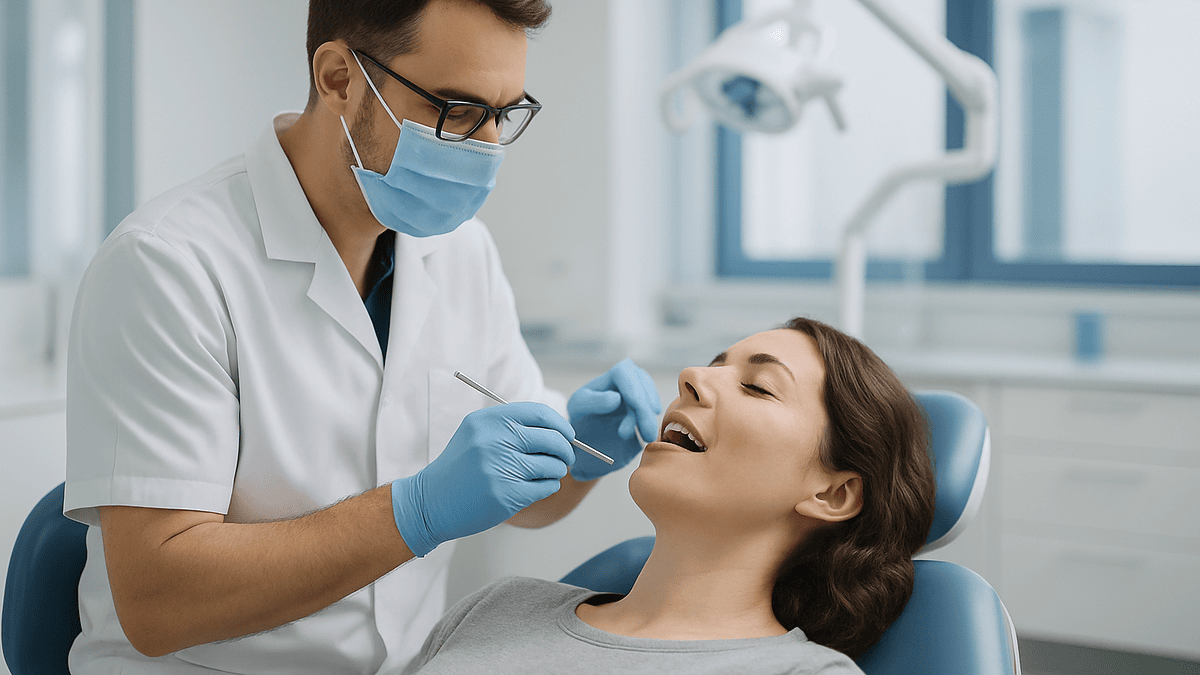
A dental crown needs a solid tooth underneath to grip. When decay or an old filling has hollowed out much of the tooth, dentists rebuild the missing structure with a core buildup before the crown is fitted. When the tooth's living pulp is inflamed or infected, a root canal is usually needed first. Some teeth need one step, some need both, and the treating dentist decides from x-rays and pulp testing.
The dentist tilts the screen so you can see it: a molar that looks, from the outside, slightly tired but ordinary. On the x-ray it is something else. An old silver filling occupies most of the tooth, a shadow of decay creeps under one edge, and what remains of natural tooth is a thin shell. “It needs a crown,” she says, “but not yet. First we have to rebuild it, and we may have to treat the nerve.”
That sentence sends a lot of people home to type “core buildup before crown” into a search bar late at night. It can sound like being upsold, or like one problem has become three. Usually it is neither. It is a dentist reading the architecture of a tooth and deciding what must happen before a crown can be trusted to stay put for years.
This explainer walks through that architecture: what a core buildup is, why some teeth need a root canal first, how the decision is made, and what the days afterward tend to feel like.
What actually happens when a tooth is prepared for a crown?
A crown is a cap, made of ceramic, metal, or a blend of the two, that covers the whole visible part of a tooth down to the gumline. To make room for it, the dentist trims away the outer layer of the tooth on every side, so the finished crown sits flush with its neighbors instead of bulging. That trimmed-down tooth is called the preparation, or “prep.”
Here is the part that decides everything else. A crown does not hold itself on. It grips the prep the way a thimble grips a finger: by wrapping snugly around a solid, roughly cylindrical core of tooth that is tall enough and wide enough to resist tipping when you chew. Put a thimble on the stub of a fingertip and it slides off. Put it on a full finger and it stays.
Teeth have three layers that matter here. Enamel is the hard outer shell. Dentin is the softer, living tissue beneath it that makes up most of the tooth’s bulk. The pulp is the soft center of nerves and blood vessels, running from the top of the tooth down through the roots. When decay, cracks, or a large old filling have removed a lot of enamel and dentin, the dentist may finish trimming for the crown and find there is simply not enough tooth left to grip. That is the moment a core buildup enters the conversation. When the pulp itself is inflamed or dying, a root canal does.
The payoff for getting the foundation right is durability. Cleveland Clinic notes that crowns commonly last somewhere between 5 and 15 years, and the difference between the two ends of that range is often what sits underneath the porcelain rather than the porcelain itself.
What is a core buildup, in plain language?
A core buildup is a filling with a job description. Instead of restoring the tooth to its final shape, it rebuilds the missing interior so the dentist has a solid, well-shaped stump to trim into a crown prep. Think of it as pouring a new foundation inside the old walls before putting on a roof.

The material is usually a tooth-colored composite resin or, in some cases, a glass-ionomer cement, both of which bond to dentin. The dentist removes any remaining decay and any old filling material that is loose or leaking, cleans and conditions the cavity, then places the core material in layers and hardens each with a curing light. Once set, it is shaped alongside the natural tooth so the two act as a single unit.
Why not simply cement the crown over the hollow? Because a crown is thin where it meets the tooth. If it bridges an empty space, chewing forces concentrate at that edge, the cement seal breaks down, bacteria find the gap, and the crown either loosens or the tooth beneath it decays silently. A core turns a hollow shell into a filled column that spreads those forces.
There is also the matter of retention, the dentist’s word for the crown’s grip. A tall, evenly tapered prep holds a crown far better than a short, irregular one. The core lets the dentist sculpt that ideal shape even when nature and old dentistry have left something lumpy behind.
A core buildup is not the same as a root canal, and it does not require one. Plenty of teeth with a perfectly healthy pulp receive a core simply because a large filling failed. The two procedures address different problems: one rebuilds structure, the other treats the living tissue inside.
Why do some teeth need a root canal before a crown?
Root canal treatment, also called endodontic treatment, removes the pulp from the center of the tooth and its roots, disinfects the hollow canals, and seals them with a rubber-like filling. The tooth stays in the jaw, held by its roots and the ligament around them, but it no longer has living tissue inside.
A crown itself does not demand this. The reasons a dentist recommends a root canal before a crown come from the pulp, not the crown. The most common is irreversible pulpitis, inflammation of the pulp that will not settle on its own. Deep decay reaching the pulp, a crack that lets bacteria in, repeated large fillings, or a hard knock can all trigger it. The pulp is sealed inside rigid walls, so when it swells it has nowhere to go; pressure builds, and the nerve reports it as a lingering ache or a throb that wakes you at night.
Sometimes the pulp has already died. A dead pulp does not always hurt, but bacteria colonize the empty canals and can seed an infection at the root tip, which shows on an x-ray as a dark halo around the root. The NHS describes this pathway from decay to pulp infection to abscess in its guidance on root canal treatment.
There is a practical reason too. Preparing a tooth for a crown involves drilling close to the pulp. If the pulp is already borderline, that extra insult can tip it into irreversible inflammation weeks or months after the crown is cemented. Treating a doubtful pulp first avoids drilling through a brand-new crown later. Dentists weigh that risk tooth by tooth, and many healthy pulps are, quite rightly, left alone.
Who usually needs a core buildup before crown, and who is asked to wait
The decision rests on three questions the dentist answers before any drilling: How much sound tooth is left? Is the pulp healthy? Are the surrounding gum and bone stable enough to support the tooth for the long term?

The first is answered with x-rays and by eye. A tooth that has lost most of its structure to decay or a large failing filling, or that has fractured a cusp, is the classic candidate for a core buildup before crown. A tooth with a small filling and thick walls often needs no buildup at all.
The second is answered with pulp testing. The dentist may touch a cold stimulus to the tooth and time how long the sensation lingers, tap the tooth to check for tenderness, and study the root tips on the x-ray. A brisk cold response that fades in seconds suggests a healthy pulp. A response that lingers, or no response at all, points toward root canal treatment first. Cleveland Clinic outlines these signs in its overview of root canal treatment.
Who is usually asked to wait? Someone with an active abscess and swelling generally has the infection drained and controlled before definitive work begins. Someone with uncontrolled gum disease around the tooth is often treated for that first, because a crown on a loose tooth solves the wrong problem. When the pulp is borderline and symptoms are mild, some dentists deliberately place a temporary restoration and re-test a few weeks later rather than commit to a root canal that might prove unnecessary. And when a tooth is so broken down that even a post and core would leave almost nothing above the gum, the honest conversation turns to alternatives instead.
Post and core build up: when the root has to help hold the core
A post is a slender rod, usually of fiber-reinforced composite or metal, cemented into one of the treated root canals so that it projects up into the space where the core will be built. Its purpose is retention of the core, not strengthening of the root. That distinction matters, and it is one of the most misunderstood points in restorative dentistry.
Consider a molar that has lost every wall above the gum. There is nothing for a core buildup to bond to except the flat floor of the tooth. Pour composite onto that floor and the first hard bite may shear it off. A post anchored in the root gives the core something to wrap around, the way rebar gives concrete an internal skeleton.
Because a post has to sit inside a root canal, it is only possible in a tooth that has already had root canal treatment. No dentist will remove a healthy pulp merely to make room for a post; if the pulp is fine and the walls are gone, that usually argues for a different plan altogether.
Fitting one involves reopening the sealed canal to a set depth, shaping it to match the post, cementing the post, and then building the core around it in the usual way. The whole assembly is trimmed as a single prep for the crown.
The trade-off is that preparing a post space removes root dentin, and a rigid post can concentrate stress inside a thin root. Dentists reserve posts for teeth that genuinely lack enough structure to hold a core otherwise, and they favor keeping as much natural tooth around the margin as possible, a collar of sound tooth that the profession calls the ferrule.
Can you get a crown without a root canal?
Yes, and it is the more common situation. Most crowns are placed on teeth with a living pulp. The pulp is left alone, the tooth is trimmed, a core is added if needed, and the crown is cemented. A living tooth under a crown keeps its blood supply and its ability to sense temperature and pressure, and it stays hydrated from within, which many clinicians believe helps it resist brittleness.
The trimming does stress the pulp. Drilling generates heat and vibration, and it brings the outer surface of the prep closer to the nerve than it was before. Dentists cool the drill with water spray and leave a protective thickness of dentin over the pulp wherever they can. Most pulps settle. A minority do not, and the tooth that felt fine at cementation begins to ache weeks or months later. That is when a root canal may be performed through the crown, leaving a small access hole that is then filled.
So the real question a dentist asks is not “does a crown require a root canal” but “how likely is this particular pulp to fail under a crown, and would I rather treat it now, while access is easy, or later, through finished porcelain?” A tooth with deep decay close to the nerve, a history of sensitivity, a visible crack, or a very large old filling sits in a gray zone. A tooth with modest wear and a healthy, quick-responding pulp does not.
If your dentist proposes a crown without a root canal, that is usually a vote of confidence in the pulp, and a reasonable one. Ask what was tested and what would change the plan.
Root canal, core buildup, or both? A side-by-side summary
Because the two procedures solve different problems, they combine in four common patterns. The table below summarizes what dentists typically do in each situation. Individual cases vary, and only the treating team can place a specific tooth in a row.
| Situation | Pulp status | Remaining tooth | What is usually done |
|---|---|---|---|
| Moderate wear, or a small filling that has failed | Healthy on testing | Thick walls remain | Crown alone |
| Large failing filling or a fractured cusp | Healthy on testing | Limited walls | Core buildup, then crown |
| Deep decay, lingering pain, or infection at the root tip | Inflamed or dead | Variable | Root canal, then core buildup, then crown |
| Root-treated tooth with almost no walls above the gum | Already treated | Very little | Post and core, then crown, or a discussion of alternatives |
Two features of this table deserve emphasis. First, having a root canal does not by itself mean a tooth needs a crown, nor does a crown mean a root canal. Second, a root-treated back tooth nearly always ends up with a crown, because removing the pulp and the roof of the tooth leaves it weaker and prone to splitting under chewing forces; the NHS notes that a crown is commonly recommended after root canal treatment to protect the tooth. Front teeth, which face gentler forces, are sometimes restored with a filling alone.
The row a tooth lands in can change once it is opened. A dentist who planned a core buildup may find decay under the last wall and pivot to a root canal; one who planned a root canal may find a crack that makes the tooth unrestorable. Agreeing beforehand that the dentist will pause and talk if that happens is worth more than any table.
What the appointments feel like, step by step
The order of work follows the logic of the foundation. If a root canal is needed, it comes first, sometimes with a general dentist and sometimes with an endodontist, a dentist who specializes in treating the inside of teeth. Cleveland Clinic puts a typical root canal at 30 to 60 minutes, with larger multi-rooted teeth taking up to about 90 minutes, and the NHS notes that treatment is often spread over two or more visits so that infection can settle between them.
The tooth is numbed with local anesthetic. A small sheet of rubber called a dental dam isolates it from saliva. The dentist opens the top, removes the pulp with fine files, rinses the canals with antiseptic solutions, dries them, and either seals them the same day or places a medicated dressing and a temporary filling to return to.
The core buildup often happens at the same visit the canals are sealed, or at the next one. Material goes in, is hardened, and is shaped. If a post is planned, it is fitted just before the core.
Then comes the crown preparation itself: trimming the core and remaining tooth into shape, taking an impression or a digital scan, and fitting a temporary crown. Cleveland Clinic describes a wait of roughly two to three weeks while a laboratory makes the permanent crown, though practices with in-office milling can sometimes finish the same day.
Most people describe the experience as pressure and vibration rather than pain. Jaw fatigue from keeping the mouth open is the complaint dentists hear most, and a bite block or a short break usually solves it. Tell your dentist if numbness fades mid-procedure; topping up the anesthetic is routine.
What the following days and weeks usually look like
After a root canal, the tooth and the gum around it are commonly tender for a few days, particularly to biting. The NHS describes this and advises avoiding hard foods on that side until the final restoration is in place. The tenderness comes from the tissues around the root tip, which were inflamed before treatment and take time to calm, not from the tooth itself, which no longer has a nerve.
After a core buildup on a living tooth, mild sensitivity to cold is common while the pulp recovers from the drilling. It typically eases over days to a couple of weeks. Sensitivity that grows rather than fades, or that lingers long after the cold is gone, is worth reporting, because it can signal a pulp that is not settling.
The temporary crown phase asks for some care. Temporaries are held with weak cement on purpose so they can be removed. Sticky foods can pull them off, and very hard foods can crack them. If one comes loose, most dentists prefer to reseat it promptly, because an uncovered tooth can shift slightly and the final crown may then not fit.
Fitting the permanent crown is usually quick. The dentist checks the bite, adjusts high spots, and cements it. A day or two of awareness of the new shape is normal. A bite that feels high, or a tooth that hurts when you close, is not something to adapt to; it is usually a simple adjustment.
Any pain medicine your dentist suggests works by damping inflammation in those root-tip tissues. How and whether to use it is a decision for you and the prescribing clinician, not for an article.
What can go wrong, and how often the plan changes
None of these procedures is risk-free, and a candid dentist will say so. The most common surprise is discovering, once the tooth is opened, that it is more damaged than the x-ray suggested. A crack running down a root, or decay that has undermined the last wall, can turn a crown plan into an extraction conversation mid-appointment. The dentist should stop and discuss options rather than proceed.
Root canal treatment can fail to clear infection if a canal is missed, unusually curved, or blocked. Symptoms may persist or return months or years later. Retreatment, or a small surgical procedure at the root tip called an apicoectomy, are the usual next steps. Files occasionally fracture inside a canal; a fragment sealed in place is often harmless, but you should be told.
Root-treated teeth are more brittle than living ones, which is the very reason they are crowned, yet even crowned teeth can split, especially those with a post. A vertical root fracture is generally not repairable.
Core buildups can debond if the remaining dentin is contaminated by moisture or blood during placement, which is why dentists work under a dam and take time to dry the tooth. A core that fails under a crown often shows up as a crown that comes off with the core still inside it.
Crowns themselves can chip, wear opposing teeth, trap plaque at the margin if the fit is imperfect, and, in a living tooth, be followed by pulp inflammation that needs a root canal through the crown. Cleveland Clinic lists these among the recognized complications of crowns. Good hygiene at the margin and a night guard for people who grind reduce, but do not eliminate, these risks.
Alternatives when a tooth cannot be saved: implants, bridges, and leaving a gap
Sometimes the foundation is too far gone. Rebuilding a tooth with a post, core, and crown when a sliver of root is all that remains can produce something that looks finished and splits within a couple of years. At that point the alternatives deserve an honest airing.
Extraction removes the tooth and any infection with it. Left alone, the gap allows neighboring teeth to drift and the opposing tooth to over-erupt, which is why most dentists recommend replacing a missing back tooth, though not every gap must be filled.
A dental implant is a titanium or ceramic post placed into the jawbone, left to fuse with it over a period of months, and then topped with its own crown. It does not rely on neighboring teeth and cannot decay, but it requires healthy bone, healing time, and meticulous gum care, and it carries its own surgical risks. It is a separate treatment pathway with its own assessment, not simply the next step after a failed crown.
A bridge replaces the missing tooth with a false tooth anchored to crowns on the teeth either side. It is quicker than an implant but commits two neighbors to being trimmed.
A removable partial denture is the least invasive replacement and the least stable.
Which of these is appropriate depends on bone, bite, gum health, general health, and personal priorities. The principle that guides good dentistry here is not “save the tooth at all costs” but “restore the tooth when it can be made durable, and replace it when it cannot.” Only the treating team, with the tooth open and the x-rays in hand, can say which side of that line a particular tooth sits on.
What people often get wrong about core buildup before crown
“A crown always means a root canal.” It does not. Most crowns sit on living teeth. A root canal is prescribed for the state of the pulp, not because a crown is coming.
“A core buildup is just padding.” A core is placed when the dentist judges there is too little tooth to grip a crown. It is often the step that decides whether the crown stays on. If you are unsure why yours was recommended, ask to see the x-ray and the prep.
“A post makes the root stronger.” A post holds the core; it does not reinforce the root. Fitting one removes some root dentin. Dentists use posts because the alternative is a core with nothing to hold onto, not because the root benefits.
“If it doesn’t hurt, the nerve is fine.” A pulp can die quietly. Pain often fades when the nerve dies, and infection can develop at the root tip without a twinge until it flares. The x-ray and the cold test tell the dentist more than symptoms do.
“A root-canaled tooth is dead and will fall out.” The pulp is removed, but the tooth is still anchored by living ligament and bone and can function for many years. Its main vulnerability is fracture, which is exactly what the crown addresses.
“Once the crown is on, the tooth can’t decay.” The crown material cannot decay, but the natural tooth at its edge can. Plaque at the margin is one of the most common ways crowned teeth are lost.
The thread running through all six is the same: the crown is the visible part, and almost everything that decides its fate happens underneath it.
Questions to ask your care team
You do not need to become a dentist to steer this conversation. A handful of specific questions will surface what matters.
- How much of my natural tooth will remain after the decay and old filling are removed, and is it enough to hold a crown on its own?
- What did the pulp tests show, and how confident are you that this tooth does or does not need a root canal first?
- If we crown it without a root canal, what is the plan if it becomes painful later?
- Will the core need a post, and if so, what type and why this tooth?
- Is there a crack you can see, and does it change the outlook?
- Are the gum and bone around this tooth healthy enough that a crown is worth doing?
- Would you do the root canal yourself or refer me to an endodontist, and what would make you choose one over the other?
- How many visits, roughly, and what happens at each?
- If you find more damage once the tooth is open, will you stop and talk to me before changing the plan?
- What are the alternatives if this tooth turns out not to be restorable, and how quickly would I need to decide?
Two of these matter more than the rest. The first is the question about remaining tooth structure, because it is the single biggest predictor of whether the crown will survive its early years. The second is the question about what happens if the plan changes mid-treatment; agreeing on that beforehand turns a stressful surprise into a conversation you already expected. Write the answers down. Plans that span several visits are easy to lose track of, and a short note of what was found and why will help you and any future dentist who inherits the tooth.
When to call your doctor
Most discomfort after these procedures is mild and fades over days. Some signs are different, and they call for a same-day phone call to your dentist or, in a few cases, urgent medical care.
Contact your dentist promptly if you have pain that increases rather than eases after the first two or three days, pain that keeps you awake, a temporary or permanent crown that comes off, a bite so high that you cannot close comfortably, a tooth that feels loose, a bad taste or pus near the gum, or a filling or core that has cracked or fallen out. None of these is an emergency in itself, but each can lead to one if left.
The NHS guidance on dental abscess is clear about the red flags that mean you should not wait for a routine appointment: swelling of the face, jaw, or neck that is spreading, difficulty breathing or swallowing, difficulty opening your mouth, a high temperature, or feeling generally unwell with a dental infection. Swelling that spreads toward the eye or under the jaw can threaten the airway and needs emergency assessment.
Two things are worth a call even without pain. If your dentist told you a pulp was borderline and you notice the tooth darkening, a small pimple on the gum near the root, or sensitivity that lingers after cold, report it; those are the quiet signs of a pulp that has not settled. And if you have a heart condition, an artificial joint, or take medicines that affect bleeding or the immune system, tell your dentist before treatment, because the approach to infection and bleeding may differ.
Every decision about what to do next belongs with your treating team. This article can explain the map; only they can see the tooth.
Frequently asked questions
What is a core buildup and how is it different from a regular filling?
A core buildup is a filling placed to rebuild the missing interior of a badly broken-down tooth so that a crown has enough solid structure to grip. A regular filling restores the tooth to its final shape and is the finished restoration. A core is an intermediate step: it is shaped into a stump that the dentist then trims for the crown.
Does a root canal before a crown always have to happen?
No. A root canal is needed only when the pulp is irreversibly inflamed, dead, or infected, which the dentist assesses with cold testing, tapping, and x-rays. Most crowns are placed on teeth with a healthy, living pulp. If the pulp is borderline, some dentists treat it first to avoid drilling through a new crown later, but that is a judgment made tooth by tooth.
Is a post and core build up always needed after a root canal?
No. A post is added only when so little natural tooth remains above the gum that a core would have nothing to bond to. Many root-treated teeth keep enough walls to hold a core without one. Because fitting a post removes some root dentin and can concentrate stress in a thin root, dentists reserve it for teeth that genuinely need the extra anchorage.
Can you get a crown without a root canal on a back molar?
Yes, and it is common. If pulp testing shows a healthy response and the decay or old filling has not reached the nerve, the molar is trimmed, given a core if needed, and crowned with the pulp left in place. The dentist should explain what would prompt a root canal later, since a small share of pulps become inflamed after crown preparation.
Why does my tooth still hurt after a root canal and core buildup?
Mild tenderness to biting for a few days is expected, because the tissues around the root tip were inflamed before treatment and take time to settle; the NHS describes this as normal. Pain that worsens after the first few days, keeps you awake, or comes with swelling is different and should be reported to your dentist the same day.
How long does a core buildup take, and is it a separate appointment?
A core buildup is usually completed within the same visit as either the final stage of root canal treatment or the crown preparation, rather than as a stand-alone appointment. The material is placed, hardened with a light, and shaped in one sitting. Your dentist can tell you how it fits into the overall sequence for your particular tooth.
Can a core buildup be done on a tooth that still has a healthy nerve?
Yes. The core rebuilds structure and does not involve the pulp. A tooth that has lost a large old filling or a cusp but responds normally to cold testing can receive a core and then a crown without root canal treatment. The dentist leaves a protective layer of dentin over the pulp and bonds the core to what remains.
What happens if my temporary crown falls off before the permanent one is ready?
Call your dentist to have it reseated promptly. Temporary crowns are held with weak cement so they can be removed easily, which is why sticky foods can dislodge them. An uncovered prep can be sensitive and may shift slightly, and even small movement can mean the permanent crown no longer fits well when it arrives from the laboratory.
Will a crowned, root-treated tooth last as long as a natural tooth?
No one can promise that for an individual tooth. Cleveland Clinic notes that crowns commonly last between 5 and 15 years, and how much natural tooth remains beneath the crown is a major influence on where a tooth falls in that range. Good hygiene at the crown margin, avoiding very hard foods, and managing grinding all help a restored tooth serve longer.
Should I choose an implant instead of a root canal, core, and crown?
That depends on whether the tooth can be made durable, which only the treating team can judge from x-rays and what they find once the tooth is opened. A restorable tooth with enough sound structure is usually kept. When too little remains, an implant, bridge, or denture becomes the discussion, each with its own assessment, healing time, and risks.
References
- Cleveland Clinic: Root Canal
- Cleveland Clinic: Dental Crowns
- NHS: Root canal treatment
- NHS: Dental abscess
This article is for general information only and is not a substitute for professional medical advice. Please consult a qualified doctor about your individual situation.

More from the Blog

How Long Do Inlays and Onlays Last? Wear, Bonding Strength and When Replacement Is Discussed
Inlays and onlays usually last many years, and patient-facing sources place comparable restorations in roughly the five-to-fifteen-year range that Cleveland Clinic gives for crowns,…
3-on-6 Dental Implants: How This Full-Arch Alternative Differs From All-on-4
3-on-6 dental implants replace a full arch of teeth using six upright implants that support three separate ceramic bridges, while All-on-4 uses four implants,…

Who Needs Maxillofacial Prosthetics? Obturators and Facial Prostheses After Surgery Explained
Maxillofacial prosthetics treat openings and missing structures in the mouth, jaws and face left by cancer surgery, injury, infection or birth differences. An obturator…
Dental Bone Graft Warning Signs: Exposed Membrane, Persistent Swelling and When to Call
Dental bone graft failure signs include swelling or pain that worsens after the third day instead of easing, a membrane or grayish graft material…
What Happens in Dental Implant Surgery: Flap or Flapless, Drilling and Seating the Post
In dental implant surgery, the area is numbed, the jawbone is reached by lifting a small gum flap or through a small opening (flapless),…

What to Ask Before All On 4: Bridge Material, Bite Design and the Long-Term Maintenance Plan
Before a full-arch fixed bridge on four implants, ask what the bridge will be made of (acrylic on a metal frame, zirconia or metal-ceramic),…