

Why Your Cold Sore History Matters Before Laser Resurfacing and How Doctors Prepare for It

Key Takeaways
- WHO estimates roughly two-thirds of people under 50 worldwide carry the cold sore virus, and many have never had a visible sore, so screening applies to everyone, not just people with a known history.
- The virus stays dormant in a facial nerve cluster for life, and the deliberate skin injury of laser resurfacing is a recognized trigger that can wake it after years of silence.
- On resurfaced skin an outbreak does not form tidy lip blisters; it spreads as painful erosions across the treated field, typically a few days in, and can delay healing and raise scarring risk.
- Preventive antiviral medicine works by blocking viral DNA copying; it is usually started before treatment and continued until the skin surface has closed, on a schedule set by the prescribing clinician.
- Mayo Clinic describes new skin covering an ablative treatment area in about one to two weeks, with redness lasting months; that open-wound window is when vigilance for herpes matters most.
- No laser, high or low power, reaches the nerve where the virus rests, and low-level laser for cold sore symptoms remains unproven in mainstream guidance.
Your cold sore history matters before laser resurfacing because the herpes simplex virus that causes cold sores stays dormant in facial nerves and can reactivate when the skin surface is removed and healing. On freshly treated skin, an outbreak can spread widely, delay healing and risk scarring. Doctors screen for this, may prescribe preventive antiviral medicine, and postpone treatment if a sore is active.
The intake form asks a question that seems oddly specific for a skin appointment: have you ever had a cold sore? Many people pause. The last one was years ago, a small blister on the lip during a bad week of exams, and it feels like ancient history. Some tick no, assuming an old flare is irrelevant.
It is not. Cold sores before laser resurfacing are one of the first things an experienced clinician wants to know about, and that single tick box can change the plan for the whole procedure. The virus behind a cold sore never fully leaves. It waits in a nerve cluster near the ear, and a laser that deliberately injures the skin to rebuild it is exactly the kind of stress that can wake it.
This explainer walks through why that matters, how care teams prepare, what the days after treatment usually look like, and which warning signs deserve a phone call rather than a wait-and-see.
Why cold sores before laser resurfacing are a bigger deal than they look
A cold sore is a small cluster of fluid-filled blisters, usually on or around the lips, caused by herpes simplex virus, most often type 1. The World Health Organization estimates that roughly two-thirds of people under 50 worldwide carry this virus, and most of them acquired it in childhood without ever noticing. Many have never had a visible sore. That matters for laser planning, because having no memory of an outbreak is not the same as having no virus.
After the first infection, the virus travels along sensory nerves to a cluster of nerve cells called the trigeminal ganglion, which sits deep in the skull and serves the face. There it goes quiet. Periodically something nudges it awake, and it travels back down the same nerve to the skin, where it produces that familiar tingle followed by blisters. Common triggers listed by the NHS and Mayo Clinic include sunlight, fever, fatigue, stress, menstruation and injury to the skin.
Laser resurfacing is, by design, a controlled injury to the skin. It strips or punches away the outer layers so that fresh tissue can grow back smoother. On an untreated face, a cold sore stays contained because intact skin limits where the virus can spread. On resurfaced skin, that boundary is gone. The virus can seed across the whole treated area, turning a lip blister into a sheet of painful erosions.
This is why clinics ask about cold sore history on the very first form, and why the question is worth answering carefully. A frank answer does not disqualify anyone. It simply tells the team which preparation steps belong in your plan.
How laser resurfacing works, and why healing skin wakes the virus
Resurfacing lasers deliver intense light that is absorbed by water in the skin. That energy vaporizes or heats tissue in a precise pattern. Mayo Clinic describes two broad families. Ablative lasers remove the outer layer of skin (the epidermis) and heat the layer beneath (the dermis), which stimulates new collagen, the protein scaffold that gives skin its firmness. Non-ablative lasers heat the deeper tissue while leaving the surface mostly intact, so recovery is shorter but results arrive more gradually. Fractional versions of either type treat only a grid of tiny columns, leaving bridges of untouched skin between them to speed healing.
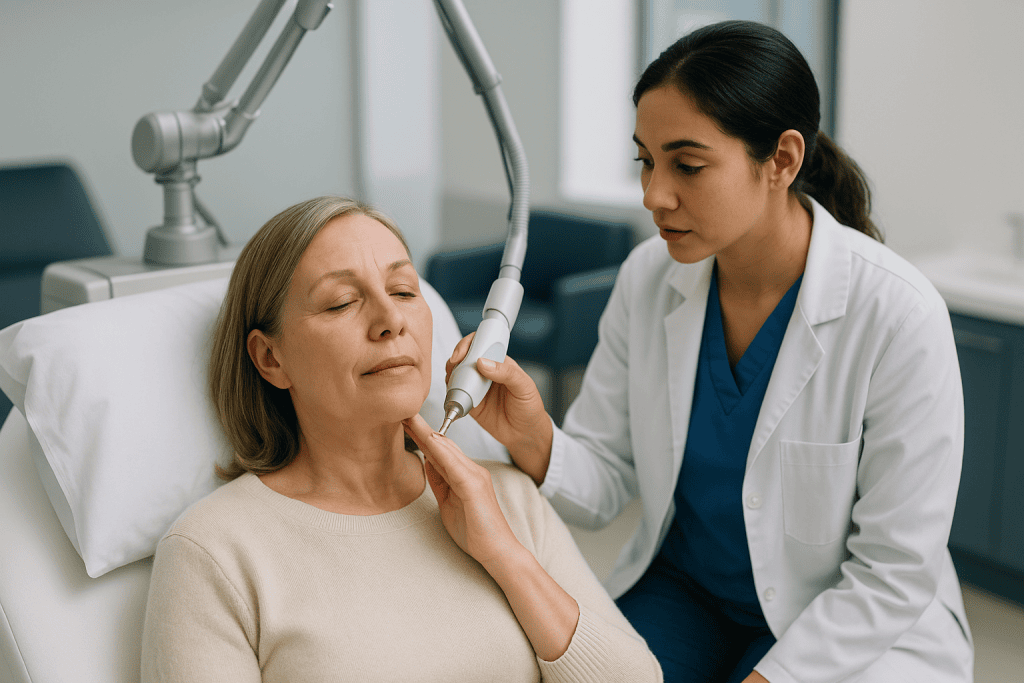
Three things happen afterward that favor herpes reactivation. First, the physical injury itself is a known trigger; even a chapped, sunburned or dental-work-irritated lip can spark a cold sore, and resurfacing is a far larger insult. Second, the skin’s barrier is open, so any virus that surfaces has no intact epidermis to confine it. Third, the body’s local immune defenses are busy with wound repair, which can give the virus a window.
Mayo Clinic lists herpes virus outbreaks explicitly among the risks of laser resurfacing, noting that treatment around the mouth is the most common place for this to happen. The risk is not limited to ablative lasers, though it is highest there, because the deeper the injury and the longer the open-wound phase, the more opportunity the virus has.
Understanding this mechanism takes the mystery out of the preparation steps. Nothing about the laser creates the virus. It simply creates conditions where a virus that was already present can cause unusual damage.
Who is usually asked about herpes and laser skin resurfacing, and who is asked to wait
Everyone considering laser resurfacing is screened, not just people who recall cold sores. Because so many adults carry the virus silently, most clinicians treat the entire face as potentially at risk once the lips or the skin around the mouth are in the treatment field. Your history simply changes how cautious the plan becomes.
People who usually receive extra preparation include:
- Anyone with a past cold sore, however long ago.
- Anyone treating the lips, the skin around the mouth or the full face.
- People having ablative or deep fractional treatments, where the open-wound phase is longer.
- People who notice cold sores after sun, illness or stress, since the laser is a comparable trigger.
People who are usually asked to postpone include anyone with an active cold sore or the tingling that often precedes one, anyone with a skin infection in the treatment area, and anyone whose recent sun exposure has left the skin tanned or burned. Mayo Clinic also notes that certain acne medicines taken in the past year, a tendency to form raised scars (keloids), and some autoimmune or immune-suppressing conditions call for careful discussion, because healing may be slower and complications more likely.
Pregnancy and breastfeeding usually mean waiting as well, partly because the antiviral and other medicines used around the procedure need separate consideration.
Being asked to wait is not a verdict. An active cold sore heals, the skin settles, and the appointment is rebooked. The alternative, treating over an outbreak, is one of the few genuinely avoidable ways to turn a cosmetic procedure into a prolonged problem. The decision about timing rests with the treating team, who weigh your skin, your history and the depth of treatment planned.
What a cold sore after laser treatment actually looks like
On ordinary skin a cold sore follows a predictable script. The NHS describes tingling, itching or burning first, then small blisters that burst and crust, usually clearing within about ten days without treatment. Mayo Clinic notes that first-time outbreaks can be more severe and that recurrences tend to appear in the same spot.
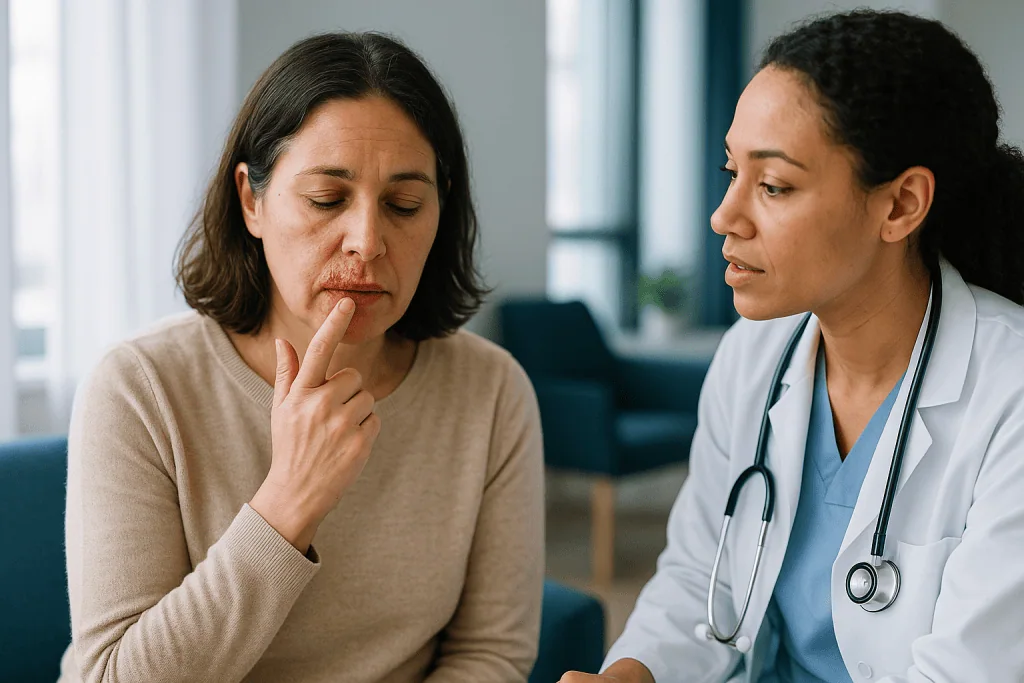
On resurfaced skin the script changes. Because the epidermis is absent or disrupted, there are no distinct blisters to see. Instead the virus produces shallow, painful erosions that can appear anywhere in the treated field, not only at the lip. Clinicians sometimes describe the pattern as sudden new rawness, often in clusters or a scalloped edge, appearing on skin that had been steadily improving. Pain that seems out of proportion to the stage of healing is a common early clue.
Timing is the other giveaway. Normal post-laser discomfort peaks early and then eases. A viral outbreak tends to arrive a few days in, exactly when the patient expected to be turning a corner, and makes things worse rather than better. The treated area can also feel hotter and more swollen than the rest of the face.
The concern is not only the discomfort. An outbreak across an open wound can delay re-epithelialization (the regrowth of the skin surface), and areas that heal late or heal through infection carry a higher chance of scarring and of lasting pigment change, especially in deeper skin tones. Mayo Clinic lists scarring and changes in skin color among the recognized risks of resurfacing, and herpes reactivation is one of the routes to both.
Early recognition changes the course. Antiviral treatment started promptly limits spread, which is why clinics ask patients to report any new pain or rawness the same day rather than wait for a scheduled review.
Antiviral before laser resurfacing: how doctors prepare for it
The main preparation is preventive antiviral medicine. The medicines used are nucleoside analogue antivirals, the same class used to treat ordinary cold sores. In plain terms, they mimic a building block of DNA. When the virus tries to copy itself inside a skin cell, the drug is incorporated into the viral DNA chain and stops it from growing. Healthy human cells are largely unaffected because the drug has to be activated by a viral enzyme first.
These medicines do not remove the virus from the nerve, and they cannot prevent it from waking. What they do is blunt the number of viral copies that reach the skin, so a reactivation that might have become a widespread erosion either never surfaces or stays small.
The typical pattern is to begin the medicine shortly before the procedure and continue it through the open-wound phase, until the skin surface has closed. Mayo Clinic notes that doctors may prescribe antiviral medicine before and after resurfacing for people with a history of herpes infections around the mouth, and many clinicians extend this to anyone having full-face or perioral treatment. The exact choice of medicine, when it starts and how long it continues are decisions for the prescribing clinician, based on the depth of the laser treatment, your history and your other medicines.
A few practical points belong in that conversation. Tell the clinician about kidney problems, because this class of drug is cleared by the kidneys. Mention any previous antiviral that upset your stomach or caused a headache, the most common side effects. If you take antiviral medicine long term to suppress frequent outbreaks, do not change it on your own before the appointment; the clinician will fold it into the plan.
Preventive antivirals are an evidence-supported routine step, not a sign that anything is wrong.
Resurfacing types compared: how the herpes risk changes with depth
Not all lasers carry the same risk, because the risk tracks the size and duration of the wound. The table below summarizes how clinicians usually think about it. Healing ranges come from Mayo Clinic’s description of recovery after ablative and non-ablative treatment and are typical, not guaranteed.
| Treatment type | What happens to the skin surface | Typical surface healing | Relevance of cold sore history |
|---|---|---|---|
| Fully ablative laser | Outer layer removed across the whole treated area; dermis heated | Raw, swollen phase for several days; new skin covers the area in about 1–2 weeks; redness can last months | Highest; open wound is largest and longest |
| Fractional ablative laser | Columns of skin removed in a grid; bridges of intact skin remain | Shorter than fully ablative, usually days to a week of visible wound | High; still an open-wound phase, especially around the mouth |
| Non-ablative or fractional non-ablative laser | Surface mostly intact; deeper tissue heated | Redness and swelling for hours to days; little open wound | Lower, but reactivation is still reported; perioral treatment often still prompts preventive antivirals |
| Light chemical peel or microdermabrasion | Superficial exfoliation only | Flaking for a few days | Low, though an active sore still means postponing |
Two caveats keep this honest. First, depth is adjustable on most modern devices, so a ‘fractional’ treatment can be set deep enough to behave like an ablative one; the setting matters more than the label. Second, individual factors shift the picture. Someone who gets a cold sore every time they catch a cold may be treated more cautiously for a gentle laser than someone with no history having a deeper one.
The practical takeaway is to ask your clinician which row your planned treatment belongs in, and what that means for antiviral preparation and for the length of time you will need to watch the skin closely.
What the consultation covers when you have a cold sore history
Expect the consultation to spend real time on your medical background, not only on the skin concern you came in with. For cold sores, useful details include when the last one occurred, how often they recur, where they tend to appear and what seems to trigger them. A person whose sores follow sun exposure is telling the clinician something useful about how reactive their virus is.
The clinician will also ask about other herpes-family infections, including shingles, because any history of viral reactivation on the face informs planning. Prior facial procedures matter too; if a chemical peel or dental work once set off a flare, that is a strong signal.
Medicines come next. Immune-suppressing drugs, long courses of steroids and certain acne treatments all affect healing. Mayo Clinic recommends disclosing all medicines and supplements, and specifically notes that some acne medicines taken within the past year can impair healing after resurfacing. Blood thinners and supplements that affect clotting are relevant for bruising.
A good consultation also includes an examination, usually under good light and sometimes with magnification, to check for any early sore, skin infection, active acne or suspicious lesions in the treatment field. Skin type is assessed, since darker skin carries a higher risk of pigment change after resurfacing and may lead the clinician to choose a gentler approach.
Finally, there is the conversation about expectations. Resurfacing improves texture, fine lines and some scarring; it does not lift sagging tissue or stop skin aging. A clinician who walks through the limitations as carefully as the benefits, and who asks about cold sores without being prompted, is showing exactly the kind of thoroughness that makes the procedure safer.
The weeks before treatment: practical preparation
Preparation for resurfacing is partly about the laser and partly about keeping your own body in the best position to heal. Several steps also reduce the chance of waking the virus.
Sun protection comes first. Sun exposure is both a classic cold sore trigger and a cause of uneven pigment after lasering. Mayo Clinic advises avoiding unprotected sun exposure before treatment and using broad-spectrum sunscreen daily. A tan in the treatment area is a common reason for postponement.
Smoking is next. Mayo Clinic recommends stopping for a period before and after resurfacing because smoking slows wound healing and raises complication rates. If you smoke, raise this early so the timing can be planned.
Skin care is usually adjusted. Many clinicians ask patients to pause retinoids, exfoliating acids and other irritating products in the days before treatment, and some prescribe a pre-treatment regimen, especially for deeper skin tones, to reduce pigment risk. Follow the instructions you are given rather than general internet advice; regimens vary with the device and the clinician’s judgment.
Then the antiviral. If it has been prescribed, start it exactly as instructed and confirm you have enough to continue through the healing period. Do not substitute a leftover course from a previous outbreak without checking; medicines and schedules differ.
In the final days, pay attention to your lips. The tingling that precedes a cold sore is a reason to call the clinic before the appointment, not after. Clinics would far rather reschedule than treat over an emerging sore. Avoid dental work, lip fillers or anything else that traumatizes the mouth area immediately beforehand, for the same reason.
Arrange time off, a ride home for deeper treatments, and a quiet first week. Healing skin does not do well with a packed schedule.
What the following days and weeks usually look like
Recovery depends on depth, so the ranges here follow Mayo Clinic’s description and should be read as typical rather than promised.
After ablative resurfacing, the treated skin is raw, swollen and itchy at first. Swelling often peaks within the first couple of days. The surface weeps and then forms a crust, and a protective ointment or dressing is used to keep it moist. Around days five to seven the skin becomes dry and begins to peel. New skin usually covers the area within one to two weeks. Redness persists well beyond that; for deeper treatments it can take two to three months to settle, and sometimes longer. Make-up can usually be worn once the surface has closed, with the clinician’s go-ahead.
After non-ablative resurfacing, expect redness, swelling and a sunburned feeling for hours to a few days, with little or no open wound. Several sessions are typically needed to approach the results of a single ablative treatment.
The window that matters most for herpes is the open-wound phase: from the day of treatment until the surface is fully covered. That is when antiviral medicine is usually continued and when any new pain, rawness or clustered erosions should be reported immediately. Once the skin has closed, the risk falls sharply, though a cold sore can still appear at the lip as it would at any other time.
Sun protection is non-negotiable during healing and for months afterward, because new skin pigments unevenly when exposed. Expect to use a physical sunscreen, hats and shade rather than relying on make-up with SPF.
Follow-up visits are usually scheduled within the first week and again later. Keep them even if things feel fine; early problems are easiest to manage when caught at a review.
Can you laser off a cold sore? What the evidence actually shows
This question comes up constantly, partly because some dental and aesthetic practices advertise laser treatment of cold sores. Two very different things are being described, and it helps to separate them.
Resurfacing lasers are not used on an active cold sore. The entire premise of resurfacing is a clean, controlled wound, and placing that wound over an infected area invites spread. An active sore is a standard reason to postpone.
The other claim involves low-level or ‘cold’ laser therapy, sometimes called photobiomodulation: light at low intensity that does not cut or vaporize tissue, applied to a cold sore in the hope of shortening it. Small studies have reported modest reductions in pain or healing time, but they are few, often small, and not consistent enough to appear in mainstream guidance. Neither the NHS nor Mayo Clinic lists laser therapy among recommended cold sore treatments; both describe antiviral creams or tablets started at the first tingle, together with simple comfort measures. In evidence-grading terms, low-level laser for cold sores is best described as unproven, not disproven.
What the virus does not do is disappear. No laser, high or low power, reaches the nerve ganglion where the virus rests between outbreaks. Any treatment that claims to remove cold sores permanently is making a promise the biology does not support.
If you have frequent cold sores and are weighing laser resurfacing, the useful conversation is not about lasering the sores away. It is about preventive antivirals, timing the procedure well away from a recent flare, and in some cases whether longer-term suppressive antiviral treatment is appropriate. Those are decisions for a prescribing clinician who knows your history.
Should I use hydrocortisone cream after a laser treatment?
Hydrocortisone is a mild topical steroid that reduces inflammation by damping the local immune response. That mechanism explains both why some clinicians use it after lasering and why it deserves caution.
On the useful side, a short course of a mild steroid cream is sometimes included in an aftercare plan to calm swelling and itching once the skin surface has closed, and some clinicians use it to reduce the risk of post-inflammatory pigmentation. When it is part of your plan, it has been chosen deliberately for your skin and the depth of your treatment.
On the cautious side, steroids suppress the local defenses that keep herpes in check. Applying a steroid cream to a cold sore makes it worse, which is why the NHS advises against using steroid creams on cold sores. On freshly resurfaced skin, where the virus may already be stirring, an unplanned steroid cream could in theory help an outbreak take hold or mask its early signs. Steroids can also thin skin with prolonged use and can delay the closing of an open wound.
The practical answer is therefore not a blanket yes or no. Use what is on your written aftercare plan and nothing else, and ask before adding anything, including over-the-counter hydrocortisone, antibiotic ointments, fragranced moisturizers or home remedies. If itching is severe enough that you are tempted to reach for a steroid cream, that is a reason to call the clinic, since intense itch can be a sign of irritation, allergy to a dressing or ointment, or early infection, each of which is handled differently.
The same rule applies to any leftover cold sore cream. Antiviral creams are designed for intact lip skin, not open wounds, and are not a substitute for the antiviral tablets a clinician prescribes for resurfacing.
Is skin resurfacing worth it if you get cold sores?
Worth is personal, but the question deserves a straight answer rather than a sales pitch. Laser resurfacing has solid evidence for improving fine lines, sun damage, uneven texture and certain acne scars, and it is one of the few non-surgical options that changes skin structure rather than its surface appearance. Mayo Clinic and Cleveland Clinic both describe it as effective for these concerns while noting that results are not permanent, that aging continues, and that deeper skin tones carry a higher risk of pigment change.
A cold sore history does not, on its own, make resurfacing a poor idea. It adds a preparation step and a period of vigilance. With preventive antivirals and a clinician who screens properly, the outbreak risk becomes manageable rather than alarming. What changes the calculation is frequency and severity. Someone with several outbreaks a year, or sores that spread beyond the lip, may be steered toward gentler treatment, a longer antiviral plan, or a longer wait after a recent flare. That is a conversation to have openly rather than something to minimize on a form.
It is also fair to weigh the honest downsides of resurfacing generally. Ablative treatment means a week or more of visible wound care, months of redness, strict sun avoidance and a real, if small, risk of scarring, infection and pigment change. Non-ablative treatment is gentler but typically needs repeated sessions for a more modest result.
A reasonable test is whether you would accept the downtime and the risks even if the result turned out to be subtler than hoped. If the answer is yes, and your care team has a clear plan for your cold sore history, resurfacing is a legitimate option. If the answer is no, there are alternatives, covered below, that avoid the open-wound phase entirely.
What people often get wrong about cold sores and laser resurfacing
Several beliefs circulate widely enough to cause real problems. Each is corrected below with what the evidence actually shows.
‘I haven’t had a cold sore in years, so it’s not relevant.’ The virus stays in the nerve ganglion for life. Dormancy for a decade does not mean it is gone, and resurfacing is a strong enough trigger to end a long quiet spell.
‘I’ve never had one, so I can’t get one.’ WHO estimates that most adults carry HSV-1, and many have never had a visible sore. A first outbreak can occur after a facial procedure, which is why many clinicians prescribe antivirals for full-face treatment regardless of history.
‘Cold sores and canker sores are the same thing.’ Canker sores are small ulcers inside the mouth, are not caused by a virus and are not contagious. Only cold sores, on the outer lip and skin, carry the resurfacing concern.
‘A laser can remove the virus.’ No laser reaches the nerve. Low-level laser for symptom relief is unproven; resurfacing lasers are never used on an active sore.
‘Folk remedies work as well as antivirals.’ Search traffic for Amish or traditional cold sore remedies reflects genuine curiosity, and home measures such as cool compresses, keeping the lip moist and avoiding sun can ease comfort. There is no evidence that herbal poultices, vinegar, toothpaste or similar remedies shorten an outbreak, and none is a substitute for prescribed antiviral prevention around a laser.
‘Antivirals mean I’m immune during healing.’ They lower the odds and the severity. Breakthrough outbreaks still happen, so monitoring continues.
‘More redness or pain just means the laser worked harder.’ New pain or rawness several days in, when things should be improving, is the classic sign of a problem and warrants a same-day call.
Alternatives when cold sores are frequent or severe
For some people the sensible route is a treatment with little or no open-wound phase, or a different approach to the same concern. None of these removes the need to disclose cold sore history, but they shift the risk profile.
Non-ablative fractional lasers heat the dermis while leaving the surface largely intact. The herpes risk is lower, though not zero, and preventive antivirals are still often used for perioral work. Results build over several sessions.
Superficial chemical peels exfoliate only the outer layers. They are gentler on the barrier, though medium and deep peels create wounds comparable to lasering and carry the same viral concern.
Microneedling creates tiny channels rather than removing surface skin. It too can reactivate herpes around the mouth, so the same screening applies, but the wound is smaller and closes quickly.
Topical retinoids and daily sun protection remain the best-evidenced long-term approach to fine lines and sun damage, and they involve no procedure at all. They work slowly, over months, and are often used alongside any of the above.
For deeper scars or lines, surgical options such as excision or fillers address different problems and are not substitutes for resurfacing, but they may suit someone for whom open-wound healing on the face is unwise.
Finally, for people with very frequent outbreaks, a prescribing clinician may discuss longer-term suppressive antiviral treatment independent of any procedure. The NHS notes that this is an option for severe or frequent recurrences. Whether it is appropriate, and how it fits with a planned laser treatment, is a decision for that clinician.
The common thread is that a cold sore history narrows nothing permanently. It shapes which tools are chosen and how carefully they are used.
Questions to ask your care team before laser resurfacing
Bringing a short list to the consultation turns a one-sided briefing into a conversation. These questions are especially relevant when cold sores are part of your history.
- Which type of laser and what depth are you planning, and how long will the skin surface be open?
- Will the lips or the skin around my mouth be in the treatment field?
- Will you prescribe a preventive antiviral, when will it start, and how long will it continue after the procedure?
- I take, or have taken, antiviral medicine before; how does that affect the plan?
- What should I do if I feel tingling on my lip in the days before the appointment?
- What would a herpes outbreak look like on treated skin, and how quickly should I report it?
- Who do I contact outside clinic hours if something changes suddenly?
- Which products should I stop before treatment, and which creams or ointments are the only ones I should use afterward?
- Is hydrocortisone or any steroid cream part of my aftercare, and when, if ever, should I use it?
- Given my skin tone, what is my risk of pigment change, and what are you doing to reduce it?
- How many follow-up visits are planned, and what are you checking at each?
- If I have frequent cold sores, would a gentler treatment or a longer wait be wiser for me?
Write the answers down, or ask for them in writing. Aftercare instructions given verbally while you are still numb or anxious are easy to misremember. A team that welcomes these questions, answers them specifically and is comfortable saying ‘let’s postpone’ when something is not right is the strongest sign that the procedure is in careful hands. Every decision about timing, medicines and depth belongs with that team.
When to call your doctor: red-flag signs after resurfacing
Most recovery discomfort is expected and settles on schedule. The signs below are different. They suggest a complication, often one that is far easier to manage early, and should prompt a same-day call to your treating team, or urgent care if the clinic cannot be reached.
- New or sharply increasing pain several days after treatment, when healing should be improving.
- Clusters of small blisters, shallow erosions or a scalloped area of fresh rawness anywhere in the treated field, especially near the lips.
- Tingling, burning or itching concentrated on the lip, the usual warning that a cold sore is starting.
- Spreading redness, warmth or swelling beyond the treated area, or swelling that worsens after the first few days.
- Yellow or green discharge, a honey-colored crust, or a foul smell, which can signal bacterial infection.
- Fever, chills or feeling generally unwell.
- Any eye symptoms, including pain, redness, light sensitivity or blurred vision, since herpes can involve the eye and this needs urgent assessment.
- Areas that fail to close within the timeframe you were given, or that reopen after healing.
- Signs of an allergic reaction to a dressing or ointment: intense itch, hives or new rash.
- Any symptom that feels wrong to you, even if it is not on this list.
Seek emergency care without waiting if you have difficulty breathing, swelling of the mouth or throat, a rapidly spreading infection with fever, or severe eye pain or vision change.
Early viral outbreaks respond to prompt antiviral treatment, and early bacterial infection responds to prompt antibiotics. The difference between a brief setback and lasting scarring is often the speed of the phone call. Keep the clinic’s contact details, including after-hours instructions, somewhere you can find them while your face is covered in ointment and you are not at your most organized.
Frequently asked questions
Can laser resurfacing trigger cold sores even if I have never had one?
Yes, it can. Most adults carry herpes simplex type 1 without ever having had a visible sore, and the skin injury from resurfacing is a strong enough trigger to produce a first outbreak. This is why many clinicians prescribe preventive antiviral medicine for full-face or perioral treatment regardless of history. Tell your team about any tingling on the lips before or after the procedure.
How long after a cold sore can I have laser resurfacing?
There is no single fixed interval; the usual requirement is that the sore has fully healed and the skin around it has returned to normal, which the NHS notes typically takes about ten days for an ordinary outbreak. Clinicians often prefer additional time beyond that and will usually examine the area before proceeding. The timing decision rests with your treating team, who will also plan preventive antivirals.
Why do doctors prescribe an antiviral before laser resurfacing?
Because the medicine blocks the virus from copying itself, which limits how much reaches the healing skin if the virus reactivates. It does not remove the virus from the nerve, but it makes a widespread outbreak on open skin far less likely and milder if it occurs. Mayo Clinic lists antiviral medicine before and after resurfacing as a standard precaution for people with a history of herpes around the mouth.
What does a cold sore after laser treatment look like?
On resurfaced skin it rarely looks like a classic lip blister. Instead it appears as new, painful shallow erosions or clustered rawness anywhere in the treated area, often several days into recovery when the skin should be improving. Pain out of proportion to the healing stage is a common early clue. Report these changes the same day, because prompt antiviral treatment limits spread and reduces the risk of scarring.
Can you laser off a cold sore?
No. Resurfacing lasers are never used on an active cold sore, because treating over infected skin spreads the virus. Low-level laser therapy is sometimes offered for symptom relief, but the evidence is limited and it does not appear in NHS or Mayo Clinic cold sore guidance. No laser reaches the nerve where the virus rests between outbreaks, so nothing removes it permanently. Antiviral medicine started at the first tingle remains the standard approach.
Is herpes and laser skin resurfacing a dangerous combination?
Not when it is planned for. A cold sore history raises the chance of an outbreak on healing skin, which can delay recovery and increase scarring and pigment risk, but screening, preventive antivirals and prompt reporting of symptoms make this a manageable risk rather than a reason to avoid treatment. People with very frequent or severe outbreaks may be guided toward gentler options or a longer antiviral plan by their clinician.
Should I use hydrocortisone cream after a laser treatment?
Only if it is on your written aftercare plan. Mild steroid creams are sometimes used by clinicians to calm swelling or reduce pigment risk once the surface has closed, but steroids suppress local immune defenses and can worsen a herpes outbreak; the NHS advises against steroid creams on cold sores. If itching is intense enough that you want to reach for one, call the clinic instead, since itch can signal irritation, allergy or infection.
Is skin resurfacing worth it if I get frequent cold sores?
It can be, but frequency changes the plan. Resurfacing has good evidence for fine lines, sun damage and some scars, and a cold sore history mainly adds antiviral preparation and a period of close monitoring. With several outbreaks a year, your clinician may suggest a gentler non-ablative treatment, a longer antiviral course, or more time after a recent flare. Weigh the downtime and risks honestly, and let the treating team guide depth and timing.
How do Amish or traditional remedies treat cold sores, and do they work?
Traditional remedies across many communities rely on soothing measures such as cool compresses, keeping the lip moist and avoiding sun, which can ease comfort. Herbal poultices, vinegar, toothpaste and similar home remedies have no evidence of shortening an outbreak. Cold sores typically clear within about ten days on their own, which makes remedies seem effective. None replaces prescribed antiviral prevention when a laser procedure is planned.
Are canker sores a concern before laser resurfacing?
Generally no. Canker sores are small ulcers inside the mouth, are not caused by a virus and are not contagious, so they do not carry the reactivation risk that cold sores do. The concern with resurfacing is specifically herpes simplex, which produces blisters on the outer lip and surrounding skin. If you are unsure which type you get, describe where the sores appear and your clinician can help clarify.
References
- NHS: Cold sores
- World Health Organization: Herpes simplex virus fact sheet
- Cleveland Clinic: Laser skin resurfacing
- MedlinePlus: Herpes simplex
This article is for general information only and is not a substitute for professional medical advice. Please consult a qualified doctor about your individual situation.

More from the Blog
Dermabrasion Recovery: The Raw Days, Ointments and When Redness Finally Fades
Dermabrasion recovery time typically runs in stages: the treated skin is raw, red and weeping for the first days, new skin usually covers the…
Sun Protection After Dermabrasion: Why Strict Cover Matters for Months, Not Days
Sun protection after dermabrasion needs to continue for months, not days, because the newly grown skin is thin and its pigment cells are easily…
What Happens During an IPL Photorejuvenation Session: Cooling Gel, Flashes and Timing
During an IPL photorejuvenation session, a clinician cleanses the skin, applies a cool clear gel, gives you protective eyewear, and passes a handpiece across…

What to Stop Before a Chemical Peel: Retinoids, Scrubs, Waxing and Sun Exposure
Before a chemical peel, people are usually asked to pause topical retinoids and exfoliating acids, stop facial scrubs, masks and exfoliating devices, avoid waxing,…

Laser Resurfacing Results: What Fine Lines and Acne Scars Realistically Look Like Afterward
Laser resurfacing results are usually a partial, gradual softening rather than a complete erasure. Fine lines around the eyes and mouth commonly look shallower,…
Blood Thinners, Anti-Inflammatories and Mesotherapy: What Your Doctor Checks First
Blood thinners and anti-inflammatory medicines matter for mesotherapy because the treatment relies on many shallow needle punctures, and anything that slows clotting raises the…