

Your First Schroth Assessment: X-Rays to Bring, What to Wear and What the Therapist Checks

Key Takeaways
- A standing full-spine X-ray taken from the back is the image the Cobb angle is measured on, and a curve of 10 degrees or more is the usual threshold for diagnosing scoliosis.
- Fitted, stretchy clothing such as a sports bra or close-fitting top with leggings lets the therapist see shoulder blades, waist creases and pelvis, which loose T-shirts hide.
- The Adams forward bend test with a scoliometer measures trunk rotation, the feature that drives the visible rib hump, and complements rather than replaces the X-ray.
- Idiopathic scoliosis affects roughly 2 to 3 percent of adolescents, and curves are most likely to progress during the adolescent growth spurt.
- Mainstream guidance keeps bracing as the established approach for moderate curves in growing children, with scoliosis-specific exercise used alongside it rather than instead of it.
- New leg weakness, numbness, bladder or bowel changes, night pain or rapid visible change are red flags that call for prompt medical review, not another exercise session.
For a first Schroth appointment, bring your most recent full-spine standing X-ray (the actual images or a digital copy, plus the radiologist's report with the Cobb angle), wear fitted, stretchy clothing such as a sports bra or close-fitting top and leggings, and expect the therapist to review your history, observe your posture, perform a forward bend test, assess breathing and movement, and classify your curve pattern before teaching any exercises.
The envelope from the radiology department is still sitting on the kitchen counter, unopened since the orthopedic visit. A teenager stands in front of the hallway mirror, twisting to see whether one shoulder blade really does stick out more than the other. A parent scrolls through a booking confirmation for a first Schroth appointment and realizes nobody explained what happens in the room.
That gap between referral and first session is where most of the anxiety lives. People picture being measured and judged, or handed a sheet of exercises they will not remember. The reality is closer to a long, careful conversation with a physical therapist who wants to understand exactly how your spine curves and how you breathe and move around that curve.
This guide walks through the practical questions people ask: which images to bring, what to wear so the therapist can see your back, how early to arrive, and what is actually being checked. It also covers who the method is usually offered to, what the following weeks look like, and the signs that mean you should call your doctor rather than wait for the next session.
What is the purpose of a first Schroth appointment?
Schroth is a form of physiotherapeutic scoliosis-specific exercise, meaning a program of postural corrections, breathing techniques and strengthening tailored to the individual shape of a person’s curve rather than a generic back workout. It was developed in Germany in the 1920s by Katharina Schroth, who had scoliosis herself, and is now taught by certified therapists in many countries, as Johns Hopkins Medicine describes.
The first session is an assessment, not a workout. Its job is to build a three-dimensional picture of your spine. Scoliosis is not just a sideways bend; the vertebrae also rotate, which is why one side of the rib cage or lower back can look more prominent. The Schroth model sorts the trunk into blocks, roughly the pelvis, the lumbar region, the thoracic region and the shoulder girdle, and describes how each block has shifted or rotated relative to the one below it. Every exercise later in the program is built from that map, so the map has to be accurate.
Expect the appointment to feel slower and more talkative than a typical physical therapy visit. The therapist will read your X-ray, compare it with what they see on your back, ask about growth and pain, watch you breathe, and only then start introducing the first positions. Many programs also record photographs or measurements at this visit so that change can be tracked over months. Nothing about the first session commits you to a long program; it gives you and the therapist the information to decide, together with your referring doctor, whether Schroth belongs in your plan and how it should fit alongside monitoring or bracing.
What X-rays should I bring to my first Schroth appointment?
The single most useful thing you can bring is a standing, full-length spine X-ray taken from the back, ideally within the last several months, with its written report. This is the image on which the Cobb angle is measured. The Cobb angle is the number of degrees between the most tilted vertebra at the top of a curve and the most tilted vertebra at the bottom; a curve of 10 degrees or more is the usual threshold for calling it scoliosis, according to Mayo Clinic.
A side-view (lateral) film is valuable too, because Schroth also addresses the front-to-back profile of the spine, including kyphosis, the forward rounding of the upper back, and lordosis, the inward curve of the lower back. If your imaging was done on a low-dose whole-body system, bring those images in the same way.
Practical points that save time:
- Ask the imaging department or your orthopedic office for a digital copy on disc or a secure download link, plus a printed report. A phone photo of a screen is a last resort.
- Bring older films as well as the newest one. A therapist who can see two X-rays a year apart learns far more about whether the curve is stable than from a single image.
- If a Risser grade is on the report, note it. The Risser sign grades how much the growth plate on the pelvis has fused and is one way clinicians estimate how much skeletal growth remains, which matters because curves tend to progress most during growth spurts, as Mayo Clinic explains.
Do not arrange new X-rays purely for the physical therapy visit. Imaging frequency is a decision for your doctor, who weighs the information gained against cumulative radiation exposure in a young person.
What to wear to a Schroth assessment so the therapist can see your back
The therapist needs an unobstructed view of your spine, shoulder blades, waist creases and pelvis from the back, front and side. Loose T-shirts hide exactly the features they are trying to read. Fitted, stretchy clothing works best: a sports bra or close-fitting tank top, and leggings or fitted shorts that sit at the natural waist rather than the hips.
Some people are asked to remove their top for the postural examination and photographs. That can feel exposing, particularly for teenagers, so it helps to ask when booking what the program’s practice is and whether a parent or chaperone can be present. A reasonable clinic will explain why, offer a private space, and let you keep a sports bra or fitted top on for most of the session.
A few more details that make the visit smoother:
- Skip belts, long necklaces and bulky waistbands; they create false lines at the pelvis.
- Tie back long hair so the neck and upper back are visible.
- Bring or wear flat shoes with a thin sole, or plan to work in socks or bare feet. Posture is assessed with the feet flat, and a stacked heel changes pelvic tilt.
- If you already wear a brace, wear it to the appointment and bring the wearing instructions from your orthotist. The therapist will usually want to see you both in and out of it.
Comfort matters as much as visibility. You will be asked to bend forward, side-bend, reach, lie on a mat and possibly kneel, so anything that rides up, pinches or restricts a deep breath will distract you from learning. Layers you can add between activities are sensible, because assessment rooms are often kept cool.
How early should I arrive, and how long does the first session usually take?
Arriving a short while before your booked time is enough for most programs, but check the confirmation for intake paperwork. First assessments almost always include a questionnaire on medical history, pain, activity levels and, for adolescents, growth and puberty milestones. Completing that in the waiting room eats into hands-on time; completing it at home the night before does not.
Programs differ in how they schedule. A first Schroth session is typically booked as a longer slot than routine follow-ups because of the history, examination and photography involved, and some programs structure the early phase as a short intensive block of sessions over a few days or weeks before spacing visits out. Ask at booking how your program works rather than assuming.
Things worth having with you or in your phone:
- Your X-ray images and reports, as described above.
- Any letter from the orthopedic surgeon, pediatrician or family doctor who referred you, including what they hope the program will address.
- A list of current medicines and any other conditions, especially anything affecting bones, joints, breathing or balance.
- Brace details if you have one: the type, when it was fitted, and the number of hours a day you were asked to wear it.
- For a child, dates of recent growth spurts and, for girls, whether periods have started. The NHS notes that idiopathic scoliosis most often appears and progresses during the adolescent growth years, so this timing shapes the whole plan.
If you are coming as an adult after decades of living with a curve, bring what you have, even if the last X-ray is old. A therapist can still learn a great deal from an older image, and the referring doctor can decide whether updated imaging is warranted.
What does the therapist actually check in the standing examination?
The examination begins before you realize it, usually while you are walking into the room. The therapist watches how you carry your head, whether one arm swings more, and how the pelvis moves. Then comes the formal look, standing with feet together and arms relaxed.
From behind, they note shoulder height, the position of each shoulder blade, the depth of the waist creases, and whether the head sits over the center of the pelvis or is shifted to one side. A plumb line is sometimes dropped from the base of the skull to check that offset. From the side, they assess the thoracic and lumbar profiles and how the head and pelvis sit relative to the ankles.
Next is the Adams forward bend test, the screening maneuver most people remember from school. You bend forward at the hips with knees straight and palms together, and the therapist sights along your back from behind. Vertebral rotation pushes the ribs or lumbar muscles into a visible hump on one side. A scoliometer, a small inclinometer laid across that hump, gives a number for the angle of trunk rotation. Cleveland Clinic describes both steps as core parts of scoliosis assessment.
Schroth therapists usually go further than a screening exam:
- They palpate the spinous processes, the bony bumps along the spine, to feel where the curve changes direction.
- They check leg length and pelvic level, since a tilted pelvis can mimic or add to a curve.
- They test hip, shoulder and trunk range of motion, and how well you can actively elongate the spine.
- They assess rib cage mobility, because the breathing work central to the method depends on it.
Most programs photograph these views for comparison later. Nothing in this part should hurt; tell the therapist if a position is uncomfortable.
Schroth method assessment: how the therapist classifies your curve
Once the X-ray has been read and your back has been examined, the therapist assigns a curve pattern. This is the moment the Schroth method assessment diverges from a general physiotherapy visit. Rather than describing the spine simply as ‘right thoracic’ or ‘left lumbar’, the classification records how many major curves there are, which direction each bends and rotates, and how the pelvis and shoulders have shifted to keep the eyes level.
The therapist compares the picture on film with the picture on your body. The two do not always match neatly. A curve can look larger on the X-ray than it appears standing, or a small radiographic curve can produce a surprisingly visible rib hump because rotation, not the sideways angle, drives what you see. Reconciling those two views is skilled work and is one reason the first appointment takes time.
Table 1 summarizes what is typically measured, why it matters, and what it feels like to be on the receiving end.
| What is assessed | Why it matters | What you will notice |
|---|---|---|
| Cobb angle from X-ray | Defines curve size; 10 degrees or more is the diagnostic threshold (Mayo Clinic) | Discussion of your report, no new imaging |
| Angle of trunk rotation | Tracks rotation, the driver of visible asymmetry | Forward bend with a small device rested on the back |
| Skeletal maturity (Risser, growth history) | Predicts remaining growth and progression risk (Mayo Clinic) | Questions about height changes and puberty |
| Posture photographs | Baseline for comparing change over months | Standing in fitted clothing, several angles |
| Breathing pattern | Foundation for rotational breathing exercises | Hands placed on ribs while you inhale |
| Movement and strength | Shapes which corrections are realistic now | Bending, reaching, holding positions |
You should leave with a plain-language description of your pattern. If the explanation is delivered only in jargon, ask for it again in everyday words; understanding your own curve is the point.
Schroth exercises first session: what the breathing and positions are like
After the assessment, most therapists introduce one or two foundational corrections rather than a full routine. The first is usually elongation: learning to grow tall through the crown of the head while keeping the pelvis level, which reduces the sideways collapse of the curve. The second is the breathing technique the method is known for, called rotational angular breathing, which means directing the inhale deliberately into the collapsed, concave side of the rib cage so the ribs expand there and gently de-rotate the trunk.
Learning this feels strange at first. The therapist places a hand on the flattened side of your ribs and asks you to breathe into that hand. Many people find they cannot feel the area at all in the first attempts, which is normal; the concave side has often been under-used for years. Mirrors, a light touch, and sometimes a rolled towel or small pad under one side are used to give feedback.
Positions in an early session commonly include:
- Sitting on a stool with feet planted, practicing elongation and corrected breathing.
- Lying on the back or side with padding placed to open the concave side.
- Standing at a wall bar or door frame, using the arms to help lengthen the spine.
Each position is held while breathing, then released. Muscles on the convex side are asked to work in a shortened, corrected position, which can produce a pleasant tired feeling afterwards rather than sharp pain. Sharp or radiating pain is not expected and should be reported immediately.
Do not expect to master anything on day one. The realistic goal of Schroth exercises in a first session is that you can feel where your concave side is, can find a corrected posture with guidance, and understand what you will be practicing at home until the next visit.
Who is a first Schroth appointment usually for, and who is asked to wait?
Scoliosis-specific exercise is most commonly offered to adolescents with idiopathic scoliosis, the form with no identified cause that accounts for the large majority of cases and affects roughly 2 to 3 percent of adolescents according to Cleveland Clinic. Within that group, therapists see the strongest rationale for young people with mild to moderate curves who are still growing, either as a standalone approach under observation or alongside a brace.
Adults also attend. Their goals differ: rather than trying to influence a growing spine, the focus is usually on posture, trunk strength, breathing and managing back pain, which the NHS notes is a common feature of scoliosis in adulthood. Adults with degenerative curves, older people with balance concerns, and those with curves that persisted from adolescence can all be assessed, with the program adjusted to what is safe and useful.
Some people are usually asked to wait, or to be seen by another specialist first:
- Anyone with a curve large enough that the treating surgeon is actively discussing surgery. Johns Hopkins Medicine describes surgery as a consideration for curves that progress beyond roughly 45 to 50 degrees. Exercise may still have a role before or after an operation, but the sequencing belongs to the surgical team.
- People with scoliosis linked to a neuromuscular condition, a congenital spinal malformation, or a syndrome, whose programs need coordination with neurology or genetics.
- Anyone with new neurological symptoms, unexplained night pain, or recent trauma, who needs medical review before starting any exercise program.
- Children too young to follow multi-step instructions, who are usually managed by observation, casting or bracing until they can participate meaningfully.
The referring doctor and the therapist together decide fit. A first appointment can also end with an honest recommendation that another pathway suits you better right now.
How does Schroth fit alongside observation, bracing or surgery?
Scoliosis care has three conventional pillars, described consistently by Mayo Clinic, the NHS and MedlinePlus: watchful monitoring for small curves, bracing for moderate curves in a child who is still growing, and surgery for large or rapidly progressing curves. Scoliosis-specific exercise sits across the first two rather than replacing either.
Under observation, the doctor repeats X-rays at intervals, typically every few months during growth according to Mayo Clinic, to see whether the curve is changing. A Schroth program during this period gives the young person something active to do and builds body awareness, while the medical decision points remain exactly the same.
Alongside a brace, the exercise program is designed to complement the corrective forces the brace applies. Therapists often teach patients to breathe into the brace’s pressure-free zones and to maintain corrected posture when the brace is off. Brace wear hours are prescribed by the orthopedic team and are not reduced because someone is exercising well; ask your doctor if you are unsure.
Around surgery, exercise is sometimes used to build strength and breathing capacity beforehand and to restore movement afterward, on a schedule set by the surgeon.
What does the evidence say about effect on the curve itself? Johns Hopkins Medicine reports that scoliosis-specific exercise programs have been associated with improvements in posture, trunk rotation and quality of life, and with slowing of progression in some adolescents, particularly when combined with bracing. The supporting studies are relatively small and vary in quality, so mainstream guidance treats these exercises as a reasonable addition within a monitored plan, not as a proven substitute for bracing or as a guarantee of a smaller curve. That framing is honest, and a good therapist will use it too.
What to bring to physical therapy for scoliosis: a one-page checklist
People searching for what to bring to physical therapy for scoliosis usually want a short, concrete list. Here is the one that covers the first visit, followed by why each item earns its place.
- Full-spine standing X-rays (back and side views) with the written reports, newest and older.
- Referral letter or clinic notes from the doctor who suggested the program.
- Brace, if you have one, plus its wearing instructions.
- Fitted, stretchy top and leggings; flat shoes or socks.
- A list of medicines, allergies and other health conditions.
- Growth notes for a child: recent height changes, puberty milestones.
- A notebook or phone for photos of positions and a few written cues.
- Water, and a snack for afterwards; sessions can be tiring for younger patients.
The imaging matters because the classification is built on it. The referral letter matters because it tells the therapist what question the doctor is asking: is this about pain, posture, preparation for bracing, or support during observation? A brace matters because corrections are taught in and out of it. Clothing matters for visibility and comfort. The medicine and health list matters because conditions affecting bone density, joint laxity, breathing or balance change what is safe to teach.
Growth notes deserve special mention. Mayo Clinic explains that the risk of a curve worsening is highest during the adolescent growth spurt, which typically starts around the onset of puberty and slows as growth plates close. Knowing where a child sits on that timeline shapes how often the therapist and doctor want to review progress.
Finally, the notebook. The home program is where results come from, and most people forget half of what they were shown by the time they reach the parking lot. Ask permission, then film the therapist demonstrating each position.
What do the following weeks usually look like after a first Schroth appointment?
The first session ends with a small home program, usually one to three positions and the breathing pattern, with clear instructions on how often to practice. Frequency is set by the therapist based on age, tolerance and goals; short daily practice is a common starting structure, but treat whatever you are given as your prescription rather than comparing with others.
Follow-up visits in the early phase tend to be closer together, then space out as you become independent. Some programs run an intensive block of sessions over a few days before moving to periodic reviews; others build up weekly. At each visit the therapist checks the quality of your corrections, progresses positions, and adds strength work. Photographs and trunk rotation measurements are repeated periodically for comparison.
The first fortnight often brings muscle soreness on the convex side, where under-used muscles are being asked to hold a corrected position. That soreness should fade between sessions. What you should not experience is pain that wakes you at night, pain shooting into a leg, or numbness; those are reasons to stop and call your doctor.
Your medical follow-up continues on its own track. For a growing child under observation, Mayo Clinic notes that repeat X-rays every few months are typical until growth slows, and the decision about bracing or referral to a surgeon is made from those images, not from how well the exercises are going. Ask your therapist to send a brief summary to the referring doctor so both teams see the same picture.
Motivation dips around week three or four for many families, once novelty fades and progress is not yet visible in the mirror. Building practice into an existing routine, pairing it with music, or having a parent learn the cues so they can coach helps. The therapist expects this dip and can adjust the program.
What people often get wrong about their first Schroth appointment
Myth: the therapist will straighten your spine on the first day. Reality: the first visit is assessment and teaching. Any visible change at the end of a session is postural, a corrected position you have learned to find, and it does not yet mean the underlying curve has changed. Radiographic change, if it occurs, is judged over months by your doctor.
Myth: Schroth replaces the brace. Reality: mainstream guidance from Mayo Clinic and the NHS continues to list bracing as the established approach for moderate curves in growing children. Exercise is usually offered alongside it. Never reduce prescribed brace hours because exercises feel like they are working; that decision belongs to your orthopedic team.
Myth: if you do the exercises perfectly, the curve cannot progress. Reality: progression is driven largely by growth and curve biology. Exercise may influence it in some adolescents, but no program can promise a particular outcome, and a curve that progresses despite excellent effort is not a personal failure.
Myth: any stretching or yoga counts as Schroth. Reality: general flexibility work is symmetrical by design; scoliosis-specific exercise is deliberately asymmetrical, matched to a classified curve. The two are different tools.
Myth: adults are too old for it. Reality: adults attend for posture, strength, breathing and pain management. The aims differ from those in adolescents, but the assessment is just as thorough.
Myth: you need to be in pain to be referred. Reality: most adolescents with idiopathic scoliosis have little or no pain, as MedlinePlus notes, and many referrals are made purely on curve size and growth stage.
Myth: the first appointment commits you to a long program. Reality: it is a starting point. You, your family and your doctor decide what happens next.
Questions to ask your care team at or after the first visit
A good first Schroth appointment leaves you with more questions answered than raised, but only if you ask them. These are the ones that tend to matter most, grouped by who can best answer.
For the therapist:
- How would you describe my curve pattern in plain words, and which part of my body is the ‘concave side’ I should breathe into?
- Which two or three cues should I remember if I forget everything else?
- How often and for how long should I practice at home right now, and how will that change?
- What should I feel during and after the exercises, and what would make you want me to stop?
- How will we measure whether this is helping, and over what time frame?
- Will you share your notes with my referring doctor?
- If I wear a brace, how do the exercises relate to it, and which should I do in the brace?
For the referring doctor or surgeon:
- When is my next X-ray planned, and what result would change the plan?
- Does doing this program alter anything about bracing or surgical decisions? (For most people the answer is no; it is useful to hear it directly.)
- Are there activities or sports you want me to limit, or are all cleared?
- Is there anything about my particular curve or history that the therapist needs to know?
For yourself or your family:
- Realistically, where in the day does practice fit, and who will help a younger child stay consistent?
- What would make this feel worthwhile at the three-month point, even if the X-ray has not changed?
Write the answers down. The Cleveland Clinic and Mayo Clinic both emphasize that scoliosis care is a long-term partnership between family, therapist and doctor, and shared notes are what keep that partnership on the same page.
When to call your doctor: red-flag signs that should not wait for the next session
Scoliosis-specific exercise is a low-risk activity for the people it is usually offered to, and idiopathic scoliosis itself rarely causes urgent problems. Some symptoms, though, point to something other than a routine curve and need medical review promptly rather than at the next scheduled visit.
Contact your doctor without delay, or seek urgent care, if you or your child develop:
- New weakness, numbness or tingling in the legs, or a change in walking such as tripping or foot drag.
- Any new difficulty controlling the bladder or bowels, or numbness around the groin or buttocks.
- Severe back pain that wakes you from sleep, is constant and worsening, or is not relieved by rest.
- Pain, fever and back stiffness together, or unexplained weight loss.
- A visible change in the shape of the back over a matter of weeks rather than months.
- New shortness of breath at rest or with light activity, or chest pain.
- Back pain following a fall or injury.
Mayo Clinic and MedlinePlus both note that pain, neurological symptoms or rapid change can signal a cause other than idiopathic scoliosis, such as a spinal cord abnormality, and that these findings usually prompt further imaging, often MRI, and specialist review.
Also tell your therapist and doctor about less dramatic problems: pain that is getting worse over successive sessions rather than better, dizziness with the breathing exercises, skin breakdown under a brace, or a mood change in a teenager who is struggling with the diagnosis. None of these is an emergency, but each is a reason to adjust the plan.
If in doubt, call. A therapist would far rather pause a program for a week while a doctor takes a look than have someone push through a symptom that needed attention. Every decision about pausing, modifying or continuing rests with your treating team.
Frequently asked questions
How early should I arrive for my first Schroth appointment?
Arriving a short while before your booked time is usually enough, provided you have completed any intake questionnaire in advance. First assessments involve history-taking, posture photographs and an examination, so most programs book a longer slot than for follow-ups. Confirm the expected length when booking, complete paperwork at home, and have your X-rays, referral letter and brace details ready so the hands-on time is not lost to admin.
What is the purpose of a first Schroth appointment if I already have a diagnosis?
The diagnosis tells you that a curve exists; the first Schroth session maps its exact three-dimensional pattern. The therapist reads your X-ray, examines your standing posture and forward bend, assesses breathing and movement, and classifies the curve so that every later exercise is matched to it. You also learn one or two foundational corrections and how the program will fit alongside your doctor’s monitoring or bracing plan.
What are the types of Schroth appointments I might be offered?
Programs generally offer three kinds of visit: the initial assessment described here; follow-up sessions where corrections are checked and progressed; and, in some programs, an intensive block of daily or near-daily sessions early on before visits are spaced out. Periodic re-assessments with repeat photographs and trunk rotation measurements are also common. Ask at booking which structure your program uses and how it coordinates with your doctor’s X-ray schedule.
What happens at a scoliosis physiotherapy first visit if I do not have any X-rays?
The therapist can still take a history, examine posture, perform the forward bend test with a scoliometer and start teaching basic positions, but formal curve classification and progress tracking rely on imaging. They will usually ask your doctor whether a standing full-spine X-ray is appropriate. Do not arrange imaging on your own; the decision about when and how often to X-ray sits with the referring clinician.
Will the therapist ask my child to undress for the Schroth method assessment?
Often the back needs to be fully visible for examination and photographs, which may mean removing a top. A sports bra or fitted tank top can usually stay on for most of the session. Ask in advance what the program’s practice is, request a private space, and confirm that a parent or chaperone can be present. Any reasonable program will explain the reason and respect a young person’s comfort.
Do Schroth exercises in the first session hurt?
They should not cause sharp pain. Positions are held while breathing, and muscles on the outer side of the curve work in a corrected posture, which can produce a mild, tired ache afterwards similar to any new exercise. Sharp, radiating or persistent pain is not expected; tell the therapist immediately if it occurs, and contact your doctor if pain continues, worsens between sessions or comes with numbness or weakness.
Can I do Schroth exercises while wearing a brace?
Usually yes, and therapists often teach some corrections both in and out of the brace so the two approaches work together. Bring the brace and its wearing instructions to the first appointment. Prescribed brace hours are set by your orthopedic team and are not reduced because you are exercising; if you have questions about wear time, take them to the doctor or orthotist who fitted it.
How long before I see results from Schroth exercises?
Changes in posture awareness and the ability to find a corrected position often come within the first sessions, but that is learned posture, not a change in the curve itself. Radiographic change, if it happens, is judged by your doctor over months, with X-rays repeated every few months in growing children according to Mayo Clinic. No program can promise a specific change in Cobb angle, and honest therapists say so.
Is a Schroth assessment useful for adults with scoliosis?
Adults are routinely assessed, but the goals differ from those in adolescents. Growth is complete, so the focus shifts to posture, trunk strength, breathing and managing back pain, which the NHS describes as common in adult scoliosis. The examination is just as thorough, and older imaging is still useful. Adults with degenerative curves, balance concerns or previous spinal surgery should make sure the therapist has their full history.
Should I stop the exercises if my next X-ray shows the curve has grown?
Not on your own. Curve progression is driven largely by growth and curve biology, and it is not a sign that you did the exercises wrongly. A change on X-ray is a medical decision point where your doctor reviews bracing, monitoring intervals or referral to a surgeon. Bring the new report to your therapist, ask both teams to talk to each other, and follow the plan they agree on together.
References
This article is for general information only and is not a substitute for professional medical advice. Please consult a qualified doctor about your individual situation.

More from the Blog

Spinal Stenosis Surgery in Your Seventies: How Fitness, Not Age, Guides the Decision
Spinal stenosis surgery is not ruled out by age alone. Surgeons assess physical fitness, heart and lung health, frailty, bone quality and other medical…

Spinal Compression Fractures Explained: When Kyphoplasty or Vertebroplasty Is Considered
Most spinal compression fractures are treated without surgery: short-term pain control, gradual return to movement, sometimes a brace, and treatment of the underlying osteoporosis.…
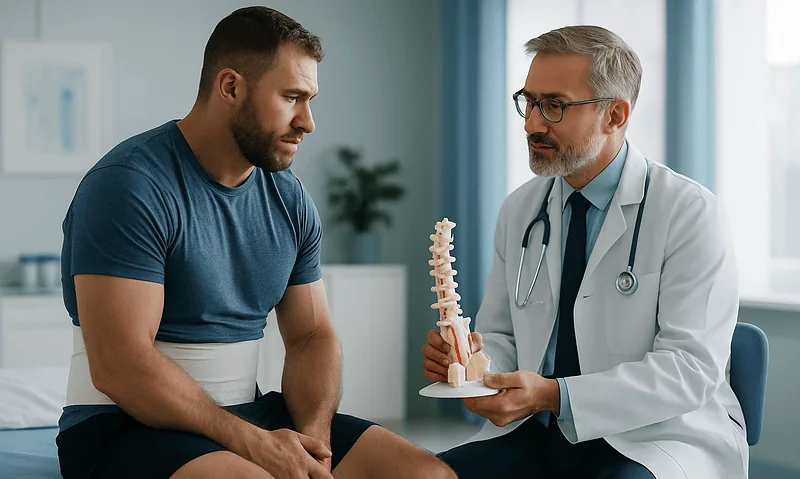
Herniated Disc Surgery for Athletes and Heavy Lifters: When Training Resumes and How
Herniated disc surgery for athletes, most often a microdiscectomy, removes the fragment of disc pressing on a nerve root. Walking usually starts within a…

Who Is a Candidate for ACDF Surgery? Arm Pain, Weakness and the Imaging That Confirms It
A candidate for ACDF surgery is usually someone whose arm pain, numbness or weakness has been traced to a specific compressed nerve root or…
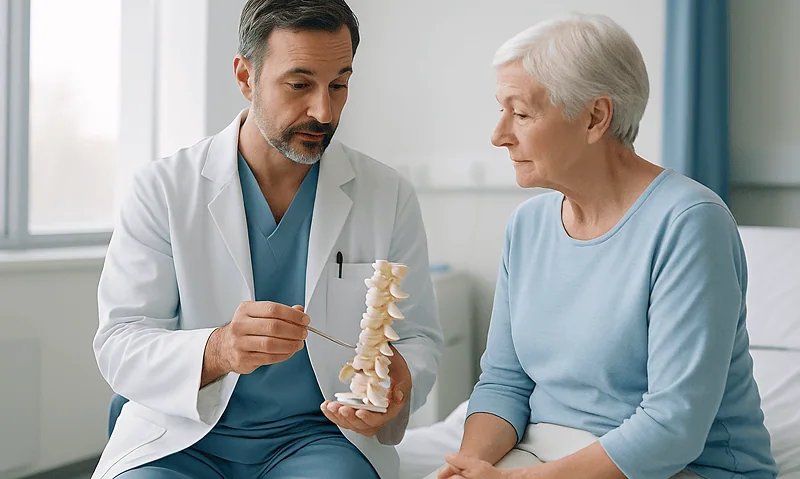
How Kyphoplasty Is Performed: The Balloon, the Bone Cement and the X-Ray Guidance
Kyphoplasty is a minimally invasive procedure for a painful vertebral compression fracture. Under live X-ray guidance, a doctor passes a narrow tube through a…

What Are the Risks of Scoliosis Surgery? Nerve Monitoring, Infection and Implant Issues
Scoliosis surgery risks include nerve or spinal cord injury, surgical site infection, bleeding that may need a transfusion, anesthetic complications, and implant problems such…