Quick answer
Adrenal cancer is a rare tumor that starts in the adrenal glands, which produce hormones above the kidneys, and treatment depends on the tumor’s type, stage, and hormone activity. At Acibadem in Turkey, evaluation typically combines imaging, blood and urine hormone tests, and pathology, with care centered on surgery when appropriate and supported by medical oncology, endocrinology, and other therapies…
What is adrenal cancer?
Adrenal cancer is a rare disease in which malignant (cancerous) cells form in one or both of the adrenal glands. The adrenal glands are two small, triangle-shaped organs, one sitting on top of each kidney. Despite their small size, they play an important role in the body: they produce hormones, which are chemical messengers that help regulate blood pressure, metabolism, the body’s response to stress, and the balance of salt and water. The most common form of adrenal cancer is adrenocortical carcinoma, a tumor that begins in the outer layer of the gland, called the adrenal cortex.
It is important to understand that most growths found on the adrenal glands are not cancer. Benign (noncancerous) adrenal tumors, often called adrenal adenomas, are far more common and are frequently discovered by chance during imaging scans done for other reasons. True adrenal cancer, by contrast, is uncommon.
So, what is adrenal cancer in practical terms? It is a tumor of the adrenal gland that has the potential to grow into nearby tissue and spread to other parts of the body. Some adrenal cancers are “functioning” tumors, meaning they produce excess hormones such as cortisol, aldosterone, or sex hormones. Others are “nonfunctioning,” meaning they do not release extra hormones and may grow silently until they become large enough to cause pressure symptoms.
Adrenal cancer can occur at any age, but it tends to appear most often in two age groups: young children and adults in middle age. It affects both men and women. Because the condition is rare, it is usually managed by specialized teams that include endocrinologists (hormone specialists), surgeons, and cancer specialists.
Symptoms of adrenal cancer
Adrenal cancer symptoms vary widely depending on whether the tumor produces excess hormones, how large it is, and whether it has spread. Some people have noticeable hormone-related changes early on, while others have no symptoms at all until the tumor grows large enough to press on nearby organs.
Common signs and symptoms may include:
- Unexplained weight gain, especially in the face, neck, and trunk, which can occur when a tumor produces too much cortisol (a stress hormone)
- Unexplained weight loss, which is more typical of advanced disease
- Muscle weakness, particularly in the legs and arms
- High blood pressure that is new, severe, or difficult to control
- High blood sugar or new-onset diabetes
- Easy bruising and skin changes, such as purple stretch marks on the abdomen
- Excess hair growth on the face or body in women, or deepening of the voice
- Irregular or absent menstrual periods in women
- Breast enlargement or tenderness in men, when the tumor produces female hormones
- Early puberty in children, such as early development of body hair or other adult features
- Abdominal or back pain, a feeling of fullness, or a lump that can be felt in the abdomen, usually when the tumor is large
- Fatigue and generally feeling unwell
How symptoms appear often depends on the type of tumor. Functioning tumors tend to cause hormone-related symptoms, which can develop relatively quickly. For example, excess cortisol may cause a group of changes doctors call Cushing syndrome, which includes weight gain, rounded face, easy bruising, and muscle weakness. Excess aldosterone, a hormone that controls salt balance, may cause high blood pressure and low potassium levels, which can lead to weakness or muscle cramps.
Nonfunctioning tumors may cause no symptoms in the early stages. In later stages, as the tumor enlarges, people may notice abdominal discomfort, back pain, a sense of fullness after eating small amounts, or unexplained weight loss. If the cancer spreads to other organs, symptoms related to those organs may appear. Because many of these adrenal cancer symptoms overlap with far more common and less serious conditions, having one or more of them does not mean you have cancer, but persistent or unexplained symptoms deserve medical evaluation.
Causes and risk factors
In most people, the exact cause of adrenal cancer is not known. Like other cancers, it develops when cells in the adrenal gland acquire changes (mutations) in their DNA that allow them to grow and divide uncontrollably. In many cases, these changes happen by chance during a person’s lifetime and are not inherited.
That said, researchers have identified some factors that appear to increase risk. When discussing adrenal cancer causes, doctors usually distinguish between inherited genetic conditions and general risk factors:
- Inherited genetic syndromes. A minority of adrenal cancers occur in people with inherited conditions that raise the risk of several cancers. These include Li-Fraumeni syndrome (caused by changes in a gene called TP53), Beckwith-Wiedemann syndrome (a growth disorder present from birth), Lynch syndrome (also linked to colon and other cancers), multiple endocrine neoplasia type 1 (a condition affecting hormone-producing glands), and familial adenomatous polyposis (a condition causing many growths in the colon).
- Age. Although adrenal cancer can develop at any age, it is diagnosed most often in young children and in adults around middle age.
- Family history. Having close relatives with adrenal cancer or with one of the genetic syndromes above may increase risk.
Lifestyle factors such as smoking have been studied, but their role in adrenal cancer is not clearly established. Importantly, most people with these risk factors will never develop adrenal cancer, and many people who develop it have no identifiable risk factor at all. If several family members have had cancers at young ages, your doctor may suggest genetic counseling, which is a service that helps assess inherited cancer risk.
Diagnosis
Adrenal cancer diagnosis usually involves a combination of a medical history, physical examination, blood and urine tests, and imaging studies. Because benign adrenal tumors are common and true cancers are rare, an important part of the process is distinguishing a harmless growth from a potentially malignant one.
Steps your doctor may take include:
- Medical history and physical exam. Your doctor will ask about symptoms such as weight changes, blood pressure problems, and hormonal changes, and will examine you for signs such as an abdominal mass or skin changes.
- Hormone testing. Blood and urine tests measure levels of adrenal hormones such as cortisol, aldosterone, and androgens (male-type hormones). These tests help determine whether a tumor is functioning and guide further evaluation. Sometimes a 24-hour urine collection or an overnight test with a medication called dexamethasone is used to assess cortisol production.
- Imaging studies. A computed tomography (CT) scan, which uses X-rays to create detailed cross-sectional pictures, is often the first imaging test. Magnetic resonance imaging (MRI), which uses magnets and radio waves instead of X-rays, may also be used. Radiologists look at the size of the tumor, its borders, and how it takes up contrast dye; larger tumors and those with irregular features are more likely to be cancerous.
- PET-CT imaging. In some cases, doctors use combined positron emission tomography and CT, a scan that highlights areas of high metabolic activity, to help judge whether a tumor is likely malignant and whether the cancer has spread elsewhere in the body. You can read more about this technique on the PET-CT imaging page.
- Biopsy in selected situations. A biopsy means removing a small tissue sample for examination under a microscope. For suspected adrenocortical carcinoma, doctors are often cautious about needle biopsies of the adrenal gland itself, because they carry risks and can sometimes be misleading; in many cases the diagnosis is confirmed after the tumor is surgically removed. A biopsy may be more appropriate when doctors suspect that a tumor in the adrenal gland is actually a spread (metastasis) from cancer elsewhere in the body.
If cancer is confirmed, doctors determine its stage, which describes how large the tumor is and whether it has spread to lymph nodes or distant organs. Staging typically relies on imaging of the chest and abdomen, and it guides treatment planning. Before any surgery, doctors also test for a different tumor type called pheochromocytoma, a tumor of the inner part of the adrenal gland that produces adrenaline-like hormones, because it requires special preparation.
Treatment options
Adrenal cancer treatment depends on the stage of the disease, whether the tumor produces hormones, the person’s overall health, and personal preferences. Because the disease is rare, treatment decisions are usually made by a multidisciplinary team that includes surgeons, endocrinologists, medical oncologists (doctors who treat cancer with medications), and radiation specialists. Within a hospital group such as Acibadem, this coordination is typically organized through the medical oncology department together with surgical and endocrine teams.
Surgery
Surgery to remove the affected adrenal gland, an operation called adrenalectomy, is the main treatment for adrenal cancer whenever the tumor can be removed completely. The surgeon may also remove nearby tissue or lymph nodes if the cancer has grown beyond the gland. For tumors suspected of being cancerous, open surgery through an abdominal incision is often preferred over keyhole (laparoscopic) surgery, because it allows the surgeon to remove the tumor intact and reduce the risk of spreading cancer cells. Complete surgical removal offers the best chance of long-term control.
Medication
Several types of medication may be used, alone or after surgery:
- Mitotane. This is a drug that specifically targets adrenal cortex cells. It may be given after surgery to lower the risk of the cancer returning, or as a treatment for cancer that cannot be fully removed. Because it also suppresses normal adrenal hormone production, people taking it usually need hormone replacement and regular blood monitoring.
- Chemotherapy. For advanced adrenal cancer, combinations of chemotherapy drugs, sometimes given together with mitotane, may be used to slow the disease.
- Hormone-blocking medications. When a tumor produces excess hormones, drugs that block hormone production or hormone effects can help control symptoms such as high blood pressure, high blood sugar, or the effects of excess cortisol.
Radiation therapy
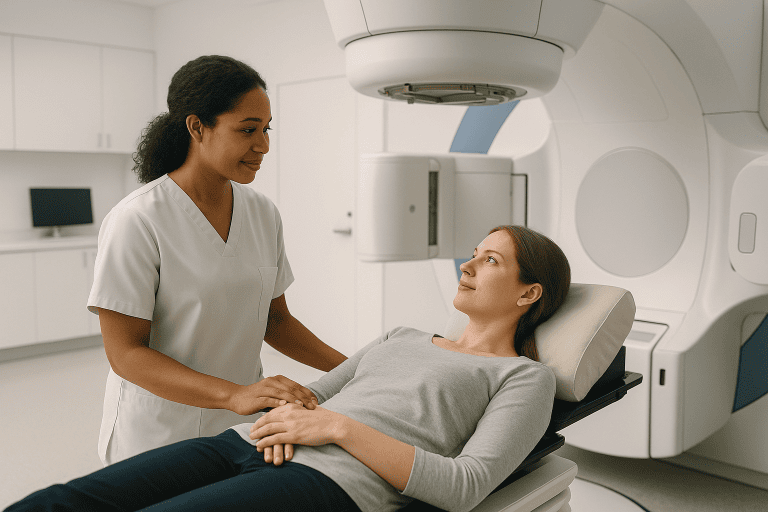
Radiation therapy uses high-energy beams to destroy cancer cells. It is sometimes used after surgery to reduce the chance of the cancer coming back in the same area, or to relieve symptoms when cancer has spread, for example to bones.
Other local treatments
In selected situations, doctors may use techniques such as ablation, which destroys tumor tissue using heat or cold delivered through a needle, particularly for small areas of cancer spread that cannot be removed surgically.
Watchful waiting and supportive care
Watchful waiting, also called active surveillance, is generally not used for confirmed adrenal cancer, which is usually treated promptly. However, small adrenal masses that appear benign on imaging and do not produce hormones are often monitored with repeat scans rather than removed. For advanced disease, supportive (palliative) care focuses on relieving symptoms, managing hormone excess, and maintaining quality of life; it can be provided alongside cancer-directed treatment. Where appropriate, doctors may also discuss participation in clinical trials, which are research studies testing new treatments.
Living with adrenal cancer and outlook
The outlook for adrenal cancer varies considerably from person to person. In general, the prognosis is more favorable when the cancer is found early and can be removed completely with surgery. When the disease is diagnosed at a later stage or has spread to other organs, treatment focuses on controlling the cancer and its hormone effects for as long as possible. Your medical team can discuss what the stage and features of your particular tumor mean for you; no one can predict an individual’s outcome with certainty.
After treatment, regular follow-up is important. This usually includes periodic imaging scans and hormone testing, because adrenal cancer can return even after successful surgery, and early detection of a recurrence may open up further treatment options. People who have had an adrenal gland removed, or who take mitotane, may need lifelong hormone replacement medication and should carry information about their condition in case of emergencies, since the body may not respond normally to stress or illness.
Living with a rare cancer can be emotionally challenging. Many people find it helpful to involve family members in appointments, ask for written information, and seek psychological support or patient support groups. Practical steps such as maintaining a balanced diet, staying as active as your doctors advise, and keeping a list of medications and symptoms can make follow-up care easier.
Frequently asked questions
What is adrenal cancer and how is it different from a benign adrenal tumor?
Adrenal cancer is a malignant tumor of the adrenal gland, most often starting in the outer layer of the gland. Unlike benign adrenal tumors, which are common and generally harmless, adrenal cancer can invade nearby tissue and spread to other organs. Doctors use tumor size, imaging features, hormone tests, and, ultimately, microscopic examination of removed tissue to tell the two apart.
Can adrenal cancer be cured?
In many cases where the tumor is found early and removed completely by surgery, long-term control and, in some people, cure are possible. When the cancer has spread beyond the adrenal gland, a cure is less likely, but treatments such as medication, radiation, and further surgery may control the disease and its symptoms for a period of time. Outcomes vary widely between individuals, so it is best to discuss your specific situation with your care team.
How serious is adrenal cancer?
Adrenal cancer is considered a serious condition because it is often aggressive and can spread if not treated. Its seriousness in any individual depends on the stage at diagnosis, whether the tumor can be fully removed, whether it produces hormones, and the person’s general health. Early diagnosis and treatment by an experienced multidisciplinary team generally improve the chances of a better outcome.
What are the first warning signs of adrenal cancer?
Early adrenal cancer symptoms, when present, are often hormone-related: unexplained weight gain, new or worsening high blood pressure, muscle weakness, easy bruising, excess facial or body hair in women, or early puberty in children. Nonfunctioning tumors may cause no early symptoms and are sometimes found by chance on a scan, or later through abdominal or back pain as the tumor grows. These signs are not specific to cancer, so evaluation by a doctor is needed.
How is adrenal cancer diagnosed?
Adrenal cancer diagnosis typically combines hormone tests of blood and urine with imaging such as CT or MRI scans. Additional imaging, including PET-CT, may help assess whether a tumor is likely malignant and whether it has spread. In most cases, the final diagnosis is confirmed when a pathologist examines the tumor tissue after surgical removal, since needle biopsy of a suspected adrenal cancer is used only in selected circumstances.
What is recovery like after adrenal cancer surgery?
Recovery depends on the extent of the operation and your overall health. Many people spend several days in the hospital after open adrenal surgery and gradually return to normal activities over the following weeks. Some people need temporary or long-term hormone replacement, especially if both glands are affected or if medications like mitotane are used. Regular follow-up scans and blood tests are a standard part of care after surgery.
Does adrenal cancer run in families?
Most adrenal cancers are not inherited. However, a minority occur in people with inherited genetic syndromes such as Li-Fraumeni syndrome, Lynch syndrome, or Beckwith-Wiedemann syndrome. If you have a strong family history of cancers, particularly at young ages, your doctor may recommend genetic counseling to assess whether testing is appropriate for you or your relatives.
When to see a doctor
Many symptoms linked to adrenal tumors overlap with common, less serious conditions. Even so, certain warning signs deserve prompt medical attention. Consider seeing a doctor without delay if you notice:
- A lump or persistent pain in your abdomen, side, or back that does not go away
- Unexplained weight gain or weight loss over weeks to months
- New, severe, or hard-to-control high blood pressure, especially at a young age
- Rapid changes in appearance, such as a rounder face, purple stretch marks, easy bruising, or unusual hair growth
- Marked muscle weakness or cramps, which can signal hormone or potassium imbalances
- Signs of early puberty in a child, such as body hair or adult body changes at an unusually young age
- Irregular or stopped menstrual periods without another explanation, or breast changes in men
If you have already been diagnosed with an adrenal tumor or are receiving adrenal cancer treatment, seek urgent care for severe abdominal pain, vomiting, confusion, fainting, fever, or sudden weakness, as these can indicate complications such as hormone imbalances that need immediate attention. A doctor can evaluate your symptoms, order the appropriate tests, and refer you to specialists if needed.
Medically reviewed by the Acıbadem International Medical Board September 3, 2026
See our medical review board →
Update history
- PublishedJune 14, 2026
- Medical review approvedSeptember 3, 2026
- Last content updateSeptember 2, 2026