Genital Warts
Learn what genital warts are, common symptoms, HPV causes and risk factors, how doctors diagnose them, and the treatment options that may be considered.
Quick answer
Genital warts are small, flesh-colored or gray growths on the genital or anal skin caused by certain low-risk types of human papillomavirus (HPV), spread through skin-to-skin sexual contact. Doctors usually diagnose them by examination. Treatments include prescription creams, freezing, laser, or surgical removal, though warts may recur because the virus itself is not eliminated.
What is genital warts?
Genital warts are small growths that appear on the skin and moist tissues of the genital and anal area. They are caused by certain strains of the human papillomavirus (HPV), a very common virus that spreads through close skin-to-skin contact. Doctors sometimes use the medical term condylomata acuminata for these growths. Genital warts are considered a sexually transmitted infection (STI), meaning an infection that is passed mainly through sexual contact.
Anyone who is sexually active can develop genital warts, regardless of sex or sexual orientation. They are most often seen in young adults, but they can occur at any age. The HPV types that usually cause visible warts are generally described as low-risk types, because they are not the same types most strongly linked to cervical and other HPV-related cancers. Even so, a person can carry more than one HPV type at the same time, which is one reason routine cervical screening remains important.
Many people who carry the virus never develop warts, and warts that do appear often clear over time, either on their own or with treatment. Understanding what is genital warts, how it spreads, and what the options are can help reduce worry and support informed conversations with a healthcare professional.
Genital warts symptoms
Genital warts symptoms vary widely from person to person. Some people notice obvious growths, while others have warts so small or so hidden that they are only found during a medical examination. Common features include:
- Small bumps on the skin that may be flesh-colored, pink, gray, or slightly darker than the surrounding skin
- Single growths or clusters that can look like a tiny cauliflower
- Flat, slightly raised, or finger-like (stalked) shapes
- Itching, mild burning, or general discomfort in the affected area
- Occasional bleeding, especially after sexual contact or rubbing
- Growths around the vaginal opening, vulva, cervix, penis, scrotum, groin, thighs, or around and inside the anus
- In some cases, no symptoms at all
Warts often appear weeks to months after exposure to the virus, and in some cases much later, so it is frequently impossible to know exactly when or from whom the infection was acquired. Early warts may be tiny, soft bumps that are easy to miss. Over time, some grow larger or merge into broader patches, although many stay small.
Symptoms can differ depending on where the warts are located. Warts on the outer skin are usually visible or can be felt. Warts inside the vagina, on the cervix, inside the anal canal, or inside the urethra (the tube that carries urine) may cause no visible signs and are sometimes only discovered during a routine gynecological or rectal examination. Warts inside the urethra can occasionally affect the flow of urine. During pregnancy, hormonal changes may cause existing warts to grow or multiply, and they sometimes shrink again after delivery.
It is important to note that not every bump in the genital area is a wart. Skin tags, normal skin glands, cysts, and other infections can look similar. Only a healthcare professional can confirm what a growth is.
Causes and risk factors
Genital warts causes come down to infection with HPV. There are many HPV types; a small number of them are responsible for most visible genital warts. The virus infects the top layers of the skin and mucous membranes (the moist lining of body openings) and causes the cells to grow faster than usual, forming a wart.
HPV passes from one person to another through direct skin-to-skin contact, most often during vaginal, anal, or oral sex. Penetration is not required; contact between genital skin is enough. A person can pass the virus on even when no warts are visible, because the virus can be present on skin that looks completely normal. Rarely, the virus can be passed to a baby during childbirth. HPV is not spread through casual contact such as hugging, sharing towels, or using toilet seats in any meaningful way.
Factors that may increase the chance of developing genital warts include:
- Having sexual contact with a partner who carries HPV, whether or not they have visible warts
- Having several sexual partners, or a partner who has had several partners
- Not using condoms, which lower but do not eliminate the risk because they do not cover all skin
- Starting sexual activity at a young age
- Having another sexually transmitted infection
- A weakened immune system, for example from certain medicines, an organ transplant, or HIV infection
- Smoking, which is associated with slower clearance of HPV in some studies
- Not having received the HPV vaccine
Having a risk factor does not mean a person will definitely develop warts, and people with no obvious risk factors can still be affected.
Genital warts diagnosis
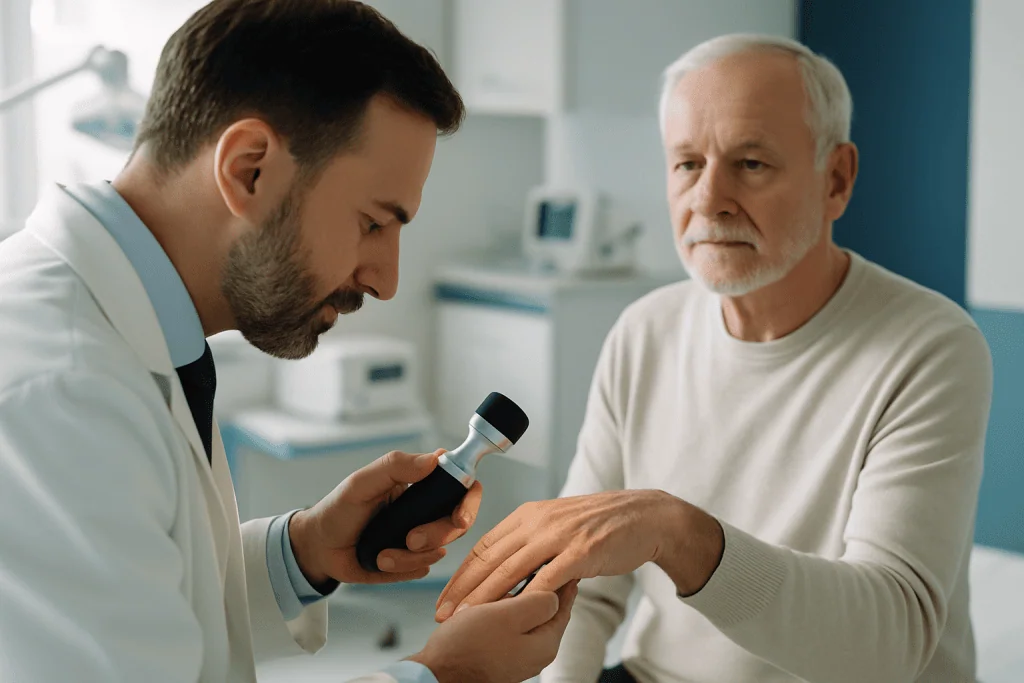
In most cases, genital warts diagnosis is made by a doctor or nurse looking carefully at the affected area. Because the appearance is often typical, laboratory tests are frequently not needed. The clinician will usually ask about symptoms, sexual history, past infections, and any medicines that affect the immune system.
The examination and possible tests may include:
- Visual examination of the external genitals, groin, and area around the anus, sometimes with a magnifying lens
- Pelvic examination with a speculum (a small instrument that gently opens the vagina) to check the vaginal walls and cervix
- Anoscopy, in which a short tube with a light is used to look inside the anal canal when internal warts are suspected
- Acetic acid test, where a mild vinegar solution is applied to the skin to make some warts turn white; this is less reliable and is not used everywhere
- Biopsy, the removal of a small sample of tissue for examination under a microscope, if a growth looks unusual, does not respond to treatment, or if the diagnosis is uncertain
- Screening for other STIs, because infections often occur together
There is no routine blood test that detects the HPV types that cause warts. HPV tests used in cervical screening look for high-risk types linked to cancer, not for the low-risk types that usually cause warts, so a negative cervical HPV test does not rule out warts. Women who have genital warts are generally advised to continue their normal cervical screening schedule (Pap test and, where offered, HPV testing) rather than having extra tests solely because of the warts.
In hospital settings, genital warts in women are often evaluated within a gynecology and obstetrics department, while dermatology, urology, or sexual health services may be involved for other patients.
Genital warts treatment options
Genital warts treatment options aim to remove visible warts and relieve symptoms. It is important to understand that current treatments remove the warts but do not eliminate the virus from the body. Warts can return after any treatment, and the choice of approach depends on the number, size, and location of warts, the patient’s preferences, pregnancy status, and what is available locally. Your doctor may suggest one of the following.
Watchful waiting
Some warts disappear on their own as the immune system clears the infection. If warts are small and not causing distress, a doctor may suggest a period of observation. This is a reasonable choice for many people, though it means the warts remain visible and potentially infectious in the meantime.
Medicines applied to the skin
Several prescription creams and solutions are used for external warts. Some are applied by the patient at home, following careful instructions, while others are applied by a clinician in the clinic. Commonly used medicines include:
- Imiquimod, a cream that stimulates the local immune response
- Podophyllotoxin (podofilox), a solution or gel that destroys wart tissue
- Sinecatechins, an ointment derived from green tea extract
- Trichloroacetic acid (TCA), a chemical applied by a healthcare professional that burns away wart tissue
These medicines can cause redness, soreness, or irritation and usually need several weeks of treatment. Some are not suitable during pregnancy, and over-the-counter wart removers designed for hands or feet should not be used on genital skin.
Procedures
When warts are large, numerous, internal, or have not responded to medicines, a doctor may recommend a procedure to remove them:
- Cryotherapy, freezing the warts with liquid nitrogen
- Electrocautery, using an electric current to burn off the tissue
- Laser treatment, using focused light to destroy wart tissue, often for extensive or hard-to-reach warts
- Surgical excision, cutting the warts away under local or, less often, general anesthesia
Procedures usually work quickly but can cause temporary pain, swelling, and occasionally scarring or changes in skin color. More than one session is sometimes needed. There is no rehabilitation period in the usual sense, although the treated skin may need a few weeks to heal, during which sexual contact is generally advised against.
Treatment during pregnancy
Warts can be treated during pregnancy, but some medicines are avoided, and physical methods such as cryotherapy are more commonly used. Very large warts are sometimes removed before delivery. Most pregnant women with genital warts have a normal vaginal delivery; a cesarean birth is considered only in rare situations, such as when warts block the birth canal.
Living with genital warts and outlook
For most people, genital warts are a treatable, non-dangerous condition. The outlook is generally good: with or without treatment, warts often clear over months to a couple of years as the immune system controls the virus. However, recurrence is common, especially in the first few months after treatment, and some people need repeated courses. People with weakened immune systems may find that warts are more persistent or widespread.
The HPV types that cause most genital warts are not the ones most closely linked with cancer, so having warts does not by itself mean a higher risk of cervical, anal, or other cancers. Because different HPV types can coexist, keeping up with recommended cervical screening remains important for women.
A diagnosis of genital warts can be emotionally difficult. Feelings of embarrassment, anxiety, or concern about relationships are very common and understandable. It may help to remember that HPV is extremely widespread, that most sexually active people encounter it at some point, and that having warts says nothing about a person’s character or hygiene. Talking openly with a healthcare professional, and where appropriate with a counselor, can be helpful.
Practical steps many doctors discuss include:
- Avoiding sexual contact while warts are present and while treated skin is healing
- Using condoms consistently, which lowers but does not remove the risk of transmission
- Telling current partners so that they can be examined if they wish
- Not smoking, which may support clearance of the virus
- Asking about HPV vaccination, which can protect against the types not yet acquired
Frequently asked questions
What is genital warts, and is it the same as HPV?
Genital warts are visible growths caused by certain types of HPV, but HPV itself is much broader. Many HPV types exist; some cause warts on the hands or feet, some cause genital warts, and others are linked to certain cancers. Having HPV does not mean a person has or will get warts, and most HPV infections cause no symptoms and clear on their own.
What are the first genital warts symptoms people usually notice?
The earliest sign is often one or more small, soft bumps in the genital or anal area that may be flesh-colored, pink, or gray. Some people notice itching or mild irritation before they see anything. Because early warts can be tiny and painless, many people do not notice them until they grow, multiply, or are found during an examination.
What are the main genital warts causes, and can you get them without sex?
Genital warts are caused by HPV, which spreads mainly through skin-to-skin contact during sexual activity, including contact that does not involve penetration. The virus can be passed on by someone with no visible warts. Transmission without sexual contact is rare; the virus is not generally spread by toilet seats, towels, or swimming pools.
How is genital warts diagnosis confirmed?
In most cases a doctor confirms the diagnosis by examining the area, sometimes with magnification or a pelvic or anal examination. A biopsy may be taken if a growth looks unusual or does not improve with treatment. There is no routine blood test for the wart-causing HPV types, and cervical HPV tests are designed for cancer screening rather than for detecting warts.
Which genital warts treatment options work best?
No single treatment is best for everyone. Creams and solutions applied to the skin are often used for smaller external warts, while freezing, burning, laser, or surgical removal are considered for larger, numerous, or internal warts. All approaches remove warts rather than cure the virus, and recurrence is possible with any of them, so your doctor may suggest trying more than one method over time.
Can genital warts go away on their own?
Yes, in many cases genital warts clear without treatment as the immune system controls the virus, although this may take months or longer. Treatment is often chosen to speed up removal, relieve discomfort, or reduce the visible signs, but watching and waiting is a reasonable option for some people after discussion with a healthcare professional.
Do genital warts lead to cancer?
The HPV types that cause most genital warts are considered low-risk and are not the types most strongly linked to cancer. Having warts does not by itself mean a higher cancer risk. Because a person can carry several HPV types, routine cervical screening should continue as recommended, and any growth that looks unusual should be examined.
When to see a doctor
Anyone who notices new bumps, growths, or unexplained changes in the genital or anal area should have them examined by a healthcare professional, as only an examination can confirm whether they are warts or something else. It is also sensible to seek an assessment if a sexual partner has been diagnosed with genital warts or another STI, even if you have no symptoms.
Seek medical attention promptly if you notice any of the following warning signs:
- A growth that bleeds easily, bleeds heavily, or bleeds without an obvious cause
- Rapid growth, a change in color, hardening, or an open sore (ulcer) on a growth
- Severe pain, swelling, warmth, pus, or fever, which may indicate infection
- Difficulty passing urine or a weak or blocked urine stream
- Pain or bleeding when passing stool, or a feeling of blockage in the anus
- Warts that keep returning or spreading despite treatment
- Genital growths in a person with a weakened immune system
- Genital growths during pregnancy, so that a safe treatment plan can be made before delivery
- Any genital growth in a child, which always requires evaluation
If you are unsure whether a symptom is serious, it is generally safer to have it checked. Early evaluation allows other conditions to be ruled out and supports timely, appropriate care.
Medically reviewed by the Acıbadem International Medical Board September 9, 2026
See our medical review board →
Update history
- PublishedSeptember 9, 2026
- Medical review approvedSeptember 9, 2026
- Last content updateSeptember 9, 2026
References2
Treatments for This Condition
Care at Acibadem

Doctors Who Treat This Condition

Vitro Fertilization and Reproductive Medicine Center
Assoc. Prof. Burak Elmas, MD



Vitro Fertilization and Reproductive Medicine Center
Assoc. Prof. Eser Çolak, MD






Vitro Fertilization and Reproductive Medicine Center