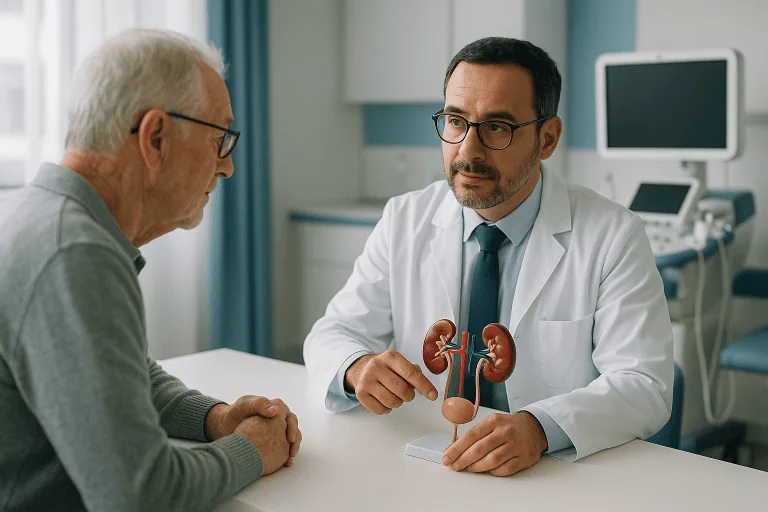
Prostate Diseases
Learn about prostate diseases including BPH, prostatitis and prostate cancer: common symptoms, causes and risk factors, how they are diagnosed, and treatment options.

Quick answer
Prostate diseases are conditions affecting the prostate, a small gland below the bladder in men. The main types are benign prostatic hyperplasia (non-cancerous enlargement), prostatitis (inflammation, sometimes from infection) and prostate cancer. They often cause urinary symptoms, become more common with age, and are diagnosed through examination, PSA blood tests, imaging and sometimes biopsy.
What is prostate diseases?
The prostate is a small gland, usually described as walnut-sized, that sits just below the bladder in men and surrounds the urethra (the tube that carries urine out of the body). It produces part of the fluid that makes up semen. “Prostate diseases” is an umbrella term for the conditions that can affect this gland. The three most common are benign prostatic hyperplasia (BPH), which is non-cancerous enlargement of the prostate; prostatitis, which is inflammation of the prostate, sometimes caused by infection; and prostate cancer, in which abnormal cells grow in the gland and may spread beyond it.
Because the prostate wraps around the urethra, many prostate diseases cause urinary problems. Prostate diseases affect people who have a prostate, and they become more common with age. BPH is very common in older men, prostatitis can occur at any adult age, and prostate cancer is one of the most frequently diagnosed cancers in men worldwide. Understanding what is prostate diseases, and how the different types differ, can help you recognize symptoms early and have a clearer conversation with your doctor.
Prostate diseases symptoms
Prostate diseases symptoms overlap considerably between the different conditions, which is one reason a medical evaluation is needed to tell them apart. Common symptoms include:
- Frequent urination, especially the need to get up several times at night (nocturia)
- Difficulty starting to urinate or a weak, slow or interrupted stream
- Feeling that the bladder is not completely empty after urinating
- Urgency, a sudden strong need to urinate that is hard to postpone
- Dribbling at the end of urination
- Pain or burning when urinating
- Pain in the pelvis, lower back, groin or between the scrotum and rectum
- Painful ejaculation or blood in the semen
- Blood in the urine
- Fever and chills, which can suggest infection
How symptoms present often depends on the type of prostate disease. With BPH, symptoms usually develop gradually over years and are dominated by obstructive problems such as a weak stream and incomplete emptying. Acute bacterial prostatitis tends to start suddenly, with fever, chills, pain and marked urinary discomfort, and it can make a person feel quite unwell. Chronic prostatitis, sometimes called chronic pelvic pain syndrome, causes pelvic or genital pain and urinary symptoms that persist or come and go over months.
Early prostate cancer frequently causes no symptoms at all, which is why it is often found through screening tests rather than because of complaints. When symptoms do appear, they may resemble those of BPH. In more advanced cancer, additional signs such as bone pain, unexplained weight loss, or swelling in the legs may occur. Having urinary symptoms does not mean you have cancer; in many cases the cause is benign, but the symptoms still deserve evaluation.
Causes and risk factors
The prostate diseases causes differ for each condition, and for some the exact mechanism is not fully understood.
Benign prostatic hyperplasia is thought to result from hormonal changes that occur with aging. Over time, cells in the prostate multiply and the gland enlarges, gradually pressing on the urethra. Nearly all men experience some prostate growth as they age, but not everyone develops troublesome symptoms.
Prostatitis can be caused by bacteria that travel up the urethra or spread from a urinary tract infection. This is called bacterial prostatitis and may be acute or chronic. Most cases of chronic prostatitis, however, are not linked to a detectable infection. In these cases, contributing factors may include nerve irritation, pelvic floor muscle tension, previous infection, or immune system activity, although the cause is often unclear.
Prostate cancer develops when changes in the DNA of prostate cells cause them to grow uncontrollably. Why these changes happen in a given person is usually not known, but inherited genetic factors play a role in some families.
Risk factors that increase the likelihood of one or more prostate diseases include:
- Older age, the strongest risk factor for both BPH and prostate cancer
- Family history of prostate cancer or of BPH in a father or brother
- Ethnic background, as prostate cancer is more common and often more aggressive in men of African descent
- Inherited gene changes, such as BRCA mutations, in some families
- Obesity, which has been linked to more advanced prostate cancer and to worse BPH symptoms
- Diabetes and heart disease, which are associated with BPH
- Urinary tract infections, catheter use or recent prostate procedures, which increase the risk of bacterial prostatitis
Prostate diseases diagnosis
Prostate diseases diagnosis begins with a detailed medical history and a discussion of your symptoms. Your doctor may ask you to complete a standardized symptom questionnaire that scores how bothersome urinary problems are. The next steps commonly include:
- Digital rectal examination (DRE): the doctor inserts a gloved, lubricated finger into the rectum to feel the size, shape and texture of the prostate. Enlargement, tenderness or hard areas can point toward different conditions.
- Urine tests: a urinalysis and urine culture check for infection, blood or other abnormalities.
- Prostate-specific antigen (PSA) blood test: PSA is a protein made by the prostate. Levels can rise with cancer, but also with BPH, prostatitis, recent ejaculation or a recent examination, so a raised PSA on its own does not confirm cancer.
- Uroflowmetry and post-void residual measurement: these tests measure how fast urine flows and how much remains in the bladder afterward, helping assess obstruction from BPH.
- Ultrasound: an abdominal or transrectal ultrasound can estimate prostate size and examine the bladder and kidneys.
- Magnetic resonance imaging (MRI): increasingly used when cancer is suspected, MRI can identify areas of the prostate that look abnormal and guide biopsy.
- Prostate biopsy: small tissue samples are removed with a needle and examined under a microscope. This is the only way to confirm prostate cancer. The samples are graded using the Gleason score or grade group system, which describes how abnormal the cells look and helps predict how the cancer may behave.
- Further imaging: if cancer is confirmed, bone scans, CT scans or specialized PET scans may be used to see whether it has spread.
For prostatitis, diagnosis often relies on symptoms, examination and urine tests, sometimes with a sample of prostate fluid. Because chronic prostatitis has no single confirming test, other causes of pelvic pain may need to be ruled out first. At Acibadem, prostate conditions are evaluated within the Urology department, often in cooperation with radiology and pathology teams.
Prostate diseases treatment options
Prostate diseases treatment options depend on which condition you have, how severe your symptoms are, your age and general health, and your own preferences. Treatment is not always needed immediately.
Observation and lifestyle measures. For mild BPH, doctors often suggest “watchful waiting” with regular check-ups. Simple changes such as limiting fluids in the evening, reducing caffeine and alcohol, avoiding certain decongestant medicines, and practicing timed urination may ease symptoms. For low-risk, slow-growing prostate cancer, “active surveillance” is a recognized approach in which the cancer is monitored closely with PSA tests, examinations, MRI and repeat biopsies, and treatment is started only if it shows signs of progressing.
Medications. For BPH, alpha-blockers relax the muscles of the prostate and bladder neck to improve urine flow, often within days to weeks. 5-alpha-reductase inhibitors slowly shrink the prostate over months. These may be combined. Other medicines can help with urgency symptoms. Bacterial prostatitis is treated with antibiotics, sometimes for several weeks; acute cases with high fever may require hospital treatment. Chronic prostatitis may be managed with alpha-blockers, pain relievers, anti-inflammatory drugs and, in some cases, medicines that calm nerve-related pain. Prostate cancer may be treated with hormone therapy, which lowers testosterone or blocks its effect because most prostate cancers depend on it to grow. Chemotherapy and newer targeted or immune-based drugs are used mainly for advanced disease.
Minimally invasive procedures. Several procedures for BPH can widen the urethra or remove excess tissue through the urethra without external cuts. Examples include transurethral resection of the prostate (TURP), which remains a standard operation, laser procedures that vaporize or remove tissue, prostatic urethral lift implants, and water vapor or water-jet therapies. Each has different advantages and side-effect profiles, which your urologist can explain in relation to your prostate size and health.
Surgery. Very large prostates may require open or robot-assisted removal of the enlarged tissue. For prostate cancer that has not spread, radical prostatectomy removes the whole prostate and seminal vesicles, and may be done through open, laparoscopic or robot-assisted approaches.
Radiation therapy. Prostate cancer can also be treated with external beam radiation or brachytherapy, in which radioactive sources are placed inside the prostate. Radiation is sometimes combined with hormone therapy.
Rehabilitation and supportive care. Treatments for prostate cancer and some BPH procedures can affect urinary control and sexual function. Pelvic floor exercises, continence programs, medicines or devices for erectile difficulties, and psychological support are part of recovery for many people. Managing bone health during hormone therapy may also be important.
Living with prostate diseases and outlook
The outlook varies widely by condition. BPH is not life-threatening, and for most men symptoms can be controlled with medication or a procedure, although the gland may continue to grow and treatment sometimes needs adjustment over time. Untreated severe obstruction can occasionally lead to bladder damage, urinary retention, infections or kidney problems, which is why follow-up matters.
Acute bacterial prostatitis usually responds well to antibiotics. Chronic prostatitis can be more frustrating, with symptoms that improve and flare over time; many people find meaningful relief with a combination of approaches, though a complete cure is not always possible.
Prostate cancer is often slow-growing, and when it is found while still confined to the gland, outcomes are generally favorable with treatment or surveillance. Cancers that have spread beyond the prostate can often be controlled for extended periods with hormone therapy and other treatments, although they are usually not curable. Your doctor can discuss your individual prognosis based on stage, grade, PSA level and overall health. Regular follow-up, including PSA monitoring after treatment, is standard.
Day to day, many people with prostate diseases benefit from staying physically active, maintaining a healthy weight, managing other health conditions, and keeping an open dialogue with their care team about urinary or sexual side effects, which are often treatable.
Frequently asked questions
What are the first prostate diseases symptoms men usually notice?
The earliest noticeable change is often getting up at night to urinate, a weaker stream, or a sense that the bladder is not fully emptying. These symptoms are most often due to benign enlargement rather than cancer, but because the conditions overlap, a doctor should evaluate any persistent change in urination.
Can prostate diseases be caused by something I did?
Most prostate diseases causes are linked to aging, hormones and genetics rather than to personal behavior. Bacterial prostatitis is caused by infection, which may follow a urinary tract infection or a procedure involving a catheter. Lifestyle factors such as obesity may influence risk, but no single habit is known to cause prostate disease directly.
How is prostate diseases diagnosis different for BPH and cancer?
Both begin with a history, a rectal examination and often a PSA blood test. BPH is usually assessed with symptom scores, urine flow tests and ultrasound. If cancer is suspected because of an abnormal examination, a raised PSA or MRI findings, a biopsy is needed to confirm the diagnosis; no blood test alone can diagnose prostate cancer.
Does a high PSA mean I have prostate cancer?
No. PSA can rise with BPH, prostatitis, urinary infection, recent ejaculation or a recent rectal examination. A raised level is a signal for further evaluation, which may include repeating the test, MRI or biopsy, rather than a diagnosis in itself.
What are the main prostate diseases treatment options for enlarged prostate?
Options range from watchful waiting and lifestyle changes, through medications such as alpha-blockers and 5-alpha-reductase inhibitors, to minimally invasive procedures like TURP or laser therapy, and surgery for very large glands. The right choice depends on symptom severity, prostate size, other health conditions and personal preference.
Is prostate cancer always treated right away?
Not necessarily. Many low-risk prostate cancers grow very slowly, and active surveillance with regular monitoring is a recognized option that avoids or delays treatment side effects. Treatment such as surgery or radiation is recommended when the cancer is higher risk or shows signs of progressing.
Can prostate diseases affect sexual function?
Yes, both the conditions and their treatments can. Prostatitis may cause painful ejaculation, some BPH medicines can reduce libido or affect ejaculation, and prostate cancer surgery, radiation or hormone therapy can lead to erectile difficulties. Many of these effects can be managed, so it is worth discussing them openly with your doctor.
When to see a doctor
Make an appointment with a doctor if you notice persistent changes in urination, such as a weaker stream, frequent nighttime urination, urgency, or ongoing pelvic or genital discomfort, or if you have a family history of prostate cancer and want to discuss whether PSA screening is appropriate for you. Seek urgent medical care if you experience any of the following red-flag signs:
- Inability to urinate at all (acute urinary retention), often with severe lower abdominal pain
- High fever, chills or shaking together with urinary symptoms, which may indicate a serious infection
- Visible blood in the urine or semen, especially if it is heavy or recurring
- Severe pain in the lower back, pelvis or genitals that comes on suddenly
- New weakness or numbness in the legs, or loss of bladder or bowel control, which in someone with known prostate cancer may signal pressure on the spinal cord
- Unexplained weight loss or persistent bone pain
These symptoms do not automatically mean something serious is happening, but they require prompt assessment so that treatable problems are not missed.
Medically reviewed by the Acıbadem International Medical Board September 9, 2026
See our medical review board →
Update history
- PublishedSeptember 9, 2026
- Medical review approvedSeptember 9, 2026
- Last content updateSeptember 9, 2026