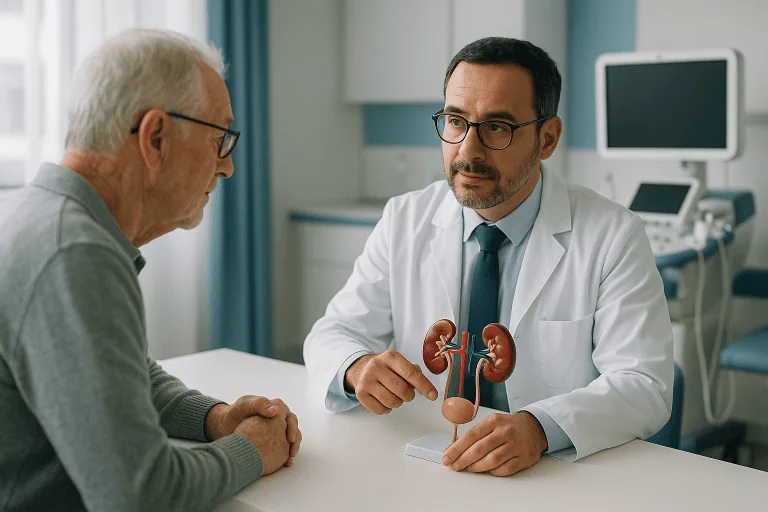
Quick answer
Prostatitis is inflammation of the prostate gland that can cause pelvic pain, urinary symptoms, and discomfort with ejaculation, and it may be linked to bacterial infection or other noninfectious causes. Treatment depends on the type and may include antibiotics, pain relief, anti-inflammatory medicines, pelvic floor support, and evaluation by urology specialists in Turkey to confirm the diagnosis and guide care.
What is prostatitis?
Prostatitis is inflammation or irritation of the prostate gland, a small gland about the size of a walnut that sits just below the bladder in men. The prostate surrounds the urethra, which is the tube that carries urine from the bladder out of the body, and it produces part of the fluid that makes up semen. When the prostate becomes inflamed, it can cause pain, urinary problems, and sexual difficulties.
Understanding what is prostatitis begins with knowing that it is not a single disease. Doctors generally recognize four main types. Acute bacterial prostatitis is a sudden bacterial infection of the prostate and is the least common but most serious form. Chronic bacterial prostatitis is a longer-lasting or repeatedly returning bacterial infection. Chronic prostatitis, also called chronic pelvic pain syndrome, is the most common form and involves ongoing pelvic pain without clear evidence of bacterial infection. Finally, asymptomatic inflammatory prostatitis causes no symptoms at all and is usually discovered by chance during tests done for other reasons.
Prostatitis can affect men of any age, but it is most often diagnosed in men under 50, which sets it apart from other prostate conditions such as benign prostatic enlargement or prostate cancer, which mainly affect older men. It is one of the most frequent reasons men visit a urologist, a doctor who specializes in the urinary tract and male reproductive system. Importantly, prostatitis is not cancer and does not appear to raise the risk of developing prostate cancer, although the two conditions can sometimes cause overlapping symptoms.
Symptoms of prostatitis
Prostatitis symptoms vary widely depending on the type and, in bacterial forms, on how quickly the infection develops. Some men have severe, sudden symptoms, while others live with milder discomfort that comes and goes over months.
Common prostatitis symptoms include:
- Pain or burning when urinating (a symptom doctors call dysuria)
- Frequent urination, often including waking at night to urinate
- Urgent need to urinate, sometimes with difficulty holding it
- Difficulty starting urination, a weak or interrupted urine stream, or dribbling
- Pain in the pelvis, lower abdomen, lower back, groin, or the area between the scrotum and rectum (the perineum)
- Pain in the penis or testicles
- Painful ejaculation or discomfort after sexual activity
- Cloudy urine or blood in the urine in some cases
How these symptoms appear often depends on the type of prostatitis. In acute bacterial prostatitis, symptoms develop suddenly and are usually severe. Men often feel very unwell, with high fever, chills, muscle aches, nausea, and strong pain along with urinary symptoms. Some men become unable to pass urine at all, a situation called acute urinary retention, which is a medical emergency.
In chronic bacterial prostatitis, symptoms are typically milder but keep returning over time, often in the pattern of repeated urinary tract infections. Between episodes, a man may feel relatively normal, only for burning urination and pelvic discomfort to come back weeks or months later.
In chronic prostatitis or chronic pelvic pain syndrome, the main feature is persistent pain in the pelvic region lasting three months or longer, often together with urinary symptoms and sexual discomfort. The intensity can fluctuate, with better and worse periods, and stress or certain activities such as prolonged sitting may seem to make symptoms worse for some men.
Asymptomatic inflammatory prostatitis, by definition, causes no noticeable symptoms. It is usually found when tests done for another reason, such as an evaluation for infertility or an elevated prostate-specific antigen (PSA) blood test, show signs of inflammation.
Causes and risk factors
Prostatitis causes differ by type, and in many cases, especially with chronic pelvic pain syndrome, no single cause can be identified.
Bacterial prostatitis, whether acute or chronic, is caused by bacteria infecting the prostate. In most cases, these are common bacteria from the urinary tract or bowel, such as Escherichia coli, that travel up the urethra or spread from infected urine into the prostate. Less often, bacteria reach the prostate through the bloodstream or after a medical procedure involving the urinary tract.
The causes of chronic prostatitis or chronic pelvic pain syndrome are not fully understood. Researchers believe several factors may contribute, including a previous infection that has cleared but left ongoing inflammation, irritation from urine flowing backward into prostate ducts, nerve dysfunction or heightened pain sensitivity in the pelvic region, tension or spasm in the pelvic floor muscles, and immune system responses. Psychological stress does not cause the condition on its own, but it can worsen how pain is experienced.
Factors that may raise the risk of developing prostatitis include:
- A recent urinary tract or bladder infection
- Use of a urinary catheter, a tube placed in the urethra to drain urine
- Recent procedures involving the urethra or prostate, such as a prostate biopsy or cystoscopy (an examination of the bladder with a thin camera)
- A previous episode of prostatitis
- Structural or functional problems of the urinary tract that block or disturb urine flow
- Pelvic injury or trauma, for example from cycling or horseback riding in some men
- Dehydration and, in some cases, sexually transmitted infections
- Conditions that weaken the immune system, including uncontrolled diabetes or HIV infection
Having one or more of these risk factors does not mean a man will develop prostatitis, and many men who develop it have no clear risk factor at all.
Diagnosis
Prostatitis diagnosis starts with a careful medical history and physical examination. Because prostatitis symptoms overlap with other conditions, such as urinary tract infections, benign prostate enlargement, bladder problems, and sexually transmitted infections, the doctor’s task is both to confirm prostate inflammation and to rule out other explanations.
Your doctor will typically ask about the nature, location, and duration of your pain, your urinary habits, sexual function, recent infections or procedures, and your general health. A digital rectal examination is usually part of the assessment: the doctor gently inserts a gloved, lubricated finger into the rectum to feel the prostate. In prostatitis, the gland may feel swollen, warm, or tender. In suspected acute bacterial prostatitis, doctors examine the prostate very gently or may avoid vigorous massage, because pressing on an acutely infected gland can be painful and may spread bacteria.
Tests that may be used to confirm the diagnosis and identify the type include:
- Urine tests (urinalysis and urine culture) to look for bacteria, white blood cells, and blood, and to identify which bacteria are present so antibiotics can be targeted
- Blood tests to check for signs of infection or inflammation; a PSA test may be done, though PSA is often temporarily raised by prostatitis itself
- Prostate fluid or post-massage urine tests, in which fluid obtained after gentle prostate massage is examined for bacteria and inflammatory cells, mainly used when chronic bacterial prostatitis is suspected
- Tests for sexually transmitted infections when relevant
- Imaging, such as ultrasound of the urinary tract or, less commonly, CT or MRI scans, mainly used to look for complications such as a prostate abscess (a collection of pus) or to exclude other conditions
- Urodynamic studies or cystoscopy in selected cases, to evaluate how the bladder and urethra are working when symptoms are persistent or unexplained
For chronic pelvic pain syndrome, there is no single confirmatory test. The diagnosis is usually made when pelvic pain has lasted at least three months and tests show no bacterial infection or other identifiable disease. Doctors may use standardized symptom questionnaires to measure the severity of symptoms and track changes over time. Specialists in urology departments, such as the urology unit at Acibadem, typically coordinate this kind of evaluation.
Treatment options
Prostatitis treatment depends on the type of prostatitis, the severity of symptoms, and each patient’s overall health. There is no single treatment that works for everyone, and for chronic forms, finding the right combination of approaches can take time and patience. An overview of how prostatitis is managed in a hospital setting is available for readers who want more detail on the care pathway.
Antibiotics
Antibiotics are the mainstay of treatment for bacterial prostatitis. In acute bacterial prostatitis, treatment usually starts promptly, sometimes with intravenous antibiotics in the hospital if the man is very unwell, followed by oral antibiotics. Courses are often longer than for ordinary urinary infections, commonly several weeks, because antibiotics penetrate prostate tissue slowly. Chronic bacterial prostatitis typically requires an even longer course, and in some men the infection returns and needs repeated or prolonged treatment. It is important to complete the full course even if symptoms improve early. For chronic pelvic pain syndrome without proven infection, antibiotics are sometimes tried once, but they often do not help if no bacteria are found.
Medications for symptoms
Several types of medication may be used to relieve symptoms, particularly in chronic prostatitis. Alpha-blockers are drugs that relax the muscle fibers at the bladder neck and in the prostate, which can ease urinary symptoms in some men. Anti-inflammatory pain relievers, such as nonsteroidal anti-inflammatory drugs (NSAIDs), may reduce pain and inflammation. In selected cases, doctors may consider medicines that act on nerve-related pain or muscle relaxants for pelvic floor muscle tension. Your doctor may adjust or combine these medicines based on how you respond.
Watchful waiting and supportive measures
For mild symptoms, or while other treatments take effect, doctors may recommend a period of monitoring combined with self-care. Supportive measures that many men find helpful include drinking enough fluids, warm baths (sitz baths) to soothe pelvic discomfort, avoiding prolonged sitting or using a cushioned seat, and limiting possible bladder irritants such as caffeine, alcohol, and very spicy foods. These measures do not cure prostatitis, but they can make symptoms easier to manage.
Physical therapy and pain-focused care
In chronic pelvic pain syndrome, pelvic floor physical therapy, which involves exercises and hands-on techniques to release tight pelvic muscles, can be an important part of treatment for men whose pain is linked to muscle tension. Relaxation techniques, stress management, and, when appropriate, psychological support can also help, because chronic pain and stress often reinforce each other. Treatment for this form of prostatitis is frequently multimodal, meaning several approaches are combined and tailored over time.
Procedures and surgery
Procedures are rarely needed for prostatitis, but they have a role in specific situations. If a prostate abscess develops, it usually needs to be drained, often with a needle guided by imaging or through a minimally invasive procedure. If a man cannot urinate because of acute inflammation, a catheter may be placed temporarily to drain the bladder. Surgery on the prostate itself is uncommon and generally reserved for carefully selected cases, for example when chronic infection persists despite all other treatments or when there is a structural problem obstructing urine flow. Surgery is not a standard treatment for chronic pelvic pain syndrome, as it often does not relieve this type of pain.
Living with prostatitis and outlook
The outlook for prostatitis depends largely on its type. Acute bacterial prostatitis, although serious, usually responds well to prompt antibiotic treatment, and most men recover fully. Delayed treatment increases the risk of complications such as abscess formation or spread of infection to the bloodstream, which is why early medical care matters.
Chronic bacterial prostatitis can be more stubborn. Many men improve with prolonged antibiotic courses, but relapses are possible, and some men need repeated treatment before the infection is fully cleared. Working closely with a urologist and completing prescribed courses improves the chances of lasting resolution.
Chronic prostatitis or chronic pelvic pain syndrome tends to follow a fluctuating course, with periods of improvement and flare-ups. There is no single reliable cure, but many men achieve meaningful and lasting relief through a combination of medication, physical therapy, lifestyle adjustments, and stress management. Symptoms often improve gradually over months, and in a substantial number of men they eventually settle considerably, though honest expectations are important: improvement is common, but no treatment can be guaranteed to eliminate symptoms completely in every case.
Day to day, men living with prostatitis often benefit from staying physically active in ways that do not aggravate pelvic pain, maintaining regular bowel habits, staying well hydrated, and paying attention to which foods, drinks, or activities seem to trigger flare-ups. Keeping a simple symptom diary can help you and your doctor identify patterns and judge whether treatments are working. Prostatitis is not contagious in the everyday sense and, in most cases, does not permanently harm fertility or sexual function, although symptoms can temporarily affect both.
Frequently asked questions
What is prostatitis and is it the same as an enlarged prostate?
Prostatitis is inflammation of the prostate gland, often but not always caused by infection, and it most commonly affects men under 50. An enlarged prostate, known medically as benign prostatic hyperplasia, is a non-inflammatory growth of the gland that mainly affects older men. The two conditions can cause similar urinary symptoms, which is one reason a proper medical evaluation is important, but they are distinct diagnoses with different treatments.
Can prostatitis heal on its own?
Mild inflammation sometimes settles without specific treatment, and some flare-ups of chronic pelvic pain improve on their own. However, bacterial prostatitis generally requires antibiotics and is unlikely to clear fully without them; untreated infection can worsen or become chronic. If you have symptoms suggestive of prostatitis, it is safer to be evaluated by a doctor rather than waiting to see whether symptoms disappear.
How serious is prostatitis?
Most forms of prostatitis are uncomfortable rather than dangerous, but acute bacterial prostatitis can be serious. It can cause high fever, inability to urinate, a prostate abscess, or, rarely, a bloodstream infection, all of which need urgent treatment. Chronic forms are rarely life-threatening but can significantly affect quality of life if left unaddressed, which is why persistent symptoms deserve medical attention.
How long does prostatitis treatment take?
It varies by type. Acute bacterial prostatitis is often treated with antibiotics for several weeks, while chronic bacterial prostatitis may require longer courses. Chronic pelvic pain syndrome usually improves gradually over weeks to months with a combination of treatments, and adjustments along the way are common. Your doctor can give you a more specific timeline based on your diagnosis and response to treatment.
Does prostatitis affect fertility or sexual function?
Prostatitis can temporarily cause painful ejaculation, reduced sexual desire, or erectile difficulties, and inflammation may affect semen quality while it is active. In many cases these problems improve as the condition is treated. Long-term effects on fertility are uncommon, but if you have concerns about fertility, discuss them with your doctor, who may recommend further evaluation.
Can prostatitis lead to prostate cancer?
Current evidence does not show that prostatitis causes prostate cancer. However, prostatitis can temporarily raise PSA levels, a blood marker that is also used in prostate cancer screening, which can cause confusion. Doctors often retest PSA after treating prostatitis before drawing any conclusions, and they can advise you on appropriate screening based on your age and history.
Can prostatitis come back after treatment?
Yes, recurrence is possible, particularly with chronic bacterial prostatitis and chronic pelvic pain syndrome. Recurrent bacterial infection may need a longer or different antibiotic course and further tests to look for an underlying cause. For chronic pelvic pain, flare-ups often respond to the strategies that helped before, and ongoing follow-up with a urologist helps manage the condition over time.
When to see a doctor
Any persistent urinary symptoms, pelvic pain, or discomfort with ejaculation deserves a medical evaluation, both to relieve symptoms and to rule out other conditions. See a doctor promptly if prostatitis-like symptoms last more than a few days or keep returning.
Seek urgent medical care, without delay, if you notice any of the following red-flag warning signs:
- Inability to urinate at all, or only passing small dribbles despite a full bladder
- High fever, chills, or shaking together with urinary symptoms or pelvic pain
- Severe, rapidly worsening pain in the pelvis, lower abdomen, or lower back
- Visible blood in the urine or semen
- Confusion, dizziness, rapid heartbeat, or feeling very unwell, which can signal that infection is spreading
- Nausea and vomiting that prevent you from keeping down fluids or medication
These signs may indicate acute bacterial prostatitis, urinary retention, or a spreading infection, all of which need immediate treatment. Even without red-flag signs, ongoing pelvic pain or urinary problems should not be ignored; an accurate diagnosis is the first step toward effective relief, and only a qualified clinician can determine what is causing your symptoms.
Medically reviewed by the Acıbadem International Medical Board September 2, 2026
See our medical review board →
Update history
- PublishedJune 14, 2026
- Medical review approvedSeptember 2, 2026
- Last content updateSeptember 2, 2026