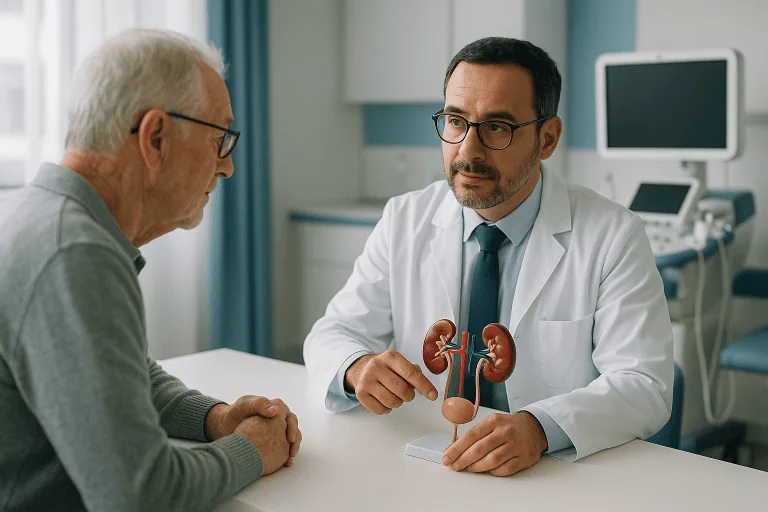
Renal Toxicology
Learn what renal toxicology is, common renal toxicology symptoms and causes, how doctors confirm the diagnosis, and the treatment options that may be considered.

Quick answer
Renal toxicology refers to kidney damage caused by harmful substances such as certain medicines, contrast dye, heavy metals, industrial chemicals, and poisons. It can develop suddenly or over years, often with few early symptoms. Doctors diagnose it with blood and urine tests, and treatment centers on stopping the exposure and supporting the kidneys while they recover.
What is renal toxicology?
Renal toxicology is the study of how medicines, chemicals, and other substances can harm the kidneys. In everyday use, the term also describes the condition itself: kidney injury caused by a toxic substance. Doctors often call this nephrotoxicity (kidney poisoning) or toxic nephropathy (kidney disease caused by a toxin). “Renal” simply means “related to the kidneys.”
The kidneys are two bean-shaped organs that filter waste and extra fluid from the blood, balance salts and minerals, help control blood pressure, and support red blood cell production. Because they receive a large share of the blood flow and concentrate many substances as they make urine, the kidneys are especially exposed to anything toxic that enters the body. This is why kidney injury is one of the more common side effects of certain drugs and chemical exposures.
Renal toxicology can affect anyone, but it is seen most often in people who take several medicines at once, older adults, people with existing kidney or heart disease, and those exposed to industrial chemicals or heavy metals. It may develop suddenly over hours or days (acute kidney injury) or slowly over months or years (chronic kidney disease). Understanding what is renal toxicology, how it shows itself, and how it is managed can help patients and families recognize problems earlier.
Renal toxicology symptoms
Renal toxicology symptoms can be subtle at first. Many people have no symptoms at all until a blood or urine test shows that kidney function has changed. When symptoms do appear, they are often related to fluid buildup, waste products accumulating in the blood, or the toxic substance itself.
- Passing less urine than usual, or in some cases much more urine than usual
- Swelling (edema) in the ankles, feet, legs, or around the eyes
- Tiredness, weakness, or difficulty concentrating
- Nausea, vomiting, or loss of appetite
- Shortness of breath, especially when lying flat
- Blood in the urine, or urine that looks dark, cloudy, or foamy
- Pain in the side or lower back (flank pain)
- Itching, muscle cramps, or a metallic taste in the mouth
- Confusion or drowsiness in more severe cases
In acute (sudden) kidney injury from a toxin, symptoms may appear within days of starting a new medicine or after a single heavy exposure. Reduced urine output, swelling, and nausea are common early clues. In chronic (long-term) toxic kidney damage, such as that linked to years of heavy pain-reliever use or ongoing exposure to heavy metals, symptoms often develop so gradually that they are mistaken for aging or other conditions. Fatigue, mild swelling, high blood pressure, and anemia (low red blood cell count) may be the only signs until kidney function is significantly reduced.
Some toxins cause a distinct pattern. For example, certain antibiotics and contrast dyes used in imaging tend to damage the tiny filtering tubes inside the kidney, while some anti-inflammatory drugs can trigger an allergic-type inflammation that may come with fever, rash, or joint pain. Your doctor may use these patterns to help identify the likely cause.
Renal toxicology causes and risk factors
Renal toxicology causes fall into a few broad groups. In many cases, more than one factor is present at the same time, which raises the overall risk.
- Prescription medicines: certain antibiotics (for example, aminoglycosides and vancomycin), some chemotherapy drugs (such as cisplatin), immune-suppressing drugs used after transplants, lithium, and some antiviral medicines.
- Over-the-counter pain relievers: nonsteroidal anti-inflammatory drugs (NSAIDs) such as ibuprofen and naproxen, especially when taken in high doses, for long periods, or while dehydrated.
- Contrast dye: iodine-based dye used in CT scans and angiography can temporarily reduce kidney function in people who are already at risk.
- Heavy metals and industrial chemicals: lead, cadmium, mercury, arsenic, and solvents such as ethylene glycol (found in antifreeze).
- Herbal and dietary supplements: some traditional remedies contain aristolochic acid or unregulated ingredients that can scar the kidneys.
- Poisons and drugs of misuse: certain mushrooms, snake venom, and some recreational drugs.
- Substances made inside the body: muscle breakdown products (rhabdomyolysis) after severe injury or extreme exertion, and uric acid crystals during some cancer treatments.
Several factors make a person more vulnerable to kidney toxicity:
- Existing chronic kidney disease, even if mild
- Older age, because kidney reserve naturally declines
- Diabetes, high blood pressure, or heart failure
- Dehydration or low blood volume, which concentrates toxins in the kidney
- Taking several potentially kidney-harming medicines at the same time
- Liver disease, which changes how drugs are processed
- Occupational exposure to metals, solvents, or pesticides
- A previous episode of acute kidney injury
Not everyone with these risk factors will develop kidney damage, and some people develop it without any obvious risk factor. Genetics and individual differences in how the body handles a drug also appear to play a role.
Renal toxicology diagnosis
Renal toxicology diagnosis relies on combining a careful history with laboratory tests. There is usually no single test that proves a toxin caused the damage; instead, doctors look for a change in kidney function that follows exposure and cannot be better explained by another cause.
Medical history and medication review. Your doctor will ask about all prescription medicines, over-the-counter products, supplements, herbal remedies, and any workplace or environmental exposures. The timing between starting a substance and the change in kidney function is one of the most important clues.
Blood tests. Serum creatinine (a waste product filtered by the kidneys) and blood urea nitrogen (BUN) are the standard markers. From creatinine, doctors calculate the estimated glomerular filtration rate (eGFR), which describes how well the kidneys are filtering. A rise in creatinine or a fall in eGFR over hours or days suggests acute kidney injury. Blood tests also check potassium, sodium, bicarbonate, and other minerals that the kidneys normally regulate. Drug levels in the blood, such as for lithium or certain antibiotics, and heavy metal levels may be measured when relevant.
Urine tests. A urinalysis looks for protein, blood, sugar, and cells or casts (clumps of cells) that point to a specific type of kidney injury. Measuring urine output over time and checking how concentrated the urine is can help distinguish toxic damage from dehydration.
Imaging. An ultrasound of the kidneys and bladder is commonly used to check kidney size and to rule out a blockage in urine flow, which can look similar on blood tests. Blockage is usually managed by a urologist, and your doctor may involve the urology team if this is suspected. CT scans without contrast dye may be used in selected situations.
Kidney biopsy. In some cases, especially when the cause is unclear or when kidney function does not improve after the suspected toxin is stopped, a small sample of kidney tissue is taken with a needle and examined under a microscope. A biopsy can show the exact pattern of injury and help guide treatment.
Diagnostic criteria. Acute kidney injury is generally defined by a set increase in serum creatinine within 48 hours, a percentage rise over a week, or a sustained drop in urine output. Chronic kidney disease is defined by reduced eGFR or signs of kidney damage that persist for more than three months. Doctors apply these criteria along with the exposure history to reach a diagnosis of toxic kidney injury.
Renal toxicology treatment options
Renal toxicology treatment options depend on the substance involved, how severe the damage is, and whether it is acute or chronic. The single most important step in most cases is to identify and stop the harmful exposure as soon as it is safe to do so.
Stopping or adjusting the cause. If a medicine is suspected, your doctor may stop it, lower the dose, or switch to an alternative that is gentler on the kidneys. This decision is balanced against the reason the medicine was needed; for example, a life-saving antibiotic or chemotherapy drug may be continued with closer monitoring rather than stopped. For environmental or workplace toxins, ending the exposure is essential.
Supportive care and observation. Many episodes of mild acute kidney injury improve on their own once the toxin is removed. Supportive care may include intravenous fluids to correct dehydration, careful management of fluid balance, and monitoring of blood tests every day or every few days. Doctors also avoid adding other medicines that could stress the kidneys during recovery.
Medications. There is no medicine that directly repairs toxic kidney damage, but several may be used to manage its effects. These can include medicines to lower high potassium, correct acid buildup, control blood pressure, or reduce fluid overload. When the injury involves an allergic-type inflammation of the kidney (interstitial nephritis), a short course of corticosteroids is sometimes considered. For some specific poisonings, such as ethylene glycol or heavy metals, antidotes or chelating agents (drugs that bind the metal so it can be removed) may be given.
Dialysis. If kidney function drops severely, dialysis can temporarily take over the kidneys’ filtering job. Dialysis may also be used to remove certain toxins directly from the blood. In many cases of acute toxic injury, dialysis is needed only for a limited time while the kidneys recover. If damage is permanent and advanced, long-term dialysis or evaluation for kidney transplant may be discussed.
Procedures and surgery. Surgery is not a treatment for toxic kidney damage itself. However, procedures may be needed for related problems, such as placing a dialysis catheter or relieving a urinary blockage. At Acibadem, toxic kidney conditions are generally managed by nephrology (kidney medicine) specialists, with urology involved when the urinary tract needs procedural care.
Rehabilitation and follow-up. After an episode of toxic kidney injury, follow-up blood and urine tests are usually recommended for weeks to months to confirm recovery. Your doctor may review all your medicines to reduce future risk and may recommend dietary changes if kidney function remains reduced.
Living with renal toxicology and outlook
The outlook after toxic kidney injury varies widely. In many cases, especially when the exposure is recognized early and stopped, kidney function returns to or near its previous level within days to weeks. The kidneys have a considerable ability to recover from acute injury, particularly in younger people without other kidney disease.
Recovery is less certain when the injury was severe, lasted a long time, required dialysis, or occurred in someone with pre-existing kidney disease. In these situations, some degree of permanent loss of function may remain, and the person may be diagnosed with chronic kidney disease. Even a single episode of acute kidney injury appears to raise the long-term risk of chronic kidney disease, so ongoing monitoring is generally advised.
Living well with reduced kidney function often involves practical steps: keeping a current list of all medicines and supplements, asking a doctor or pharmacist before starting any new product, staying adequately hydrated unless told otherwise, managing blood pressure and blood sugar, and attending regular check-ups. Some people are advised to avoid NSAIDs permanently and to remind healthcare providers about their kidney history before imaging with contrast dye.
Emotional well-being matters too. A diagnosis linked to a medicine you took or a job you held can bring frustration or worry. Talking openly with your care team about these feelings, and about realistic expectations, is a normal part of care.
Frequently asked questions
What is renal toxicology in simple terms?
Renal toxicology refers to kidney damage caused by harmful substances, including certain medicines, chemicals, heavy metals, and poisons. The kidneys filter the blood and concentrate many substances, which makes them especially sensitive to toxins. The condition may be sudden or develop slowly, and its severity ranges from mild, reversible changes to lasting kidney disease.
What are the first renal toxicology symptoms?
Often there are no early symptoms, and the first sign is an abnormal blood or urine test. When symptoms do occur, common early ones include passing less urine, swelling in the legs or around the eyes, tiredness, and nausea. Because these signs are not specific to the kidneys, anyone who develops them after starting a new medicine or after a chemical exposure should mention this to a doctor.
What are the most common renal toxicology causes?
Medicines are the most frequent cause in healthcare settings. Commonly involved drugs include NSAID pain relievers, certain antibiotics, some chemotherapy agents, and contrast dye used in imaging. Outside of medicine, heavy metals such as lead and cadmium, industrial solvents, and some herbal products are recognized causes. Dehydration and existing kidney disease make any of these more likely to cause harm.
How is renal toxicology diagnosis confirmed?
Doctors compare kidney blood tests, mainly creatinine and eGFR, before and after the suspected exposure, and check the urine for protein, blood, and abnormal cells. An ultrasound is often done to rule out a blockage. In unclear or non-improving cases, a kidney biopsy may be used to see the pattern of injury. The diagnosis is usually based on the combination of exposure history, timing, and test results rather than a single test.
What are the renal toxicology treatment options?
The main treatment is to stop or reduce the harmful exposure and support the body while the kidneys recover. This may involve intravenous fluids, careful monitoring, medicines to correct mineral imbalances or blood pressure, and, in specific poisonings, antidotes. If kidney function falls severely, dialysis may be used for a limited time or, in cases of permanent damage, long term. Treatment plans are individual and depend on the substance and the severity of injury.
Can the kidneys recover from toxic damage?
In many cases, yes, particularly when the injury is mild, recognized early, and the toxin is removed. Recovery can take days to several weeks. However, severe or prolonged injury, or injury in someone with pre-existing kidney disease, may leave permanent damage. Your doctor may recommend follow-up testing for months afterward to see how much function has returned and to watch for chronic kidney disease.
Which doctor treats renal toxicology?
Kidney injury from toxins is usually managed by a nephrologist, a doctor who specializes in kidney medicine, often together with the doctor who prescribed the medicine involved. Pharmacists frequently help review medicines. Urologists, who focus on the urinary tract, may become involved if a blockage or a procedure such as catheter placement is needed. In poisoning cases, toxicology or emergency specialists may also take part.
When to see a doctor
Kidney injury can progress quickly, and early evaluation gives the best chance of limiting damage. It is reasonable to arrange a medical review if you notice new swelling, unusual tiredness, changes in how much or how often you urinate, or if you have started a new medicine or supplement and feel unwell. People with known kidney disease, diabetes, or heart disease who are prescribed a new medicine may be advised to have follow-up blood tests even without symptoms.
Seek urgent medical care if any of the following occur:
- Passing very little or no urine for 12 hours or more
- Sudden severe swelling of the legs, face, or abdomen
- Shortness of breath, chest pain, or difficulty breathing when lying down
- Confusion, extreme drowsiness, or difficulty staying awake
- Seizures, or an irregular or very slow heartbeat
- Persistent vomiting that prevents you from keeping fluids down
- Known or suspected swallowing of antifreeze, a large overdose of medicine, wild mushrooms, or other poisons
- Severe muscle pain with dark brown urine after intense exertion or injury
These signs may indicate severe kidney failure, dangerous mineral imbalances, or poisoning that requires immediate treatment. If you are unsure, it is safer to be assessed promptly than to wait.
Medically reviewed by the Acıbadem International Medical Board September 9, 2026
See our medical review board →
Update history
- PublishedSeptember 9, 2026
- Medical review approvedSeptember 9, 2026
- Last content updateSeptember 9, 2026