3D Printing in Medicine: Surgical Planning, Implants, and Prosthetics

3D printing uses medical imaging data to create physical models, devices, or components tailored to an individual patient. Common uses include surgical planning, anatomical models, custom implants, prosthetics, dental devices, and training tools.
Key Takeaways
- 3D printing uses medical imaging data to create physical models, devices, or components tailored to an individual patient.
- Common uses include surgical planning, anatomical models, custom implants, prosthetics, dental devices, and training tools.
- Not every patient needs a 3D printed solution; doctors decide based on diagnosis, anatomy, expected benefit, and safety requirements.
- Medical 3D printed items must follow appropriate material, sterilization, testing, and regulatory standards.
- Patients should ask how a 3D printed model or device will be used, what benefits are expected, and whether alternatives are available.
3D printing in medicine is helping healthcare teams create patient-specific models, implants, guides, and prosthetics that can support planning and personalize care. The technology is used alongside imaging, clinical expertise, and strict quality standards to improve preparation, communication, and fit.
Overview
3D printing in medicine, also called additive manufacturing, is the process of creating three-dimensional objects layer by layer from a digital design. In healthcare, that design is often based on a patient’s CT scan, MRI scan, ultrasound, or digital surface scan. The result may be an anatomical model, a surgical guide, an implant, a prosthetic limb component, or a dental device.
The main value of medical 3D printing is personalization. Human anatomy varies widely, and some conditions involve complex shapes that are difficult to fully understand on a flat screen. A physical model can help surgeons examine a structure from different angles, plan an approach, and explain a procedure to a patient and family in clearer terms.
3D printing is not a replacement for medical judgment, imaging, or standard surgical care. It is a tool that can support decision-making when used by trained teams. The best results depend on accurate imaging, careful digital design, suitable materials, and appropriate quality checks before anything is used in patient care.
How Medical 3D Printing Works
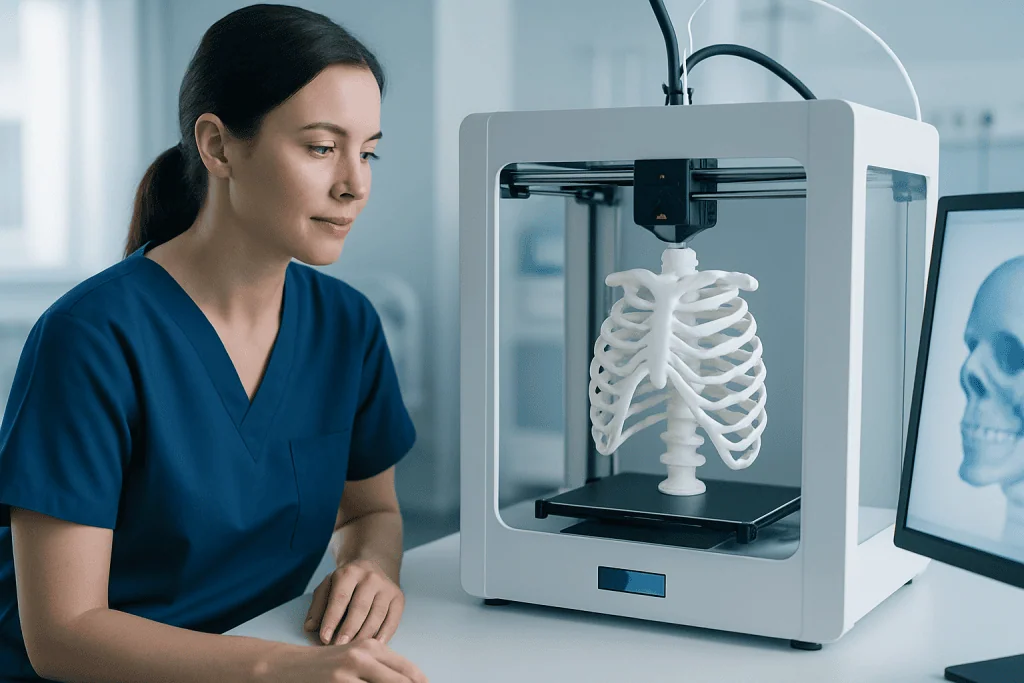
The process usually begins with medical imaging. A radiology or engineering team converts scan data into a digital 3D model through a process known as segmentation, where relevant tissues such as bone, blood vessels, or organs are identified. The digital file is then refined so that it can be printed accurately and safely.
Different printing technologies and materials are selected depending on the purpose. A surgical planning model may be made from plastic-like materials, while an implant may require medical-grade titanium or another biocompatible material. Some devices need to be sterilized before use in the operating room, so the material must tolerate the required sterilization method.
Common steps include:
- Obtaining high-quality imaging or surface scanning data.
- Creating and reviewing a digital 3D design.
- Selecting a suitable printer, material, and printing method.
- Post-processing, such as cleaning, curing, polishing, or sterilizing.
- Quality control to confirm size, strength, fit, and intended use.
Because small errors can affect clinical use, medical 3D printing is typically performed within a structured workflow. Doctors, radiologists, biomedical engineers, technicians, and quality specialists may all contribute to the final result.
Surgical Planning and Patient-Specific Models
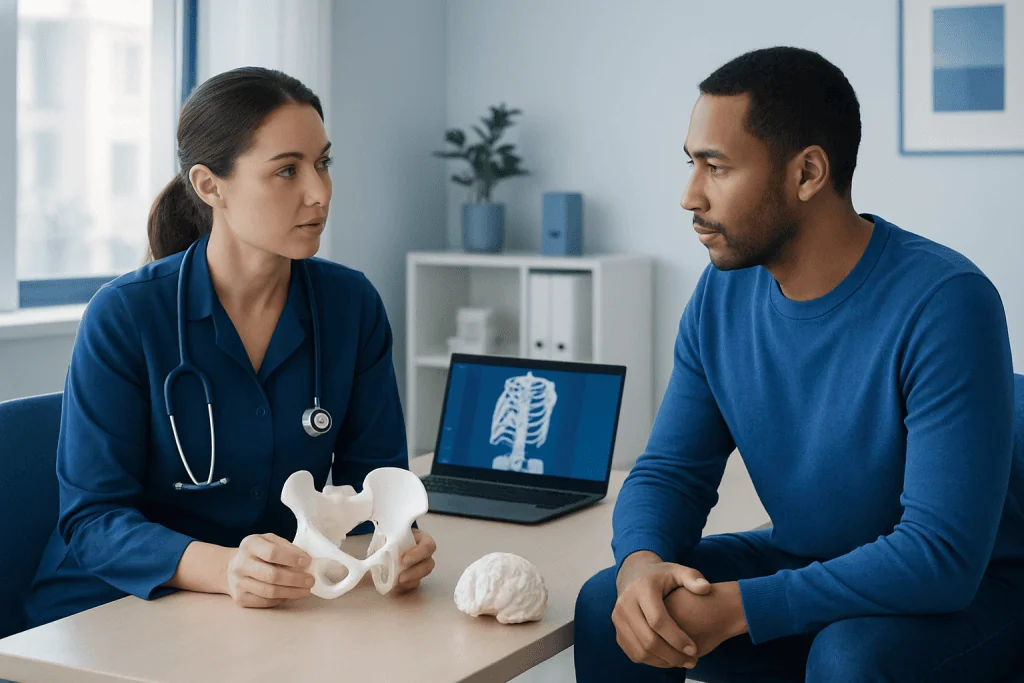
One of the most established uses of 3D printing in medicine is surgical planning. When anatomy is complex, a printed model can help the surgical team understand the size, location, and relationship of important structures. This may be useful in areas such as orthopedics, craniofacial surgery, cardiovascular surgery, neurosurgery, and selected cancer operations.
For example, a surgeon may use a model of a fractured bone to plan how plates and screws could be positioned. In heart or vascular care, a model may help visualize unusual anatomy before an intervention. In tumor surgery, a model may support planning around nearby nerves, vessels, or organs. The aim is to improve preparation and team communication, not to guarantee a specific outcome.
Patient-specific models can also improve education. Many patients find it easier to understand their condition when they can see or hold a model rather than interpret scan images. This can support shared decision-making by helping patients ask more informed questions about the proposed procedure, its alternatives, and expected recovery.
3D Printed Implants and Surgical Guides
Some 3D printed medical devices are designed to be used in or on the body. Implants may be customized for a patient’s anatomy, especially when standard sizes do not fit well or when bone loss, trauma, or previous surgery has changed the normal shape. 3D printed titanium implants, for instance, can be designed with porous surfaces that may support bone integration when clinically appropriate.
Surgical guides are another important application. These are patient-specific tools that help surgeons position cuts, drill holes, or implants according to a planned angle or location. They are used in selected orthopedic, dental, maxillofacial, and reconstructive procedures. A guide can help translate a digital surgical plan into the operating room with improved consistency.
Every implant or guide must meet strict requirements before clinical use. The team must consider mechanical strength, biocompatibility, sterilization, manufacturing accuracy, and regulatory compliance. Patients should feel comfortable asking whether a device is custom-made, what material it is made from, and how its safety and fit have been checked.
Prosthetics, Orthotics, and Rehabilitation Devices
3D printing has created new opportunities in prosthetics and orthotics, especially for devices that need to match an individual’s shape and lifestyle. Prosthetic sockets, cosmetic covers, braces, splints, and other supportive devices can be designed from body scans and adjusted digitally before production. This may make it easier to refine fit and comfort over time.
For children, whose bodies grow quickly, 3D printed components may help clinicians create lightweight and adaptable solutions in selected cases. In adults, custom designs can support daily function, rehabilitation goals, and personal preferences. However, fit, durability, skin comfort, and long-term usability remain essential, and these devices should be assessed by qualified rehabilitation and prosthetics professionals.
3D printed rehabilitation tools may also be used in therapy settings, such as custom hand splints or training aids. These tools are most effective when they are part of a broader rehabilitation plan that includes assessment, exercise, monitoring, and adjustment by a specialist team.
Dental, Facial, and Other Clinical Uses
Dentistry and maxillofacial care are among the most common areas for 3D printing. Digital dental scans can be used to create models, aligner patterns, surgical guides for implants, crowns, bridges, dentures, and other devices. In facial reconstructive surgery, 3D printing may help plan bone repositioning or create patient-specific implants for selected cases.
Medical teams also use 3D printing for education, simulation, and device development. Trainees can practice on realistic models before working with patients. Surgeons may rehearse difficult steps using anatomy that resembles the patient’s own. Researchers and device developers may use printed prototypes to test designs before moving toward formal evaluation.
Another developing area is bioprinting, where cells and biomaterials are printed to create tissue-like structures. This field is promising for research, drug testing, and future regenerative medicine, but many applications are still experimental. Patients should distinguish between established clinical uses, such as planning models or approved devices, and early-stage research that is not yet routine care.
Safety, Limitations, and When to Ask About 3D Printing
Medical 3D printing can be helpful, but it is not necessary for every diagnosis or procedure. In many situations, standard imaging, established implants, and conventional surgical tools are entirely appropriate. A doctor may recommend 3D printing when the anatomy is unusual, the procedure is technically complex, or a custom fit is expected to offer a meaningful advantage.
Limitations include cost, production time, availability of suitable materials, regulatory requirements, and the need for specialized expertise. A printed model is only as accurate as the imaging and digital processing used to create it. For implants and guides, quality control is particularly important because the device may influence surgical precision or remain in the body.
Patients considering surgery or a custom device can ask practical questions: Will 3D printing change the treatment plan? Is it being used for education, planning, a guide, or an implant? What alternatives are available? How will the device be tested and sterilized? These questions can help patients understand the role of the technology in their own care.
For international patients, Acibadem International’s multidisciplinary specialists and JCI-accredited hospitals can evaluate whether advanced imaging, surgical planning, or 3D printing may be appropriate as part of a personalized treatment pathway. Decisions should always be made after consultation with qualified healthcare professionals who can review the patient’s full medical situation.
Frequently asked questions
What is 3D printing in medicine?
3D printing in medicine is the use of digital designs to create physical medical models, devices, implants, or prosthetics layer by layer. The design is often based on a patient's imaging scans, such as CT or MRI. It helps healthcare teams personalize planning and, in selected cases, create custom medical solutions.
Is a 3D printed implant safe?
A 3D printed implant can be safe when it is designed, manufactured, tested, sterilized, and used according to appropriate medical and regulatory standards. The material must be biocompatible and strong enough for its intended purpose. Patients should ask their doctor what type of implant is being used and how its safety has been assessed.
Does 3D printing make surgery more accurate?
3D printing may support accuracy in selected procedures by helping surgeons plan in detail or use patient-specific guides. However, surgical results depend on many factors, including the condition being treated, the surgeon's expertise, the patient's overall health, and recovery. It should be seen as a supportive tool rather than a guarantee.
Can 3D printing be used for prosthetic limbs?
Yes, 3D printing can be used to create some prosthetic limb components, sockets, covers, and related rehabilitation devices. It may help customize fit, shape, and design, especially when combined with digital scanning. A prosthetics specialist should evaluate comfort, skin health, durability, and function before regular use.
Will patients feel or notice a difference with a 3D printed device?
Some patients may notice improved fit or comfort, particularly with custom prosthetics, orthotics, dental devices, or implants designed for unusual anatomy. Others may not feel a direct difference because 3D printing is used mainly for surgical planning before the procedure. The expected benefit depends on how the technology is applied.
Is 3D bioprinting available for organ replacement?
3D bioprinting is an active research field that uses cells and biomaterials to create tissue-like structures. At present, fully functional 3D printed organs for routine transplantation are not standard clinical care. Patients should be cautious about claims that sound experimental and should discuss proven treatment options with qualified doctors.
References
- U.S. Food and Drug Administration
- World Health Organization
- Radiological Society of North America
- European Medicines Agency
- National Institutes of Health
This article is for general information only and is not a substitute for professional medical advice. Please consult a qualified doctor about your individual situation.
Explore treatments in Turkey — costs, top hospitals & a free quote
JCI-accredited · board-certified surgeons · reply within 24h
Add us as a Preferred Source to see more of our trusted health content across Google Search, AI Overviews and Discover.