Collarbone Dislocated — Explained by Medical Evidence, Not Myths

The collarbone does not truly dislocate in the middle; the injury usually affects the acromioclavicular or sternoclavicular joint. Pain, swelling, deformity, and trouble moving the arm are common symptoms after a fall or direct blow.
Key Takeaways
- The collarbone does not truly dislocate in the middle; the injury usually affects the acromioclavicular or sternoclavicular joint.
- Pain, swelling, deformity, and trouble moving the arm are common symptoms after a fall or direct blow.
- Diagnosis is based on physical examination and imaging such as X-rays, with CT used for some sternoclavicular injuries.
- Many injuries are treated without surgery, but severe displacement, instability, or complications may need specialist care.
- Urgent medical evaluation is important after major trauma, breathing trouble, numbness, or visible deformity.
A “collarbone dislocated” usually refers to a joint injury where the collarbone shifts out of place at either the shoulder end or the breastbone end, rather than the bone itself dislocating. Most cases improve with proper evaluation, pain control, and targeted rehabilitation, but some injuries need urgent assessment or specialist treatment.
What “collarbone dislocated” usually means
When people say a collarbone dislocated, they are usually describing a joint injury involving the collarbone rather than the bone itself slipping out of place. The collarbone, or clavicle, connects to the shoulder blade at the acromioclavicular (AC) joint and to the breastbone at the sternoclavicular (SC) joint. Either of these joints can become displaced after trauma.
The most common injury is an AC joint separation near the outer end of the collarbone, often caused by a fall onto the shoulder. Less commonly, the inner end of the collarbone can dislocate at the SC joint near the center of the chest. These injuries vary from mild ligament sprains to more obvious displacement with a visible bump or asymmetry.
This distinction matters because treatment depends on the exact site and severity of the injury. A collarbone fracture, for example, is different from a joint dislocation and may need a different plan. Careful examination and imaging help tell these injuries apart and guide recovery safely.
Symptoms and what they can feel like
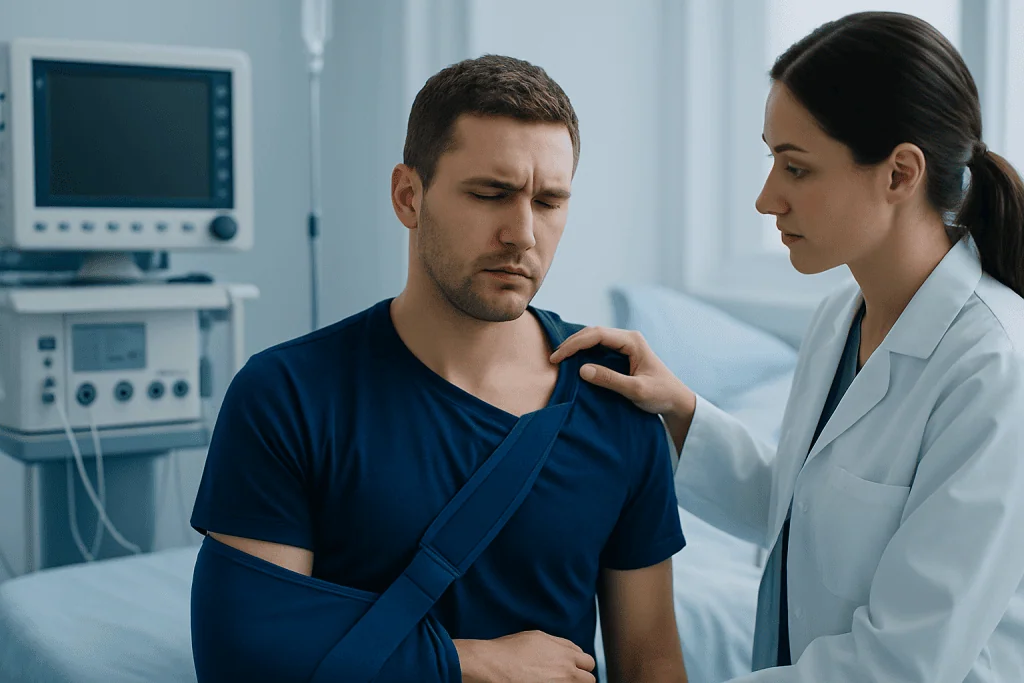
Symptoms often begin suddenly after a fall, sports impact, road traffic accident, or direct blow. Pain is usually felt at the top of the shoulder for AC joint injuries or near the upper chest for SC joint injuries. Many people notice swelling, bruising, tenderness, and difficulty lifting the arm or reaching across the body.
A visible change in shape can also occur. With some AC injuries, the outer end of the collarbone looks more prominent, creating a bump above the shoulder. In SC joint injuries, there may be asymmetry near the base of the neck or upper chest. Mild injuries may look subtle, while more severe ones can be easier to see.
Symptoms that deserve extra attention include numbness, tingling, weakness, color changes in the arm, shortness of breath, trouble swallowing, or a sense of pressure behind the breastbone. These can suggest irritation of nearby nerves, blood vessels, or structures in the chest, especially with certain SC joint dislocations.
- Pain that worsens with shoulder movement
- Swelling or bruising after trauma
- Limited range of motion
- A visible bump or uneven shoulder contour
- Tenderness over the AC or SC joint
Causes, types, and risk factors

Most collarbone joint dislocations happen because of trauma. A fall directly onto the point of the shoulder is a classic cause of AC joint separation. Contact sports, cycling, skiing, and road traffic accidents also increase the chance of injury. SC joint dislocations are less common and often result from higher-energy impacts.
Doctors classify these injuries by which joint is affected and how much the supporting ligaments are damaged. In AC injuries, mild forms involve stretching of the ligaments, while more severe forms show clear separation and displacement. SC injuries are often described as anterior or posterior depending on the direction the inner clavicle moves. Posterior SC dislocation is uncommon but more urgent because it can affect structures behind the joint.
Risk can be higher in athletes involved in collision sports, people with previous shoulder injuries, and those with occupations that involve falls or heavy physical demands. Children and adolescents may have related injuries involving growth plates rather than a true joint dislocation, so age and injury pattern matter during assessment.
Sometimes a person may assume the problem is only a bruise or “popped collarbone,” but ongoing pain or deformity should not be ignored. A clinician may also need to rule out a fracture or another shoulder injury such as shoulder dislocation or a rotator cuff tear, depending on the mechanism and symptoms.
How doctors diagnose the injury
Diagnosis begins with a medical history and physical examination. The doctor asks how the injury happened, where the pain is located, whether there was a popping sensation, and if symptoms such as numbness or breathing difficulty are present. On examination, they look for swelling, tenderness, deformity, and how shoulder movement affects pain.
X-rays are often the first imaging test and can help show displacement or an associated fracture. Special views may be used if an AC joint injury is suspected. For SC joint injuries, especially when the direction of dislocation is unclear or there is concern about structures in the chest, CT imaging is often more informative than standard X-rays.
Additional imaging may be considered when symptoms suggest soft tissue damage, persistent instability, or a complex injury pattern. Accurate diagnosis is important because treatment for a mild ligament sprain is very different from treatment for a severe joint displacement. In some cases, patients may be referred for MRI or CT scan as part of a fuller evaluation.
Treatment options and recovery
Many people with a collarbone joint dislocation recover well without surgery. Early treatment often includes rest, ice, a sling for comfort, and pain-relief measures recommended by a doctor. As pain settles, guided exercises help restore motion, strength, and shoulder control. Recovery time depends on the severity of the injury, the person’s age, and everyday demands such as sport or manual work.
Mild to moderate AC joint injuries are commonly treated conservatively. Even when a bump remains visible, function may return well with rehabilitation. Physical therapy can help reduce stiffness and support a gradual return to daily activities. Some discomfort with overhead movement may continue for a period, but symptoms often improve steadily.
Surgery may be considered for selected cases, such as severe displacement, ongoing pain or instability despite rehabilitation, open injuries, or specific demands in competitive athletes or heavy laborers. SC joint dislocations may also need reduction or surgery depending on the direction of dislocation and associated risks. If the injury is complex, a specialist may discuss options in orthopedic rehabilitation and, when needed, operative repair.
After the early healing stage, structured rehabilitation is a key part of recovery. It focuses on range of motion, shoulder blade control, strengthening, and safe return to activity. Rushing back too soon can worsen pain or delay healing, so follow-up advice should be tailored by a qualified clinician.
Self-care, prevention, and activity tips
Self-care after a suspected collarbone dislocation should be simple and protective until medical advice is obtained. Resting the arm, using a sling if recommended, and applying ice for short periods may reduce discomfort and swelling. People should avoid trying to push the collarbone back into place, as this can worsen injury.
During recovery, posture and gradual movement matter. Gentle exercises are usually started only when advised by a clinician or physical therapist. Sudden lifting, contact sports, and repetitive overhead activity are usually limited at first. The goal is to protect healing tissues while avoiding unnecessary stiffness.
Prevention is not always possible, but some steps may lower risk. Strengthening the shoulder and upper back, using proper sports technique, wearing appropriate protective equipment, and improving balance may help. For older adults, fall prevention strategies can also reduce injuries around the shoulder girdle.
- Use protective gear for contact or high-speed sports
- Warm up and strengthen shoulder-supporting muscles
- Address balance problems and home fall hazards
- Follow return-to-sport guidance after any shoulder injury
When to seek medical care
Medical assessment is important after a significant shoulder or chest impact, especially if there is severe pain, a visible deformity, or inability to move the arm normally. Emergency care is recommended if symptoms include shortness of breath, trouble swallowing, chest pressure, faintness, numbness, weakness, or changes in arm color or temperature. These features may point to a more serious injury that needs urgent attention.
Even when symptoms seem mild, persistent pain, swelling, or loss of function should be evaluated. An injury that is mistaken for a simple strain may actually be a fracture, joint dislocation, or soft tissue tear. Early diagnosis can reduce complications and help plan the safest recovery timeline.
Near the end of evaluation and treatment, some people benefit from coordinated care involving orthopedics, radiology, and rehabilitation specialists. Acibadem International’s multidisciplinary teams in JCI-accredited hospitals diagnose and treat shoulder and collarbone-related injuries for international patients when specialist assessment is needed.
Frequently asked questions
Can the collarbone itself actually dislocate?
Usually, no. When people say the collarbone is dislocated, they usually mean the collarbone has shifted at one of its joints, most often the acromioclavicular joint near the shoulder or the sternoclavicular joint near the chest. A fracture of the collarbone is a different injury.
How can someone tell the difference between a dislocated collarbone and a fracture?
Both injuries can cause pain, swelling, bruising, and trouble moving the arm. A visible bump can happen with either one, so symptoms alone are not always enough to tell the difference. A medical examination and imaging, usually with X-rays, are often needed for an accurate diagnosis.
Does a collarbone dislocation always need surgery?
No. Many AC joint injuries and some SC joint injuries are treated successfully without surgery using a sling, pain relief, and rehabilitation. Surgery is usually reserved for severe displacement, instability, persistent symptoms, or injuries that threaten nearby structures.
How long does recovery usually take?
Recovery time depends on the type and severity of the injury. Mild injuries may improve over several weeks, while more severe injuries can take longer and may require structured rehabilitation. Return to sports or heavy work should follow a clinician’s advice rather than a fixed timeline.
Is it safe to try to pop the collarbone back into place?
No. Trying to force the joint back can worsen damage to ligaments, blood vessels, nerves, or nearby chest structures. The safest approach is to support the arm, avoid further strain, and seek professional medical care.
When is a collarbone dislocation an emergency?
It should be treated urgently if there is breathing difficulty, trouble swallowing, chest pressure, faintness, numbness, weakness, or major deformity after trauma. These symptoms can occur with more serious SC joint injuries or associated trauma. Emergency assessment is also important after high-energy accidents.
This article is for general information only and is not a substitute for professional medical advice. Please consult a qualified doctor about your individual situation.
Joint and spine care in Turkey — expert assessment & treatment
JCI-accredited · board-certified surgeons · reply within 24h
Add us as a Preferred Source to see more of our trusted health content across Google Search, AI Overviews and Discover.

More from the Health Library

Trimethylaminuria: What Patients Need to Know

Jalapeno: A Complete Medical Overview

Appetite Suppressant: An Evidence-Based Guide for Patients
Sinus Arrhythmia: A Complete Medical Overview

Big Poo: What Patients Need to Know