CRP (C-Reactive Protein) Blood Test: What Low and High Levels Mean — and What to Do Next

CRP is a blood marker of inflammation, not a diagnosis on its own. Low CRP levels are often normal and usually do not cause symptoms by themselves.
Key Takeaways
- CRP is a blood marker of inflammation, not a diagnosis on its own.
- Low CRP levels are often normal and usually do not cause symptoms by themselves.
- High CRP levels can happen with infections, autoimmune diseases, injury, obesity, smoking, and some chronic illnesses.
- Reference ranges vary by laboratory, so results should be read using the report’s own range.
- Doctors interpret CRP together with symptoms, examination findings, and sometimes other tests such as ESR or CBC.
- Urgent medical care is important if a high CRP result comes with severe symptoms such as chest pain, breathing trouble, confusion, or signs of serious infection.
crp low high levels usually help show whether there is little, mild, or significant inflammation in the body, but the result does not by itself diagnose a specific illness. A low CRP is often normal or reassuring, while a high CRP suggests inflammation, infection, tissue injury, or another underlying condition that should be interpreted alongside symptoms and other tests.
Overview: what crp low high levels usually mean
The CRP blood test measures C-reactive protein, a substance made by the liver in response to inflammation. When people search for crp low high levels, the short answer is that low levels often mean there is little or no significant inflammation at the time of testing, while high levels suggest the body is reacting to inflammation, infection, tissue injury, or another medical problem.
CRP is useful because it can rise quickly, often within hours of an inflammatory trigger, and fall again as the problem improves. At the same time, it is a non-specific marker. In other words, it can show that inflammation may be present, but it cannot identify the exact cause on its own. Doctors usually interpret it together with symptoms, medical history, physical examination, and other laboratory or imaging results.
There are different types of CRP testing. A standard CRP test is commonly used to evaluate suspected infection or inflammatory disease. A high-sensitivity CRP, often called hs-CRP, uses a different range and may be ordered in cardiovascular risk assessment. Because these tests are used for different purposes, it is important to know which one was ordered before drawing conclusions from the number alone.
What the marker measures and the reference range table
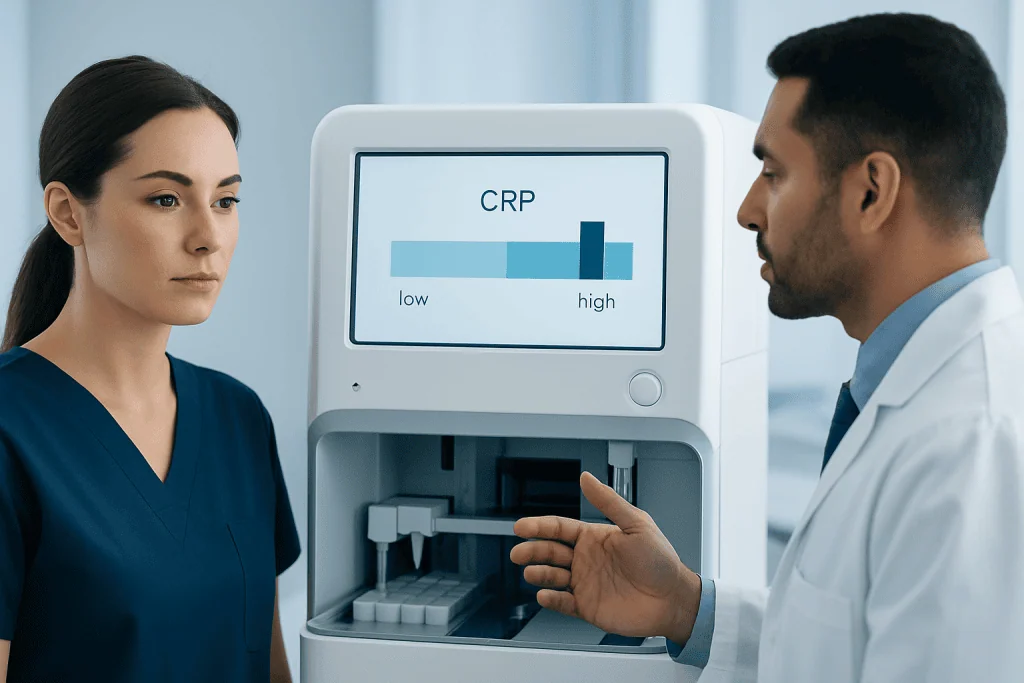
CRP reflects the body’s inflammatory response. It does not measure one organ directly, and it does not show where inflammation is happening. Instead, it acts as a general signal that the immune system may be reacting to infection, autoimmune activity, tissue damage, or other stressors in the body.
Laboratories may report CRP in milligrams per liter (mg/L), and the exact reference range can vary. This is why the result should always be read in the context of the laboratory’s own report. As a broad guide, standard CRP results are often interpreted like this:
- Low or normal: commonly within the lab’s normal range, often under about 10 mg/L
- Mildly elevated: may suggest minor inflammation, a recent illness, obesity, smoking, or chronic low-grade inflammatory activity
- Moderately elevated: may be seen with active infection, inflammatory disease flares, or more significant tissue injury
- Markedly elevated: can occur in serious bacterial infections, major inflammatory conditions, or substantial trauma
For hs-CRP, the numbers are much lower and are used mainly to estimate cardiovascular risk rather than to investigate severe infection. A person should not compare a standard CRP result with an hs-CRP reference chart unless a clinician confirms that this is appropriate. If there is uncertainty, the simplest next step is to ask which type of CRP test was performed and what range the laboratory uses.
Low CRP levels: causes, symptoms, and next steps

A low CRP level is usually a reassuring finding. In many people, it simply means there is no strong inflammatory process happening at the time of the blood test. Low CRP itself does not typically cause symptoms, and people usually feel normal unless another unrelated issue is present.
Common reasons for a low CRP result include being generally well, recovering after an illness has resolved, or having a condition that is not currently active. Some people with well-controlled inflammatory disorders may also have low or near-normal CRP levels. In cardiovascular screening, a low hs-CRP level may be considered favorable, but it is still only one part of the overall risk picture.
If symptoms are present despite a low CRP, the result does not automatically rule out disease. Some infections, autoimmune conditions, or localized problems may not raise CRP very much, especially early in the illness. In those situations, doctors may look at other tests, such as a complete blood count, erythrocyte sedimentation rate, liver function tests, urine testing, or imaging, depending on the symptoms. If inflammatory symptoms are ongoing, evaluation for conditions such as rheumatoid arthritis may be considered when clinically appropriate.
High CRP levels: causes, symptoms, and what to do next
A high CRP level means the body is likely responding to inflammation, but it does not say exactly why. The increase may be temporary and mild, such as after a recent viral illness, or more significant, as can happen with bacterial infection, active autoimmune disease, injury, surgery, or chronic inflammatory disorders. Higher values generally suggest a stronger inflammatory response, but the number still needs context.
Possible causes of high CRP include respiratory or urinary infections, inflammatory bowel disease, autoimmune conditions, obesity, smoking, poorly controlled chronic disease, recent trauma, and recovery after an operation. High CRP may also be seen alongside conditions affecting the heart or blood vessels, depending on the type of test used and the clinical situation. If symptoms suggest an ongoing inflammatory disorder, a doctor may investigate related conditions such as Crohn’s disease or other autoimmune illnesses.
Symptoms linked with a high CRP result come from the underlying cause rather than from CRP itself. These may include fever, tiredness, body aches, joint pain, swelling, cough, abdominal pain, diarrhea, burning with urination, or general malaise. The next steps often include reviewing symptoms, repeating the test if needed, checking other blood markers, and treating the suspected cause. Depending on the findings, care may involve antibiotics for a bacterial infection, monitoring, lifestyle measures, or treatment of an inflammatory disease with options that may include internal medicine evaluation or rheumatology care.
How the CRP test is done and how results are interpreted
The CRP test is done with a blood sample, usually taken from a vein in the arm. In most cases, no special preparation is needed, although the ordering clinician may give specific instructions if other blood tests are being done at the same time. The procedure is quick, and most people can return to normal activities right away.
Results are interpreted by looking at the number, the laboratory’s reference range, and the reason the test was ordered. A single CRP value can be helpful, but trends are often even more useful. For example, a CRP level that falls after treatment may suggest that inflammation is improving, while a level that keeps rising may prompt further investigation.
Doctors also consider timing. CRP can rise early during acute illness and then decline as recovery begins. Because of this, a test done very early or late in an illness may tell a different story than one done during peak symptoms. If a result seems inconsistent with how a person feels, repeating the test or ordering additional studies can clarify the picture.
Factors that can skew results
Several factors can affect CRP levels and make interpretation less straightforward. Temporary illnesses, even a minor cold, can increase CRP for a short time. Recent surgery, injury, strenuous exercise, and chronic conditions such as obesity can also raise the result. Smoking and some long-term inflammatory states may contribute to persistently mild elevation.
Medications can change CRP as well. Anti-inflammatory drugs, steroids, or treatments that suppress immune activity may lower it. On the other hand, a person can still have symptoms from an underlying condition even if treatment has reduced CRP. Pregnancy and aging may also influence inflammatory markers in some individuals, though interpretation remains individualized.
Because CRP is non-specific, it should not be used in isolation to self-diagnose. A mildly abnormal result may not be clinically important in one person but may be meaningful in another depending on symptoms and medical history. If there are repeated abnormal results, a clinician may recommend a broader assessment, sometimes including imaging such as MRI or specialist review, to look for the source of inflammation.
When to seek medical care
Medical review is a good idea if a CRP result is high and there are ongoing symptoms such as fever, worsening fatigue, joint swelling, persistent abdominal pain, chronic diarrhea, unexplained weight loss, or a cough that does not improve. Follow-up is also sensible when a mildly elevated CRP keeps appearing on repeat tests, even if symptoms are subtle, because patterns over time can help guide diagnosis.
Urgent care is important if a high CRP result comes with chest pain, shortness of breath, severe weakness, confusion, bluish lips, high fever with shaking chills, severe dehydration, or signs of sepsis such as rapid breathing and extreme drowsiness. These symptoms may point to a serious illness that needs prompt assessment.
For people who need further evaluation, Acibadem International’s multidisciplinary specialists and JCI-accredited hospitals diagnose and treat inflammatory, infectious, digestive, and rheumatologic conditions for international patients. The right follow-up depends on the wider clinical picture rather than the CRP number alone.
Frequently asked questions
Is a low CRP level always a good sign?
A low CRP level is often reassuring because it usually means there is little active inflammation at the time of the test. However, it does not rule out every illness, especially very early disease, localized problems, or conditions that do not strongly raise CRP.
What level of CRP is considered high?
There is no single cutoff that applies to every situation because laboratories use different reference ranges and standard CRP differs from hs-CRP. In general, values above the lab’s normal range suggest inflammation and should be interpreted together with symptoms and other test results.
Can stress or lack of sleep raise CRP?
General life stress and poor sleep may contribute to low-grade inflammation over time, but they are usually not the only explanation for a clearly high CRP result. Doctors look for more direct causes such as infection, autoimmune disease, obesity, smoking, or tissue injury.
Does a high CRP mean there is an infection?
Not necessarily. Infection is one common reason, but high CRP can also occur with autoimmune disease, inflammatory bowel disease, trauma, surgery, and other conditions. The result points to inflammation, not to one specific diagnosis.
How quickly can CRP levels change?
CRP can rise within hours after inflammation begins and may fall relatively quickly as the underlying problem improves. Because it changes over time, repeat testing can sometimes be more informative than one isolated result.
Do I need fasting before a CRP blood test?
Usually, no fasting is needed for a standard CRP test. If it is ordered together with other blood tests that do require fasting, the clinician or laboratory will provide instructions.
What should someone do after getting a high CRP result?
The best next step is to review the result with a qualified doctor, especially if symptoms are present. The clinician may ask about recent illness, examine the patient, repeat the test, or order other investigations to find the cause and decide whether treatment is needed.
References
This article is for general information only and is not a substitute for professional medical advice. Please consult a qualified doctor about your individual situation.
Explore treatments in Turkey — costs, top hospitals & a free quote
JCI-accredited · board-certified surgeons · reply within 24h
Add us as a Preferred Source to see more of our trusted health content across Google Search, AI Overviews and Discover.

More from the Health Library



Related Specialists

Prof. Dr. Cem Demirel
Gynecology & Obstetrics
Assoc. Prof. Dr. Bahar Temur
Cardiovascular Surgery
Erdem Terzi
Physical Medicine & Rehabilitation
Dr. Fatih Gürler
Thoracic Surgery