Dead Hangs: A Complete Medical Overview

Dead hangs can support grip strength, upper-body endurance, and shoulder mobility when performed correctly. They are not appropriate for everyone, especially people with active shoulder, elbow, wrist, or hand injuries.
Key Takeaways
- Dead hangs can support grip strength, upper-body endurance, and shoulder mobility when performed correctly.
- They are not appropriate for everyone, especially people with active shoulder, elbow, wrist, or hand injuries.
- Pain, numbness, tingling, or a feeling of instability during hanging should be assessed by a qualified clinician.
- A gradual approach, proper bar setup, and attention to shoulder positioning can reduce injury risk.
- Dead hangs are one exercise tool, not a treatment for chronic pain or a substitute for medical care.
Dead hangs are a simple exercise that involves hanging from a bar with the arms extended. They may help build grip strength, support shoulder mobility, and gently decompress the upper body, but they should be performed with good technique and avoided or modified if they cause pain.
Overview: What dead hangs are and what they can do
Dead hangs are a bodyweight exercise in which a person holds onto an overhead bar and hangs with the arms straight for a period of time. In fitness settings, they are often used to build grip endurance, improve tolerance to overhead positions, and prepare the body for movements such as pull-ups. In a medical context, dead hangs are best understood as a physical loading exercise that places demand on the hands, wrists, elbows, shoulders, and upper back.
Some people find that dead hangs feel relieving through the upper body, especially after long periods of sitting or desk work. This may be related to gentle traction through the shoulders and trunk, as well as activation of the muscles that stabilize the shoulder blades. However, the exercise is not a universal remedy. A dead hang that feels comfortable for one person may trigger discomfort in another, especially if there is underlying joint instability, tendon irritation, nerve sensitivity, or poor overhead mechanics.
The safest way to think about dead hangs is as an optional exercise that may be helpful when matched to the right person and performed with control. They can be included in general conditioning, rehabilitation under professional guidance, or mobility work, but they should not be forced. If there is ongoing pain, weakness, or limited range of motion, a fuller evaluation may be needed to rule out conditions such as rotator cuff problems or other shoulder disorders.
Potential benefits and normal responses
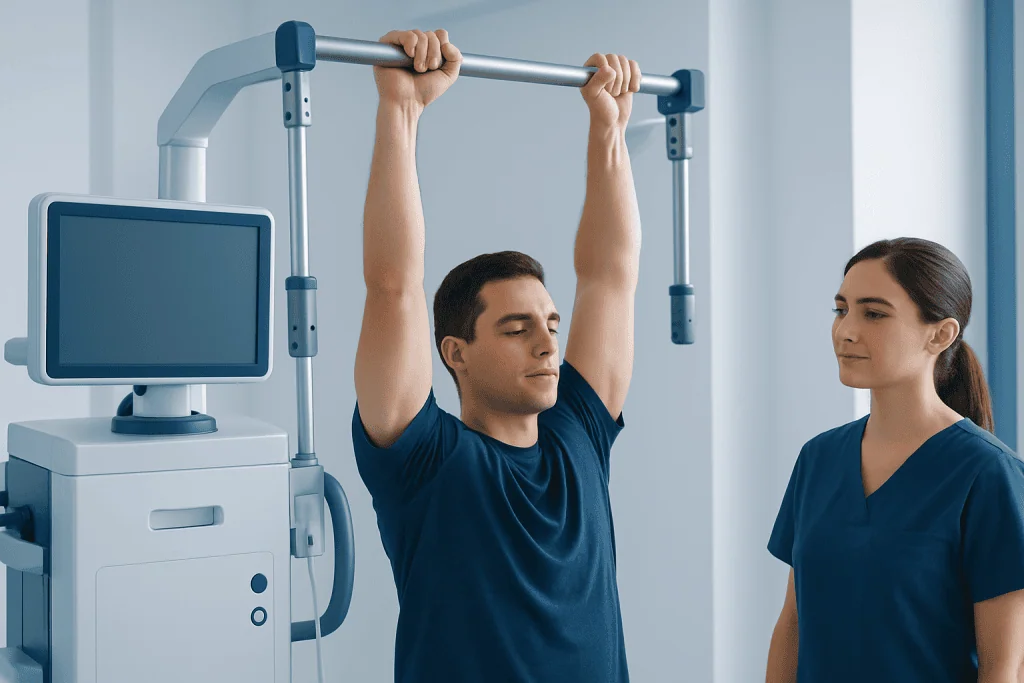
When performed well, dead hangs may improve grip strength and endurance because the muscles of the forearm and hand must maintain continuous tension. They can also challenge the stabilizing muscles around the shoulders, including the lower trapezius, serratus anterior, and rotator cuff. Over time, this may support better overhead control for sports, climbing, gymnastics, and everyday tasks that involve reaching.
Some people also use dead hangs as a way to practice shoulder mobility. Hanging places the shoulder in a fully elevated position, which can help a person gradually tolerate overhead movement if it is already comfortable. A mild stretching sensation through the shoulders, chest, and sides of the body may be normal. Temporary muscular fatigue in the forearms, hands, and upper back is also expected.
What should not be considered normal is sharp pain, pinching in the front or top of the shoulder, numbness in the hands, or a sense that the shoulder is slipping or unstable. These signs suggest that the exercise may be too advanced, incorrectly performed, or unsuitable because of an existing condition. In those cases, assessment and sometimes physical therapy and rehabilitation can help identify safer alternatives.
Who should be cautious or avoid dead hangs

Dead hangs are not ideal for everyone. People with recent injuries to the shoulder, elbow, wrist, hand, or neck should be cautious, particularly if the injury affects weight-bearing or overhead movement. This includes tendon irritation, ligament sprains, fractures, postoperative recovery, and active inflammation. Hanging may also aggravate symptoms in people with shoulder impingement, labral injuries, recurrent shoulder dislocation, or certain nerve compression syndromes.
People with limited shoulder mobility may compensate by shrugging excessively, arching the lower back, or gripping in a strained position. These patterns can increase stress on joints and soft tissues. Children and adolescents involved in climbing or gymnastics may be especially prone to overuse if volume is increased too quickly. Older adults may also need modifications if they have arthritis, reduced grip strength, or balance concerns when mounting or dismounting the bar.
Caution is also reasonable for anyone with dizziness, fainting tendencies, uncontrolled blood pressure problems, or conditions affecting circulation in the arms. Although dead hangs are usually brief, they place the body in an overhead suspended position that may not be comfortable or appropriate for every medical situation. If there is uncertainty, a clinician can help decide whether the exercise is safe and what adjustments may be needed.
Common problems, symptoms, and warning signs
The most common complaints during dead hangs are hand fatigue, forearm burning, shoulder tightness, and difficulty maintaining the grip. These are often training-related and may improve gradually with shorter hold times and better technique. Mild muscle soreness afterward can be normal, particularly in beginners. Soreness should settle within a reasonable period and should not interfere significantly with daily movement.
More concerning symptoms include pain located deep in the shoulder joint, clicking associated with pain, pain that continues after the exercise ends, swelling, bruising, or reduced range of motion. Tingling, numbness, color changes in the fingers, or weakness in the hand can suggest irritation of nerves or blood vessels and should not be ignored. Wrist or elbow pain may reflect excessive load, poor hand position, or a preexisting tendon problem.
If overhead activities are already painful, dead hangs may worsen the issue rather than help it. Conditions such as shoulder impingement syndrome can make hanging uncomfortable because the tissues around the shoulder are already sensitive. Persistent symptoms deserve medical assessment to clarify whether the discomfort is due to exercise overload, movement mechanics, or an underlying musculoskeletal condition.
How dead hangs are assessed in a medical setting
Dead hangs themselves are not a medical diagnosis, but symptoms related to them can point to underlying issues. A clinician usually begins by asking when the pain started, whether there was an injury, what position causes symptoms, and whether there is numbness, weakness, or instability. A physical examination may assess shoulder motion, grip strength, neck function, scapular control, and specific movements that reproduce discomfort.
In many cases, the problem can be understood through history and examination alone. If symptoms are severe, long-lasting, or linked to trauma, imaging may be recommended to evaluate bones, tendons, or joint structures. Depending on the symptoms, this may include X-ray, ultrasound, or MRI to look for tendon tears, labral injury, inflammation, or other structural causes.
The goal of assessment is not simply to decide whether hanging should stop. It is to identify why the exercise causes trouble and whether the person needs technique changes, activity modification, rehabilitation, or treatment for a specific diagnosis. This individualized approach is especially important for athletes, regular gym users, and people trying to return safely to overhead exercise.
Safe technique, progression, and treatment options for pain
For healthy adults without pain, safe dead hangs usually begin with a secure bar, a controlled step-up or platform, and a comfortable grip width around shoulder width. The body should stay relatively still, with the neck relaxed and the shoulders active rather than collapsing completely. Many people benefit from starting with short holds and gradually increasing time as tolerance improves. Using both feet on a support for partial bodyweight can be a useful first step.
If pain develops, the first response is usually to reduce or stop the provoking exercise and review form, training volume, and recovery. Some people improve by switching temporarily to easier variations such as supported hangs, scapular engagement drills, or non-hanging grip work. Ice, relative rest, and a gradual return may help simple overuse symptoms, but persistent pain should be professionally evaluated rather than repeatedly trained through.
Treatment depends on the cause. Rehabilitation may focus on shoulder blade control, rotator cuff strength, thoracic mobility, grip mechanics, and progressive loading. In selected cases, medical treatment may also involve pain management strategies, guided exercise therapy, or evaluation by an orthopedic specialist. When symptoms suggest a more significant structural problem, a consultation in orthopedics and traumatology may be appropriate.
Prevention, self-care, and when to seek medical care
Prevention starts with respecting current ability. A person is less likely to develop problems if they warm up the shoulders and forearms, increase hanging time gradually, and avoid combining dead hangs with sudden large increases in pull-ups, climbing, or heavy gripping work. Recovery also matters. Adequate rest between upper-body sessions and attention to technique can reduce overload on tendons and joints.
It is often helpful to stop a set before grip failure, especially for beginners. A neutral wrist position, smooth breathing, and controlled entry and exit from the bar can make the exercise safer. If one shoulder feels very different from the other, or if there is repeated discomfort in the same area, pushing through is usually not the best option. Modifying the exercise early is often easier than recovering from a more established overuse injury.
Medical care is recommended if pain is sharp, symptoms persist for more than a short period despite rest, or there is swelling, weakness, instability, numbness, or loss of movement. Immediate care is important after a fall, a sudden tearing sensation, or obvious joint deformity. For international patients who need assessment, Acibadem International’s multidisciplinary specialists and JCI-accredited hospitals diagnose and treat shoulder, arm, and sports-related conditions with individualized care plans.
Frequently asked questions
Are dead hangs good for the shoulders?
Dead hangs may help some people improve shoulder tolerance to overhead positions and strengthen supporting muscles around the shoulder girdle. However, they are not automatically beneficial for every shoulder, especially if there is pain, instability, or limited mobility.
Can dead hangs help posture?
They may support better upper-body control by strengthening grip and muscles involved in shoulder blade positioning. Still, posture is influenced by many factors, so dead hangs should be seen as one exercise option rather than a complete posture solution.
Why do dead hangs hurt my shoulders?
Shoulder pain during dead hangs can result from poor technique, doing too much too soon, limited mobility, tendon irritation, or an underlying shoulder condition. Pain that is sharp, persistent, or associated with weakness or instability should be assessed by a healthcare professional.
How long should a beginner do dead hangs?
Beginners usually do best with short, controlled holds rather than long maximal efforts. The exact duration varies, but the exercise should stop before pain, loss of form, or sudden grip failure occurs.
Are dead hangs safe every day?
Daily dead hangs may be tolerated by some well-conditioned individuals, but they are not necessary for everyone. Muscles, tendons, and joints often benefit from recovery time, especially when other pulling or gripping exercises are also part of the routine.
Do dead hangs decompress the spine?
Some people feel a temporary sense of relief or stretching through the upper body while hanging. This does not mean dead hangs treat spinal disorders, and anyone with back pain, nerve symptoms, or known spinal disease should seek personalized medical advice before using them for symptom relief.
This article is for general information only and is not a substitute for professional medical advice. Please consult a qualified doctor about your individual situation.
Joint and spine care in Turkey — expert assessment & treatment
JCI-accredited · board-certified surgeons · reply within 24h
Add us as a Preferred Source to see more of our trusted health content across Google Search, AI Overviews and Discover.
Check your numbers in seconds
BMI, calories, due date, blood pressure and 30+ more clinical calculators — free, instant, doctor-reviewed ranges.

More from the Health Library

Appetite: What Patients Need to Know

Wet Dandruff: A Complete Medical Overview

Benjamin Button Illness: What Patients Need to Know

Eye Crust — Explained by Medical Evidence, Not Myths

Aspartame: A Complete Medical Overview