Eye Scratch Treatment: How It Works, Results and What to Expect

An eye scratch usually means a corneal abrasion, a surface injury to the clear front layer of the eye. Treatment may include lubricating drops, antibiotic eye medicine when appropriate and pain relief recommended by a clinician.
Key Takeaways
- An eye scratch usually means a corneal abrasion, a surface injury to the clear front layer of the eye.
- Treatment may include lubricating drops, antibiotic eye medicine when appropriate and pain relief recommended by a clinician.
- Contact lenses should not be worn until the eye has healed and an eye professional says it is safe.
- Worsening pain, light sensitivity, discharge or reduced vision needs prompt medical assessment.
- Most small abrasions heal quickly, but deeper injuries, infection and chemical exposure require urgent care.
Eye scratch treatment usually involves protecting the cornea, controlling discomfort and checking for infection or a retained foreign body. Many minor corneal abrasions heal within one to three days, but an eye examination is important when pain, vision changes or symptoms are significant.
Eye Scratch Treatment: How It Works
Eye scratch treatment addresses an injury to the cornea, the clear, sensitive tissue covering the front of the eye. The medical name is a corneal abrasion. It can happen after dust, sand, a fingernail, makeup applicator, contact lens or small foreign object rubs against the eye. Treatment focuses on confirming the cause of symptoms, keeping the eye comfortable and supporting safe healing.
For a minor abrasion, the corneal surface often repairs itself quickly. A clinician may recommend preservative-free lubricating drops or ointment, pain-relieving medicine and, in some cases, antibiotic eye drops or ointment to lower the chance of infection. The best plan depends on the injury, contact lens use, the possibility of contamination and the findings of the eye examination.
It is important not to rub the eye, try to remove an embedded object or use leftover prescription eye drops. Steroid-containing drops can delay healing or worsen certain infections unless prescribed by an eye specialist. Numbing drops used during an examination should not be used at home because they can mask worsening injury and harm the cornea with repeated use.
Symptoms, Causes and Who May Need Assessment
A corneal abrasion may cause sharp pain, a gritty or foreign-body sensation, tearing, redness, blinking or eyelid spasm. The eye can be sensitive to light, and vision may become temporarily blurred. Symptoms can feel severe even when the scratch is small because the cornea contains many nerve endings.
Common causes include accidental rubbing, an injury from a fingernail or plant material, airborne particles, poorly fitting or damaged contact lenses, and trauma during sports or work. A scratch can also occur if a foreign body remains beneath the upper eyelid. People who use contact lenses should be assessed carefully, as they have a higher risk of some corneal infections.
Not every painful red eye is a scratch. Dry eye, conjunctivitis, inflammation inside the eye and corneal infection can produce overlapping symptoms. An examination is especially valuable if there was a high-speed injury, metal exposure, a chemical splash, previous eye surgery, a weakened immune system or symptoms that do not begin to improve promptly.
How Eye Scratch Treatment Is Assessed Step by Step

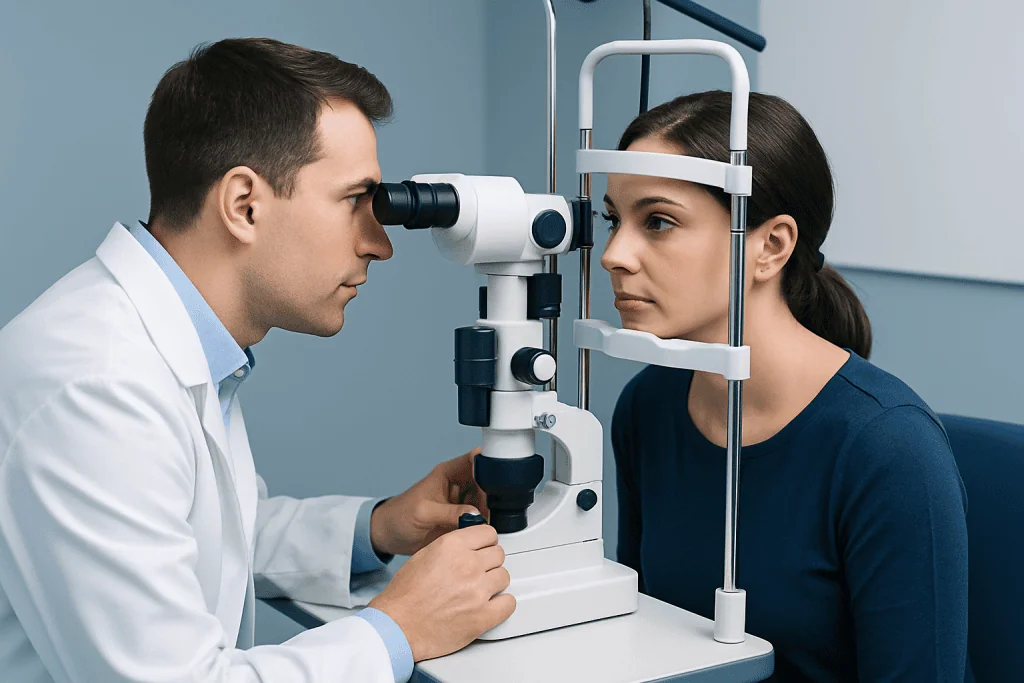
At urgent care, an eye clinic or emergency department, a clinician first asks how the injury occurred, when symptoms began and whether the person wears contact lenses. They will check vision in each eye, examine the eyelids and look for redness, discharge, pupil changes or signs of more serious trauma.
A harmless orange dye called fluorescein is commonly placed in the eye. Under blue light, it highlights breaks in the corneal surface and can help show their size and location. The eyelid may be gently turned outward to look for a hidden particle. If a superficial object is present, a trained clinician may remove it safely.
Further testing or urgent referral to an ophthalmologist may be needed if there is penetrating trauma, an irregular pupil, significant loss of vision, a suspected embedded object or concern for infection. Imaging is sometimes used after high-velocity injuries, but it is not routinely needed for an uncomplicated surface scratch.
- Vision testing helps establish whether the injury is affecting sight.
- Fluorescein staining identifies and maps a corneal abrasion.
- Eyelid examination can reveal retained dust, metal or other material.
- Follow-up is based on abrasion size, symptoms and individual risk factors.
Treatment Options, Benefits and Possible Risks
The purpose of treatment is to allow the corneal epithelium, its outer cell layer, to regrow while minimizing pain and avoiding infection. Lubricating drops can reduce friction during blinking. A clinician may prescribe antibiotic ointment or drops, particularly when the injury is contaminated, the scratch is more extensive or the person wears contact lenses. Contact lens wear should stop until healing is complete and medical advice confirms that lenses can be used again.
Oral pain relievers may be appropriate for some people. In selected cases, an eye clinician may use other short-term treatments for significant pain. Patching is not routinely recommended for simple corneal abrasions because it generally does not improve healing and can make it harder to monitor symptoms. Larger or more complex injuries may require closer follow-up, a protective bandage contact lens placed by an eye specialist or other individualized care.
The expected benefit is prompt symptom relief and uncomplicated healing. Risks mainly arise when a scratch is untreated, a foreign body is missed, prescribed treatment is not followed or infection develops. Contact lens-related abrasions deserve particular caution because certain bacteria can cause a rapidly progressive corneal infection. If pain, redness, discharge, light sensitivity or blurred vision worsens, prompt reassessment is needed.
How Quickly Does an Eye Scratch Heal?
Small, uncomplicated corneal abrasions often heal within 24 to 72 hours. A larger abrasion, an injury involving a foreign body, repeated irritation from blinking or contact lens-related injury may take longer. Symptoms should generally become noticeably better rather than progressively worse.
The surface can look healed before all discomfort has fully settled, and some people have temporary sensitivity or dryness afterward. Occasionally, the surface cells do not adhere firmly as they heal, causing recurrent corneal erosion with repeated pain, often on waking. Recurrent symptoms should be evaluated by an ophthalmologist.
A follow-up examination may be recommended within a day, particularly for contact lens wearers, larger abrasions, ongoing symptoms or uncertain diagnosis. Follow the clinician’s plan even if the eye feels better quickly.
How to Speed Up Eye Scratch Healing?
The safest way to support healing is to avoid further irritation and use treatments exactly as prescribed. Rest the eyes when comfortable, wash hands before touching the face or applying eye medicine, and use lubricants or medication recommended by the treating clinician. Sunglasses may make light sensitivity more manageable outdoors.
Do not rub or press on the eye. Avoid contact lenses, eye makeup and swimming until the eye has healed and a clinician advises that these activities are safe. Do not use another person’s eye drops, leftover antibiotics, redness-relieving drops or topical anesthetic drops. These may irritate the eye, hide important symptoms or be unsuitable for the cause of the injury.
If a particle may be on the eye surface, gently rinsing with clean water or sterile saline can be reasonable, but this should not delay care for persistent pain, vision changes or a suspected embedded object. Protective eyewear during home repairs, sports, gardening and work involving particles helps prevent future injuries.
How to Sleep With a Corneal Abrasion?
Sleeping can be difficult when a corneal abrasion causes pain, tearing or light sensitivity. Using any prescribed ointment at bedtime and taking clinician-approved pain medicine before sleep may help. A clean, cool compress over the closed eyelid can also be soothing for some people, provided there is no pressure on the eye.
People should avoid sleeping in contact lenses, even if the eye feels somewhat better. Keeping the bedroom dim and avoiding direct airflow from a fan or air conditioner may reduce dryness and irritation. If an eye shield has been specifically provided after an injury or procedure, it should be used according to the clinician’s instructions.
Severe pain that prevents sleep, increasing discomfort overnight, nausea with eye pain, worsening redness or any new change in vision should not simply be managed at home. These symptoms warrant urgent professional advice.
What Will Urgent Care Do for a Scratched Eye?
Urgent care commonly checks vision, examines the eye and uses fluorescein dye to confirm a corneal abrasion. The clinician may rinse the eye, inspect under the eyelid and remove a superficial foreign body when this can be done safely. They will also look for signs that point to a more serious injury or infection.
Depending on the findings, urgent care may recommend lubrication, prescribe antibiotic eye medicine or suggest pain management. They may advise avoiding contact lenses and arrange follow-up. If the examination suggests a deep injury, chemical burn, metal fragment, corneal ulcer, severe vision change or a problem needing specialized equipment, urgent care will refer the patient to emergency or ophthalmology services.
Acibadem International’s multidisciplinary specialists and JCI-accredited hospitals can assess and treat eye injuries for international patients when ophthalmic evaluation is needed.
When to Seek Medical Care
Medical assessment should be sought promptly for eye pain after an injury, particularly if there is blurred or reduced vision, marked light sensitivity, inability to keep the eye open, persistent foreign-body sensation, discharge or increasing redness. A person should seek urgent emergency care after a chemical splash, an injury involving a sharp object, high-speed metal or glass, or any suspicion that something has penetrated the eye.
Contact lens wearers with a painful red eye should not wait for symptoms to resolve on their own. They should remove the lenses and obtain same-day medical advice because infection can develop quickly. Anyone with diabetes, immune suppression, previous corneal disease or recent eye surgery should also have a lower threshold for evaluation.
For a simple abrasion that has been assessed, return for care if symptoms are not improving within 24 hours, are not resolved as expected, or worsen at any point. Early review helps protect vision and ensures that a different cause, retained foreign body or infection has not been missed.
Frequently asked questions
Can an eye scratch heal on its own?
Many small corneal abrasions heal on their own within one to three days because the corneal surface regenerates quickly. However, an examination is advisable when symptoms are significant, vision is affected, a foreign object may be present or the person wears contact lenses. Treatment may be needed to reduce discomfort and prevent infection.
Should a scratched eye be covered with an eye patch?
Eye patches are not routinely recommended for uncomplicated corneal abrasions. They do not usually speed healing and may make it more difficult to notice worsening symptoms. A clinician may give different instructions for a specific injury, so individual advice should be followed.
Can I use contact lenses after an eye scratch?
Contact lenses should not be worn while the cornea is healing. They can increase irritation and, in some situations, infection risk. Lenses should only be restarted after symptoms have resolved and a clinician has confirmed it is safe.
What should I avoid after scratching my eye?
Avoid rubbing the eye, wearing contact lenses, using eye makeup and swimming until healing is complete. Do not use leftover prescription drops, anesthetic drops or redness-relieving drops without medical guidance. These products may not be appropriate and can delay recognition of a problem.
How do I know whether an eye scratch is infected?
Increasing pain, redness, discharge, worsening light sensitivity, a white spot on the cornea or reduced vision can suggest infection or another complication. These signs need urgent eye assessment. Contact lens wearers should seek same-day care for a painful red eye.
Can a corneal abrasion cause permanent vision loss?
A simple, promptly treated corneal abrasion usually heals without permanent vision problems. Vision risk increases when there is deep trauma, a retained foreign body, scarring or infection. Prompt assessment is important if vision changes or symptoms are severe or worsening.
References
- American Academy of Ophthalmology
- National Eye Institute
- Mayo Clinic
- Merck Manual Consumer Version
This article is for general information only and is not a substitute for professional medical advice. Please consult a qualified doctor about your individual situation.
Explore treatments in Turkey — costs, top hospitals & a free quote
JCI-accredited · board-certified surgeons · reply within 24h
Add us as a Preferred Source to see more of our trusted health content across Google Search, AI Overviews and Discover.

More from the Health Library



Related Specialists

Dr. Özkan Uysal
Internal Medicine
Prof. Dr. Tayyar Sarioğlu
Cardiovascular Surgery
Prof. Dr. Bülent Tutluoğlu
Pulmonary Medicine
Assoc. Prof. Dr. Hayrettin Dizen
General Surgery