Organoids Screening Enhancers: How It Works, Results and What to Expect

Organoids are three-dimensional cell models grown from tissue samples in specialized laboratories. Screening enhancers may improve organoid growth, consistency, imaging, or the ability to test multiple medicines.
Key Takeaways
- Organoids are three-dimensional cell models grown from tissue samples in specialized laboratories.
- Screening enhancers may improve organoid growth, consistency, imaging, or the ability to test multiple medicines.
- Organoid testing is mainly used in research and is not appropriate or available for every patient or condition.
- Results may provide additional information for treatment planning, but they cannot reliably predict every person’s response.
- The tissue-sampling procedure and underlying medical condition determine most practical risks and recovery needs.
Organoids screening enhancers are laboratory approaches that improve the growth, testing, and interpretation of miniature tissue models called organoids. They may support research and selected precision-medicine programs by helping clinicians study how an individual’s cells respond to different treatments, but they do not replace standard diagnosis or clinical trial evidence.
Overview: What Are Organoids Screening Enhancers?
Organoids screening enhancers are tools, laboratory methods, and supportive substances used to make organoid-based testing more reliable or informative. Organoids are small, three-dimensional groups of cells grown from a person’s tissue sample. Under carefully controlled conditions, the cells can organize in ways that reproduce selected features of an organ, healthy tissue, or a tumor.
In drug screening, researchers expose organoids to different medicines and observe changes such as cell growth, cell death, structure, or activity. Enhancers may include optimized culture materials, growth factors, laboratory matrices, automated imaging, molecular testing, and computer-based analysis. Their purpose is to help create models that are more consistent and more useful for evaluating possible treatment responses.
This field is often discussed in relation to precision medicine, particularly in cancer care. However, organoid testing remains an evolving area. It may complement established pathology, imaging, genetic testing, and multidisciplinary clinical decision-making; it should not be viewed as a stand-alone way to diagnose disease or choose treatment.
How does organoid work?
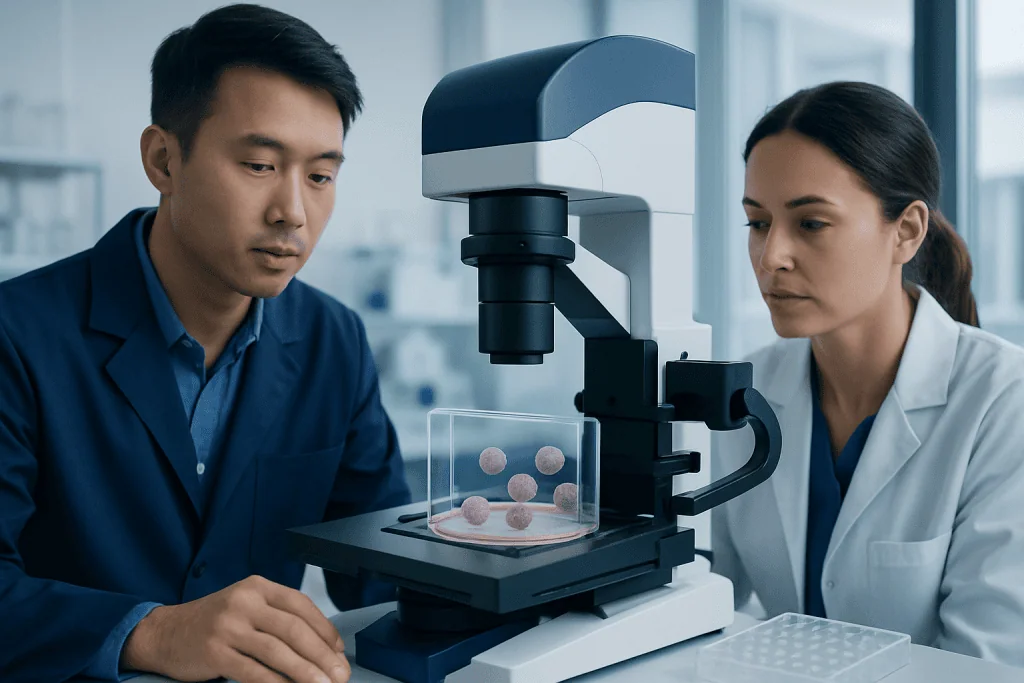
An organoid begins with cells collected from a tissue sample. Depending on the clinical question, the sample may come from a biopsy, surgical tissue, blood-derived cells, or another clinically appropriate source. In a laboratory, trained specialists isolate suitable cells and place them in a nutrient-rich environment designed to support growth.
Cells are grown in three dimensions rather than as a flat layer in a dish. This arrangement can allow them to communicate, divide, and form structures that resemble certain aspects of the original tissue. A cancer organoid, for example, may preserve some biological characteristics of the patient’s tumor, although it cannot reproduce every feature of the tumor and its environment in the body.
Once enough organoids have grown, the laboratory may test selected treatments. Researchers measure predefined endpoints, such as whether a treatment slows growth or causes cellular damage. Results are reviewed alongside the quality of the organoid model, the type of tissue, available evidence, and the patient’s overall clinical situation.
Because organoids take time to establish and not every sample grows successfully, they are usually considered an additional source of information. Standard tests and treatments should not be delayed unless the treating team believes waiting is clinically safe and appropriate.
Can organoids be used in drug screening?

Yes. Organoids can be used in drug screening to study how tissue models respond to existing medicines, combinations of medicines, or investigational compounds. They are useful in research because they may reflect human biology more closely than some traditional two-dimensional cell cultures.
In oncology, patient-derived tumor organoids may be screened against therapies that are already considered relevant to the cancer type. This may help researchers identify patterns worth discussing within a multidisciplinary cancer team. It can also support laboratory research into treatment resistance and the development of new therapies.
However, an organoid response in a laboratory does not guarantee that the same response will occur in a person. Drug absorption, immune-system activity, blood supply, treatment side effects, other health conditions, and tumor behavior can all affect real-world outcomes. For this reason, treatment decisions remain based on established clinical guidelines, pathology findings, imaging, molecular tests, and clinician judgment.
For people being evaluated for cancer treatment, organoid-based work may be considered alongside established services such as chemotherapy or immunotherapy when these are clinically indicated. The treating oncologist can explain whether an organoid program is available, validated for the specific disease, and likely to add useful information.
Candidacy and the Step-by-Step Process
There is no universal eligibility rule for organoid testing. A person may be considered when a suitable tissue sample is available, the laboratory has experience with the relevant tissue type, and the anticipated information could reasonably support a research question or a clinical discussion. It is most commonly explored in specialized settings, including selected cancer programs.
The process usually begins with a consultation and review of the diagnosis, prior tests, treatment history, and available tissue. The clinical team determines whether existing stored tissue can be used or whether a new sample may be needed. A new biopsy is only considered when it is medically appropriate and its potential benefit outweighs the risks.
After collection, the sample is transported and processed under controlled laboratory conditions. Cells are grown to form organoids, checked for quality, and then exposed to selected treatment options. The laboratory may use imaging, cell-viability measurements, genetic analysis, or other techniques to assess the response.
The final report, if a usable model is produced, should be interpreted by qualified clinicians and laboratory specialists. In cancer care, this may include medical oncologists, surgeons, pathologists, radiologists, genetic specialists, and other members of the care team. Cancer care remains individualized, and organoid findings are only one part of the broader clinical picture.
Expected Timeline, Benefits, and Limitations
There is no standard recovery period from organoid growth itself because the organoids are developed in a laboratory, not inside the body. Recovery depends on how the tissue was obtained. If no new procedure is needed, there may be no physical recovery at all. After a biopsy or surgery, the care team provides procedure-specific aftercare instructions.
The timeline from sample collection to a result varies. Some organoids may establish quickly, while others require more time or do not grow successfully. Testing can also take additional time, especially if multiple medicines or detailed molecular analyses are included. Patients should ask whether results are likely to be available in time to influence a treatment decision.
Potential benefits include a more biologically relevant laboratory model, the opportunity to examine several candidate treatments, and insights into how a tumor or tissue may behave. Organoids may also reduce reliance on some animal-based experiments during early drug research. They can be especially valuable for scientific discovery and for understanding why treatments sometimes stop working.
Important limitations include variable success rates, costs and access that differ between programs, the need for specialized expertise, and uncertain ability to predict an individual clinical outcome. Organoids may lack important elements of the human body, including a full immune system, blood vessels, hormones, and interactions with surrounding tissues. Results therefore require careful interpretation rather than a simple “works” or “does not work” conclusion.
Do organoids feel pain?
No. Organoids do not feel pain. They are laboratory-grown cell structures and do not have a nervous system, brain, consciousness, or the organized sensory pathways required to experience pain.
Some organoids may contain cell types related to nerve tissue or may show electrical activity in research settings. This does not mean they are aware or able to suffer. Research involving organoids is subject to ethical oversight, institutional policies, and applicable regulations.
A person may feel discomfort only if a tissue sample needs to be collected through a medical procedure, such as a biopsy. Clinicians discuss the reason for the procedure, possible discomfort, pain-control options, and aftercare before obtaining consent.
What Are the Disadvantages of Organoids?
The main disadvantage is that an organoid is a model, not a complete organ or a complete representation of a person’s disease. Even when it originates from a patient’s own tissue, it may not capture all the cells, immune responses, blood supply, microbiome influences, or environmental factors that affect health and treatment response.
Not every sample can produce a successful organoid. Tissue may contain too few viable cells, may not grow in the laboratory, or may change over time in culture. Laboratory methods also differ between centers, which can make it difficult to compare results across programs or establish identical standards for every disease.
Testing may take longer than is practical for urgent clinical decisions. A result can also be uncertain or difficult to act upon if the tested medicine is not clinically appropriate, has unacceptable side effects, or is not supported by evidence for the person’s diagnosis. Organoid testing should never lead someone to stop prescribed treatment without discussing it with their treating doctor.
These limitations do not mean organoids lack value. Rather, they show why organoid-based screening is best used as part of carefully governed research or specialist-led precision medicine, alongside established diagnostic and treatment pathways.
When to Seek Medical Care
People should seek medical care for new, persistent, or worsening symptoms rather than relying on laboratory testing to determine what is wrong. Symptoms such as unexplained bleeding, a new or changing lump, persistent pain, unexplained weight loss, prolonged fever, worsening shortness of breath, or marked changes in bowel or urinary habits should be assessed by a qualified clinician.
After a biopsy, patients should contact their care team promptly if they develop increasing redness, swelling, drainage, fever, heavy bleeding, severe pain, or symptoms that do not improve as expected. Urgent or emergency assessment is needed for severe breathing difficulty, chest pain, fainting, sudden weakness, or uncontrolled bleeding.
Questions about organoid screening are best discussed with the specialist managing the underlying condition. Acibadem International’s multidisciplinary specialists and JCI-accredited hospitals evaluate and treat patients from abroad, including people seeking individualized cancer care and related diagnostic assessment.
Frequently asked questions
What are organoids screening enhancers?
Organoids screening enhancers are laboratory methods or materials that help organoids grow, remain stable, or be tested more effectively. They can include specialized culture systems, imaging tools, molecular assays, and data-analysis methods. Their goal is to improve the usefulness of organoids for research and selected clinical programs.
How does organoid work?
A tissue sample provides cells that are grown in a controlled three-dimensional laboratory environment. The cells can form structures with some features of the original tissue. Researchers can then observe how the organoids respond to selected medicines or other conditions.
Can organoids be used in drug screening?
Yes, organoids can be used to test how laboratory-grown tissue models respond to medicines. This is valuable in drug development and may support precision-medicine research. A laboratory response does not guarantee the same response in a patient, so results must be interpreted with other clinical evidence.
Do organoids feel pain?
No. Organoids do not have a brain, consciousness, or functioning nervous system and cannot experience pain. Any discomfort related to organoid testing would involve tissue collection, if a biopsy or other sampling procedure is needed.
What are the disadvantages of organoids?
Organoids cannot fully reproduce the complexity of the human body, including blood flow, immune activity, and interactions among different organs. Some samples do not grow successfully, and results may not be available quickly enough for urgent decisions. Methods are still evolving, so clinical usefulness varies by disease and treatment question.
Does organoid testing replace genetic testing or a biopsy?
No. Organoid testing does not replace pathology, imaging, genetic testing, or standard biopsy assessment. It may provide complementary information in certain specialist settings. The treating clinician decides which tests are appropriate based on the person’s diagnosis and care needs.
References
- National Cancer Institute
- U.S. Food and Drug Administration
- National Institutes of Health
- World Health Organization
- European Medicines Agency
This article is for general information only and is not a substitute for professional medical advice. Please consult a qualified doctor about your individual situation.
Explore treatments in Turkey — costs, top hospitals & a free quote
JCI-accredited · board-certified surgeons · reply within 24h
Add us as a Preferred Source to see more of our trusted health content across Google Search, AI Overviews and Discover.