Prostate Size Ultrasound Normal: Preparation, Procedure and Results
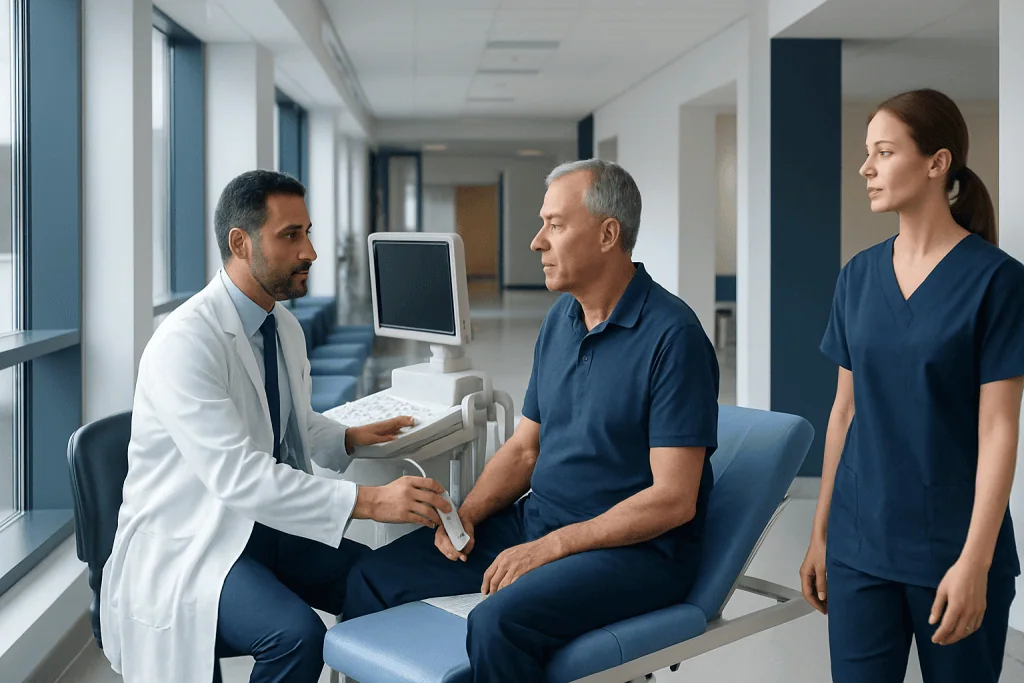
Prostate ultrasound estimates gland volume in millilitres (mL), which is approximately the same as cubic centimetres (cc). Prostate size commonly increases with age, often because of benign prostatic hyperplasia (BPH).
Key Takeaways
- Prostate ultrasound estimates gland volume in millilitres (mL), which is approximately the same as cubic centimetres (cc).
- Prostate size commonly increases with age, often because of benign prostatic hyperplasia (BPH).
- A larger prostate does not always cause severe symptoms, and significant symptoms can occur with a relatively small prostate.
- Transabdominal ultrasound is performed over the lower abdomen; transrectal ultrasound provides more detailed prostate imaging.
- Ultrasound findings should be interpreted by a urologist alongside urinary symptoms, examination and relevant blood tests.
A prostate size ultrasound measures the gland’s dimensions and calculates its volume, helping clinicians assess urinary symptoms, benign enlargement and other prostate concerns. Although a volume of roughly 20–30 mL is often cited for younger adults, there is no single normal result for every age; symptoms, examination findings and PSA results also matter.
Prostate Size Ultrasound Normal: What the Result Means
A prostate size ultrasound normal result does not have one fixed number for every person. In many younger adults, the prostate is commonly around 20–30 mL (or cc), but it often becomes larger gradually with age. A clinician interprets the measurement together with urinary symptoms, medical history, examination findings and, when appropriate, prostate-specific antigen (PSA) testing.
The prostate is a walnut-sized gland below the bladder that surrounds part of the urethra, the tube that carries urine out of the body. It contributes fluid to semen. With ageing, non-cancerous growth of prostate tissue is common and may narrow the urethra, affecting urine flow. This condition is called benign prostatic hyperplasia (BPH).
Ultrasound is useful because it can estimate prostate volume, assess bladder emptying and help guide further testing when needed. It cannot, by itself, diagnose prostate cancer or determine whether an enlarged prostate needs treatment. Results are best viewed as one part of a broader urological assessment.
How Prostate Ultrasound Works and Who May Need It
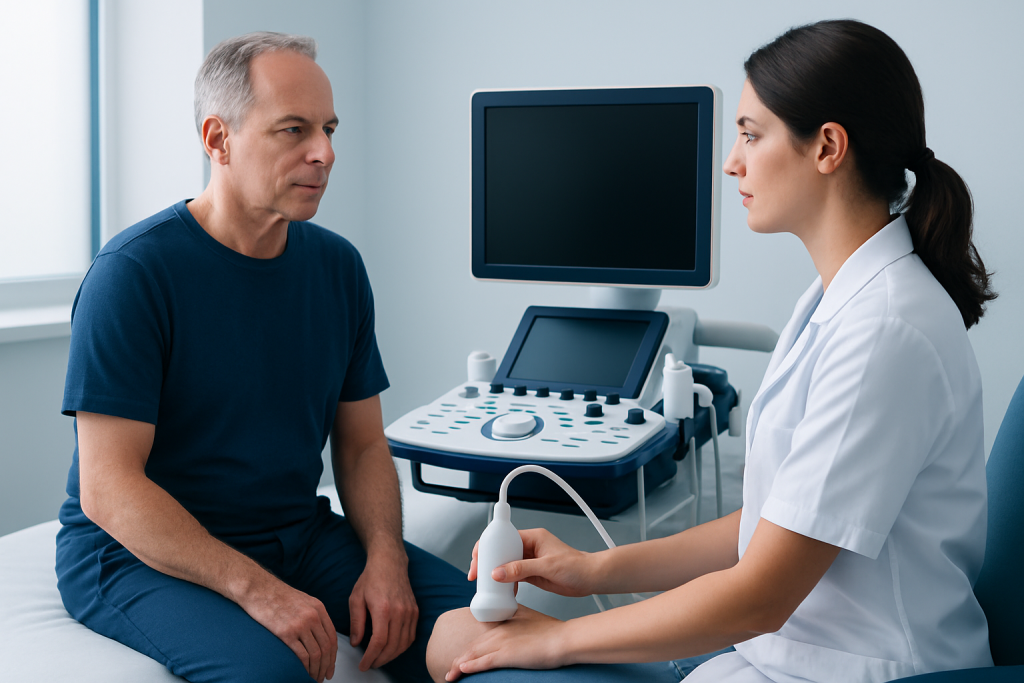
Ultrasound uses sound waves rather than radiation to create images. A computer converts returning sound-wave signals into images and measurements. The sonographer or radiologist typically records the prostate’s length, width and height, then uses these values to estimate its volume.
A clinician may request this examination for difficulty starting urination, a weak stream, frequent urination, waking at night to urinate, a feeling of incomplete bladder emptying, recurrent urinary tract infections or blood in the urine. It may also be used to measure residual urine left in the bladder after urination.
There are two common approaches. A transabdominal scan is done with a probe on the lower abdomen and may provide an overall estimate of prostate size. A transrectal ultrasound, often called TRUS, places a slim covered probe a short distance into the rectum and usually provides clearer detail of the prostate. The most suitable approach depends on the clinical question and local practice.
- Transabdominal ultrasound may be chosen for an initial assessment of urinary symptoms and bladder emptying.
- Transrectal ultrasound may be used for more accurate prostate imaging or to guide a biopsy when clinically indicated.
- Not every person with urinary symptoms needs prostate ultrasound; a clinician considers individual symptoms and test findings.
How Should I Prepare for a Prostate Ultrasound?

Preparation depends on the type of scan. For a transabdominal prostate ultrasound, patients are often asked to arrive with a comfortably full bladder. Instructions may include drinking water in the hour before the appointment and avoiding urination until after the first part of the examination. The imaging centre should provide its specific guidance, as requirements can vary.
For a transrectal ultrasound, preparation may include an enema beforehand to empty the rectum. Some patients may also be advised to pause certain medicines, particularly blood-thinning medicines, if a biopsy is planned. No one should stop prescribed medication without specific advice from the clinician managing it.
Patients should tell the care team about allergies, rectal conditions such as active haemorrhoids or fissures, previous prostate procedures, infections and all regular medicines. Comfortable clothing can make the visit easier. Eating and drinking are usually allowed unless the centre has given different instructions.
If uncertainty remains, it is sensible to contact the imaging department before the appointment. Following the supplied preparation instructions helps obtain clearer images and can reduce the need to repeat part of the scan.
What Happens During the Procedure?
For a transabdominal scan, the patient usually lies on an examination couch. Gel is placed on the lower abdomen, and the clinician moves a handheld transducer over the skin. The gel may feel cool, and mild pressure may be felt over a full bladder. Images of the bladder and prostate are recorded, often before and after urinating.
For a transrectal scan, the patient commonly lies on their side with knees bent. A narrow ultrasound probe covered with a protective sheath and lubricating gel is inserted gently into the rectum. The probe is moved slightly to capture images from different angles. The examination itself is often brief, though the overall appointment may take longer because of registration, preparation and discussion.
The clinician may calculate the prostate volume using the formula for an ellipsoid-shaped structure. Measurements are reported in mL or cc, which are equivalent units. The report may also describe the gland’s appearance, any asymmetry, calcifications or cysts, and the amount of urine remaining after voiding.
When a biopsy is planned, additional preparation and consent are required. A biopsy is a separate procedure from diagnostic ultrasound and has its own risks, including bleeding and infection. The clinician should explain why it is being considered and what alternatives may be appropriate.
How Uncomfortable Is a Prostate Ultrasound?
A transabdominal prostate ultrasound is generally painless. The main sensation is the pressure of the probe against the lower abdomen, which can feel more noticeable when the bladder is full. The scan does not involve needles, radiation or cuts in the skin.
A transrectal prostate ultrasound can feel uncomfortable or unfamiliar because of pressure in the rectum, but it should not be sharply painful. Lubrication, slow insertion and clear communication can make the examination more tolerable. Patients should tell the clinician immediately if they have pain, anxiety or difficulty continuing.
After a routine ultrasound without biopsy, most people can return to usual activities straight away. There is generally no recovery period, sedation or driving restriction. If an examination includes a biopsy or another intervention, aftercare instructions will be different and should be followed carefully.
The benefits of ultrasound include no ionising radiation, real-time imaging and the ability to estimate both prostate size and post-void residual urine. Its limitations are equally important: image quality can vary, and ultrasound does not replace a clinical evaluation for possible infection, obstruction or cancer.
What Is the Normal Prostate Volume for a 70 Year Old?
There is no single normal prostate volume for a 70-year-old. The prostate commonly enlarges with age, and a volume above the range often quoted for younger adults may still be consistent with age-related benign enlargement. Some men in their seventies have a prostate around 30–40 mL, while others have substantially different measurements without the size alone establishing whether there is a problem.
Clinicians often consider a prostate volume above about 30 mL enlarged, but this is a practical clinical reference point rather than a diagnosis. The more important question is whether the prostate contributes to bothersome symptoms, bladder obstruction, recurrent infections, urinary retention, kidney effects or other complications.
Prostate volume and symptoms do not always match. A person with a moderately enlarged gland may have minimal urinary difficulty, while another person with a smaller prostate may experience a weak stream or urgency because of the location of growth, bladder changes or another urinary condition. This is why treatment decisions are not based on volume alone.
A urologist may combine the ultrasound result with a symptom questionnaire, urine testing, digital rectal examination, PSA testing when appropriate and measurement of urine flow. This fuller assessment helps distinguish BPH from other possible causes of urinary symptoms.
What Is the Typical Size of an Enlarged Prostate on an Ultrasound?
An enlarged prostate on ultrasound is often described when the estimated volume is greater than about 30 mL. Mild enlargement may be in the 30–40 mL range, while larger glands may measure 50 mL, 80 mL or more. These categories are descriptive only; they do not reliably predict symptom severity or the need for a procedure.
Benign enlargement can occur in different patterns. Growth in the transition zone around the urethra may affect urine flow more than an equal amount of growth elsewhere. Ultrasound may also identify a protrusion of prostate tissue into the bladder, which can be relevant when assessing obstruction, although the overall clinical picture remains essential.
Treatment may range from monitoring and lifestyle adjustments to medicines or procedures, depending on symptoms and complications. For people whose symptoms significantly affect daily life or who develop complications, a urologist can discuss appropriate prostate surgery options alongside non-surgical approaches.
A large measurement should not be interpreted as cancer, and a normal-sized gland does not rule out cancer. Concerning examination findings, changes in PSA, persistent symptoms or suspicious imaging may lead to additional evaluation, which can include MRI or biopsy where medically appropriate.
Self-Care, Follow-Up and When to Seek Medical Care
For mild urinary symptoms, helpful measures may include reducing evening fluids, limiting alcohol and caffeine if they worsen urgency or frequency, allowing enough time to empty the bladder and addressing constipation. Keeping a short bladder diary can help identify patterns and give the clinician useful information. These measures do not shrink the prostate, but they may improve day-to-day comfort for some people.
Regular follow-up is important when a clinician has identified BPH, a raised post-void residual volume or recurring urinary symptoms. Follow-up plans vary and may include symptom review, urine tests, PSA testing where appropriate and repeat imaging. It is important not to self-treat persistent symptoms with supplements or medicines without medical advice, as some products can interact with prescribed treatment.
When to seek medical care: Prompt medical assessment is needed for an inability to urinate, fever or chills with urinary symptoms, visible blood in the urine, severe lower abdominal pain, new flank pain, or symptoms of a urinary infection. A non-urgent appointment is appropriate for ongoing changes in urine flow, frequent nighttime urination, urgency, dribbling or a persistent sensation that the bladder does not empty fully.
Acibadem International’s multidisciplinary specialists and JCI-accredited hospitals can assess prostate and urinary symptoms for international patients, using imaging and urology evaluation to guide individualized care. A qualified clinician can explain what an ultrasound finding means in the context of the person’s overall health.
Frequently asked questions
Is 30 mL a normal prostate size?
A prostate volume of about 30 mL may be near the upper end of the range commonly quoted for younger adults and is often used as a practical threshold for mild enlargement. However, it can be common in older adults and does not by itself mean treatment is needed. Symptoms, bladder emptying and other clinical findings are also important.
What does prostate volume mean on an ultrasound report?
Prostate volume is an estimate of the gland’s total size, calculated from its ultrasound measurements. It is usually reported in millilitres or cubic centimetres, which are equivalent. The result helps clinicians assess enlargement and plan further evaluation when necessary.
Can an ultrasound tell whether prostate enlargement is cancer?
No. Ultrasound can measure the prostate and show some structural features, but it cannot reliably diagnose or rule out prostate cancer. If there is clinical concern, a clinician may recommend PSA assessment, MRI, biopsy or other investigations.
Do I need a full bladder for a prostate ultrasound?
A full bladder is commonly requested for a transabdominal prostate ultrasound because it can improve visualization and allows measurement of urine left after voiding. A transrectal ultrasound has different preparation requirements and may involve bowel preparation instead. The imaging centre’s instructions should be followed.
How long does a prostate ultrasound take?
The scan itself often takes a short time, commonly around 15 to 30 minutes depending on the approach and whether bladder measurements are needed. The full appointment can take longer because of preparation, registration and discussion. A biopsy-guided examination may take more time and requires separate planning.
Can a large prostate become smaller without treatment?
Age-related benign prostate enlargement does not usually reverse on its own. Some urinary symptoms may improve with fluid timing and other lifestyle changes, while medicines can reduce symptoms and, in selected cases, reduce prostate volume. A urologist can help determine whether observation, medication or a procedure is appropriate.
References
- National Institute of Diabetes and Digestive and Kidney Diseases
- American Urological Association
- European Association of Urology
- National Health Service
- Radiological Society of North America
This article is for general information only and is not a substitute for professional medical advice. Please consult a qualified doctor about your individual situation.
Ultrasound in Turkey — costs, top hospitals & a free quote
JCI-accredited · board-certified surgeons · reply within 24h
Add us as a Preferred Source to see more of our trusted health content across Google Search, AI Overviews and Discover.

Check-up & Preventive Medicine
Comprehensive health screenings designed for early detection and prevention.
2 specialists in this unit