Recommendations for Mammography Screening: How It Works, Results and What to Expect

Many current guidelines recommend mammography every two years from ages 40 to 74 for women at average risk, while some support annual screening from age 40. People with a strong family history, inherited genetic variant, prior chest radiation or certain breast conditions may need earlier or additional screening.
Key Takeaways
- Many current guidelines recommend mammography every two years from ages 40 to 74 for women at average risk, while some support annual screening from age 40.
- People with a strong family history, inherited genetic variant, prior chest radiation or certain breast conditions may need earlier or additional screening.
- A mammogram is a short X-ray examination that compresses each breast briefly to create clear images.
- An abnormal mammogram does not by itself mean cancer; most recalls require further imaging and are not cancer.
- Screening decisions after age 70 should consider overall health, life expectancy, breast cancer risk and personal preferences.
Recommendations for mammography screening generally advise women at average risk to begin regular screening at age 40, although the best interval may vary by guideline, personal risk factors and preferences. Mammography can find breast changes before they cause symptoms, but it does not prevent breast cancer and sometimes leads to additional testing.
Overview: recommendations for mammography screening
Recommendations for mammography screening generally support regular breast X-ray screening for women from age 40, before symptoms develop. For people at average risk, many leading guidelines advise a mammogram every two years between ages 40 and 74, while other professional groups recommend offering annual screening from age 40. The most suitable schedule depends on an individual’s risk of breast cancer, health history and preferences.
Mammography is designed to detect small breast cancers and certain early changes, including calcifications, that may not be felt during a breast examination. Finding cancer early can increase treatment options and may reduce the chance that more extensive treatment is needed. However, screening also has possible downsides, including false-positive results, additional tests and the detection of some cancers that may never have caused symptoms.
These recommendations apply to people without breast symptoms. A new lump, nipple discharge, skin change or other breast concern requires diagnostic assessment rather than waiting for a routine screening appointment. Screening is one part of breast health care and does not replace breast awareness or medical evaluation of symptoms.
What is the recommendation for mammogram screening?
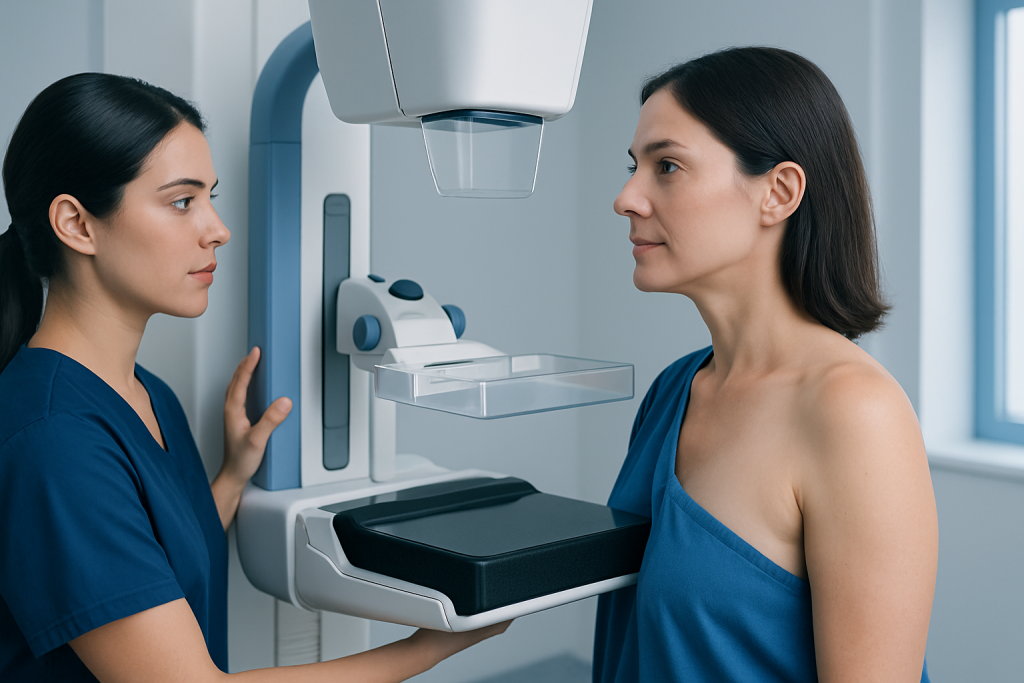
For women at average risk of breast cancer, the United States Preventive Services Task Force recommends screening mammography every two years from age 40 through 74. Other respected organizations, including the American Cancer Society and the American College of Radiology, also support starting at age 40 but may recommend or support annual screening. Different recommendations reflect different ways of balancing the benefits of earlier detection against the chance of false-positive findings and follow-up procedures.
Average risk generally means there is no known high-risk inherited gene variant, no previous chest radiation at a young age, no personal history of breast cancer, and no particularly strong family history. Breast density, previous biopsies and reproductive history can also influence risk. A clinician can help assess whether routine mammography alone is appropriate.
People at higher risk may be advised to start earlier, have screening every year, or have breast MRI in addition to mammography. Examples include carriers of BRCA1 or BRCA2 variants and people with a close relative carrying one of these variants. Screening plans should be individualized with a breast specialist, radiologist, genetic counselor or primary care clinician.
- Average risk: screening commonly begins at age 40.
- Higher risk: earlier and more intensive screening may be appropriate.
- Symptoms: diagnostic imaging should be arranged promptly, regardless of age or last screening date.
What are the new guidelines for mammogram screening in 2026?

As of 2026, a major current United States recommendation is biennial mammography for women aged 40 to 74 who are at average risk. This reflects the 2024 final recommendation from the United States Preventive Services Task Force. It lowered the routine starting age from 50 to 40 and recommends screening every other year rather than every year for this population.
Not all organizations use exactly the same interval. The American Cancer Society recommends that women aged 45 to 54 receive mammograms annually, with annual screening available from age 40, and that women aged 55 and older may move to every two years or continue annually. The American College of Radiology supports annual screening beginning at age 40 for average-risk women. Local national guidance may differ, particularly outside the United States.
There is not yet enough evidence for some organizations to make a universal recommendation about supplemental ultrasound or MRI solely because a person has dense breasts. Dense tissue can make mammograms more difficult to interpret and is associated with higher breast cancer risk, but additional imaging also increases false-positive findings. A clinician can discuss whether supplemental imaging is appropriate based on the complete risk profile.
How mammography works and who may need it
A mammogram uses low-dose X-rays to produce images of breast tissue. Digital mammography stores the images electronically, allowing radiologists to review them closely and compare them with earlier studies. Many screening centers use digital breast tomosynthesis, sometimes called 3D mammography, which takes images from several angles and creates thin image slices of the breast.
Screening mammography is for people without signs or symptoms of breast cancer. Diagnostic mammography is used when there is a symptom, an abnormal screening result, or a need to examine a specific area more closely. Diagnostic imaging may include additional mammographic views, breast ultrasound and, in selected circumstances, MRI.
A person should tell the imaging team about breast implants, prior breast surgery, pregnancy or the possibility of pregnancy, breastfeeding, previous breast cancer, and any new breast symptoms. Previous mammograms are valuable because comparison can show whether a finding is stable or new. If prior images were taken elsewhere, arranging their transfer before the appointment can help reduce unnecessary callbacks.
What happens during a mammogram?
A screening mammogram usually takes about 15 to 30 minutes. The person changes from the waist up and stands at the mammography machine. A radiologic technologist positions one breast at a time on a support plate, then gently but firmly compresses it with another plate for a few seconds while images are taken.
Compression spreads breast tissue, limits movement and allows lower radiation exposure while improving image quality. Standard screening images are usually taken from two views of each breast. The pressure can feel uncomfortable, especially if the breasts are tender, but it should be brief. The technologist can adjust positioning and should be told if discomfort is difficult to tolerate.
It may help to schedule the mammogram when breasts are less sensitive, if menstrual cycles are still regular. On the day of imaging, people are commonly advised not to use deodorant, talcum powder, lotion or perfume on the chest or underarms because some products can create image artifacts. There is no recovery period, and normal activities can resume immediately after the examination.
Mammography results, benefits and possible limitations
A radiologist reviews the images and usually assigns a Breast Imaging Reporting and Data System, or BI-RADS, category. A result may be negative or benign, meaning routine screening can continue. A finding may also be described as probably benign, which commonly leads to short-term follow-up imaging. If an area needs more assessment, the person may be recalled for diagnostic mammography, ultrasound or occasionally MRI.
Can a radiologist tell if you have breast cancer from a mammogram? A mammogram can show findings that are suspicious for cancer, such as a mass, distortion or certain calcification patterns, but it cannot confirm cancer on its own. A biopsy is usually needed to examine cells or tissue under a microscope and establish a diagnosis. Most people called back after screening do not have breast cancer.
The main benefit of mammography is earlier detection. Its limitations include false-positive results, false-negative results and overdiagnosis. Mammograms can miss cancers, particularly in dense breast tissue, and some cancers grow between scheduled examinations. The radiation dose is low, and for eligible people the potential benefit of regular screening generally outweighs this small exposure.
If imaging identifies a concerning abnormality, further evaluation may include breast cancer treatment planning after diagnosis. Care is based on the specific pathology, cancer stage, tumor biology and the person’s overall health and wishes.
Is it recommended to get mammograms after 70 years old?
Yes, mammograms may still be recommended after age 70. Current United States Preventive Services Task Force guidance supports screening through age 74 for average-risk women. For people aged 75 and older, the evidence is not sufficient for the Task Force to make one recommendation for everyone, rather than meaning screening should automatically stop.
The decision after age 70 should be individualized. Factors include general health, the presence of long-term medical conditions, ability to undergo treatment if cancer is found, personal breast cancer risk and preferences. Some organizations advise continuing screening as long as a person is in good health and has a life expectancy of at least 10 years.
A clinician can help weigh the potential benefit of early detection against the possibility of follow-up tests and treatment burdens. Regardless of age, new breast symptoms should be assessed promptly. Routine screening guidance does not apply to a new lump or another concerning change.
When to seek medical care
A person should arrange medical assessment without waiting for the next screening mammogram if they notice a new breast or underarm lump, persistent focal breast pain, dimpling or thickening of the skin, redness that does not settle, a newly inverted nipple, nipple eczema, or spontaneous bloody or clear nipple discharge. These symptoms often have non-cancerous causes, but timely assessment is important.
Medical advice is also appropriate after an abnormal mammogram result, especially if follow-up imaging or biopsy has been recommended. A callback is common and should be viewed as a request for more information, not a diagnosis. The imaging team or referring clinician can explain the next step and its timeframe.
Acibadem International’s multidisciplinary specialists and JCI-accredited hospitals support international patients who need breast imaging, diagnostic assessment and treatment planning. People with inherited risk concerns may also benefit from discussion of family history and breast cancer risk with an appropriately qualified clinician.
Frequently asked questions
How often should an average-risk woman have a mammogram?
Many current guidelines recommend a mammogram every two years from age 40 through 74 for women at average risk. Some professional organizations recommend annual screening from age 40. A clinician can help select an interval that fits the person’s risk factors and preferences.
Should people with dense breasts have a mammogram?
Yes. Mammography remains an important screening tool for people with dense breasts, although dense tissue can make some findings harder to see. A clinician can discuss whether other imaging tests may be useful based on breast density, family history and overall risk.
Does a callback after a mammogram mean cancer?
No. A callback means the radiologist needs more images or another test to clarify an area seen on the screening mammogram. Most callbacks do not result in a cancer diagnosis.
Can mammography detect all breast cancers?
No screening test detects every breast cancer. Mammograms can miss some cancers, especially in dense breast tissue, and some cancers can develop between screenings. New breast symptoms should always be evaluated, even after a recent normal mammogram.
Is mammography painful?
Mammography involves brief breast compression, which can feel uncomfortable or painful for some people. The compression lasts only a few seconds for each image and helps produce clearer images. Let the technologist know about significant discomfort so positioning can be adjusted where possible.
Do breast implants prevent someone from having a mammogram?
No. People with breast implants can usually have mammograms, but they should tell the imaging center when booking and on arrival. Additional views may be needed to visualize as much breast tissue as possible.
References
- United States Preventive Services Task Force
- American Cancer Society
- American College of Radiology
- National Cancer Institute
- World Health Organization
This article is for general information only and is not a substitute for professional medical advice. Please consult a qualified doctor about your individual situation.
Oncology care in Turkey — second opinion and treatment plan
JCI-accredited · board-certified surgeons · reply within 24h
Add us as a Preferred Source to see more of our trusted health content across Google Search, AI Overviews and Discover.