Sciatic Nerve Pain Treatment: How It Works, Results and What to Expect

Sciatica is a symptom pattern caused by irritation or compression of nerve roots that contribute to the sciatic nerve. Remaining gently active and following a guided rehabilitation plan is usually more helpful than prolonged bed rest.
Key Takeaways
- Sciatica is a symptom pattern caused by irritation or compression of nerve roots that contribute to the sciatic nerve.
- Remaining gently active and following a guided rehabilitation plan is usually more helpful than prolonged bed rest.
- Imaging is not always needed initially, but may be appropriate when symptoms persist, worsen or include neurological warning signs.
- Surgery is generally reserved for significant or ongoing nerve compression when non-surgical treatment has not provided adequate relief.
- New bladder or bowel changes, numbness around the groin, or rapidly worsening weakness require urgent medical assessment.
Sciatic nerve pain treatment is tailored to the cause, severity and duration of symptoms. Most people improve with conservative care such as staying gently active, physiotherapy and appropriate pain management, while procedures or surgery are considered for selected cases of persistent nerve compression or neurological weakness.
Overview: How Sciatic Nerve Pain Treatment Works
Sciatic nerve pain treatment aims to reduce pain, protect nerve function and address the underlying reason a nerve root is irritated or compressed. Sciatica typically causes pain that begins in the lower back or buttock and travels down one leg, sometimes with tingling, numbness or weakness. Although the term refers to the sciatic nerve pathway, the problem commonly starts in the lower spine.
For many people, symptoms settle over time with non-surgical treatment. A clinician may recommend education about safe movement, a gradual return to usual activities, physiotherapy and short-term medicines when appropriate. If symptoms are persistent, severe or associated with loss of strength, the care team looks more closely for causes such as a disc herniation, spinal narrowing or other conditions affecting the nerve roots.
The best approach is not identical for everyone. Treatment decisions take account of the pain pattern, examination findings, daily function, scan results when needed and the person’s overall health. The goal is not simply to suppress pain, but to help the person move confidently and safely while treating any meaningful nerve compression.
Symptoms, Causes and Who May Need More Than Self-Care
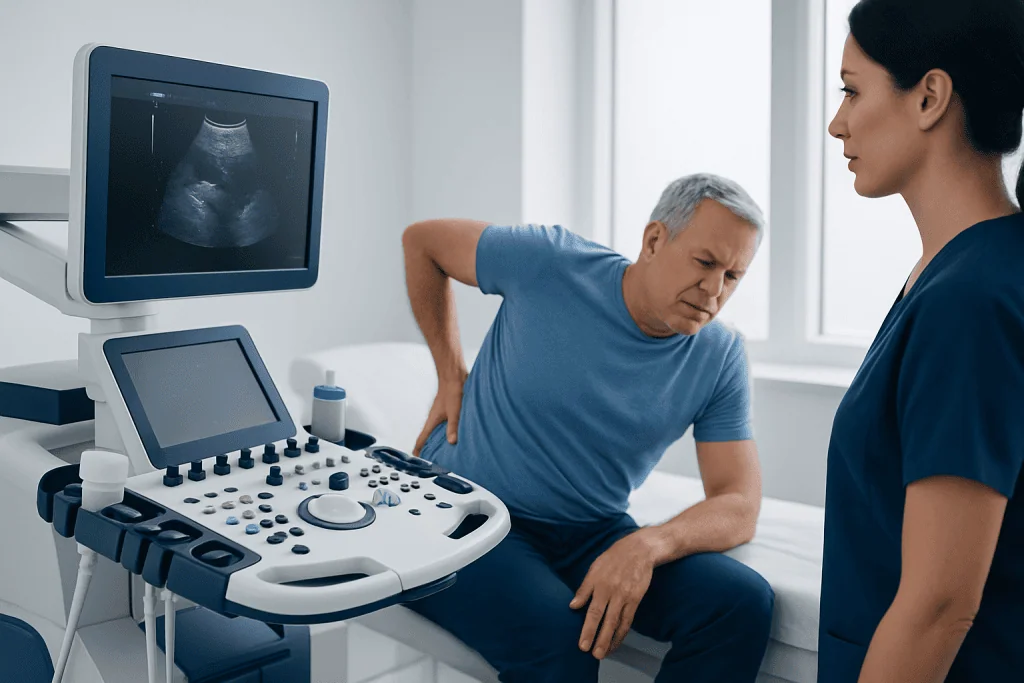
Sciatica often affects one side of the body. Pain may feel sharp, burning, electric or aching, and can worsen with coughing, sneezing, prolonged sitting or certain bending movements. Some people notice pins and needles, reduced sensation or weakness in the leg or foot. Back pain may be present, but leg pain can be the most prominent symptom.
A herniated or bulging lumbar disc is a common cause, particularly in younger and middle-aged adults. Other possible causes include spinal stenosis, where the spaces around nerves narrow; degenerative changes in the spine; vertebral slippage; and, less commonly, injury, infection, inflammatory disease or a mass. Similar leg pain can also arise from hip disorders, peripheral nerve problems or muscle-related conditions, so an accurate assessment matters.
People may need more targeted assessment when symptoms do not improve after a reasonable period of conservative care, significantly limit walking, sleep or work, or are accompanied by objective weakness. Older age, a history of cancer, immune suppression, recent serious injury, fever or unexplained weight loss may also change the urgency and type of investigation.
Assessment and Candidacy for Procedures or Surgery

Diagnosis begins with a medical history and physical examination. A clinician assesses the location of pain, sensation, muscle strength, reflexes, walking and movements that reproduce symptoms. This helps distinguish nerve-root irritation from other causes of leg pain and identifies signs that may require prompt action.
Magnetic resonance imaging (MRI) is often considered when symptoms are severe, last longer than expected, there is progressive weakness, or an injection or surgery is being considered. An MRI can show a disc herniation, narrowing around nerves or another structural explanation. However, scans may show age-related changes that are not necessarily the source of pain, so results should always be interpreted alongside symptoms and examination findings.
Procedural treatment may be considered for people with persistent, function-limiting sciatica despite a well-supported non-surgical plan, provided imaging and clinical findings point to the same nerve source. Surgery is more likely to be appropriate when there is significant weakness, disabling leg pain from a confirmed compressive lesion, or a serious complication such as cauda equina syndrome. A spine specialist can explain whether the expected benefits outweigh the risks for the individual.
Sciatic Nerve Pain Treatment Options: A Step-by-Step Plan
Initial treatment commonly focuses on maintaining gentle movement rather than prolonged rest. Short periods of relative rest may be helpful during intense pain, but staying in bed for days can lead to stiffness, deconditioning and slower return to normal activity. A physiotherapist may provide a personalized programme including mobility work, gradual strengthening, walking progression and advice on lifting, sitting and work activities.
Medicines may be used for short-term symptom relief when suitable for the person’s health history. Options can include anti-inflammatory pain relievers or other pain medicines, but they should be selected and monitored by a qualified clinician because benefits, side effects and interactions vary. Heat or cold packs may provide temporary comfort for some people. Treatments should support activity and rehabilitation, rather than replace them.
If pain remains severe and a clear irritated nerve root is identified, an image-guided epidural steroid injection or selective nerve-root injection may be discussed. The procedure typically involves reviewing medicines and medical history, positioning the patient safely, cleaning and numbing the skin, using imaging guidance to place a needle near the affected nerve, and delivering medication. It is usually an outpatient procedure; it may reduce inflammation and pain temporarily enough to support rehabilitation, but it does not remove every cause of compression.
When a disc herniation or narrowing continues to compress a nerve and conservative treatment has not been sufficient, decompression surgery may be an option. Depending on the cause, this may involve removing the portion of disc pressing on the nerve (discectomy or microdiscectomy) or creating more room in a narrowed spinal canal (decompression). Decisions about spine surgery should be made after a detailed discussion of expected benefit, alternatives and individual risks.
Benefits, Risks and Recovery Timeline
Conservative treatment can help many people return gradually to daily activities, often over several weeks. Recovery is rarely completely linear: symptoms may fluctuate as tissues settle and activity increases. Improvement in pain may occur before numbness or weakness resolves, because nerve recovery can take longer than relief of mechanical irritation.
Injections may offer short-term reduction in radiating leg pain for selected patients, but responses vary. Potential risks include temporary soreness, headache, bleeding, infection, medication reactions and, rarely, nerve injury or more serious complications. The treating team reviews individual risks, including blood-thinning medicines, diabetes and infection concerns, before recommending an injection.
After lumbar decompression surgery, many patients stand and walk soon after the procedure, though the exact schedule depends on the operation and personal health. Light daily activity generally increases gradually over the following weeks, while return to work, driving, exercise and lifting should follow the surgeon’s advice. Surgical risks can include infection, bleeding, a leak of spinal fluid, blood clots, persistent symptoms, recurrent disc herniation or need for further treatment.
A good recovery plan includes follow-up, progressive rehabilitation and attention to sleep, pacing and emotional wellbeing. Acibadem International’s multidisciplinary specialists and JCI-accredited hospitals assess and treat spine-related causes of sciatica for international patients when specialist care is needed.
What Is the Most Successful Treatment for Sciatica?
There is no single treatment that is most successful for every person with sciatica. The most effective approach is the one that matches the cause and severity of the symptoms. For uncomplicated sciatica, education, continued gentle activity, structured physiotherapy and time are often effective. These measures help preserve function while the irritated nerve root settles.
For sciatica caused by a confirmed disc herniation with persistent disabling leg pain or progressive weakness, surgery can provide faster relief for carefully selected people. It is not routinely the first choice for everyone, because many disc-related episodes improve without surgery and every procedure has risks. A specialist can help compare the likely outcomes of continued non-surgical care, injection treatment and surgery.
Long-term success also depends on maintaining a gradual activity routine, using safe movement techniques and managing contributing factors such as smoking, sedentary habits or excess mechanical strain where relevant. Treatment should be reviewed if symptoms are not improving or are limiting normal life.
What’s the Worst Thing You Can Do for Sciatica?
One of the least helpful responses to sciatica is prolonged, complete bed rest. Avoiding all movement for an extended period can reduce muscle conditioning, increase stiffness and make return to activity more difficult. During a painful flare, it is sensible to modify activities briefly, but regular gentle movement is usually preferable to immobilization.
It is also unwise to repeatedly push through movements that clearly trigger sharp radiating pain, to begin strenuous exercise without guidance, or to rely on unverified treatments instead of seeking assessment when symptoms are severe. Heavy lifting, deep bending or twisting may need to be temporarily adjusted, particularly in the early phase.
Ignoring neurological warning signs is another important concern. Worsening leg weakness, numbness in the saddle area, or loss of bladder or bowel control should not be managed at home. These symptoms require urgent medical evaluation.
How Long Does It Take to Fix Your Sciatic Nerve?
The recovery timeline depends on what is irritating the nerve, how long symptoms have been present and whether there is nerve damage. Many episodes improve substantially within several weeks, while others take several months to settle. The term “fix” can be misleading: treatment often focuses on allowing inflammation to settle, relieving compression when necessary and restoring normal movement and strength.
Numbness, tingling and weakness may improve more slowly than pain. If a nerve has been significantly compressed, recovery can continue over months even after the pressure is relieved. Regular follow-up is important when weakness is present, because it helps the clinician determine whether recovery is progressing appropriately.
Persistent symptoms do not automatically mean permanent damage. They do mean that reassessment may be needed to confirm the diagnosis, review the rehabilitation plan and discuss whether imaging, injections or surgical consultation would be helpful.
Can You Ever Fully Get Rid of Sciatica?
Yes, many people recover fully from a sciatica episode and return to usual activities without ongoing pain. This is particularly common when the underlying nerve irritation settles and a person resumes activity gradually. However, the likelihood of complete and lasting relief depends on the cause, the degree of nerve involvement and any underlying spinal changes.
Some people experience future episodes, especially if they have recurrent disc problems or degenerative narrowing in the spine. Recurrence does not mean that severe symptoms are inevitable. Continuing strength, mobility and general physical activity within comfortable limits can support spinal health and confidence with movement.
If pain continues beyond the expected recovery period, repeatedly returns or is accompanied by weakness, a clinician can reassess the source of symptoms. The aim is to identify treatable contributors and develop a realistic long-term plan rather than assuming the condition must be permanent.
When to Seek Medical Care
Medical advice is appropriate when leg pain is severe, lasts beyond a few weeks, interferes substantially with sleep or daily activity, or is associated with numbness or weakness. A clinician should also assess sciatica after a significant injury, or when there is fever, unexplained weight loss, a history of cancer or other symptoms suggesting that a different cause may be present.
Urgent assessment is needed for new difficulty controlling the bladder or bowels, inability to pass urine, numbness around the genitals or buttocks, or rapidly worsening leg weakness. These can be signs of serious nerve compression requiring prompt treatment.
Early, individualized assessment can be reassuring and helps avoid unnecessary tests or treatments. A primary care doctor, physical medicine specialist, neurologist, orthopedic spine specialist or neurosurgeon may be involved depending on the symptoms and suspected cause.
Frequently asked questions
What is sciatic nerve pain treatment?
Sciatic nerve pain treatment is care aimed at relieving pain that travels from the lower back or buttock into the leg because of nerve-root irritation or compression. It commonly includes guided activity, physiotherapy and appropriate pain relief, with injections or surgery considered in selected cases.
Should a person rest or exercise with sciatica?
Complete bed rest is generally not recommended for most people with sciatica. Gentle movement and a gradual return to activity are usually encouraged, while activities that sharply worsen radiating pain may need temporary modification. A physiotherapist can advise on safe exercises for the individual.
Do epidural injections cure sciatica?
Epidural steroid injections do not cure every cause of sciatica. For selected people, they may reduce inflammation and leg pain for a period of time, helping them participate in rehabilitation. Their benefit and duration vary, and they are not appropriate for everyone.
When is surgery considered for sciatica?
Surgery may be considered when imaging confirms nerve compression and pain remains disabling despite non-surgical treatment, or when there is significant or progressive weakness. Urgent surgery may be needed for rare emergencies involving bladder or bowel changes and saddle numbness.
Can sciatica cause permanent nerve damage?
Most episodes do not lead to permanent nerve damage, especially when symptoms improve and serious compression is not present. However, prolonged or severe nerve compression can sometimes affect sensation or strength. Worsening weakness or other neurological changes should be assessed promptly.
What symptoms need urgent care for sciatica?
Urgent medical care is needed for new loss of bladder or bowel control, difficulty passing urine, numbness around the groin or buttocks, or rapidly worsening weakness in one or both legs. These symptoms can indicate serious nerve compression and should not be delayed.
References
- National Institute for Health and Care Excellence
- American Academy of Orthopaedic Surgeons
- North American Spine Society
- National Institute of Neurological Disorders and Stroke
- Mayo Clinic
This article is for general information only and is not a substitute for professional medical advice. Please consult a qualified doctor about your individual situation.
Joint and spine care in Turkey — expert assessment & treatment
JCI-accredited · board-certified surgeons · reply within 24h
Add us as a Preferred Source to see more of our trusted health content across Google Search, AI Overviews and Discover.