Turf Toe: An Evidence-Based Guide for Patients

Turf toe is an injury to the ligaments and soft tissues around the big toe joint. It often happens during sports that involve sprinting, cutting, jumping, or playing on firm surfaces.
Key Takeaways
- Turf toe is an injury to the ligaments and soft tissues around the big toe joint.
- It often happens during sports that involve sprinting, cutting, jumping, or playing on firm surfaces.
- Symptoms include pain, swelling, tenderness, and difficulty pushing off the foot.
- Mild cases may improve with rest, ice, compression, and activity changes, while severe cases need specialist care.
- Early evaluation helps identify fractures, joint instability, or cartilage injury that may need imaging or more structured treatment.
Turf toe is a sprain of the joint at the base of the big toe, usually caused when the toe bends upward too far during sports or sudden push-off movements. Most cases improve with early care, but a proper diagnosis matters because more severe injuries can lead to persistent pain, stiffness, or difficulty walking.
Overview: What turf toe means
Turf toe is a sprain of the metatarsophalangeal joint, the joint where the big toe meets the foot. It happens when the big toe is forced upward beyond its normal range, stretching or tearing the ligaments, capsule, and other soft tissues that stabilize the joint. Despite the name, this injury is not limited to artificial turf and can occur on many playing surfaces.
For patients, the simplest way to understand turf toe is that it is a big toe joint injury caused by overload during movement. It often develops during sports that involve explosive push-off, sudden direction changes, or landing with the toes bent back. The injury can range from a mild overstretching of the tissues to a more serious tear with joint instability.
Turf toe is sometimes mistaken for a simple jammed toe or general forefoot pain. However, because the big toe plays an important role in walking, balance, and running, even a seemingly small injury can interfere with daily activity. A careful evaluation helps distinguish turf toe from problems such as ankle sprain-related altered gait, sesamoid injury, or fracture.
Symptoms and how the injury feels
The most common symptom of turf toe is pain at the base of the big toe, especially during walking, running, climbing stairs, or pushing off the front of the foot. The pain may begin suddenly after a specific movement, or it may gradually worsen after repeated stress. Many people notice tenderness when pressing over the joint on the sole side of the foot.
Swelling and bruising can appear around the big toe joint. Some patients feel stiffness or reduced ability to bend the toe, while others notice weakness when trying to push off. In more serious injuries, the toe may feel unstable, and putting weight on the forefoot can become difficult.
Symptoms often vary by injury severity. Mild cases may cause discomfort only during sports, while moderate to severe injuries can affect normal walking. Signs that suggest a more significant problem include marked swelling, visible bruising, inability to bear weight comfortably, a popping sensation at the time of injury, or persistent pain that does not improve over several days.
- Pain at the base of the big toe
- Swelling or bruising around the joint
- Tenderness on the underside of the toe
- Stiffness and limited toe motion
- Pain with push-off, running, or jumping
- Difficulty walking normally
Causes, sports patterns, and risk factors

Turf toe usually occurs when the front of the foot is planted and the heel lifts, forcing the big toe into excessive upward bending. This motion places stress on the plantar structures under the metatarsophalangeal joint. Football, soccer, basketball, dance, wrestling, gymnastics, and similar activities commonly create this pattern, but the injury can also happen in everyday life after a slip, fall, or awkward step.
Several factors can increase the risk. Flexible or minimal footwear may provide less support to the forefoot during high-intensity movement. Playing on hard surfaces can increase the load transmitted through the toe joint. A history of prior foot injury, limited ankle mobility, muscle imbalance, or foot mechanics that increase forefoot pressure may also contribute.
Not every painful big toe after sports is turf toe. Conditions such as sesamoiditis, fractures, osteoarthritis, or tendon irritation can feel similar. Because the treatment approach differs, clinicians may consider whether related foot and ankle problems are present, including Achilles tendon irritation or compensatory overuse in nearby structures.
How doctors diagnose turf toe
Diagnosis begins with a medical history and physical examination. The clinician will ask how the injury happened, whether there was a sudden twist or push-off, and how severe the pain and swelling became. On examination, the doctor checks tenderness, swelling, bruising, toe motion, strength, and whether the joint feels stable.
The big toe may be gently moved upward and downward to see which structures are painful. The doctor also looks for signs of fracture, cartilage injury, sesamoid damage, or other forefoot problems. Because symptoms can overlap with other injuries, the examination helps determine whether the problem is a mild sprain or a more serious disruption of the joint complex.
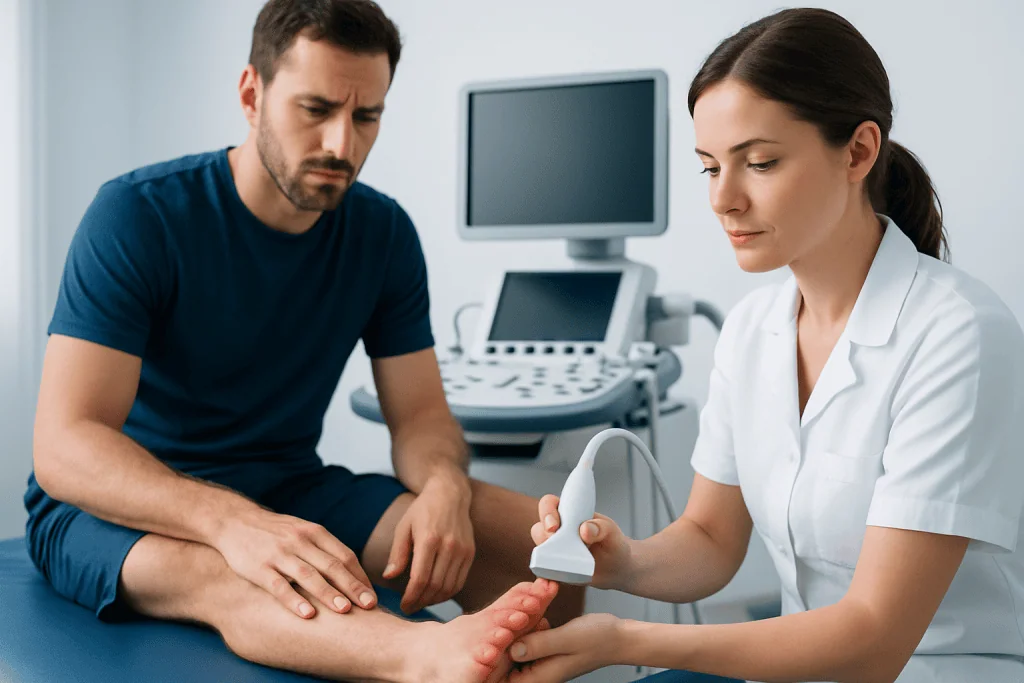
Imaging may be recommended if there is severe pain, marked swelling, difficulty bearing weight, suspected fracture, or ongoing symptoms. Standard X-rays can help rule out bone injury or joint malalignment. In selected cases, ultrasound or MRI may be used to assess ligament tears, plantar plate injury, cartilage damage, or the extent of soft tissue involvement. In some patients, a broader musculoskeletal assessment may also help guide diagnostic imaging and follow-up planning.
Treatment options and recovery
Treatment depends on how severe the injury is. Mild turf toe often improves with conservative care: rest from aggravating activity, ice, gentle compression, elevation, and temporary support of the joint. Reducing load early can help protect the tissues and limit swelling. Supportive shoes with a stiff sole or inserts may reduce painful toe motion during walking.
Doctors may classify turf toe by grade. Grade 1 injuries involve stretching of the soft tissues; grade 2 injuries involve a partial tear with more swelling and limited movement; grade 3 injuries involve a more complete tear, significant weakness, bruising, and possible instability. As severity increases, recovery usually takes longer and may require a walking boot, crutches, taping, or structured rehabilitation.
Physical therapy can be helpful once pain begins to settle. Rehabilitation may focus on restoring motion, improving foot and ankle strength, rebuilding balance, and gradually returning to sport-specific movement. Depending on the case, a clinician may recommend physical therapy and rehabilitation to improve function while protecting the healing joint.
Surgery is not needed for most patients, but it may be considered when there is major joint instability, a large soft tissue tear, persistent pain despite appropriate treatment, or associated structural injury. In complex cases involving the forefoot or related joints, evaluation by orthopedics and traumatology specialists may be appropriate.
Self-care, prevention, and return to activity
Self-care starts with reducing activities that trigger pain. Patients often benefit from avoiding running, jumping, sprinting, or barefoot forefoot loading until symptoms improve. Ice can be applied for short intervals, and elevating the foot may help reduce swelling in the early phase. Taping or a stiff insole may provide added support, but these measures are best used with professional guidance if pain is significant.
Prevention focuses on protecting the big toe joint during high-demand movement. Supportive, properly fitted footwear can reduce excessive toe bending. Some athletes benefit from shoe modifications, taping techniques, or orthotic support to limit stress on the forefoot. Strengthening the calf, foot, and lower leg muscles and maintaining good mobility may also improve mechanics during push-off.
Return to sport should be gradual and guided by symptoms rather than the calendar alone. The patient should be able to walk comfortably, regain adequate toe motion and strength, and perform sport-specific drills without significant pain before full return. Pushing through symptoms too early may prolong recovery or increase the chance of reinjury.
For international patients who need coordinated care, Acibadem International’s multidisciplinary specialists and JCI-accredited hospitals evaluate and treat sports-related foot injuries with individualized plans that may include imaging, rehabilitation, and orthopedic assessment.
When to seek medical care
Medical evaluation is sensible when big toe pain is more than mild, especially if it affects walking, sports participation, or normal daily activities. Prompt assessment is particularly important after a sudden injury with swelling, bruising, or a popping sensation. Early diagnosis can help identify injuries that need more protection or further imaging.
A patient should seek medical care if there is severe pain, inability to bear weight, obvious deformity, increasing swelling, numbness, or symptoms that do not begin to improve with rest. Ongoing stiffness, repeated reinjury, or pain that returns during training also deserves review. These signs may suggest a higher-grade sprain, fracture, cartilage injury, or another condition that needs specific treatment.
It is also reasonable to see a doctor if a person is uncertain whether the injury is turf toe at all. Similar symptoms can come from fractures, sesamoid problems, arthritis, or tendon disorders. A qualified clinician can confirm the cause and advise the safest path back to work, exercise, and sport.
Frequently asked questions
Is turf toe the same as a broken toe?
No. Turf toe is usually a sprain of the soft tissues around the big toe joint, while a broken toe involves a fracture in the bone. Because the symptoms can overlap, imaging may be needed if pain is severe or weight-bearing is difficult.
Can turf toe heal on its own?
Many mild cases improve with rest, activity modification, and support of the big toe joint. However, a more serious injury may not heal well without proper protection and follow-up. Medical assessment is helpful when symptoms are significant or persistent.
How long does turf toe take to recover?
Recovery time depends on the severity of the injury. Mild sprains may settle over days to a few weeks, while more severe injuries can take much longer and may require rehabilitation. Return to sport should be based on comfort, strength, and joint function, not just time.
Should a person keep walking with turf toe?
Light walking may be possible in mild cases, but painful push-off should not be forced. If walking changes the person’s gait or increases pain, reducing activity and seeking medical advice is sensible. Severe pain or inability to bear weight should be evaluated promptly.
What is the best shoe for turf toe?
A supportive shoe with a relatively stiff sole often helps by limiting excessive bending of the big toe. Some people also benefit from inserts or taping to reduce motion at the joint. The best option depends on the injury severity, activity level, and foot mechanics.
When is surgery needed for turf toe?
Surgery is uncommon and is generally reserved for more severe injuries. It may be considered when there is significant instability, a major soft tissue tear, associated structural damage, or pain that does not improve with appropriate conservative treatment. An orthopedic specialist can explain whether this applies in an individual case.
This article is for general information only and is not a substitute for professional medical advice. Please consult a qualified doctor about your individual situation.
Joint and spine care in Turkey — expert assessment & treatment
JCI-accredited · board-certified surgeons · reply within 24h
Add us as a Preferred Source to see more of our trusted health content across Google Search, AI Overviews and Discover.

More from the Health Library

Rosacea Sun Cream: What Patients Need to Know

Type 3 Diabetes: What Patients Need to Know

Hairline Fracture: An Evidence-Based Guide for Patients

Thickened Endometrium: An Evidence-Based Guide for Patients

Physical Exam: A Complete Medical Overview