Understanding Lip Cancer Pictures Early Stages: A Complete Patient Guide

Early lip cancer may look like a sore, crusted patch, ulcer, or lump that does not heal. A picture alone cannot confirm diagnosis because cold sores, sun damage, and other conditions can look similar.
Key Takeaways
- Early lip cancer may look like a sore, crusted patch, ulcer, or lump that does not heal.
- A picture alone cannot confirm diagnosis because cold sores, sun damage, and other conditions can look similar.
- The lower lip is affected more often, and long-term sun exposure and tobacco use are major risk factors.
- Diagnosis usually requires an exam and biopsy to identify the exact cause.
- Treatment is often highly effective when lip cancer is found early.
Lip cancer pictures in early stages often show subtle changes rather than a dramatic wound. Common early features include a persistent sore, a scaly or crusted patch, bleeding, or a small firm lump on the lip, especially the lower lip.
Overview: what early lip cancer can look like
People searching for lip cancer pictures early stages usually want to know whether a new lip sore or mark could be serious. In many cases, early lip cancer appears as a small but persistent change on the lip rather than a large obvious growth. It may look like a sore that does not heal, a dry scaly area, a crusted patch, a pale or red spot, or a firm bump.
Most lip cancers begin in the thin, delicate skin of the lip and are commonly a type of oral cancer called squamous cell carcinoma. The lower lip is affected more often because it tends to receive more sun exposure. Many early lesions are painless at first, which is one reason they can be overlooked.
Pictures can be helpful for awareness, but they have limits. Non-cancerous conditions such as a cold sore, chapped lips, actinic cheilitis, irritation from dental appliances, or an allergic reaction can look similar in a photo. Because of this, the most important clue is not only how something looks, but whether it persists, changes, crusts, bleeds, or keeps coming back in the same place.
Common visual signs and symptoms
Early lip cancer may cause only mild symptoms. A person may notice a rough area while applying lip balm, brushing teeth, or eating. The surface can seem thicker than the surrounding lip, or it may repeatedly split and heal incompletely.
Features that may appear in early-stage photos include:
- a sore or ulcer that remains for more than two to three weeks
- a scaly, dry, or crusted patch on the lip border
- a small lump, thickened area, or wart-like growth
- bleeding with minor contact
- a white, red, or mixed red-white patch
- pain, burning, numbness, or tenderness, though some lesions are painless
As the condition progresses, symptoms may become more noticeable. There may be increasing pain, swelling, trouble moving part of the lip, or enlarged lymph nodes in the neck. Still, these later features are not always present early on, so even a small persistent change deserves attention.
It can help to compare the spot with the rest of the lip in good light. A lesion that stands out because it is firmer, more irregular, or more persistent than ordinary dryness should be evaluated by a clinician rather than monitored indefinitely at home.
How early lip cancer differs from other lip problems
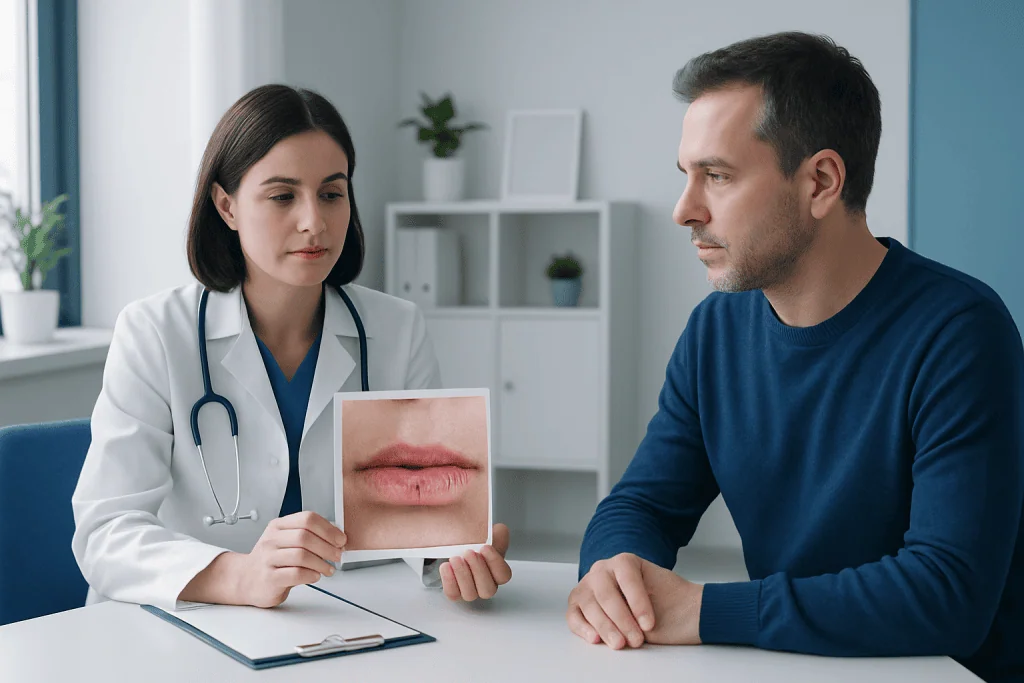
One reason online image searches can be confusing is that several common lip conditions overlap in appearance. A cold sore is usually caused by herpes simplex virus and often begins with tingling or burning before small blisters form. These sores typically heal within days to a couple of weeks, while cancer-related sores usually persist or slowly worsen.
Actinic cheilitis, a chronic sun-damage condition of the lip, can cause dryness, scaling, and loss of the sharp border between the lip and surrounding skin. It is not the same as lip cancer, but it is considered a precancerous condition and can develop into squamous cell carcinoma over time. Some people first notice lip cancer in an area previously diagnosed as sun-related lip damage.
Other look-alikes include chronic chapped lips, eczema, traumatic ulcers from biting, fungal or bacterial infection, and irritation from smoking or dental appliances. In some cases, a suspicious lesion may resemble a nonhealing canker sore or a patch of thickened skin.
The key difference is persistence. A simple irritation usually improves when the trigger is removed and the lip is protected. A lesion that stays longer than expected, repeatedly returns, or changes in size, texture, or color should be assessed by a qualified doctor, dentist, dermatologist, or ENT specialist.
Causes and risk factors
Lip cancer develops when cells in the lip lining grow abnormally and form a malignant lesion. The strongest risk factors are long-term ultraviolet exposure from sunlight, tobacco use, and heavy alcohol use. The lower lip is especially vulnerable because it often receives direct sun over many years.
Risk rises in people who spend a great deal of time outdoors, have fair skin, or have a history of significant sun damage. Smoking cigarettes, cigars, or pipes and using smokeless tobacco can also increase the chance of cancer in and around the lips and mouth. Alcohol may add to the effect of tobacco, especially in cancers of the oral cavity.
Other factors may include older age, a weakened immune system, prior head and neck cancer, and infection with certain strains of human papillomavirus in some mouth and throat cancers. Not every person with lip cancer has all of these risk factors, and having one or more risk factors does not mean cancer is certain.
Because lip cancer is closely related to head and neck oncology, a doctor may also evaluate nearby areas of the mouth and throat if a suspicious lesion is found. This broader assessment helps rule out related disease and guides the most appropriate care plan.
How doctors diagnose lip cancer
Diagnosis starts with a careful medical history and physical examination. The doctor will look at the lip lesion closely, ask how long it has been present, and check whether it has changed, bled, or caused pain. They may also examine the inside of the mouth, the tongue, the gums, and the lymph nodes in the neck.
The only reliable way to confirm lip cancer is a biopsy. In a biopsy, a small sample of tissue is removed and examined under a microscope. This distinguishes cancer from conditions such as actinic cheilitis, inflammation, infection, or benign growths. If cancer is confirmed, the pathology report helps determine the exact type and features of the tumor.
Additional tests are not always needed for a very small early lesion, but they may be used if the cancer appears larger or deeper. Imaging may help assess nearby tissues or lymph nodes, especially when planning treatment. Depending on the case, the care team may involve specialists in oncology, dermatology, oral and maxillofacial surgery, plastic surgery, or ENT.
Early diagnosis matters because smaller lesions are often easier to remove completely while preserving appearance and lip function. A prompt evaluation can also provide reassurance when the cause turns out to be something non-cancerous.
Treatment options and what recovery may involve
Treatment depends on the size, depth, exact location, and type of cancer, as well as whether nearby lymph nodes are involved. For early-stage lip cancer, surgery is often the main treatment. The goal is to remove the lesion completely while preserving speech, eating, and facial appearance as much as possible.
Small cancers may be removed with a focused operation, and reconstruction is planned if needed to support good cosmetic and functional results. In selected cases, doctors may consider other therapies such as radiation therapy, especially when surgery is not the best option or when additional treatment is needed after surgery. Some patients with advanced or recurrent disease may require combined care, including radiation oncology or systemic treatment through medical oncology.
Recovery varies. After surgery, temporary swelling, tightness, and sensitivity are common. The team may recommend wound care, soft foods for a short period, sun protection, and follow-up visits to check healing and review pathology results.
Long-term follow-up is important because people who have had one lip cancer may remain at increased risk for future skin or oral cancers. In international centers such as Acibadem International, multidisciplinary specialists in JCI-accredited hospitals evaluate and treat lip and oral cancers with coordinated care for patients traveling from abroad.
Prevention and self-care
Not all cases can be prevented, but several steps can lower risk. Protecting the lips from ultraviolet exposure is especially important. A lip balm with sun protection, a wide-brimmed hat, and avoiding intense midday sun can reduce cumulative damage over time.
Stopping tobacco use is one of the most meaningful prevention steps. Limiting alcohol, keeping routine dental visits, and having persistent lip changes checked early are also helpful. People who work outdoors or have previously been told they have actinic cheilitis should be especially careful with sun protection and follow-up.
At home, it is reasonable to monitor a minor sore briefly, but not indefinitely. Taking a clear photo every few days can help track whether an area is healing or changing. If there is no steady improvement after two to three weeks, or if the lesion is bleeding, thickening, or becoming more irregular, medical assessment is recommended.
Self-care should focus on protection, not self-diagnosis. Avoid picking at the lesion or trying to treat a persistent sore with repeated over-the-counter remedies alone. Early professional review is safer and more informative than relying on pictures online.
When to seek medical care
A person should arrange medical review if a lip sore, crusted patch, ulcer, or lump lasts longer than two to three weeks. The same applies to a lesion that repeatedly returns in the same spot, bleeds easily, or seems to be getting larger or firmer.
Prompt assessment is also important if there is unexplained numbness, persistent pain, swelling of the lip, difficulty speaking or eating, or a new lump in the neck. People with significant sun exposure, tobacco use, or prior oral cancer should have a lower threshold for seeking evaluation.
Emergency care is not usually needed for a stable chronic lesion, but urgent advice is appropriate if there is rapidly increasing swelling, heavy bleeding, or difficulty breathing or swallowing. When in doubt, a doctor, dentist, dermatologist, or ENT specialist can decide whether the lesion needs biopsy or follow-up.
Frequently asked questions
What does lip cancer look like in the early stages?
Early lip cancer may look like a small sore, scaly patch, crusted area, or firm lump that does not go away. It can be red, white, pale, or mixed in color, and it may bleed or crack repeatedly.
Can a photo tell whether a lip sore is cancer?
No. Photos can raise suspicion, but they cannot confirm whether a lesion is cancerous because many harmless conditions can look similar. A clinical examination and biopsy are usually needed for a definite diagnosis.
How long should a lip sore last before it is checked?
A lip sore that lasts more than two to three weeks should be assessed by a healthcare professional. This is especially important if it is enlarging, crusting, bleeding, or returning in the same place.
Is lip cancer usually painful at first?
Not always. Early lip cancer can be painless, which is why it may be mistaken for dryness or minor irritation. Some people notice tenderness, burning, or numbness, but others notice only a visible change.
Who is most at risk for lip cancer?
People with long-term sun exposure, tobacco use, heavy alcohol use, fair skin, or a history of sun damage are at higher risk. The condition is also more likely in older adults and in those with a weakened immune system.
Is early lip cancer treatable?
Yes. When found early, lip cancer is often very treatable, commonly with surgery that removes the lesion while aiming to preserve appearance and function. The exact treatment depends on the size, depth, and pathology of the tumor.
References
- American Cancer Society
- National Cancer Institute
- National Health Service
- World Health Organization
- National Comprehensive Cancer Network
This article is for general information only and is not a substitute for professional medical advice. Please consult a qualified doctor about your individual situation.
Oncology care in Turkey — second opinion and treatment plan
JCI-accredited · board-certified surgeons · reply within 24h
Add us as a Preferred Source to see more of our trusted health content across Google Search, AI Overviews and Discover.

More from the Health Library



Related Specialists

Prof. Dr. Mustafa Kemal Batur
Cardiology
Dr. Mehmet Hancioğlu
Psychiatry
Assoc. Prof. Dr. Eser Çolak
Vitro Fertilization and Reproductive Medicine Center
Dr. Tuğba Çelebi
Internal Medicine