

Quick answer
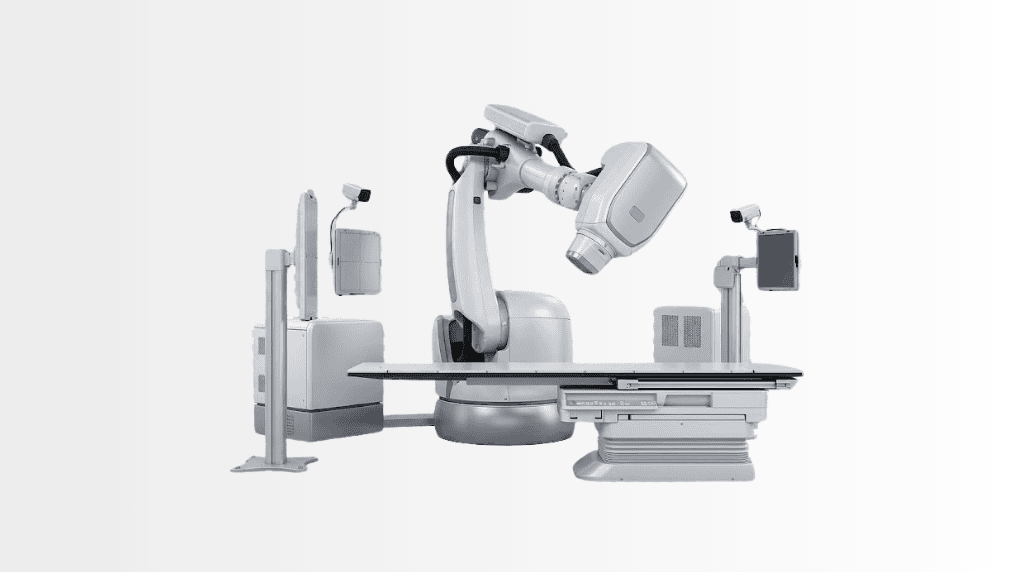
CyberKnife is a robotic radiation delivery system that provides highly targeted stereotactic radiosurgery and stereotactic body radiation therapy for selected tumours and other conditions. At Acibadem in Turkey, radiation oncology teams use image-guided planning and motion tracking to tailor treatment and assess suitability, expected benefits and possible side effects.
CyberKnife mounts a compact linear accelerator on a surgical robot and gives radiosurgery something no fixed machine has: freedom of angle and the reflexes to follow a moving target. It delivers ablative doses of radiation from hundreds of positions with sub-millimetre accuracy, tracks the target between beams, and, for lung and liver, breathes with the patient in real time. No incision, no anaesthesia, typically one to five outpatient sessions. This page explains how CyberKnife treatment works, what it treats, and how candidacy is honestly decided.
How CyberKnife works
Three abilities define the platform. Reach: the robotic arm positions the beam source almost anywhere around the patient, attacking a target from dozens or hundreds of non-coplanar angles so surrounding tissue shares only slivers of dose. Vision: stereoscopic X-ray imaging repeatedly checks the target’s position against the plan during treatment, no frame screwed to the skull; accuracy is maintained by live correction instead. Reflex: for targets that move with breathing, the Synchrony system correlates chest motion with tumour position and moves the beam in rhythm: the defining trick for lung and liver radiosurgery, treating a moving target without enlarging the field around it.
What CyberKnife treats
Intracranially, CyberKnife covers classic radiosurgery ground, metastases, meningiomas, vestibular schwannomas, pituitary adenomas, AVMs, trigeminal neuralgia, with the frameless comfort of a mask. Beyond the skull, it is one of the reference platforms for stereotactic body radiotherapy (SBRT): spine tumours, where dose must stop at the spinal cord’s doorstep; early-stage and oligometastatic lung tumours; liver tumours; locally confined prostate cancer, where five-session CyberKnife SBRT is an established option; and selected pancreatic, kidney and recurrent head-and-neck cases. Indication by indication, the decision belongs to a tumour board, radiosurgery is a tool in a plan, not a plan by itself.
CyberKnife treatment: what to expect
The pathway: imaging and planning first: CT, usually fused with MRI or PET, and for some body targets tiny fiducial markers placed beforehand to give tracking an unambiguous anchor; a custom mask or body cradle for comfortable repeatability; then the sessions themselves, typically one for many brain targets, three to five for most body indications, each lasting roughly 30–90 minutes of lying still while the robot moves around you. Nothing is felt during delivery; most patients drive themselves home and keep their normal week. Effects unfold over weeks to months on follow-up imaging, and early side effects, fatigue foremost, plus site-specific effects your team details, are usually mild and short-lived.
CyberKnife vs surgery, Gamma Knife and conventional radiotherapy
Against open surgery: radiosurgery trades immediate removal and histology for zero incision and near-zero downtime: the right trade only when imaging already defines the target and resection offers no added benefit worth its risks. Against Gamma Knife: inside the skull the two are peers with different engineering; Gamma Knife’s converging-cobalt design is a dedicated cranial instrument, while CyberKnife adds frameless comfort, easy fractionation and, decisively, the whole body below the neck. Against conventional radiotherapy: CyberKnife compresses treatment from many weeks of moderate daily doses into a few ablative sessions, appropriate for well-defined targets rather than wide fields. At a centre operating all three, the tumour board chooses by anatomy and plan, which is exactly how it should be chosen.
Who is a candidate?
The favourable profile: a well-defined target on imaging, small-to-moderate volume, a location where surgery is risky or unwanted, and a patient for whom avoiding anaesthesia and hospital stay matters. Poor fits are equally honest: widely infiltrative disease, very large volumes, or cases where tissue diagnosis or decompression makes surgery the answer. Candidacy usually reads from current imaging, which is why a records-based opinion typically precedes any travel decision.
CyberKnife at Acibadem
CyberKnife operates within the group’s radiation oncology practice, planned alongside neurosurgery and medical oncology in the tumour boards that decide method by case, with Gamma Knife, MR-Linac, TrueBeam and TomoTherapy in the same network, so the recommendation follows the anatomy rather than the available machine. International patients send imaging first; the written answer, plan, session count and estimate, usually arrives before a flight is considered.
Two body indications in depth: spine and prostate
Spine SBRT is precision radiotherapy at its least forgiving: ablative dose millimetres from the spinal cord, whose tolerance is absolute. CyberKnife’s spine tracking follows the vertebrae themselves on live imaging, no implanted markers needed, while planning wraps dose around the cord’s contoured no-fly zone. The payoff for patients with spinal metastases: durable local control and meaningful pain relief in a majority of treated cases, in one to five sessions, often re-treatable territory where prior conventional radiotherapy has been given, with the cumulative-dose judgement strictly the team’s. Prostate SBRT tells a different story: the prostate wanders with bladder and rectal filling, so implanted gold fiducials give tracking its anchor and the beam follows the gland’s drift in real time. Five sessions across a week or two replace many weeks of conventional visits, with long-term outcome data now mature enough that major guidelines list SBRT among standard options for appropriate localized disease, chosen, honestly, alongside surgery and conventional courses in a joint urology–oncology conversation.
Behind the robot: the team and the physics
A CyberKnife plan is authored, not generated. Radiation oncologist and, for cranial and spine cases, neurosurgeon contour target and risk structures; the medical physicist sculpts beam sets from hundreds of candidate angles and verifies, with measurements rather than assumptions, that the machine will deliver what the plan promises; quality assurance runs before every course and every morning the system treats. Session count is a clinical decision written into the plan: single-session where the target and its neighbours allow, three to five where fractionation buys safety for nerves, bowel or bronchi. Patients rarely see any of this, which is precisely why centre experience is the quiet variable behind published outcomes, and why the honest question to any radiosurgery provider is not “do you have the machine?” but “how many of my kind of case does this team treat, and who reviews the plan?”
Frequently Asked Questions
How does CyberKnife protect the spinal cord?
The cord is contoured as an absolute no-fly zone and dose is wrapped around it, while spine tracking follows the vertebrae live, markerless, through every beam.
Why does prostate treatment need gold markers?
Because the prostate drifts with bladder and rectal filling, implanted fiducials give real-time tracking its anchor so the beam follows the gland, not its average position.
Who reviews my treatment plan?
Radiation oncologist, physicist and, where anatomy demands, neurosurgeon together, with measured quality assurance before delivery; the machine executes, the team authors.
Is CyberKnife painful?
No, delivery is painless; you lie still, usually in ordinary clothes, while the robot moves around you.
How many CyberKnife sessions will I need?
Typically one for many brain targets and three to five for most body indications: your plan states the exact number and why.
How long does each session take?
Roughly 30–90 minutes depending on target complexity and tracking method.
Do I need a head frame?
No: CyberKnife is frameless; a custom mask provides comfort while live imaging maintains accuracy by correction.
What are fiducial markers and will I need them?
Tiny implanted markers that give tracking an unambiguous anchor for some body targets: a short outpatient placement days before planning; many targets, including spine, need none.
Can CyberKnife treat lung tumours that move when I breathe?
Yes, motion tracking is the platform’s signature: the beam follows your breathing in real time rather than enlarging the field around the motion.
Is CyberKnife used for prostate cancer?
Yes, five-session SBRT for locally confined prostate cancer is an established indication, weighed against surgery and conventional radiotherapy in a joint decision.
What side effects should I expect?
Fatigue is the common one; site-specific effects, swelling, irritation of nearby structures, depend on the target and are detailed for your case before consent.
When does the treatment take effect?
Over weeks to months, on the target’s biology, scheduled follow-up imaging tracks response; radiosurgery works by disabling cells’ ability to divide, not by instant removal.
CyberKnife or Gamma Knife, which is better for a brain target?
They are peers with different engineering; for a given case the tumour board’s choice follows anatomy, fractionation needs and plan quality, at a centre with both, that choice is honest.
Can I keep working during treatment?
Most patients keep their normal week around sessions, no anaesthesia, no incision, no hospital stay.
Can CyberKnife re-treat an area that had radiation before?
Sometimes, precise re-irradiation is a recognised strength, but cumulative-dose judgement is strictly the radiation oncology team’s, case by case.
How do I find out if I am a candidate?
Send current imaging, candidacy largely reads from it, and the team’s written opinion with plan and session count typically precedes any travel.
Related Medical Units
Available at these Hospitals









Related Treatments
Speak with our medical team
Find out how this technology could support your diagnosis or treatment.