

Aftercare Abroad: How to Arrange Wound Checks and Dressing Changes in Turkey

Arrange wound checks before you are discharged, while your surgical team can still book them against your procedure notes. Confirm the review dates, who changes the dressing, which supplies you need, and the contact pathway printed on your discharge summary. Keep everything, instructions, documents, spare dressings, in one bag, and match your hotel stay and flight to the review schedule rather than the other way round.
Who changes your dressing on day four, when you are in a hotel room in a city you do not know? Most patients only ask that question after discharge. It is far easier to answer before you leave the hospital, and this guide walks through exactly how.
If you need wound checks or dressing changes while recovering in Turkey, the safest approach is to plan them in advance and keep the arrangements simple, written down, and easy to reach. Clear instructions. The right supplies. A realistic journey between your hotel and the clinic. With those in place, aftercare abroad becomes a schedule you follow rather than a problem you solve while sore and tired.
At a glance
- Best time to plan: before discharge, while your team has your notes open
- What to confirm: review dates, dressing type, who performs each change, and the contact pathway on your discharge papers
- Where reviews happen: hospital outpatient clinic, ward review, or, for some wounds, a home-visit nursing service
- Keep with you: discharge summary, passport, medication and allergy list, spare dressings if provided
- Warning signs: procedure-specific, listed in writing on your discharge summary
- Priority: stay close to your review location and match your flight to the wound plan
Why aftercare abroad needs a plan, not improvisation
Wound checks and dressing changes are usually a routine part of recovery. What makes aftercare abroad feel harder is not the wound care itself: it is everything around it. You are managing a hotel stay, unfamiliar transport, medication timing, a language you may not speak, and a return flight with a fixed date. Each of those is manageable on its own. Together, and while you are recovering, they add up. The fix is not a perfect schedule; it is a clear one, agreed before you walk out of the hospital.
A clear plan answers five questions. When is the next wound review due? Where will it happen? Who will perform it? What supplies are needed between now and then? And what does the discharge summary say about signs that would bring the review forward? Written answers matter more than spoken ones, because it is easy to forget details once you are tired, medicated, or moving between appointments.
There is one more reason to plan early: wounds differ. A dressing that must stay sealed for a week is managed differently from one changed every second day, and a wound with a drain or clips needs a different reviewer from one closed with adhesive strips. Nobody can build the right schedule for you from a hotel room. Your surgical team can build it in minutes while your procedure notes are in front of them. That asymmetry is the whole argument for sorting aftercare abroad before discharge rather than after.
Arrange your wound checks before you leave the hospital

The best moment to organise dressing changes is the discharge conversation, when your care team still has your operation record, wound plan, and medication list to hand. This is when appointments can be booked against real clinical detail rather than guesswork.
Questions worth having answered in writing
- How often should the wound be reviewed, and are the dates already booked?
- Must the dressing stay dry, and for how long? Can you shower, and with what protection?
- Should each change be done by a clinician, or is any part of it something you can do yourself?
- Are stitches, clips, drains, or adhesive strips in place, and when and where will they be removed?
- Which supplies do you take with you, and which will the clinic provide at each visit?
- What activity limits apply between reviews, lifting, bending, walking distances, sitting time?
Ask for the aftercare summary as a document, not a conversation. A useful one includes the procedure date, the wound location, the dressing type, bathing instructions, activity limits, the date and place of the next review, and the phone contact pathway. If you are staying in Istanbul or another Turkish city for only a short period, ask the team to fit the review schedule to your hotel stay and departure date as far as is safely possible, and to tell you plainly if your intended flight date does not fit the wound plan. It is better to hear that in the hospital than at the airport. If your stay does need to stretch, our guide on what to arrange when a stay in Turkey runs longer than planned covers the practical side.
Where dressing changes actually happen in Turkey
Patients sometimes assume any clinic can change any dressing. In practice, the right setting depends on the wound. Some dressings are simple gauze changes; others involve specific products, drain checks, or a surgeon’s assessment of the wound edges. Clarifying the setting early prevents unnecessary travel and stops the dressing being disturbed more often than it should be.
| Setting | Typically used for | Worth knowing |
|---|---|---|
| Hospital outpatient clinic | Scheduled wound reviews, suture or clip removal, drain checks | Usually the same hospital that treated you; bring your discharge summary and ID |
| Surgeon-led review | Wounds needing clinical judgement, healing concerns, complex closures, drains | Booked as an appointment; not a walk-in dressing change |
| Home-visit nursing service | Simple dressing changes when travel is difficult | Available in some cities for some wounds; must be agreed with your team, not self-arranged |
| Pharmacy (eczane) | Supplies only, gauze, tape, saline, shower covers | A source of products your team has named, not a place for wound assessment |
Which of these applies to you is a clinical decision, not a convenience decision. If your team says the wound needs a surgeon’s eyes at day five, a hotel-room change on day five is not an equivalent. For a closer look at what happens during the changes themselves, see our guide to wound dressing changes after surgery in Turkey.
What to keep with you during your stay
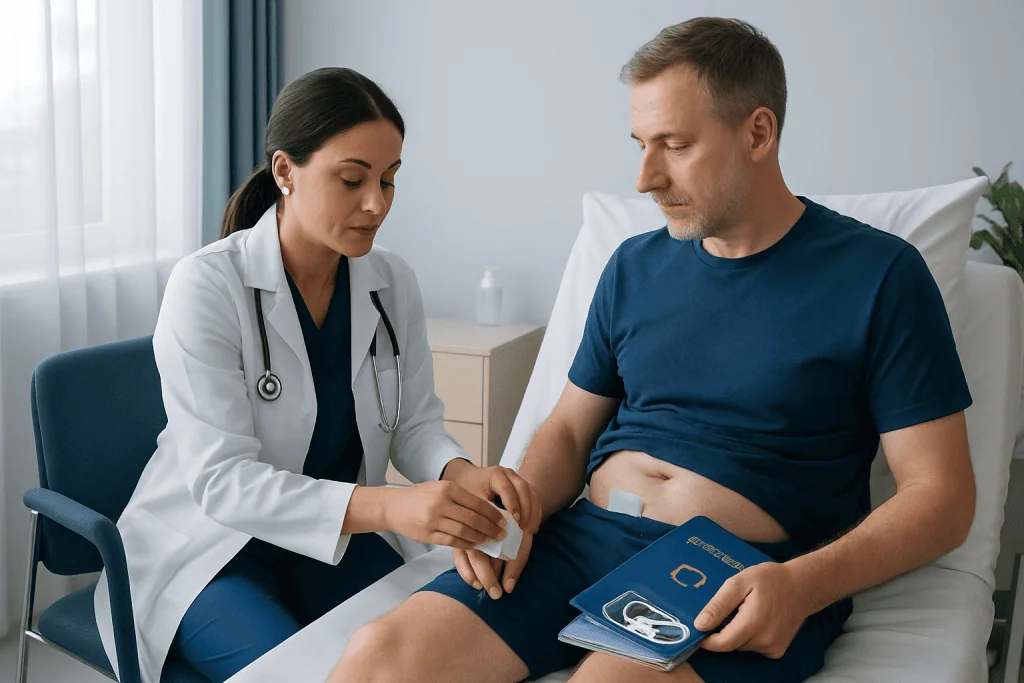
A small aftercare folder, physical or on your phone, ideally both, saves time at every appointment and removes guesswork if you see a clinician who has not met you before. Carry your discharge summary, passport or ID, medication list, allergy information, and the written wound instructions. If your surgeon has asked for photo monitoring, keep a simple dated record on your phone, but do not remove a dressing just to take pictures unless you were told to.
Check what supplies you were sent away with before you leave the building. Some patients need only one spare dressing; others need gauze, adhesive dressings, saline, skin-friendly tape, or a waterproof cover for showering. Use only the products your team named. Swapping to a different dressing type because a pharmacy stocks it can irritate the skin or interfere with how the wound is meant to heal, and it makes the next review harder, because the clinician no longer knows what the wound has been under.
Keep everything wound-related in one clean bag that goes with you to every appointment:
- Discharge summary and follow-up plan
- Medication and allergy list
- Spare dressings and any named supplies
- Clinic phone numbers and the discharge contact pathway
- Passport or hospital ID details
- Hand sanitiser and tissues
If you are recovering with a companion, show them where this bag is and what the next appointment date is. On a rough day, that transfer of knowledge is worth more than any checklist.
Making follow-up visits easy and low-stress
When you are healing, the easiest appointment is usually the safest appointment, because it is the one you will actually attend on time and rested. Choose accommodation with a realistic travel time to the clinic or hospital, realistic meaning after surgery, when you may be moving slowly, sore, or unable to sit comfortably. A journey that reads as twenty minutes on a map can feel very different across Istanbul traffic with a fresh abdominal wound. Ask about traffic patterns, building access, and whether a wheelchair or porter can be arranged if needed.
Do not stack errands around a dressing change. Leave time for registration, waiting, the review itself, and rest afterwards. If your appointment sits in a busy district, ask your hotel or patient coordinator for the most practical route rather than the fastest one on a map: a route with a lift and a drop-off point beats a shortcut with stairs.
Language support matters most when something has changed and you need to describe it precisely. Acibadem’s international patient teams routinely arrange interpreters and sit between clinicians and non-Turkish-speaking patients so that instructions survive the translation. Whatever the setting, if an instruction is unclear, ask for it to be repeated slowly and written down. “Keep it dry” and “keep it covered” are different instructions; you should never leave a room unsure which one you were given.
What healing normally looks like, and what clinicians watch for
Some discomfort, mild swelling, light bruising, and small amounts of staining on a dressing can be a normal part of healing, depending on the procedure. That word, depending, is the important one. What is expected after one operation can be significant after another, which is why comparing your wound to someone else’s recovery photos online tells you very little, and why your own surgeon’s written instructions outrank anything general, including this guide.
Your discharge summary will list the warning signs specific to your procedure, alongside the contact pathway your team wants used. As a general picture of how clinicians think about it: healing is expected to trend in one direction, and reviews exist to confirm that trend. If the picture changes, the planned date is not a fixed one: the contact pathway on your discharge papers exists precisely so that an earlier review can be arranged, and using it is part of the plan, not a deviation from it.
For a fuller walk-through of the days after leaving the ward, dressings, rest, and what your paperwork should cover, see after discharge in Turkey: wound care, dressings, and red flags.
Planning around your flight home and the handover
Your return journey should fit around your recovery, not the other way round. Before you fly, three things should be confirmed in writing: whether you need another wound check in Turkey first, whether the dressing stays in place for travel, and whether stitches or clips come out before departure or later at home. If removal happens at home, the letter your local doctor or nurse receives should say exactly what is in the wound and when it goes.
Ask for plain guidance for the travel day itself. Depending on your procedure, that may mean keeping the wound dry, moving carefully, carrying medication in hand luggage, or avoiding heavy bags entirely. If sitting for long periods is difficult, book airport assistance in advance and leave generous time for transfers: a rushed connection is exactly the situation in which a wound gets knocked or a bag gets lifted badly.
The final piece of aftercare abroad is the handover: making sure the care that started in Turkey continues cleanly at home. Ask for a summary letter written for a clinician who has never seen you, procedure, wound details, dressing history, what happens next. At Acibadem, this handover can extend to structured communication with your own doctor; our guide on how we arrange remote follow-up with your local doctor explains how records and remote reviews are coordinated. For the home end of the journey, appointments, rest, and getting your own healthcare system involved, see aftercare abroad: preparing for recovery once you return home.
Step by step
- Confirm the wound care plan before discharge. Get the review schedule, the dressing instructions, and the procedure-specific warning signs in writing, while your team has your notes open.
- Book the next appointment before you leave. Confirm date, time, exact location, who performs the review, and whether you bring supplies or reports.
- Build your aftercare bag. Discharge summary, medication and allergy list, ID, spare dressings, and the contact pathway, one bag, every appointment.
- Choose accommodation and transport for a patient, not a tourist. Short realistic journeys, lift access, and interpreter support arranged in advance rather than on the day.
- Follow the dressing instructions exactly. Do not remove, wet, or replace a dressing unless you were specifically told to. Your written instructions should say what to do if a dressing loosens or soaks through, if they do not, ask for that to be added before discharge.
- Note how the wound is trending each day. Healing should move in one direction. Your discharge summary names the changes your team wants to know about and the pathway for arranging an earlier review.
- Confirm the handover before you fly. A summary letter for your home clinician, clarity on stitch or clip removal, and one named point of contact for questions after you land.
Your checklist
- Written discharge and wound care instructions
- Date, time, and location of the next dressing change or wound check
- Medication list, allergies, and the discharge contact pathway
- Spare dressings or approved supplies, if provided
- Interpreter or language support arranged where needed
- Hotel-to-clinic transport plan with realistic travel time
- Answers in writing on showering, activity limits, and flying
- Summary letter for your doctor or nurse at home
Key takeaways
- Plan wound checks and dressing changes before you leave the hospital, not after.
- The right setting for each change, outpatient clinic, surgeon review, or home nursing, is a clinical decision made with your team.
- Keep written instructions, documents, and supplies together in one bag for the whole stay.
- Choose accommodation and transport around the wound schedule, and match your flight to the plan.
- Your discharge summary carries the procedure-specific warning signs and the contact pathway that goes with them.
Frequently asked questions
Can I arrange dressing changes in Turkey if I am only staying a few days after treatment?
Often yes, but it is best arranged before discharge. Your care team can say whether a short stay allows the reviews your wound needs, whether the schedule can be compressed safely, or whether part of the follow-up should continue in your home country instead, and they can put that split in writing.
Should I change my own dressing in the hotel?
Only if your clinical team specifically told you to and showed you how. Many dressings are designed to stay in place for a set period, and removing them early can irritate the wound and make the next assessment harder. If self-changing is part of your plan, it will be written into your instructions along with the exact products to use.
Can a nurse come to my hotel for dressing changes?
Home-visit nursing services exist in some Turkish cities and suit some simple wounds, but not all. Whether it is appropriate for your wound is a decision for your surgical team, made against your procedure notes: it is arranged through them, not booked independently.
What documents should I bring to a wound check appointment?
Your discharge summary, identification, medication list, allergy information, and the written wound care instructions. If your team asked you to track the wound with dated photos or notes, bring those too: they let the clinician see the trend, not just today’s snapshot.
What if I do not speak Turkish?
Ask for interpreter support when the appointment is arranged rather than on the day. At providers experienced with international patients, including Acibadem, coordination teams arrange interpreters and help instructions pass accurately in both directions. Always ask for anything important to be written down.
Can I buy dressing supplies at a Turkish pharmacy?
Pharmacies (eczane) are widespread and stock basics such as gauze, tape, saline, and waterproof shower covers. Use them as a source for the specific products your team has named, not as a substitute for a wound assessment: a pharmacist cannot judge how your particular wound is healing.
Can I fly with a fresh dressing?
Often yes, but it depends on the procedure, the timing, and your surgeon’s advice. Before travelling, confirm in writing whether the dressing stays on for the flight, whether it must be kept dry, what the travel day means for lifting and sitting, and when and where the next review happens.
Will I need follow-up again after I return home?
Many patients do, stitch or clip removal, scar checks, or a period of wound monitoring often continue at home. Ask for a summary letter written so that a doctor or nurse who has never met you can pick up the plan, and confirm your point of contact for records and questions before you check out of the hotel.
Add us as a Preferred Source to see more of our trusted health content across Google Search, AI Overviews and Discover.

Update history
- PublishedJuly 6, 2026
- Medical review approvedSeptember 13, 2026
- Last content updateSeptember 12, 2026
References2
- Medical Tourism: CDC Travelers' Health wwwnc.cdc.gov
- After Surgery: MedlinePlus medlineplus.gov
More Patient Guides

Flying After a C-Section: Timing for New Mothers
A C-section is real abdominal surgery that happens to come with a newborn attached, so the flying question has two clocks…

When Can You Drive After Anesthesia or Sedation?
You feel fine an hour after the procedure. You are chatting, you walked to the car unaided, you could obviously drive it.…

Flying After Hip Replacement: When Is It Safe?
Hip replacement recovers famously well, many patients walk further at three weeks than they had in three years. Flying is part…

Flying After Knee Replacement: When Is It Safe?
The knee is new, the physio is going well, and there is a boarding pass with your name on it. Flying after…