

Airport Assistance When Returning Home After Surgery

Request airport assistance through your airline, ideally when booking and again at least 48 hours before departure. Describe your practical limits, walking distance, stairs, lifting, rather than your diagnosis. Assistance staff handle mobility and navigation, not clinical care, so confirm your fitness to fly and any medical documents with your treating doctor before you confirm the flight.
A long terminal. A queue at passport control. A suitcase you are not allowed to lift. The journey home after surgery asks more of your body than a normal trip, and the airport is usually the hardest part. The right assistance, arranged in advance, makes it manageable.
This guide explains how airport assistance when returning home after surgery actually works: what to arrange before you leave the hospital, who provides which service, what documents to keep in reach, and how to get through departure, connections and arrival with the least strain.
At a glance
- When to arrange it: Before discharge, request airline assistance at booking and confirm at least 48 hours before the flight
- Who provides it: The airline and airport coordinate mobility assistance; your doctor confirms fitness to fly
- Key document: A fit-to-fly or medical clearance note if your treating doctor advises one
- Most useful services: Wheelchair support, help with bags, priority boarding, escorted connections
- What assistance staff cannot do: Clinical monitoring, wound care or giving medicines: that needs separate planning
- Carry-on essentials: Medicines, wound supplies, discharge summary, prescription list, emergency contacts
Why airport assistance matters after surgery
Airports are built for healthy people in a hurry. After an operation, the ordinary parts of a journey, walking a kilometre of terminal, standing in a slow queue, hauling a bag off a belt, sitting upright for hours, can become the risky parts. Arranging airport assistance when returning home after surgery is not an admission that something has gone wrong. It is a practical way to protect a wound, an incision or a joint that is still healing.
You do not need to be unable to walk to qualify. Assistance is equally appropriate if you can manage short distances but not a full terminal, if lifting is restricted, if you tire quickly, or if standing for long periods causes pain or swelling. Many patients after abdominal, orthopaedic, cardiac or bariatric surgery fall exactly into this middle ground: mobile, but not yet robust.
Be honest with yourself about the day itself. Departure day usually involves an early start, a car transfer, check-in, security, boarding, a flight of several hours, and then the whole sequence in reverse. Each step is small; together they add up. Patients frequently report that the airport tired them more than the flight did. Planning airport assistance when returning home after surgery means deciding, before you are tired, which steps you will hand to someone else.
If you were treated at Acibadem, international patient services can help you understand what to request from your airline and which documents to keep ready. The assistance itself, however, is delivered by the airline and the airports you pass through: the hospital cannot book it on the airline’s behalf in every case, so start the request early yourself.
Before you book or confirm your return flight

Do not treat your return date as fixed until your medical team has reviewed your recovery. Whether flying is advisable, and when, depends on the type of surgery, the anaesthesia used, wound status, mobility, pain control and the length of the flight. Cabin air pressure is lower than at ground level, trapped gas in the body expands at altitude, and long periods of sitting raise the risk of blood clots in some patients. These are the reasons doctors sometimes ask you to wait, and they apply differently to every operation. Our separate guide on when it is safe to fly home after surgery in Turkey covers the timing question in detail; the short answer is always the same, follow your own surgeon’s advice, not a general rule.
Before confirming the flight, ask your care team three things directly:
- Do I need a fit-to-fly letter or an airline medical clearance form? Some airlines require their own form (often called a MEDIF) for recent major surgery, oxygen, stretcher transport or medical equipment on board, and these need days to process.
- Are there seating, compression or movement instructions for the flight itself?
- Which symptoms mean I should not board? Review the warning signs to report before flying home so you know them in advance.
Choose the routing with your recovery in mind, not just the schedule. A direct flight removes one full cycle of boarding, deplaning and terminal walking, which suits most recovering patients. If a connection is unavoidable, allow a generous transfer window, assistance handovers between flights take time, and rushing between gates is exactly what you are trying to avoid. Skip overnight airport waits and any itinerary that requires changing airports in one city.
Requesting wheelchair, porter and priority support
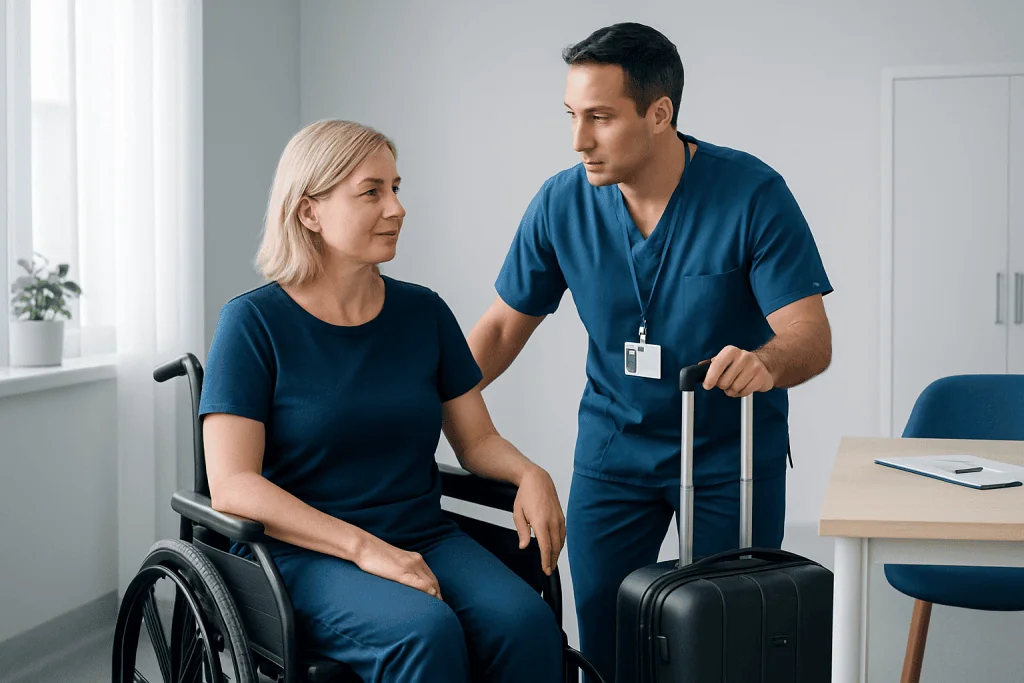
Airlines use standard categories of mobility assistance, and it helps to know they exist so you can ask for the right one. Broadly, the levels are: assistance for the terminal only (you can climb aircraft steps and walk to your seat), assistance to the aircraft door (you cannot manage stairs), and assistance to the seat itself (you cannot walk the aisle). You do not need to memorise the airline codes, describing what you can and cannot do is enough, and the agent will select the category.
Make the request when booking if possible, and confirm it again at least 48 hours before departure. If your ticket is already issued, call the airline or use its website to add special assistance to the booking; do not rely on turning up and asking at the counter, because staffing at the airport is allocated based on advance requests. Be specific and practical: state whether you can climb steps, how far you can walk, whether you can stand in a queue, whether you can transfer from a wheelchair to a seat, and whether you can carry hand luggage.
Services worth considering after surgery include:
- Wheelchair assistance from check-in to the gate, from the aircraft to arrivals, or across connecting terminals.
- Help with luggageporter services where the airport offers them, or trolley assistance from the person escorting you. If your surgeon has restricted lifting, treat that limit as absolute; our guide on activity and lifting limits after returning home explains why these restrictions matter.
- Priority or early boarding, so you can settle into your seat without being pushed along by a queue.
- Seat selectionan aisle seat, or one near the front, if your doctor and the airline agree it suits your condition.
- Escorted connections, essential in large hub airports where gates can be far apart.
What conditions qualify? There is no diagnosis list and no medical proof required for standard mobility assistance. Any passenger with reduced mobility, temporary or permanent, can request it, and recent surgery clearly qualifies. Airlines do not ask you to justify a wheelchair request; they ask what help you need. Medical clearance forms are a separate matter and apply only when the airline’s own rules require them for your situation.
One limit to understand clearly: assistance staff are not medical escorts. They help you move and navigate. They cannot monitor your condition, change a dressing, manage a drain or give medicines. If you need clinical supervision in the air, that is a different arrangement, discuss it with your treating doctor and the airline well before travel.
Documents to keep within easy reach
Everything medical travels in your carry-on, never in checked luggage. You may need documents at check-in, at security, at border control, during a connection, or if you need medical help mid-journey. A single clear pouch or folder, kept in the same pocket of the same bag, means you or your companion can produce anything in seconds.
A sensible document pack includes:
- Passport, boarding passes and any visa or residence documents
- Discharge summary and follow-up plan
- Fit-to-fly letter or completed airline medical form, if required
- Prescription list with generic drug names, doses and timings
- Implant or device card if you have one (relevant at security screening)
- Insurance details and emergency contacts, including your care team’s number
If your medicines include injections, liquids above standard limits, controlled substances or anything temperature-sensitive, ask your care team whether a supporting letter is advisable and check the entry rules of your home country. Our guide on returning home with new medicines after treatment in Turkey covers this in full. If you are travelling with a PICC line or port, ask your care team for specific handling and screening guidance before you fly.
If you were treated at Acibadem, ask your international patient coordinator before discharge to confirm that your summary, instructions and contacts are complete. Request translations of key documents early, translation takes time, and the day before a flight is too late to start.
Packing your carry-on for comfort and safety
Your carry-on has two jobs: keep you supplied during the journey, and cover you if checked luggage is delayed. It should be light enough for you to manage alone if you must, but complete enough that losing your suitcase for two days would be an inconvenience, not a medical problem.
Pack all prescribed medicines for the journey plus a small buffer supply, following your doctor’s instructions on quantities. Keep medicines in original packaging where possible. Add:
- A written medication schedule with doses and times, crossing time zones complicates timing, and the guide on adjusting your medication schedule across time zones explains how to plan this with your doctor before departure
- A small wound-care pack, if the nursing team advises spare supplies
- Your document pouch
- Loose, comfortable clothing and easy shoes; compression garments if prescribed
- A water bottle to fill after security, unless your doctor has restricted fluids
- Light snacks that fit your post-operative diet
- Phone, charger and printed emergency numbers in case the phone fails
Liquid and medical-item rules vary by airport and country, so check your specific airports before travel. If you have dressings or drains, ask the nursing team how to protect them in transit and what to do if a dressing needs attention mid-journey.
Moving through the airport on departure day
Arrive earlier than you normally would, meaningfully earlier, not slightly. Rushing after surgery is the fastest route to pain, breathlessness, dizziness and anxiety, and every buffer of time you build in is a buffer of energy you keep. Extra time lets you check in calmly, take medicines on schedule, use the toilet before boarding and rest at the gate.
At the counter, state that special assistance was requested and confirm the plan out loud: where the wheelchair or escort meets you, whether you are taken through security, and what happens at the gate. If you have a companion, make sure they know this plan too and hold copies or photos of your key documents. Preparing the person who will meet you at home is just as useful, brief them on your arrival time, the luggage plan and the help you expect to need in the first days.
At security, explain calmly that you have dressings, a mobility aid, an implanted device or medical liquids, and offer your documents. Do not remove medical supports unless security staff ask and it is safe to do so; most airports have alternative screening procedures for exactly this situation. If your journey home passes through a United States airport, the TSA Cares programme provides additional support through screening for passengers with medical conditions: you request it via the TSA Cares helpline or online form, ideally at least 72 hours before the flight, and a support specialist can assist you through the checkpoint.
If you feel unwell at any point, stop, sit down and tell staff. Every major airport has medical support. It is far better to be assessed and miss a flight than to board while seriously unwell. If you develop chest pain, sudden shortness of breath, fainting, severe bleeding or sudden limb swelling, call your local emergency number or go to the nearest emergency department now.
Arrival, connections and the first hours at home
Assistance matters just as much when you land, and this is the leg patients most often forget to book. Fatigue after a long flight is usually worse than expected. If you requested arrival support, stay seated when the aircraft parks, assistance staff typically board after other passengers have left, then take you through immigration and baggage claim to arrivals.
For connections, confirm at first check-in that assistance is arranged at every airport on the itinerary, not just the first. During layovers, prioritise rest, hydration if permitted, and short gentle movement if your doctor advised it. Do not spend a layover carrying bags between distant gates when an escort could do it.
Arrange your onward transport before you fly: a vehicle you can get into and out of without strain, met by someone who will handle the luggage. Plan a quiet first day at home, no errands, no visitors you have to host. Follow your discharge plan, and know the warning signs to watch for after returning home: fever, increasing pain, wound changes, or anything specific your doctor flagged. If a severe symptom appears, chest pain, breathing difficulty, collapse, heavy bleeding, call your local emergency number or go to the nearest emergency department now.
Step by step
- Confirm you are medically ready to fly. Before finalising travel, ask your treating doctor whether your recovery is stable enough for the planned flight, and clarify restrictions on walking, lifting, sitting duration, compression garments and wound care.
- Ask what documentation you need. Request a discharge summary, a prescription list and any fit-to-fly letter or airline medical form your doctor recommends. Keep printed and digital copies.
- Contact the airline for special assistance. Add wheelchair, mobility or boarding assistance to the booking at least 48 hours before departure. Describe your practical limits: no heavy lifting, limited walking distance, no stairs.
- Prepare your carry-on. Medicines, wound supplies, documents, charger, comfort items and snacks stay with you. Keep the bag light and let a companion or porter handle everything else.
- Arrange transport at both ends. Book vehicles you can enter and exit without strain. If you are leaving Turkey after treatment at Acibadem, ask international patient services about transfer coordination.
- Arrive early and confirm assistance at the counter. Verify where the wheelchair or escort meets you and how support continues to the gate, and, for connections, at every airport on the route.
- Rest after arrival and follow your aftercare plan. Avoid overexertion in the first days, keep follow-up appointments, and contact your doctor promptly about any concerning symptom.
Your checklist
- Doctor has confirmed fitness to travel or advised the safest timing
- Fit-to-fly letter or airline medical form completed, if required
- Special assistance added to the airline booking and reconfirmed 48 hours out
- Assistance confirmed for connections and arrival, not just departure
- Airport transfers arranged at both ends
- Medicines and wound supplies packed in carry-on with the prescription list
- Discharge summary, follow-up plan and emergency contacts in one pouch
- Lifting plan agreed: you know who handles every bag
- A companion or receiving family member knows your arrival details
- You know the warning signs and who to contact once home
Key takeaways
- Plan airport assistance before discharge, not when you reach the terminal, request it at booking and reconfirm 48 hours before the flight.
- The airline coordinates wheelchair, boarding and connection support; your treating doctor decides fitness to fly and whether clearance forms are needed.
- No diagnosis is required for mobility assistance: you describe what you need, not why.
- Assistance staff help with movement and navigation only; clinical needs in transit require separate arrangements.
- Medicines, wound supplies and medical documents travel in your carry-on, always.
- Arrive early, move slowly and ask for help before fatigue becomes a problem, including at the arrival airport.
Frequently asked questions
What conditions qualify for airport assistance?
There is no qualifying list and no medical proof is needed for standard mobility assistance. Any passenger with reduced mobility, temporary or permanent, can request it, and recent surgery clearly counts. You simply describe the help you need: limited walking distance, no stairs, no lifting. Airline medical clearance forms are separate and apply only in specific situations, such as very recent major surgery or in-flight oxygen.
Why is flying not recommended soon after surgery?
Cabin pressure at cruising altitude is lower than at ground level, so gas trapped in the body expands, which matters after some abdominal, eye, ear and neurosurgical procedures. Long periods of sitting can also raise the risk of blood clots in some patients, and a fresh wound copes poorly with strain and fatigue. How long to wait depends entirely on your operation: your surgeon’s advice overrides any general rule.
How do I get extra assistance at the airport?
Request it through your airline, ideally when booking and again at least 48 hours before departure, by phone or through the manage-booking page. The airline notifies the assistance teams at each airport. On the day, confirm the plan at check-in: where staff will meet you, whether they take you through security, and what happens at the gate and on arrival.
How do I request TSA Cares assistance?
TSA Cares applies at United States airports. Contact the programme through its helpline or online request form, ideally at least 72 hours before your flight, and describe your medical situation. A support specialist can then assist you through security screening, including alternative procedures for dressings, implanted devices and medical liquids. It complements, but does not replace, the wheelchair assistance you book with your airline.
Can airport assistance staff help with my medicines or wound care?
No. Assistance staff help with movement, directions, boarding and navigating the terminal. They do not give medicines, change dressings or monitor your condition. If you need clinical supervision during travel, discuss a medical escort or other arrangement with your treating doctor and the airline well in advance.
Should I travel with a companion after surgery?
Many patients are safer and more comfortable with one, especially after major surgery or on long flights. A companion can carry bags, manage documents, help you communicate and notice if you become unwell. Ask your care team whether travelling alone is reasonable in your specific situation before you book.
What should I do if I feel unwell at the airport?
Stop, sit down and tell airport or airline staff, every major airport has medical support, and it is better to be assessed than to board unwell. If you have chest pain, sudden shortness of breath, fainting, severe bleeding or sudden limb swelling, call your local emergency number or go to the nearest emergency department now.
Can Acibadem International help with my return journey?
International patient services can help with practical coordination: discharge documents, translations, interpreter support, transfer guidance and communication with your care team after you leave. Airline medical clearance and airport assistance still have to be arranged under airline and airport rules, so raise the topic with your coordinator early enough to complete the requests in time.
Add us as a Preferred Source to see more of our trusted health content across Google Search, AI Overviews and Discover.

Update history
- PublishedJune 8, 2026
- Medical review approvedAugust 30, 2026
- Last content updateAugust 30, 2026
References2
- Travelers' Health wwwnc.cdc.gov
- Travelers' Health (MedlinePlus) medlineplus.gov
More Patient Guides

Flying After a C-Section: Timing for New Mothers
A C-section is real abdominal surgery that happens to come with a newborn attached, so the flying question has two clocks…

When Can You Drive After Anesthesia or Sedation?
You feel fine an hour after the procedure. You are chatting, you walked to the car unaided, you could obviously drive it.…

Flying After Hip Replacement: When Is It Safe?
Hip replacement recovers famously well, many patients walk further at three weeks than they had in three years. Flying is part…

Flying After Knee Replacement: When Is It Safe?
The knee is new, the physio is going well, and there is a boarding pass with your name on it. Flying after…