

At Acibadem, How We Prepare Your Discharge Papers and Medical Records

Before you leave an Acibadem hospital, your care team assembles a discharge summary, prescriptions, test and imaging reports, and follow-up instructions. Preparation starts once your doctor confirms you are ready to leave, and some parts begin earlier. Tell the team your travel date 24–48 hours in advance so documents, imaging copies and any translation support can be organised without a last-minute rush.
You have a flight in two days, and you are wondering whether you will walk out of the hospital with everything your doctor at home will need. It is a fair worry. Paperwork is easy to leave until the last hour, and that is usually when it becomes stressful.
This guide explains, step by step, how we prepare your discharge papers and medical records at Acibadem: what goes into the pack, who assembles it, when each part is ready, and what you can do to make the process faster. It also covers the practical questions international patients ask most — formats, languages, pending results, and what to do if something is missing after you get home.
At a glance
- Best time to ask: 24–48 hours before discharge, or earlier if you have a flight booked
- Usually included: Discharge summary, prescriptions, test reports, imaging and follow-up instructions
- Who prepares it: Your doctor, ward nurses, pharmacy, laboratory, radiology and the international patient team, working together
- Language support: Interpreters and international patient coordinators can walk through each document with you
- Format options: Paper copies, digital files, imaging CDs or secure digital access, depending on your case
- Good to have ready: Passport details, your home doctor’s contact information and your travel date
What your discharge papers and medical records are for
Discharge papers are not a formality. They are the written version of your treatment: what was found, what was done, which medicines you should take, what to watch for during recovery, and what follow-up your doctors recommend. When you fly home shortly after treatment, these documents become the fastest way for a clinician in your own country to understand your recent care without repeating tests that were already done in Turkey.
Understanding how we prepare your discharge papers and medical records helps you plan the last days of your stay. The contents of the pack depend on your treatment. A short outpatient visit may produce only a brief note and a prescription. Surgery or an inpatient stay usually produces more: a detailed discharge summary, nursing instructions, laboratory and imaging reports, an operative note, pathology information where relevant, and specific follow-up recommendations. Records you brought with you also matter — the reports and scans described in our guide on travelling to Turkey with medical records become part of the picture your discharge file completes.
One honest limit is worth stating early: not everything can be finalised on the day you leave. Some results, particularly pathology and specialised laboratory tests, take days to complete. The preparation process is designed around that reality, which is why the sections below separate what is ready at discharge from what follows later.
What documents you may receive before going home
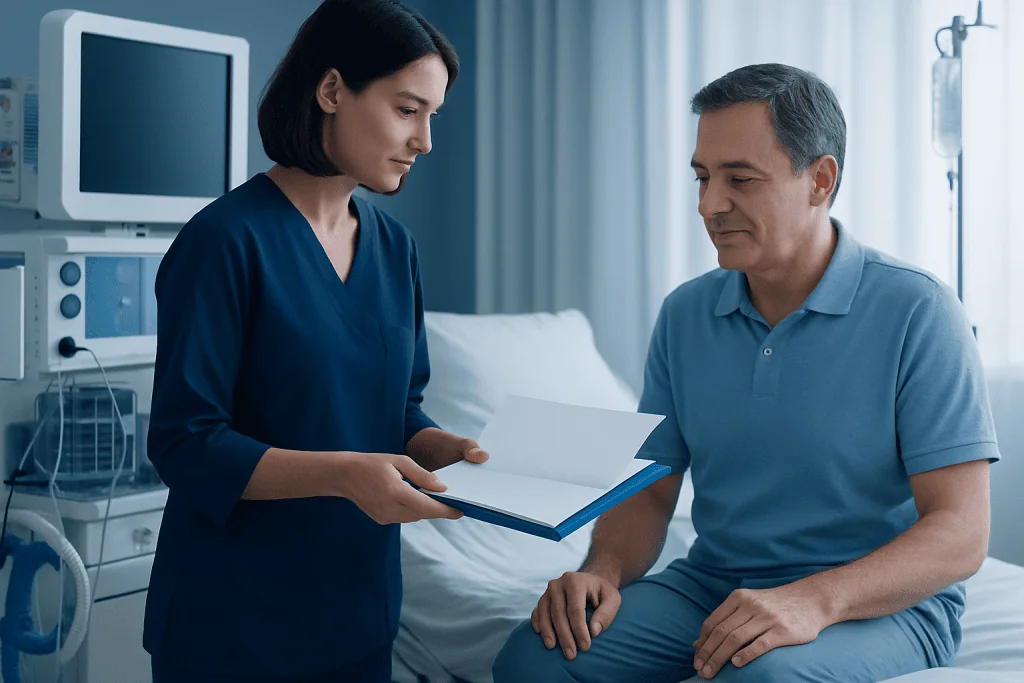
Most patients receive a discharge summary — sometimes called an epicrisis in Turkish hospitals — that explains the reason for treatment, the main findings, the care provided and the plan after leaving hospital. Alongside it, you may receive medication instructions, prescriptions, wound care or activity advice, and written guidance on the warning signs your doctor wants you to know about during recovery.
For international patients, the supporting records are often just as important as the summary itself, because they are what your doctor at home will read in detail. Depending on your treatment, your file may include:
- Discharge summary — the core narrative of your admission and treatment
- Prescription and medication plan — what was prescribed and how it fits your aftercare
- Laboratory reports — blood tests and other results completed during your stay
- Imaging reports and images — written reports plus a CD or secure digital access to the scans themselves
- Operative notes — a technical record of any surgery performed
- Implant or device details — the make, model and identifiers of anything implanted, which matter for future imaging and airport security
- Pathology reports — when tissue was examined and the result is available
- Follow-up recommendations — timing and purpose of the reviews your doctors advise
You can also ask whether you need documents for practical use outside the hospital: a fit-to-fly note if your doctor recommends one, a medication letter for airport security, or written instructions for home nursing or rehabilitation. If you received an implant, a device card or implant letter is worth requesting explicitly — our guide on flying with medical devices or implants explains why this document earns its place in your hand luggage. For a fuller list of what belongs in the pack before you travel, see what discharge papers you need before leaving Turkey.
How Acibadem prepares your records

How we prepare your discharge papers and medical records is a coordinated process rather than a single handover. Preparation usually begins before the day you leave, as part of discharge planning. Once your doctor confirms that you are medically ready for discharge, the different parts of your record are finalised, checked and assembled. That involves several teams: your consultant writes and signs the discharge summary, ward nurses complete care and aftercare documentation, the pharmacy confirms prescriptions, radiology exports imaging, the laboratory issues final reports, and administrative staff bring the pieces together into one file.
Because these parts come from different departments, they are not all ready at the same moment. Prescriptions and nursing instructions are typically ready on discharge day. Imaging reports are usually available, though exporting the images themselves to a CD or digital link can take extra time if requested late. Final pathology and some specialised laboratory results routinely arrive after discharge — that is normal in any hospital, not a delay specific to your case. When a result is pending, your team should tell you what is outstanding, when to expect it, and how it will reach you securely once you are home.
Sharing records also follows consent and privacy rules. Your documents are yours; they are released to you, and to other doctors only with your agreement. If a relative or companion will collect papers on your behalf, mention this in advance so the right permissions are in place. Our guide to medical records privacy in Turkey explains consent, sharing and your rights in more detail.
If interpretation or translation support would help, ask for it early. Interpreters can sit with you while the papers are explained, and the international patient team can advise on which documents are typically issued in English and how translation of others is arranged. Translation takes time, so this is one of the requests that benefits most from advance notice.
When to request copies and how to avoid last-minute stress
The single most useful thing you can do is mention your travel date as early as possible. If you already know your discharge day, tell your doctor, nurse or international patient coordinator that you will need the full discharge pack plus copies for your home doctor. This matters most if you need digital imaging, translated summaries or travel-related letters, because those items involve extra steps and sometimes extra departments.
Try not to wait until your transport has arrived. Some items need final signatures; others need collection from radiology or the laboratory. Asking 24 to 48 hours in advance gives the team room to coordinate and gives you time to clarify details — the spelling of your name, your passport number if it appears on documents, your destination country, and the contact information of the doctor who will see you at home.
If you are staying in Istanbul or elsewhere in Turkey for a few recovery days after discharge, ask how and when pending reports will be delivered. Digital sharing is often more practical than collecting extra papers, especially if you have already left the hospital neighbourhood. And if you are recovering without a companion, planning the paperwork early removes one task from a day when your energy is limited — our guide on preparing for discharge when you are recovering alone covers this in depth.
How to review your papers before you leave
Before you leave the hospital, take a few minutes to review the discharge pack with a nurse, doctor or international patient representative. Even if you are tired, this short review is one of the most valuable parts of the process. Make sure you understand your diagnosis in plain terms, your medication schedule as your doctor has set it, any restrictions on activity, wound care, diet, and the follow-up plan. The discharge summary also lists the warning signs your doctor considers relevant to your recovery; the review is the moment to have those explained in language you fully understand.
If English is not your first language, ask for interpreter support during this conversation. It is far better to ask questions in the hospital than to guess on a flight or in a hotel room. Good record entries follow the same principles everywhere — they should be clear, concise, complete, correct and in chronological order — and your review is a chance to confirm the file meets that standard from your side too.
Check the basics carefully: your name as it appears in your passport, your date of birth, treatment dates, and any identifiers used across documents. Confirm that every report you expected is actually in the envelope or the digital folder, and note the contact point given for missing documents. A few minutes of checking here prevents a long chain of messages later. Keeping everything in one system from the start also helps — see how to keep your medical records organised during treatment in Turkey.
What these documents are called — and one common mix-up
Names vary between countries, which can make searching confusing. In hospitals, the main document is usually called a discharge summary; you may also see discharge instructions (the patient-facing aftercare sheet), epicrisis (common in Turkey and much of Europe) or simply discharge papers. They all refer to the written record you receive when leaving hospital care.
A frequent online mix-up: the DD214 is not a hospital document at all. It is a United States military form certifying release from active duty, issued by the US armed forces and requested through the US National Archives. No hospital — in Turkey or anywhere else — can issue or replace one. If you searched for “discharge papers” and found military record pages, that is why. Everything on this page concerns hospital discharge documents only.
Using your records after you return home
Once you are home, keep your discharge documents together and share them with the doctor who will manage your ongoing care. If you have a planned review with a local specialist, sending the records ahead of the appointment usually makes the consultation more productive and helps avoid repeating tests that were already done. A clear summary lets any clinician quickly understand what treatment you received in Turkey and what follow-up was advised.
Your records also matter for prescription continuity and for any questions that arise weeks later. Keep the post-discharge contact details you were given somewhere easy to find, alongside both your paper and digital copies. If a pending result becomes available after you have left, it can be sent to you securely, and the international patient team can help coordinate communication with your home doctor when clarification is needed. The aim throughout is continuity: your care information should travel with you, even after your hospital stay ends.
Step by step
- Tell the team your expected travel and discharge date. As soon as you know when you may leave hospital or fly home, share that timing with your doctor, nurse or international patient coordinator. It lets the team prioritise the documents that matter most for safe discharge and onward travel.
- Ask what will be included in your discharge pack. Before discharge day, ask for a simple overview of the papers you should expect. This is how you find out early whether you also need imaging copies, a fit-to-fly note, an implant letter, medication documentation or translated summaries.
- Confirm whether any results are still pending. Not every result is ready at the same time, especially after surgery or specialised testing. Ask which reports you will receive on the day, which will follow later, and how the later ones will be shared securely.
- Review medicines and aftercare instructions with a clinician. Go through the prescription, timing and any restrictions before you leave. This is also the right moment to have wound care, bathing, activity, diet and warning signs explained in terms you fully understand.
- Check your personal details and the document list. Verify your name, date of birth and any passport details on the paperwork. Confirm the reports you expected are present and note the contact point for anything missing.
- Keep paper and digital copies in separate places. Carry one printed set and save digital files securely on your phone, email or cloud storage. If a folder goes missing during the journey, you still have everything.
- Share the records with your home doctor promptly. Do not wait until a problem arises. Early sharing supports continuity of care and makes your first follow-up appointment at home far more useful.
Your checklist
- Passport or ID details confirmed on all documents
- Discharge summary received
- Prescription and medication schedule explained by a clinician
- Test reports and imaging copies collected or arranged digitally
- Implant or device documentation received, if applicable
- Pending results and their delivery timeline understood
- Follow-up plan after returning home clarified
- Warning signs relevant to your recovery explained
- Contact details for post-discharge questions saved in two places
Key takeaways
- How we prepare your discharge papers and medical records is a coordinated process across doctors, nurses, pharmacy, laboratory and radiology — not a single handover.
- Ask for your records 24–48 hours early, especially if you need imaging copies, translations or travel-related letters.
- Some results, particularly pathology, routinely arrive after discharge; agree on a delivery route before you leave.
- Review medicines, restrictions and warning signs with a clinician before departure, with interpreter support if useful.
- Keep printed and digital copies separately, and share your Acibadem records with your home doctor soon after returning.
Frequently asked questions
What are hospital discharge papers called?
The core document is usually called a discharge summary. You may also hear discharge instructions, discharge report or, in Turkey and much of Europe, epicrisis. Together with prescriptions, test reports and follow-up notes, these make up what patients commonly call discharge papers.
Is a DD214 the same as a hospital discharge paper?
No. A DD214 is a United States military form certifying release from active duty. It is issued by the US armed forces and requested through the US National Archives, typically online. Hospitals cannot issue or replace it, and it has no connection to the medical discharge summary described in this guide.
What are the 5 C’s of medical record entries?
The 5 C’s are a common teaching principle for documentation: entries should be clear, concise, complete, correct and in chronological order. Some versions add confidentiality as a further principle. They describe the standard good clinical records aim for, wherever they are written.
Will I receive all of my medical records on the day I leave?
You will usually receive the key documents needed for discharge, but some results may still be pending — final pathology is a common example. If so, your team should explain what is outstanding, when it is expected, and how it will be sent to you securely after you leave.
Can Acibadem provide records in English?
International patients are commonly supported in English, and interpreter assistance is available for other languages where possible. If you need records or explanations in a particular language, request this as early as you can, because translation takes time to arrange.
Can I get digital copies as well as paper copies?
In many cases, yes, depending on the type of record and the hospital process. Digital access is especially practical for imaging and for reports that become available after you travel. Ask what formats are available for your case before discharge day.
When are my discharge papers usually prepared?
Preparation starts during discharge planning, often before the day you leave, and the pack is finalised once your doctor confirms you are medically ready. Final notes, prescriptions and signatures are usually completed close to discharge time, which is why early notice of your travel date helps.
What if I notice a document is missing after I leave?
Your discharge pack includes a contact point for exactly this situation. Missing reports can usually be re-issued and sent electronically. It helps to state precisely which document you need and by when, particularly if a follow-up appointment at home is already scheduled.
Add us as a Preferred Source to see more of our trusted health content across Google Search, AI Overviews and Discover.

Update history
- PublishedAugust 16, 2026
- Medical review approvedSeptember 2, 2026
- Last content updateSeptember 1, 2026
References1
- Personal Health Records — MedlinePlus — medlineplus.gov
More Patient Guides

Flying After a C-Section: Timing for New Mothers
A C-section is real abdominal surgery that happens to come with a newborn attached — so the flying question has two clocks…

When Can You Drive After Anesthesia or Sedation?
You feel fine an hour after the procedure. You are chatting, you walked to the car unaided, you could obviously drive it.…
Flying After Hip Replacement: When Is It Safe?
Hip replacement recovers famously well — many patients walk further at three weeks than they had in three years. Flying is part…

Flying After Knee Replacement: When Is It Safe?
The knee is new, the physio is going well, and there is a boarding pass with your name on it. Flying after…