

At Acibadem, Which Istanbul Hospital Campus May Suit Your Treatment Needs

The most suitable Acibadem campus in Istanbul is the one that supports your full treatment pathway — the right specialist team, diagnostics, procedure facilities and follow-up in one coordinated place. Location, transfer times and accommodation matter, but they work best as tie-breakers. International patient coordinators compare these factors against your records and travel dates before you book anything.
Perhaps you already know which treatment you need. Now you are looking at a map of Istanbul, a city of more than fifteen million people spread across two continents, wondering which hospital campus to choose. It is a fair question, and it is genuinely difficult to answer alone.
This guide gives you a practical way to work out which Istanbul hospital campus may suit your treatment needs, by comparing what actually matters: specialty fit, the shape of your care pathway, location and travel logistics, support for you and your companion, and how coordination works when you plan treatment from abroad. It will not tell you that one campus is “the best”, because that claim rarely survives contact with a real treatment plan. It will show you how to work out which one fits yours.
At a glance
- Best for: International patients comparing Acibadem hospital campuses in Istanbul before booking travel
- Main decision factors: Specialty match, specialist availability, on-site diagnostics, travel time, accommodation, companion needs
- The core principle: Clinical suitability first; location and convenience as the tie-breaker
- What shapes the answer: Your records, your likely sequence of appointments, and your travel dates — not the map alone
- Good to know: Istanbul spans Europe and Asia; crossing the city can take well over an hour in traffic, so campus choice affects your whole stay
Which Istanbul hospital campus may suit your treatment needs?
If you are planning care in Istanbul, the natural first question is which hospital is best. The more useful question — and the one this guide answers — is which Istanbul hospital campus may suit your treatment needs specifically: your diagnosis, your history, the sequence of appointments ahead of you, and the realities of travelling to a very large city, possibly with a companion, possibly while unwell.
Acibadem operates several hospital campuses across Istanbul, on both the European and Asian sides of the city. They differ in the specialist teams based there, the diagnostics available on site, and their position relative to the two airports and the main accommodation districts. That variety is an advantage, but only if someone maps it against your case. Acibadem International’s coordinators do exactly that: they review the records you provide, look at the treatment you are seeking and your travel window, and explain which campus appears most suitable for consultations, imaging, a procedure, or follow-up.
It helps to remember that most treatment journeys involve more than one step. A typical pathway includes an initial consultation, imaging or laboratory tests, the treatment itself, and one or more follow-up visits. Sometimes all of this happens at a single campus. Sometimes the most efficient plan depends on where a particular specialist or facility is available. Understanding which Istanbul hospital campus may suit your treatment needs means understanding that whole sequence, not just where the first appointment could happen.
What matters most: specialty fit and care pathway
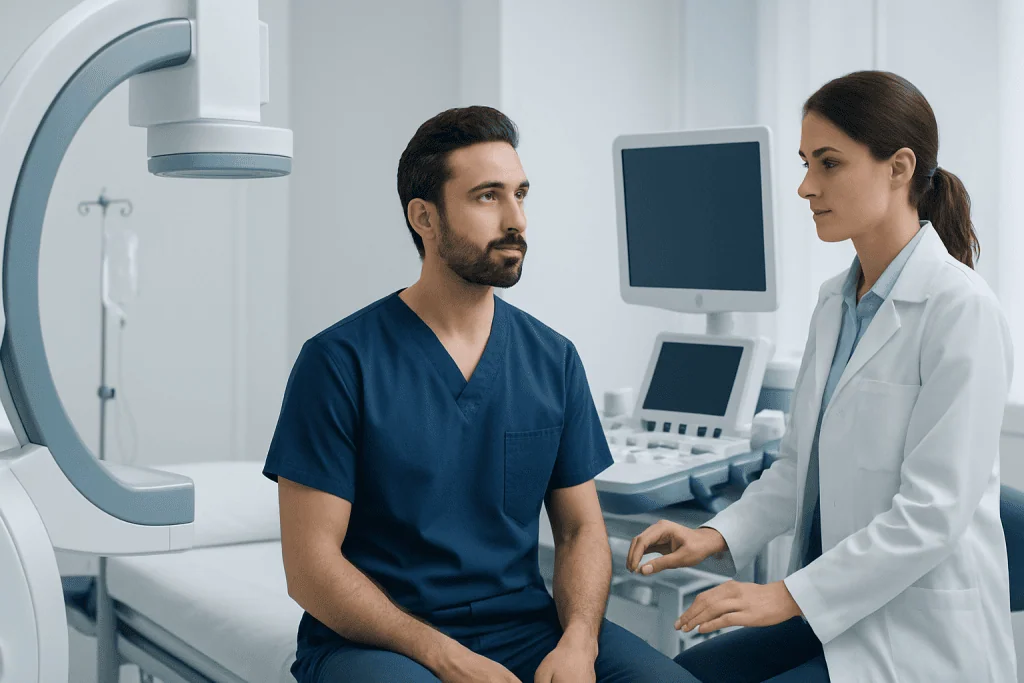
Your first filter should always be clinical: does the campus support the specialty and the treatment pathway you need? A patient seeking cancer care, cardiology, orthopaedics, IVF, neurology or general surgery may need very different combinations of specialists, imaging equipment, operating facilities or intensive monitoring. A campus ten minutes from your hotel is pleasant. A campus where your surgeon, anaesthesiologist and imaging team all work under one roof is useful. When the two conflict, the second wins.
At Acibadem, care is often organised through multidisciplinary teams. This matters more than it sounds. Many treatments involve several specialists working together — a surgeon alongside anaesthesiology, or an oncologist working with radiology, pathology and supportive care. Whether your care can be coordinated smoothly at one campus is usually a better question than any comparison of buildings, bed counts or addresses.
Practical pathway questions worth raising early:
- Can the consultation and the key tests be scheduled close together, ideally within the same one or two days?
- Would the likely treatment take place at the same campus as the consultation?
- Is inpatient care expected, and roughly for how long?
- How many return visits are usually needed for a case like yours?
- Will physiotherapy, rehabilitation or follow-up imaging be part of the plan, and where would that happen?
These answers often decide which campus feels easiest once you are actually in Istanbul. They also affect preparation: some tests are better completed at home before you fly, and the guide on which medical tests to complete before flying to Turkey explains how to think that through with your own doctor.
Location in Istanbul: why geography still matters

Once the clinical picture is clear, geography becomes your second filter — and in Istanbul it deserves respect. The city is split by the Bosphorus into a European side and an Asian side, and crossing between them means a bridge or tunnel that can move quickly at midday and crawl at rush hour. A journey that takes forty minutes on a Sunday can take well over an hour on a weekday evening. If your schedule includes several appointments across multiple days, staying near the campus where most of your care happens will save real energy.
Two other geographic facts shape planning. Istanbul has two international airports: Istanbul Airport on the European side and Sabiha Gökçen on the Asian side. Which one you land at affects your first transfer, though it should not decide your campus — a longer transfer on day one is a small price for a smoother pathway across the rest of the trip. If you want to know what arrival looks like in practice, see medical check-in at Istanbul airport for patients.
Convenience matters most when you are dealing with limited mobility, fatigue, pain, or early-morning appointment times. Think beyond the hospital gate: pharmacies, supermarkets, quiet places to rest, and child-friendly options if family is travelling with you. For daily movement between accommodation and appointments, the guide on getting around Istanbul for hospital appointments covers taxis, transfers and public transport in useful detail.
Accommodation deserves the same deliberate thinking. If most of your care will happen at one campus, staying within a short ride of it usually beats staying in a famous district across the city. Whether a recovery hotel or a serviced apartment suits you better depends on your length of stay, who travels with you, and how much rest your treatment will demand.
Is there a single “best” hospital in Istanbul?
Search results are full of ranked lists, and it is tempting to treat them as an answer. In honest terms, there is no single best hospital in Istanbul — not for everyone at once. A campus that is an excellent match for complex cardiac surgery may be an ordinary choice for someone seeking dental work, and the reverse is equally true. Rankings compare institutions in the abstract; your decision is concrete.
The same logic applies to the broader question of which hospital in Turkey is best for medical tourism. What actually distinguishes a good choice for an international patient is fairly boring: whether the specialty you need is genuinely established there, whether diagnostics and treatment can be coordinated without long gaps, whether interpreters are available in your language, and whether someone owns your schedule from the first email to the follow-up plan. Those are the things to test, and they are testable — you can ask direct questions and expect direct answers.
The same honesty applies to plastic surgery, one of the most searched treatment areas in Turkey. There is no objectively “best” hospital for it. What you can assess is whether the specific procedure you want is performed at the campus under consideration, how the consultation and pre-operative assessment are structured, what the facility offers if something needs closer monitoring, and how follow-up is handled after you fly home. A careful answer to those questions is worth more than any list.
Do you have to pay for hospital treatment in Turkey?
Yes — as an international patient at a private hospital group such as Acibadem, treatment is paid care. Turkey’s public health system covers Turkish citizens and eligible residents; it does not cover visitors travelling for treatment. What you can expect instead is a structured quoting process, and understanding how it works helps you compare options sensibly.
A quote is normally prepared after your medical records have been reviewed, because the figure depends on the specifics of your case: the specialty and complexity of the treatment, the expected length of any hospital stay, the type of anaesthesia, imaging and laboratory work involved, any implants or materials used, and the room category. Questions worth asking about any quote, from any provider:
- What exactly is included — and, just as importantly, what is excluded?
- What happens to the estimate if test results change the plan after arrival?
- Are follow-up visits during your stay covered within the same quote?
- How is payment handled, and what documentation will you receive for insurers at home?
Some international health insurance policies cover planned treatment abroad, either directly or by reimbursement; that is a conversation to have with your insurer before travel, in writing. Travel insurance, by contrast, typically covers emergencies rather than planned procedures — read the policy rather than assuming.
Questions to ask before deciding on a campus
If more than one Acibadem campus could work for you, ask the same set of questions about each. Comparing like with like turns an anxious decision into an administrative one.
Clinical and scheduling questions: Are the specialists relevant to your case based at that campus? Is the imaging or diagnostic work you need available on site? Would the procedure itself happen there, or elsewhere? How many visits does a case like yours usually involve, and does that timeline fit your travel window?
Support questions matter just as much for international patients: Is interpretation available in your language? How are airport and daily transfers arranged? Can appointments and billing be handled through one point of contact? What is available for your companion — seating, meals, accommodation guidance, a place to wait during procedures?
Finally, ask what happens if the plan changes after you arrive. Test results sometimes lead to an additional consultation, a different recommendation, or a revised timetable. Knowing in advance how care is coordinated across Acibadem facilities makes those moments far less stressful. And once you arrive, large hospitals can be disorienting in themselves — the guide on how to navigate a large hospital campus in Turkey is worth ten minutes before your first appointment.
How Acibadem International narrows down the options
You do not need to work this out from a map and general impressions. Acibadem International’s coordinators work from your medical files and your preferred travel dates, and match your needs against the specialist teams and facilities across the Istanbul campuses. The recommendation that comes back is a starting point for discussion, not a sales pitch — and you are entitled to ask why a particular campus was suggested over another. A good coordinator can answer that question specifically.
Support extends beyond the medical appointment itself. Depending on your situation, coordination can cover appointment scheduling, interpreter arrangements, documentation guidance and practical travel planning. That matters most when you are organising treatment from another country while balancing work and family, and cannot spend weeks chasing details across time zones.
There is also the quieter benefit of continuity. Instead of repeating your story to a new contact at every step, a coordinated process connects your records, your schedule and your questions. If your treatment involves several specialties, that connection saves time and prevents the small miscommunications that make medical travel exhausting.
To be clear about the limits: no coordinator can tell you which treatment is right for you before a specialist has reviewed your case, and the campus recommendation may be refined once a doctor has seen your records or examined you. That is normal, and it is how it should work.
Making the final decision
When you are close to a choice, favour the campus that gives you the clearest overall pathway. A longer airport transfer is a one-time cost; a fragmented pathway is a daily one. If two campuses are equally suitable clinically, then — and only then — let convenience decide: the shorter daily journey, the better accommodation options, the easier area for your companion’s errands.
Decide from written information, not memory. Keep a simple document listing the recommended campus, the expected sequence of appointments, the likely length of stay, your accommodation area, transfer times, and any special support you will need. If a companion is travelling with you, involve them: they will notice things you miss, such as whether the route looks tiring or whether the schedule leaves enough rest.
And stay flexible. The most suitable campus sometimes becomes clearer only after your records are reviewed or after an initial specialist opinion. That is not a failure of planning — it is the plan responding to information. What matters is that you understand the reasoning behind the recommendation and feel prepared for the next step.
Step by step
- Gather your records and define your treatment goal. Collect recent reports, imaging, laboratory results, your medication list, and a short summary of the treatment or opinion you are seeking. Campus recommendations are built on this material; the more complete it is, the more specific the answer.
- Let the full pathway drive the recommendation. The useful question is not where the first appointment can happen, but which campus best supports the likely sequence of consultation, diagnostics, treatment, any hospital stay, and follow-up.
- Compare the clinically suitable options on practicality. Weigh airport access, accommodation availability nearby, daily transfer times, and ease for your companion. In a city Istanbul’s size, these differences are felt every single day of your stay.
- Confirm support services early. Interpreter availability in your language, wheelchair support, documentation help and accommodation guidance are easier to arrange before travel than after arrival.
- Review the likely timeline before booking flights. Ask how many days the plan may require, whether tests can happen soon after arrival, and when a procedure might realistically be scheduled if one is indicated. Build in margin rather than booking the tightest possible trip.
- Choose accommodation around your treatment pattern. If most care happens at one campus, stay near it. If the plan involves several visits over many days, prioritise a safe, comfortable area with easy daily logistics over a scenic one.
- Keep one written plan. Before departure, save a single document with the campus name and address, appointment times, contact numbers, transfer instructions, and the documents you must carry. Having everything in one place is a quiet but real source of control.
Your checklist
- Passport details and possible travel dates ready
- Recent medical reports, scans and test results collected in one folder
- Current medication list prepared
- Questions about specialty fit and treatment pathway written down
- Interpreter needs identified, if any
- Companion travel and accommodation needs considered
- Estimated number of visits and expected length of stay clarified
- Airport and daily transfer plan noted
- Insurance coverage checked in writing with your insurer, if relevant
- Follow-up arrangements after returning home understood
Key takeaways
- The most suitable Istanbul campus depends on your treatment pathway and specialist needs, not on rankings or the nearest pin on the map.
- Istanbul’s size and its two-continent geography make location a genuine factor — but a secondary one, after clinical fit.
- Ask whether consultation, tests, treatment and follow-up can be coordinated at one campus, and how the plan adapts if results change it.
- International patient treatment in Turkey’s private hospitals is paid care; quotes are case-specific and prepared after records are reviewed.
- Written comparison of like-for-like questions across campuses turns a stressful decision into a practical one.
Frequently asked questions
What is the best hospital in Istanbul, Turkey?
There is no single best hospital in Istanbul, because “best” depends on the treatment you need. A campus that is a strong match for complex surgery may be an ordinary choice for a different specialty. The most useful comparison looks at whether your specialty is genuinely established there, whether diagnostics and treatment can be coordinated smoothly, and whether the location works for your stay.
Which hospital in Turkey is best for medical tourism?
The honest answer is that it depends on your case, not on a league table. For an international patient, the qualities that matter are specialty fit, coordinated scheduling, interpreter availability, clear written quotes, and a single point of contact from planning through follow-up. Any hospital you consider should be able to answer direct questions about all of these.
Do you have to pay for hospital treatment in Turkey?
Yes. Turkey’s public system covers citizens and eligible residents, not visitors travelling for treatment. International patients at private hospitals pay for their care, usually based on a written quote prepared after their records are reviewed. Some international insurance policies cover planned treatment abroad — confirm this with your insurer in writing before travelling.
Which hospital in Turkey is considered the best for plastic surgery?
No hospital is objectively best for plastic surgery, and claims to the contrary deserve scepticism. What you can meaningfully assess is whether the specific procedure you want is performed at the campus in question, how consultation and pre-operative assessment are structured, what monitoring the facility offers, and how follow-up works once you return home.
Should I choose the campus closest to my hotel or the airport?
Not necessarily. If another campus better suits your treatment pathway, a longer transfer on arrival day is usually worth it for smoother care across the whole trip. It generally works better to choose the campus first and then book accommodation near it, rather than the other way round. Proximity becomes the deciding factor only when two options are clinically equivalent.
Can all my appointments happen at one Acibadem campus?
Often, but not always. Many patients have consultations, tests, treatment and follow-up coordinated at a single campus, while some plans depend on where a particular specialist or facility is available. This is worth clarifying early, because the answer shapes where you stay and how long your trip should be.
Does the biggest or newest campus mean the best one for me?
No. Size and newness are not proxies for suitability. What matters is whether the specialist team and facilities relevant to your specific care plan are available there, and whether your pathway can be coordinated without unnecessary gaps or cross-city journeys.
What information is a campus recommendation usually based on?
Recent medical reports, imaging where available, pathology or laboratory results, a current medication list, and a short description of the diagnosis or the opinion being sought — together with travel dates and any mobility or language needs. The more complete this picture, the more specific and reliable the recommendation.
Add us as a Preferred Source to see more of our trusted health content across Google Search, AI Overviews and Discover.

Update history
- PublishedJune 25, 2026
- Medical review approvedAugust 31, 2026
- Last content updateAugust 31, 2026
References2
More Patient Guides

At Acibadem, How We Explain Expected Clinical Outcomes and Treatment Success Information
Expected clinical outcomes at Acibadem are explained in clear, realistic terms so you understand likely benefits, limits, risks, and next steps in…
9 min read
At Acibadem, How Families and Companions Are Supported During Treatment Travel
At Acibadem, family support during treatment travel in Turkey includes interpreters, planning help, visitor guidance, and practical support for companions.
9 min read
At Acibadem, What Happens If Your In-Person Evaluation Changes the Initial Plan
In-person evaluation plan changes at Acibadem can happen if new findings appear in Turkey. Your team explains why, what changes, and your…
9 min read
At Acibadem, How We Explain Deposits, Payment Steps, and Billing Documents
Deposits, payment steps, and billing documents at Acibadem are explained clearly so you know when to pay, what documents you receive, and…
8 min read