

Cardiac Stress Test in Turkey: Patient Preparation Guide

Preparing for a cardiac stress test in Turkey means confirming the exact test type before you travel, following written medication and caffeine instructions, sending recent records in advance, and keeping several hours free on the day. Never pause prescribed medicines on your own, only the requesting doctor decides that. Ask before departure how your report will be delivered and shared with your home cardiologist.
Can you have your morning coffee? How much of the day will the hospital visit actually take? Those are the two questions international patients ask first, and both have honest answers: it depends on which stress test you are having, and longer than the test itself. This guide walks you through both, plus everything in between.
If you are planning a cardiac stress test in Turkey, the preparation is straightforward once you know what has been requested. Below you will find what to arrange before you fly, what to bring, how the day usually unfolds, what the results can and cannot tell you, and how costs are typically worked out.
At a glance
- Best for: Patients whose cardiologist has requested an exercise or medication-based assessment of how the heart performs under load
- Typical timing: The test itself is short; the full visit, registration, preparation, monitoring, recovery and report coordination, can take several hours
- Key preparation: Confirm the exact test type, send recent records ahead, follow written caffeine and fasting instructions, wear comfortable shoes
- Medication rule: Never stop heart, blood pressure or diabetes medicines unless the requesting doctor specifically instructs it in writing
- Travel support: Interpreters, appointment scheduling, transfer guidance and document coordination are easiest to arrange before you fly
What a cardiac stress test measures
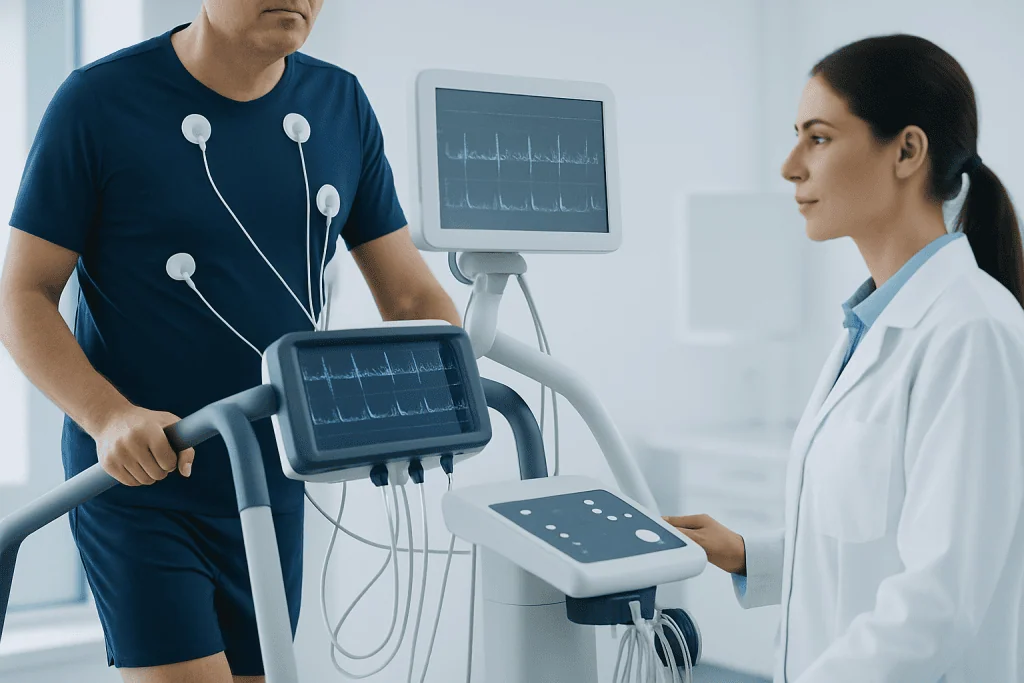
A cardiac stress test shows how your heart behaves when it works harder than it does at rest. Some problems with blood flow to the heart muscle only reveal themselves under effort: the resting ECG can look entirely normal while a narrowed artery struggles to supply enough blood during exertion. The test creates that effort in a controlled, monitored environment, either through exercise on a treadmill or stationary bike, or through a medication that mimics the effect of exercise on the heart.
Throughout the test, the team watches your ECG, heart rate, blood pressure and symptoms continuously. Depending on the format, imaging may be added: a stress echocardiogram uses ultrasound before and immediately after exertion, while nuclear stress testing uses a small tracer dose to map blood flow through the heart muscle. Your cardiologist decides which format fits your situation based on your symptoms, history, mobility and any earlier results, including whether you have a known cardiac arrhythmia, previous stents, bypass surgery or a pacemaker.
For patients arranging a cardiac stress test in Turkey from abroad, the important point is that the test is one component of a day, not the whole day. Registration, nursing checks, a medicines review, consent, the test, recovery observation and report coordination all take time. Knowing this in advance stops you booking onward plans that are too tight.
The main types of stress test
Preparation differs by test type, so it helps to know which one is on your referral.
- Exercise ECG (treadmill test). You walk on a treadmill that gradually increases in speed and incline while your ECG and blood pressure are monitored. It is the most common format for patients who can exercise comfortably.
- Stress echocardiogram. Ultrasound images of the heart are taken at rest and again immediately after exertion, allowing the cardiologist to compare how the heart walls move under load.
- Pharmacological (medication-based) stress test. A medication delivered through a small cannula raises the heart’s workload or dilates its arteries. This is the usual route when exercise is not practical, for example with joint problems, severe breathlessness or limited mobility.
- Nuclear stress test. A tracer injection and specialised camera map blood flow through the heart muscle at rest and under stress. This format tends to carry the strictest caffeine and fasting instructions.
If your referral letter does not state which type has been requested, ask the coordinating team to confirm with the cardiology department before you travel. It changes what you can eat, drink and possibly which medicines are paused, and getting it wrong can mean a wasted trip to the hospital.
Before you travel to Turkey
Start with the referral. Confirm in writing which test has been requested and ask for the preparation instructions that apply to that specific format. Generic advice from the internet is no substitute, caffeine windows, fasting periods and medication decisions vary between an exercise ECG and a nuclear study.
Share your medical background early. Details that matter include chest pain, breathlessness, fainting episodes, rhythm problems, previous stents or bypass surgery, valve disease, pacemaker or ICD devices, asthma, kidney disease, diabetes, pregnancy and any mobility limits. None of these necessarily prevent testing; they help the team choose the safest format and allow the right amount of time.
Send recent documents in advance if you have them: previous ECGs, echocardiogram reports, angiography results, CT or MRI reports, blood tests, discharge summaries and a full medication list. If your records are not in English or Turkish, ask before you travel which documents are worth translating, usually the most recent cardiology reports rather than your entire file.
If your cardiologist at home has also raised questions about your breathing, it is worth knowing that lung assessment is often scheduled alongside cardiac testing; our guide to the pulmonary function test in Turkey covers that preparation separately.
Medication, caffeine and food instructions

This is the part of preparation that patients most often get wrong, usually by trying to be helpful. Some heart medicines, beta blockers in particular, can blunt the heart rate response the test is designed to measure, and for that reason a doctor sometimes asks for a specific medicine to be held before testing. That decision belongs entirely to the doctor. Never stop beta blockers, calcium channel blockers, nitrates, rhythm medicines, blood pressure tablets, blood thinners or diabetes medicines on your own initiative. If the instructions you received are unclear, ask before the test day rather than guessing.
Caffeine restrictions apply to certain formats, especially medication-based and nuclear stress tests, because caffeine can interfere with the stress agent. You may be asked to avoid coffee, tea, energy drinks, cola, chocolate and caffeine-containing painkillers for a defined period beforehand. The window varies by test and by patient, so follow the instructions issued for your appointment, and if you slip up and have a coffee out of habit, tell the team honestly. Adjusting the appointment is far better than an unreliable result.
Fasting rules also vary. Some patients are simply asked to avoid a heavy meal beforehand; others need a longer fasting window when imaging or a stress medication is planned. If you have diabetes, ask for a personalised plan covering meals, insulin timing or tablets, so your blood sugar stays managed while you still prepare correctly.
- Bring all medicines in their original packaging where possible.
- Carry a written list of doses and timings, including supplements and herbal products.
- Mention allergies, inhalers, patches and over-the-counter medicines.
- Ask in advance what to do if you accidentally take caffeine or a medicine that was meant to be paused.
What to wear and bring on the day
Dress for movement and monitoring. Comfortable walking or trainer-style shoes, loose trousers or shorts, and a top that allows ECG leads or ultrasound access are the practical choices. Skip heavy creams, oils or powders on your chest that morning: they make electrodes harder to attach and can interrupt the recording.
Bring your passport or official ID, appointment confirmation, insurance or payment documents if applicable, and your medical records. Keep glasses, hearing aids, mobility aids, inhalers and glucose monitors with you rather than in a companion’s bag. A light jacket, phone charger and a small snack for after the test, if you have been fasting, are all sensible additions.
If someone is travelling with you, confirm in advance where they can wait. Companions usually cannot enter the testing area itself, but they can help with registration, transport and reassurance. For medical conversations, professional interpreter support is a better option than relying on a family member, and it can be arranged in advance for international patients.
Planning your hospital day in Istanbul
Allow more time than you think you need. Istanbul traffic is genuinely unpredictable, and the visit involves several stages: registration, insurance or payment confirmation, nursing assessment, the test, recovery observation and report preparation. Arriving early matters most if this is your first visit to the hospital or you are using interpreter support.
Do not book an airport transfer, a long sightseeing plan or another significant medical appointment immediately after the stress test unless the timing has been confirmed to work. Exercise testing leaves some patients tired; medication-based tests usually involve a short observed recovery; and the cardiologist may want to discuss preliminary findings or add a further scan on the same day.
The practical layer, appointment sequencing across departments, transfer and accommodation guidance near the hospital, and interpreter arrangements, is easiest to sort out before travel rather than on the day, particularly if you are travelling alone, on a short stay, or combining the stress test with a wider cardiology check-up.
What the results can and cannot tell you
A stress test report typically covers how long you exercised, the workload you reached, your heart rate and blood pressure response, any symptoms, and any ECG or imaging changes under stress. Workload is often expressed in METs, metabolic equivalents. One MET is roughly the energy your body uses sitting at rest, and treadmill protocols estimate how many multiples of that you achieved. There is no single “good” METs number that applies to everyone: the cardiologist interprets your achieved capacity against what would be expected for your age, sex, fitness and the protocol used, alongside everything else the test recorded. Judging yourself against a figure from the internet is not meaningful.
It is also honest to say what the test cannot do. A stress test is designed to detect narrowings severe enough to limit blood flow under effort. It is possible to have coronary artery diseaseplaque that has not yet reached that flow-limiting threshold, and still produce a normal stress test. That is not a flaw in the testing; it reflects what the test is built to answer. When symptoms or risk factors do not match a normal result, cardiologists often add other assessments, such as coronary CT angiography, to look at the arteries directly.
Depending on what the test shows, recommendations range widely: reassurance and lifestyle guidance, medication review by the treating doctor, structured cardiac rehabilitation, further imaging, invasive angiography, or, where a significant problem is confirmed, a discussion of procedural and surgical options, which today include approaches such as robotic cardiac surgery in suitable cases. The stress test is a decision-making tool, not a verdict on its own.
How the cost of a stress test is worked out
You will see fixed package prices advertised online for cardiac testing in Turkey. Rather than quoting figures, it is more useful to understand what any quote depends on, because that is what determines whether two offers are actually comparable.
The main variables are the type of test (a treadmill ECG is priced differently from a nuclear study), whether imaging is included, whether a cardiology consultation before and after the test is part of the quote, whether the test sits inside a wider check-up programme, and the hospital and city. Interpreter services, transfers and accommodation may be bundled or separate.
A reliable quote usually follows a review of your referral and records, and it should be itemised. Before comparing offers, ask each provider the same questions: exactly which test, which imaging, how many consultations, what happens to the price if the cardiologist recommends an additional scan on the day, and how the written report is delivered. A quote that cannot answer those questions is not yet a quote.
After the test and next steps
After the test you rest under observation while your heart rate, blood pressure and symptoms settle. Tell the team straight away if you feel chest discomfort, unusual breathlessness, dizziness, palpitations, nausea or weakness during or after the test: you are in the right place for it to be assessed, and your own feedback matters alongside the monitors.
Results may be discussed the same day or after the ECG and images have been fully reviewed, depending on the format and schedule. Before you leave Turkey, confirm three things: how you will receive the written report and any image files, whether documents can be provided in English, and how the results can be shared securely with your cardiologist at home. Keep both a digital and a printed copy: it is the simplest safeguard against delays once you are back.
If flying home soon after the test, raise it with the cardiologist rather than assuming. Most routine testing does not interfere with travel plans, but the answer depends on why the test was done and what it showed, so it is a question for the person holding your results.
Step by step
- Confirm the exact test type. Ask in writing whether your appointment is for an exercise ECG, stress echocardiogram, medication-based test or nuclear study. Preparation, duration and restrictions differ between them.
- Send your medical records in advance. Recent ECGs, echocardiograms, angiography reports, discharge summaries and a complete medication list let the cardiology team review your background and flag safety considerations early.
- Clarify medication and caffeine rules. Do not pause any prescribed medicine on your own. Ask specifically about heart rate medicines, blood pressure tablets, blood thinners, diabetes medicines, inhalers and caffeine-containing drinks or tablets.
- Plan your arrival and timing. Arrive early and keep the hours after the test free. Registration, preparation, testing, recovery and report coordination can take several hours, particularly for international patients.
- Dress for comfort and monitoring. Walking shoes and loose clothing suit exercise testing; avoid chest creams or oils, and bring a change of top if you want to freshen up afterwards.
- Arrange language and logistics support early. Interpreter support, transfer guidance and cross-department scheduling all work better when requested before the appointment rather than on the day.
- Sort out results before departure. Confirm when the report will be ready, whether images are included, whether an English version is available, and how the findings reach your doctor at home.
Your checklist
- Passport or official ID and appointment confirmation
- Referral letter or the stated reason for the stress test
- Recent ECG, echocardiogram, angiography, CT, MRI or discharge reports if available
- Complete medication list with doses and timings, including supplements and inhalers
- Comfortable walking shoes and loose clothing
- Written instructions covering fasting, caffeine and medicines
- Glasses, hearing aids, mobility aids or glucose monitoring supplies if used
- Insurance, payment or guarantee documents if applicable
- Phone charger and your coordinator’s contact details
- A companion’s contact number and your hotel address
Key takeaways
- A cardiac stress test in Turkey runs smoothly when the test type, medication rules and timing are confirmed in writing before you travel.
- Never stop heart, blood pressure, blood thinner or diabetes medicines without a specific instruction from the requesting doctor.
- Caffeine and fasting rules depend on the test format, follow the instructions issued for your appointment, and be honest about slip-ups.
- Allow several hours at the hospital and keep flights, transfers and sightseeing out of the same afternoon.
- A normal result answers a specific question about blood flow under effort; it is not a blanket statement about your arteries, which is why further imaging is sometimes added.
- Before leaving, confirm how you will receive the report, whether it can be issued in English, and how it reaches your cardiologist at home.
Frequently asked questions
What is a cardiac stress test?
It is a monitored assessment of how your heart performs under effort. The effort comes either from exercise on a treadmill or bike, or from a medication that mimics exercise, while the team records your ECG, heart rate, blood pressure and symptoms. Imaging, ultrasound or a nuclear tracer scan, can be added to show how blood flows through the heart muscle under load.
How much does a cardiac stress test in Turkey cost?
There is no single figure, because the price depends on the test type, whether imaging is included, how many cardiology consultations are part of the quote, and whether the test sits inside a broader check-up. Reliable quotes are itemised and follow a review of your referral. When comparing offers, ask each provider exactly what is included and what happens if an additional scan is recommended on the day.
Can you have heart blockage with a normal stress test?
Yes, it is possible. Stress testing is designed to detect narrowings severe enough to restrict blood flow under effort. Coronary plaque that has not reached that threshold may not show up. When symptoms or risk factors do not fit a normal result, cardiologists often add other assessments, such as coronary CT angiography, to examine the arteries directly.
What is a good METs score for a stress test?
One MET is roughly the energy your body uses at rest, and treadmill protocols estimate how many multiples of that you reach. There is no universal target number: the cardiologist interprets your achieved capacity against what would be expected for your age, sex, fitness and the protocol used, alongside your ECG, blood pressure response and symptoms. The written report puts the figure in that context.
Can I drink coffee before my stress test?
Follow the instructions issued for your specific test. Certain formats, especially medication-based and nuclear tests, require avoiding caffeine for a set period beforehand because it can interfere with the stress agent. If you accidentally have coffee, tea or an energy drink, tell the team rather than staying quiet; the appointment can be adjusted, an unreliable result cannot.
Should I stop my heart medicines before the test?
Not unless the requesting doctor clearly tells you to. Some medicines can affect stress test results, and a doctor may deliberately ask for one to be held, but stopping medicines without that instruction can be unsafe. Ask in advance, in writing, about beta blockers, calcium channel blockers, nitrates, blood pressure medicines, blood thinners and rhythm medicines.
What if I cannot walk on a treadmill?
Tell the team before your appointment about mobility limits, joint pain, neurological conditions or severe breathlessness. A medication-based stress test is the usual alternative when exercise is not practical, and other assessments exist as well. The right format depends on your health history and the question the test needs to answer.
Can I fly home after a cardiac stress test?
Many patients travel without issue after routine testing, but do not assume: the answer depends on why the test was done, what it showed and which format was used. Ask the cardiologist who holds your results, and if you travelled specifically because of cardiac symptoms, build some flexibility into your return itinerary in case further assessment is suggested.
Add us as a Preferred Source to see more of our trusted health content across Google Search, AI Overviews and Discover.

Update history
- PublishedJune 16, 2026
- Medical review approvedAugust 30, 2026
- Last content updateAugust 30, 2026
References2
- Exercise Stress Test: Cleveland Clinic my.clevelandclinic.org
- Stress Tests: MedlinePlus medlineplus.gov
More Patient Guides
Sleep Apnea Testing in Turkey: What Happens During Your Evaluation
Sleep apnea testing in Turkey may include a consultation, overnight sleep study or home test, and a clear review of your results…

How to Organize Your Test Results Before Traveling to Turkey
Organize your test results before traveling to Turkey by sorting records, images, medicines and timelines so your Istanbul care team can review…

When Extra Tests Are Needed Before Treatment in Turkey
Extra tests before treatment in Turkey may be needed to confirm diagnosis, timing, and safety. Here is what you can expect in…

At Acibadem, How to Prepare for Blood Tests, Scans, and Pre-Op Checks
Blood tests, scans, and pre-op checks at Acibadem in Turkey help confirm you are ready for treatment and avoid delays on the…