

Pulmonary Function Test in Turkey: Breathing Test Preparation

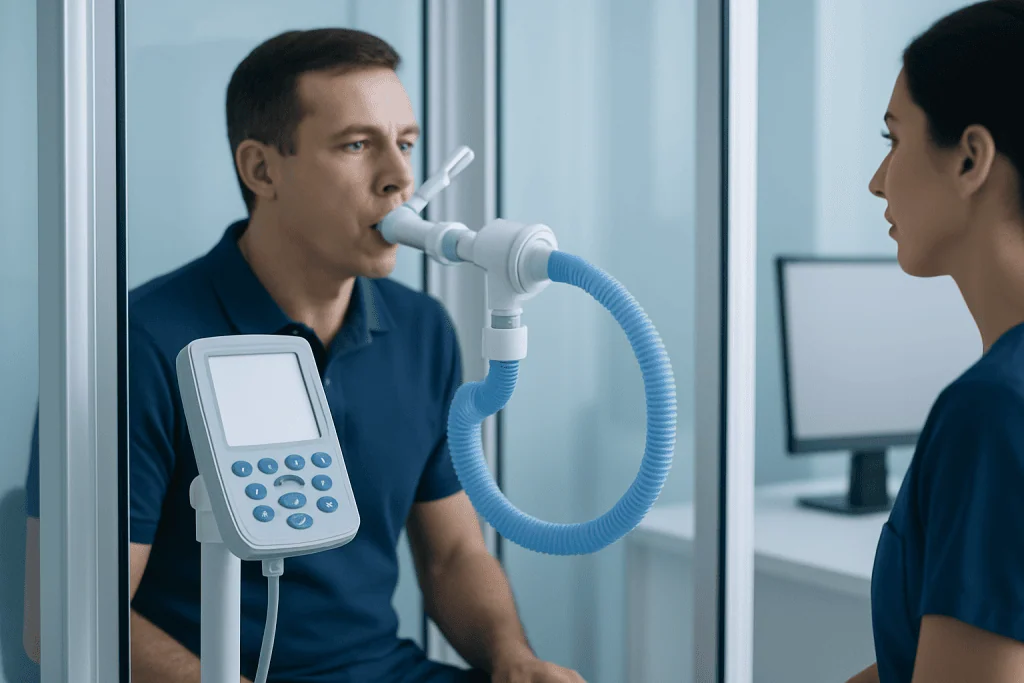
Preparation for a pulmonary function test is mostly practical. Confirm medication instructions in advance, never pause an inhaler on your own, wear loose clothing, avoid a heavy meal, and follow any guidance on smoking, caffeine or exercise. Bring your ID, medication list and previous lung reports. The test itself is non-invasive: you breathe through a mouthpiece while a technician coaches each effort.
Should you take your inhaler on the morning of the test? What should you pack for the hospital visit? These are usually the first questions international patients ask, and the honest answer to the first one is: it depends on why the test was ordered. A pulmonary function test is a non-invasive breathing assessment that shows your doctor how well your lungs move air and transfer oxygen. Nothing about it involves needles or surgery, but the results are only as good as the preparation and the effort you bring to it.
This guide explains what a pulmonary function test in Turkey usually involves, how to prepare before you travel and on the day itself, what happens in the testing room, and what to sort out before you leave so your results reach the right people.
At a glance
- Test type: Non-invasive breathing and lung function assessment, no needles, no anaesthesia
- Common components: Spirometry, lung volumes, diffusion capacity and bronchodilator response testing
- Typical visit length: Often 30–90 minutes, depending on which measurements are planned
- Preparation focus: Medication instructions, clothing, meal timing, smoking and recent symptoms
- Key rule: Never stop or change any medicine unless your doctor or the testing laboratory specifically instructs it
- Results: Raw values appear quickly, but a physician interprets the final report in context
What a pulmonary function test in Turkey measures
A pulmonary function test in Turkey is arranged for the same reasons it would be anywhere: to measure how much air you can move in and out, how much air your lungs can hold, and how efficiently oxygen crosses from your lungs into your blood. You may hear the test called spirometry, a lung function test, a breathing test or simply a PFT. These names overlap but are not identical, spirometry is one component, and a full pulmonary function test may add several others.
The exact combination depends on the question your doctor is trying to answer. The main building blocks are:
- Spirometryyou blow out as hard and fast as you can into a mouthpiece. This measures airflow and is the most common starting point.
- Lung volumesusually measured in a clear booth called a body plethysmograph, or with a gas-dilution technique. This shows how much air your lungs hold in total, including air you cannot blow out.
- Diffusion capacity (DLCO)you inhale a small amount of a special test gas and hold your breath briefly. This estimates how well gas transfers across the lung tissue into the bloodstream.
- Bronchodilator responsepart of the test is repeated after an inhaled medication, so your doctor can compare your breathing before and after.
All of these are performed while you are awake, usually seated, and coached step by step by a technician. None of them require any incision, sedation or recovery period in the usual sense.
Why doctors request the test
Doctors commonly arrange lung function testing for people with shortness of breath, ongoing cough, wheezing, chest tightness or reduced exercise tolerance, and for the assessment or monitoring of conditions such as asthma, COPD and other forms of pulmonary disease. It is also used after lung infections, after lung surgery, in people with relevant occupational exposures, and as part of broader cardiology, pulmonology, allergy or internal medicine evaluations, for example alongside conditions such as pulmonary hypertension, where breathing measurements form one piece of a larger clinical picture.
Lung function testing is also a routine part of surgical planning. If your treatment in Turkey involves an operation, a breathing test may sit alongside blood work, ECG and imaging in your pre-operative work-up; our guide to pre-op tests in Turkey explains how that broader assessment usually fits together. In some cases the test is scheduled on the same visit as a cardiology assessment, if that applies to you, the preparation notes in our cardiac stress test preparation guide are worth reading as well, because the two tests have different rules about caffeine, exercise and medication timing.
For international patients, a pulmonary function test in Turkey is usually a single, straightforward hospital visit. It runs most smoothly when your documents, medication questions and language needs are settled before you travel rather than sorted out at the reception desk.
Before you travel or attend the hospital
The single most important preparation step is clarifying your medication instructions. Some breathing tests are designed to capture your usual, medicated state; others deliberately measure your baseline before a bronchodilator is given, which may mean temporarily adjusting the timing of certain inhalers. Because the instructions differ by test type and by medicine, there is no universal rule you can safely apply yourself. Ask the ordering doctor or the testing laboratory exactly what to do, and do not stop, delay or change any prescribed medicine unless they specifically tell you to.
If you are travelling from abroad, gather your recent medical records early: the appointment can be planned more accurately when the clinical team sees them in advance. Useful documents include:
- Previous pulmonary function test results, even if they are in another language
- Chest X-ray or CT reports and, if available, the images themselves
- Discharge summaries from any recent hospital admissions
- A current medication list with inhaler names, doses and how often you use them
- An allergy list and details of any home oxygen use
- Relevant cardiac or surgical history
These records help the clinical team plan the right combination of measurements, book an appropriate appointment length and compare new results against old ones, comparison over time is often more informative than a single set of numbers.
Certain recent events are relevant to the safety and timing of forced breathing manoeuvres. Make sure the team knows if you have recently had chest pain, a heart event, eye or abdominal surgery, a collapsed lung, an episode of coughing blood, a respiratory infection, fever, or severe breathlessness at rest. None of these automatically rules out testing, but each one is information the medical team uses to decide whether the test should go ahead as planned, be modified or be rescheduled. Give them the full picture and let them make that call.
How to prepare on the day of your breathing test

Dress for deep breathing. A tight belt, high-waisted shapewear or a restrictive top makes it genuinely harder to take a full breath, and the test asks you to fill and empty your lungs completely. Loose, comfortable clothing is the right choice. Comfortable shoes help if your appointment includes a walking assessment, although most pulmonary function measurements are done seated.
Plan your meal timing so you are not overly full when you arrive: a heavy meal immediately beforehand can make deep breathing uncomfortable and can trigger coughing during forced efforts. You do not usually need to fast, but check your specific instructions.
Your care team may ask you to avoid smoking, vaping, caffeine, alcohol or strenuous exercise for a set window before the test, because each of these can influence airway behaviour or the diffusion measurement. Follow the timings you were given rather than a generic rule. If you slip up, you used an inhaler out of habit, or had a coffee at the airport, do not hide it. Tell the technician exactly what you took and when. The information can be recorded alongside your results, and the test may still be perfectly useful.
- Bring your passport or official ID, appointment confirmation and any insurance or payment documents you have been asked to carry.
- Bring all inhalers, spacers and nebuliser medicines you use, plus a written medication list.
- Bring previous lung test results and imaging reports, even in another language.
- Bring glasses or hearing aids if you need them: the test depends on following spoken instructions precisely.
- Arrive early so registration, interpretation and finding the department do not eat into your appointment.
What happens during the appointment
A technician or respiratory staff member will explain each measurement before it starts and show you how to seal your lips around the mouthpiece. You will usually wear a soft nose clip so that air cannot escape through your nose. Depending on the measurement, you will be asked to breathe quietly, take the deepest breath you can, blow out as hard and fast as possible, or follow a specific breathing pattern while a machine records the results.
Expect repetition: it is deliberate
You will repeat each breathing effort several times. This is not a sign that you did something wrong. Repeat attempts are how the laboratory confirms that your results are consistent and reliable; international quality standards for these tests actually require it. The technician will coach you through each attempt, often quite energetically, because maximum effort matters, and you can ask to pause at any point if you feel tired, lightheaded or anxious.
If a bronchodilator is part of your test
Some patients are given an inhaled bronchodilator partway through the appointment and then wait, typically ten to twenty minutes, before repeating part of the test. This lets your doctor compare your baseline breathing with your breathing after the medication has taken effect, which can be a useful clue about how your airways behave. The waiting period is a normal part of the appointment, not a delay.
Lung volumes and diffusion testing
If lung volumes are measured in a body plethysmograph, you will sit inside a clear booth with a door that closes. It looks a little like a telephone box and the door can be opened at any time, tell the team in advance if enclosed spaces make you anxious, as they can talk you through it or consider alternatives. Diffusion testing involves inhaling a test gas mixture at very low, carefully controlled concentrations and holding your breath for around ten seconds. Both are non-invasive and generally well tolerated.
Comfort, safety and language support
Many people feel nervous before a breathing test because it demands effort and coordination in front of a stranger. The staff who run these tests coach first-time patients every day. Nobody expects a perfect performance on the first attempt; the technician’s job is to help you produce the best, safest and most reliable efforts you can.
During the test, tell the technician straight away if you feel dizzy, notice chest discomfort, become unusually short of breath, cough severely, feel nauseated or start to panic. Mild breathlessness or brief lightheadedness can occur after forceful blowing, it usually settles quickly, but the team should always know how you are feeling. The appointment can be paused, and the clinical staff will decide how to proceed.
Language matters more in this test than in most, because your results depend on following instructions with precise timing, when to breathe in, when to blast the air out, when to keep pushing. For international patients in Istanbul and other Turkish cities, interpreter support is available at major hospitals and works best when requested before the visit rather than on the day. Breathing tests are also often scheduled alongside a same-day specialist consultation or imaging, so it helps to know your full itinerary before you arrive.
Understanding your results and next steps
The raw numbers appear quickly, but interpretation takes a physician. Your report will typically include values such as FEV1 (the air you can force out in one second), FVC (the total air you can force out), the FEV1/FVC ratio, and possibly total lung capacity and diffusion capacity. Each value is compared against reference ranges based on your age, height, sex and other factors, which is why the same number can mean different things for different people, and why these figures should not be read in isolation.
Your doctor uses the pattern of results, alongside your symptoms, history, examination and any imaging, to identify features such as airflow limitation, restriction, a response to bronchodilators or reduced gas transfer. The report may guide diagnosis, monitor a known condition, assess fitness for surgery or determine whether further tests are needed. A normal result is not a wasted appointment: it narrows the search and helps your doctor look elsewhere for the cause of your symptoms.
Before you leave the department, settle the practical questions. When will the final report be ready, and in what format? Is a pulmonology consultation already scheduled, or does one need to be arranged? Should the report be translated or forwarded to your doctor at home? If you are flying back soon after your visit, confirm how to access digital copies of your results, because chasing documents from another country is far harder than asking in person.
Step by step
- Share your medical background before the appointment. Provide recent reports, medication lists and previous lung test results if available. This helps the team plan the correct type of pulmonary function test and spot any safety considerations before you arrive.
- Confirm medication instructions. Ask specifically about inhalers, nebulisers, allergy medicines and breathing treatments. Never stop or delay a medicine on your own; follow only the instructions given by your doctor or the testing laboratory.
- Prepare for a comfortable test day. Wear loose clothing, avoid anything that restricts your chest or abdomen, and time your meals so you are not overly full. Follow any guidance on smoking, vaping, caffeine, alcohol or exercise.
- Arrive early for registration and interpretation. Allow extra time for hospital entry, document checks and finding the correct department. If an interpreter has been arranged, arriving early keeps the schedule smooth.
- Follow the technician’s coaching. You will be guided through each breathing pattern and will repeat the same effort several times. Repetition is quality control, not criticism.
- Speak up if you feel unwell. Tell the team about dizziness, chest discomfort, severe coughing or unusual breathlessness. The test can usually be paused while the staff check on you.
- Ask how results will reach you. Before leaving, confirm the report timing, whether a consultation is scheduled, and how to access digital copies to share with your doctor at home.
Your checklist
- Passport or official ID
- Appointment confirmation and hospital contact details
- Current medication list with inhaler names and doses
- All inhalers, spacers or nebuliser medicines you use
- Previous pulmonary function test results, if available
- Recent chest imaging reports or relevant specialist letters
- Comfortable, loose clothing
- Glasses or hearing aids if you need them for instructions
- Questions you want to ask about results and follow-up
Key takeaways
- A pulmonary function test is a non-invasive breathing assessment that measures airflow, lung capacity and gas transfer.
- Good preparation means confirming medication instructions in advance, dressing comfortably and bringing accurate medical records.
- Repeated breathing efforts are a normal part of quality control, not a sign of poor performance.
- Tell the technician immediately if you feel dizzy, notice chest discomfort or become unusually short of breath during the test.
- Results are interpreted by a physician in context; sort out report access and follow-up plans before you leave the hospital.
- Interpreter support and same-day scheduling work best when arranged before the visit rather than on the day.
Frequently asked questions
Is a pulmonary function test painful?
No. The test involves no needles, incisions or anaesthesia. You breathe through a mouthpiece while following the technician’s instructions. Some people feel temporarily tired, lightheaded or briefly short of breath because the test requires strong breathing effort, but these sensations usually settle quickly.
How long does a pulmonary function test in Turkey take?
Many appointments take around 30 to 90 minutes, depending on which measurements are planned and whether a bronchodilator is given during the test. Allow extra time for registration, interpretation and any consultation or imaging arranged for the same day, and avoid booking a very tight schedule immediately afterwards.
Can I use my inhaler before the test?
It depends on the reason for the test and the type of inhaler. Some patients are asked to pause certain inhalers for a specific period; others should continue as usual. Do not stop or delay any treatment unless your doctor or the testing laboratory has clearly instructed you to, and tell the technician what you have taken on the day.
What should I avoid before a breathing test?
Your care team may advise avoiding smoking, vaping, heavy meals, strenuous exercise, alcohol, caffeine or certain inhalers for a set period before the test, because each can influence the measurements. The exact timings vary, so follow the instructions given for your specific appointment. If you could not follow an instruction, tell the technician before starting.
Will I get my results immediately?
The raw data appears quickly, but the final report usually needs physician review, because the values must be interpreted alongside your symptoms, history and any other tests. Ask before you leave when the report will be ready, whether a consultation is planned, and how the report will be shared with you.
Can I have the test if I do not speak Turkish?
Yes. Interpreter support is available for international patients at major Turkish hospitals, and it is particularly valuable for this test because the results depend on following timed breathing instructions accurately. Language arrangements work best when confirmed before the visit rather than on the day.
Is it safe to fly after a pulmonary function test?
Most people continue normal activities after a routine pulmonary function test, including travel, unless their doctor advises otherwise. If you have significant symptoms, recent surgery, oxygen needs or an unstable condition, discuss your travel plans with your physician before booking flights close to the appointment.
Add us as a Preferred Source to see more of our trusted health content across Google Search, AI Overviews and Discover.

Update history
- PublishedJune 16, 2026
- Medical review approvedSeptember 13, 2026
- Last content updateSeptember 12, 2026
References2
- Spirometry: NHS nhs.uk
- Pulmonary Function Testing: Cleveland Clinic my.clevelandclinic.org
More Patient Guides
Sleep Apnea Testing in Turkey: What Happens During Your Evaluation
Sleep apnea testing in Turkey may include a consultation, overnight sleep study or home test, and a clear review of your results…

How to Organize Your Test Results Before Traveling to Turkey
Organize your test results before traveling to Turkey by sorting records, images, medicines and timelines so your Istanbul care team can review…

When Extra Tests Are Needed Before Treatment in Turkey
Extra tests before treatment in Turkey may be needed to confirm diagnosis, timing, and safety. Here is what you can expect in…

At Acibadem, How to Prepare for Blood Tests, Scans, and Pre-Op Checks
Blood tests, scans, and pre-op checks at Acibadem in Turkey help confirm you are ready for treatment and avoid delays on the…