

Donor Testing for Transplant Treatment in Turkey: Travel Checklist

Donor testing confirms that a willing donor is medically suitable, legally eligible and donating freely. Before travelling to Turkey, gather medical records for both recipient and donor, identity and relationship documents, and medication lists, and keep travel plans flexible. Some results can be reviewed remotely, but key tests are usually repeated in the Turkish hospital, and evaluation often takes several days.
If someone is willing to donate for you, your trip has two patients to plan for, not one. That changes almost everything: the documents you gather, the days you allow, the flights you book. This guide explains what donor testing for transplant treatment in Turkey involves, what to organise before departure, and where the process can slow down if you arrive unprepared. It is a logistics guide, not a medical assessment, suitability is always decided by the specialist team after evaluation.
At a glance
- Best time to prepare: Several weeks before travel, and before any non-refundable booking
- Main purpose of testing: To confirm donor compatibility, donor safety, informed consent and legal eligibility
- Who usually travels: The recipient, the potential donor and often one companion, depending on the plan
- Documents to prioritise: Passports, medical records for both people, relationship proof, test results and medication lists
- Realistic expectation: Key tests are often repeated in Turkey, and evaluation can extend the stay, keep plans flexible
What donor testing for transplant treatment in Turkey involves
Donor testing is not a single appointment. It is a structured pathway that answers three separate questions: is the donor compatible with the recipient, is donation safe for the donor, and is the donation legally and ethically permitted. All three must be answered before a transplant plan can move forward. A willing donor is a starting point, not an approval.
Depending on the type of transplant, the evaluation may cover blood group and tissue compatibility, infection screening, imaging of the relevant organ, general health and cardiac assessment, medication and surgical history, and a consent process that confirms the donor understands the decision and is acting freely. Some of this can be reviewed on paper before you travel. Other parts require the donor to be physically present, because samples must be processed in the hospital’s own laboratory and specialists must examine the donor in person.
When you plan donor testing for transplant treatment in Turkey, your practical goal is simple: arrive with enough clear, organised information for the hospital team to make safe decisions without waiting for missing paperwork. Transplant care at Acibadem is coordinated through multidisciplinary teams within its organ transplantation units, and international patient services can help with interpreters, scheduling and travel logistics, but the medical and legal decisions rest with the specialists and with Turkish regulation, not with any travel arrangement.
Before you book flights: confirm the pathway
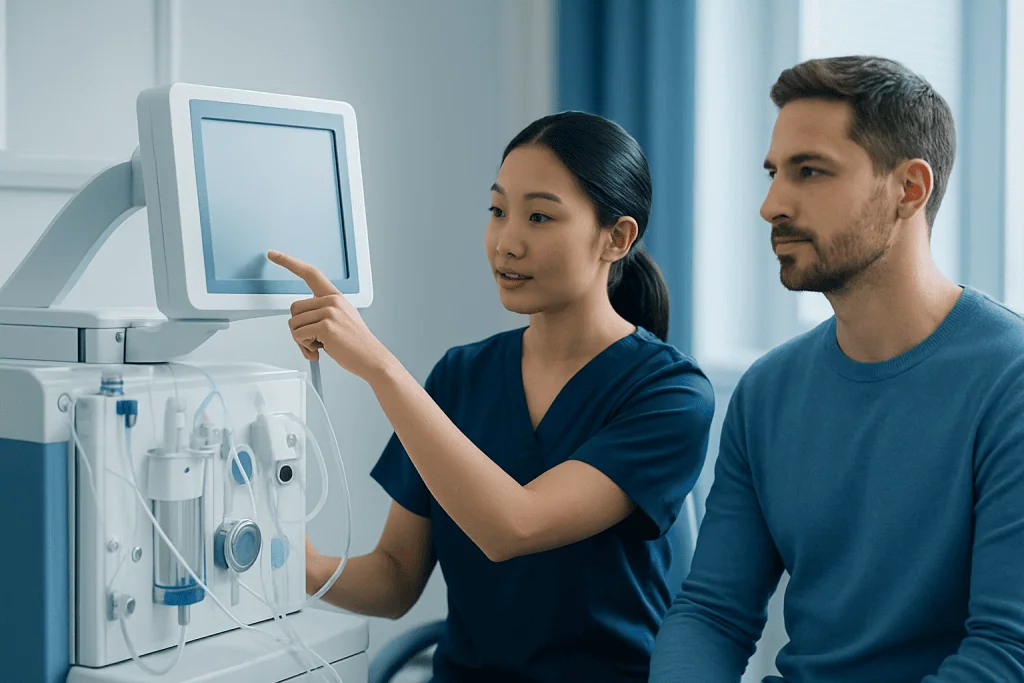
The most common planning mistake is buying tickets before the hospital has reviewed the basic facts of the case. Most transplant programmes review a medical summary first: the recipient’s diagnosis and recent reports, basic donor information, previous transplant evaluations, laboratory results and imaging. That early review determines whether travel for in-person testing makes sense at all, and whether the donor and recipient should arrive together or in stages.
It also matters to understand from the outset that a potential donor may be declined. This can happen for medical reasons, compatibility reasons, psychological reasons, or legal and ethical ones, and sometimes the answer only becomes clear after in-person assessment in Turkey. Building this possibility into your plans from the start makes the whole journey less stressful for both of you.
Points worth settling before any booking is made:
- Which transplant programme is being considered, and whether donor evaluation is available for this specific case.
- Whether the donor and recipient should travel together or whether initial records can be reviewed remotely first.
- How many days the initial evaluation typically requires, while accepting that timing can change once testing begins.
- Which documents need translation, notarisation, apostille or original copies for your situation.
- Whether a companion is advisable for daily support, particularly if either traveller has limited mobility or a chronic condition.
A broader pre-travel health checklist for international patients covers fitness to fly, medication supply and travel insurance in more detail, all of which apply doubly when two people are travelling for assessment.
How donor testing differs by transplant type
The word “donor” covers very different situations, and the testing pathway follows the transplant type.
Living organ donation
For solid organ transplants such as kidney or liver, the donor evaluation is extensive because donation involves major surgery for a healthy person. Expect blood group and crossmatch testing, detailed imaging of the organ, kidney or liver function tests, cardiac and general health assessment, infection screening and psychological evaluation. Turkish law regulates living organ donation closely: in general, living donation is permitted between close relatives, and donation involving people who are not closely related requires additional review by an ethics committee before any plan can proceed. Relationship documents are therefore not a formality: they are central to whether the transplant is legally possible.
Bone marrow and stem cell donation
For a bone marrow transplant or stem cell transplant, the first question is HLA (tissue type) matching between donor and recipient. Initial typing can sometimes be done from a blood sample before travel, with confirmatory testing repeated in the hospital’s own laboratory. If the related donor is a match, they then undergo a health evaluation to confirm that donation is safe for them, blood tests, infection screening and a general medical review. The donor’s procedure is less invasive than organ donation, but the safety and consent principles are the same.
Because the pathways differ, so do the travel plans. A bone marrow donor may need a shorter initial visit than a living organ donor, and the sequencing of who travels when varies case by case. This is exactly why the pathway should be confirmed before flights are booked, not after.
Documents to prepare for the recipient and donor

Bring both digital and printed copies of everything important, and keep originals in hand luggage, never in checked baggage. If the donor and recipient are related, official documents proving the relationship may be required, birth certificates, family registry records, marriage certificates or equivalent civil records, depending on your country. Find out in advance whether these need certified translation or apostille; requirements differ by document type and by case.
Organise medical records as a simple timeline for each person separately. For the recipient: diagnosis reports, discharge summaries, previous test results, imaging reports with the original image files where possible, a current medication list, allergy information and any earlier transplant or donor evaluation notes. A detailed medical records checklist before traveling to Turkey walks through formats, translations and how to structure the file.
The donor needs their own health summary, prepared with the same care: current and past medical conditions, surgeries, pregnancies where relevant, regular medications and supplements, smoking and alcohol history, and known family medical conditions. Complete honesty matters here. The donor evaluation exists to protect the donor as much as the recipient, and withheld information undermines that protection.
| Document | Recipient | Donor |
|---|---|---|
| Passport valid for the full stay | Yes | Yes |
| Medical summary and diagnosis reports | Yes | Health summary |
| Current medication and allergy lists | Yes | Yes |
| Imaging files and laboratory reports | Yes | If available |
| Relationship documents (if related) | Shared | Shared |
| Prescriptions or doctor letters for medicines carried | Yes | Yes |
Planning your arrival and the testing days
Testing days are busy. A single day can involve registration, fasting blood tests, imaging, specialist consultations and administrative paperwork, often in different parts of the hospital. Wear comfortable clothing, keep all documents in one folder that travels with you between departments, and bring water and snacks for after any fasting tests, if permitted for that day’s schedule.
For most international patients, Istanbul is the main arrival point. Plan flights that allow rest before the first hospital visit, particularly if either traveller has a chronic illness. A fasting blood draw the morning after a long overnight flight is an avoidable strain unless the schedule specifically requires it. Requests such as wheelchair assistance, dietary needs or a larger room for a family companion are far easier to arrange when they are raised before travel rather than on arrival.
Two people travelling for assessment means two sets of daily costs, accommodation, meals, local transport, possible extra nights if evaluation runs long. None of this appears in a treatment quote, which typically covers the clinical services themselves. What a quote includes and excludes, and how to plan for the gap, is covered in the Turkey medical travel budget checklist. The cost of donor evaluation itself depends on the transplant type, the number and kind of tests required, and whether additional consultations or repeat tests are needed, which is why written quotes are prepared case by case after the medical review.
What happens during the donor evaluation
Every donor testing schedule is personalised, but most include some combination of blood tests, infectious disease screening, compatibility testing, imaging, cardiac or general medical checks, and specialist consultations. In many pathways a psychological assessment or independent donor counselling is included, to confirm that the donor understands the decision, has had their questions answered and is not under pressure from anyone.
Do not be surprised if a test you completed at home is repeated. Hospitals routinely repeat key tests to confirm accuracy against their own laboratory standards and to comply with national regulations. Results may also need review by more than one specialist before the team can advise on the next step. Repetition is a safeguard, not a sign that your records were doubted or that something has gone wrong.
Testing does not lead directly to surgery. The team must confirm suitability for both people, review the risks openly, complete the required legal approvals and plan treatment properly. If the results show that donation is not advisable, the doctors explain the situation and discuss what options remain for the recipient’s care. That conversation is part of the pathway, not a failure of it.
Legal, consent and ethical checks
Transplant donation is closely regulated in Turkey, as it is in many countries, and the regulation exists to protect donors, recipients and medical teams alike. Identity documents, relationship records, consent forms and other official paperwork are reviewed before any transplant plan can proceed. Where a living organ donor is not a close relative, additional ethics committee review applies before the case can move forward.
Consent must be voluntary, informed and free from pressure, and it remains revocable. A donor has the right to ask questions at any stage and to withdraw from the process. The medical team may speak with the donor privately, without the recipient or family present, precisely to protect that freedom. Families sometimes find this separation uncomfortable; it is a standard protection, applied to everyone.
Requirements vary with transplant type, donor relationship, citizenship and individual circumstances, so informal advice from other patients, however well meant, is not a reliable guide to what your case will need. The document list that applies to your situation is confirmed during the pre-travel review, before anything is notarised or translated at your own expense.
Comfort, communication and contingency planning
Even with careful preparation, transplant evaluation involves waiting. Some results take longer than others, extra consultations may be requested, and legal checks have their own timelines. Build flexibility into hotel bookings and return flights wherever possible, especially if you are travelling from far away. A changeable ticket usually costs less in the end than a missed confirmatory test.
Clear communication reduces stress for everyone. Nominate one person in the family to receive updates, keep notes and share information with the others. Mixed messages between relatives are one of the most common sources of confusion during evaluation weeks. If an interpreter is needed for medical discussions, arrange one in advance rather than relying on a companion to translate sensitive consent conversations: the donor’s private discussions in particular should happen through a neutral interpreter.
Plan for ordinary life as well as hospital days: chargers, comfortable shoes, reading glasses, prescription medicines in original packaging with enough supply for extra days, copies of insurance and payment documents, and a notebook for questions as they occur to you. Small preparations make long testing days considerably easier for both travellers.
Step by step
- Have the records reviewed before travelling. The recipient’s diagnosis, recent reports and any previous transplant assessments should reach the hospital team early, along with basic donor information, so the medical review can confirm whether travel for testing is appropriate at all.
- Confirm identity and relationship paperwork. Prepare passports, national IDs and official documents showing the relationship between donor and recipient where applicable, and find out whether originals, certified copies, translations, notarisation or apostille are required for your case before paying for any of them.
- Prepare two separate health summaries. The recipient and the donor each need their own medical summary, medication list and allergy list, including surgeries, chronic conditions, infection history and relevant imaging or laboratory results.
- Check travel fitness and medication supply. Before departure, ask your local doctor whether both travellers are fit to fly. Carry enough medication for the full stay plus spare days, in original packaging, with prescriptions or doctor letters where possible.
- Plan the first hospital days realistically. Avoid tight schedules immediately after arrival. Donor testing can involve multiple departments, fasting blood tests, imaging and consultations in quick succession, so allow time for rest, meals and transport between appointments.
- Arrange interpreter support in advance. Consent discussions must be fully understood by everyone involved, and the donor’s private conversations should not depend on a family member translating. Interpreter arrangements are easiest when requested before travel.
- Keep return arrangements flexible. Additional tests, specialist reviews or legal checks can extend the stay. Choose accommodation and flights that can be changed, and avoid non-refundable commitments until the evaluation timeline is clearer.
Your checklist
- Passports valid for the full travel period, plus copies stored separately from the originals
- Recipient medical summary, diagnosis reports and recent laboratory results in timeline order
- Donor health summary, medication list, allergy list and surgical history
- Official relationship documents if the donor is a relative, with any required translations
- Previous imaging files in digital format as well as printed reports
- Current prescriptions and enough medication for extra days in Turkey, in original packaging
- Hospital address, appointment schedule and coordination contact details in one folder
- Comfort items for long testing days: chargers, glasses, snacks if permitted, a notebook for questions
- Flexible hotel and flight arrangements in case evaluation takes longer than planned
Key takeaways
- Start preparing for donor testing before booking flights, so the hospital can review the basic suitability of the case first.
- Bring original identity, relationship and medical documents, and confirm translation or certification requirements before travel.
- A willing donor still needs medical, compatibility, consent and legal evaluation before any transplant plan can proceed, and may be declined.
- The pathway differs by transplant type: living organ donation involves a more extensive evaluation than bone marrow or stem cell donation.
- Expect busy hospital days, repeated tests and possible extensions to the stay; flexibility in accommodation and flights is the single most useful precaution.
Frequently asked questions
Should the donor travel to Turkey at the same time as the recipient?
Often both need to be present during the same evaluation period, but this depends on the transplant type and the stage of review. In some cases initial records or samples can be assessed remotely before the donor travels, so the sequencing is worth confirming before any flights are booked.
Can tests done in my home country be accepted?
Previous tests are genuinely useful for the early review and for planning the evaluation. However, key tests are commonly repeated in Turkey to confirm results against the hospital’s own laboratory standards and to meet regulatory requirements. Bring all previous reports so the team can compare them.
How long does donor testing take in Turkey?
It varies with the transplant type, the donor’s health, the recipient’s condition and whether additional tests or approvals are needed. Initial evaluation may take several days, and complex cases take longer. Keeping flights and accommodation flexible until the plan is confirmed is the practical answer.
Can someone who is not a relative donate an organ in Turkey?
Turkish regulation permits living organ donation between close relatives, while donation involving people who are not closely related requires additional review by an ethics committee before any plan can proceed. The documents proving the relationship, or supporting the committee review, are therefore an essential part of preparation.
What happens if the donor is not approved?
If the donor is found unsuitable on medical, compatibility or legal grounds, the team explains the situation as appropriate and discusses what options remain for the recipient’s care. The decision protects the donor’s safety as much as the recipient’s, and a declined donor has done nothing wrong.
Do we need translated documents?
Some documents may need translation into English or Turkish, particularly official relationship records, consent-related paperwork and medical reports written in another language. Requirements depend on the document and the case, so confirm what is needed before paying for translations, and bring the originals even when translated copies exist.
Can a donor change their mind after arriving?
Yes, at any stage. Donation must be voluntary, and the process is designed so that a donor can ask questions or withdraw. The medical team may speak with the donor privately, without family present, to confirm the decision is freely made.
How is the cost of donor testing worked out?
There is no single figure, because the evaluation is built around the case. The cost depends on the transplant type, the number and kind of tests required, imaging, specialist consultations and whether any tests need repeating. Written quotes are prepared after the medical review, and travel costs, accommodation, meals, extra nights, sit outside them and need separate budgeting.
Add us as a Preferred Source to see more of our trusted health content across Google Search, AI Overviews and Discover.

Update history
- PublishedJune 22, 2026
- Medical review approvedSeptember 13, 2026
- Last content updateSeptember 12, 2026
References3
- WHO: Transplantation who.int
- MedlinePlus: Organ Donation medlineplus.gov
- NHS: Kidney transplant nhs.uk
More Patient Guides

HoLEP in Turkey: How It Compares With TURP and What Recovery Involves
HoLEP in Turkey treats enlarged prostate tissue with laser enucleation; learn how it compares with TURP, recovery, travel and follow-up.

Porcelain Veneers in Turkey: Who Is Suitable and How Many Visits Are Needed?
Porcelain veneers in Turkey can enhance tooth shape and colour in two visits for suitable patients after a personalised dental assessment.

How to Prepare for a Sedation Procedure in Turkey
Prepare safely for a sedation procedure in Turkey with guidance on fasting, medicines, travel, recovery and follow-up.

Treatment Delays in Turkey: What Happens If Tests or Recovery Change Your Schedule
Treatment delays in Turkey can happen if tests or recovery change your plan. Learn how to manage appointments, travel, accommodation and follow-up.