

How Acibadem Supports You After Treatment Abroad

Support after treatment abroad covers two things: clinical follow-up and practical logistics. At Acibadem, that means a planned discharge with written instructions, complete medical records in a shareable format, guidance on fit-to-travel timing, help with transfers and accommodation changes, and an agreed route for follow-up questions once you are home, with your local doctor kept informed throughout.
The operation or treatment is behind you. What comes next is quieter but just as important: who holds your records, when you can fly, how your medicines travel with you, and how your doctor at home picks up the thread. Recovery abroad feels much calmer when each of those questions already has an answer.
This guide explains how Acibadem supports you after treatment abroad, from the discharge conversation in your hospital room to the moment your local doctor reads your treatment summary. It also sets out what you should reasonably expect from any hospital at this stage, so you can judge the arrangements on their merits rather than on reassurance.
At a glance
- Best for: International patients planning discharge, recovery and follow-up after treatment in Turkey
- Main support: Discharge planning, medical records and reports, medication logistics, and coordination with your treating team
- Travel help: Fit-to-travel assessment by your doctor, transfer arrangements, accommodation extensions, airport assistance requests
- Who is involved: International patient coordinators, interpreters, nurses, and your specialist team
- Worth preparing: Passport, insurance details, medication list, your home doctor’s contact details, and your travel itinerary
- One principle: Emergencies are handled locally, wherever you are; planned follow-up sits with the team that treated you
What support after treatment abroad actually covers
Treatment does not end at the operating theatre door, and good support does not end at discharge. When a hospital says it supports you after treatment abroad, that claim should break down into specific, checkable things: a discharge plan you understand, documents your home doctor can use, a realistic travel timeline set by your treating doctor, and a clear route for follow-up questions once you have left the country.
At Acibadem, this phase is organised around what you need next rather than around your departure date. Depending on your treatment and how your recovery is progressing, it may include structured discharge planning, explanations through an interpreter, printed and digital copies of your medical records, prescriptions with instructions you can actually follow, and follow-up appointments arranged before you travel. The broader picture of how the international team works across your whole journey is described in this overview of support before, during, and after treatment.
For many international patients, the single most useful element is having one named point of contact in the international patient services team. Questions after treatment tend to be small but frequent: a document that needs clarifying, a follow-up date that clashes with a flight, a form your insurer wants. One coordinator who knows your case keeps those questions from scattering across departments.
Be realistic about the limits, too. Your treating team cannot examine you remotely, and no hospital abroad can replace local emergency services or your own doctor. A hospital that honestly supports you after treatment abroad offers continuity and clarity, not a pretence that distance does not exist.
How your discharge is planned before you leave the hospital
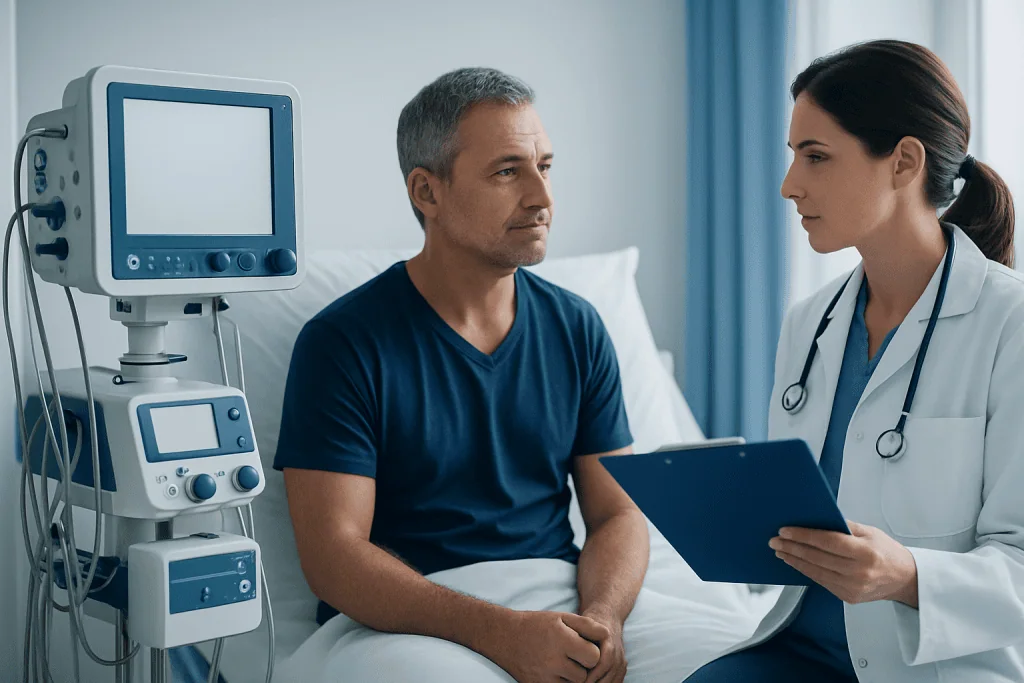
A safe discharge starts well before you leave your room. Your care team checks that your immediate recovery is stable, that your pain is being managed on a plan you can continue outside the ward, and that you understand what the next few days should look like. If pain management is on your mind, it helps to read what patients can expect from pain control after surgery in Turkey before that conversation, so you know which questions to raise.
You should leave with written discharge information covering your medications, wound or symptom monitoring, activity limits, bathing and eating guidance where relevant, and the warning signs specific to your procedure. These warning signs are not generic; they depend on what was done and on your own health, which is why they belong in your discharge summary rather than in a general guide. If English is not your first language, ask for the explanation through an interpreter, understanding these instructions confidently matters more than getting through the conversation quickly.
Because Acibadem hospitals are multidisciplinary, more than one team can contribute to your discharge plan when needed. Your surgeon, the nursing team, and another department, physiotherapy, for instance, or dietetics, may each add practical detail, so the plan reflects how you will actually live for the next few weeks, not just the clinical facts of the procedure.
Before you sign off on discharge, check you are holding:
- A discharge summary and treatment notes
- Prescriptions with clear medication instructions
- Confirmed follow-up appointment dates
- Advice on movement, rest, and diet specific to your case
- Written guidance on the warning signs your team wants you to watch for, and which contact route handles which type of question
Getting your records, prescriptions, and follow-up plan organised

The documents you carry home are the bridge between your treating team and your local doctor. At minimum, that means your discharge summary, test results, imaging reports where relevant, pathology or laboratory findings, and a medication list that states what you are taking, at what dose, and for how long. A doctor in another country who has never met you should be able to reconstruct your treatment from this file alone. That is the standard to aim for.
Ask for both printed and digital copies where available. Paper survives a flat phone battery; digital copies survive a lost folder. It is also worth confirming, before you leave, whom to ask if a document later needs clarifying: a pathology report written in medical shorthand, for example, or a scan your local radiologist wants context for.
If you have ongoing care needs, your team will explain when your next review should happen and where: in Turkey, remotely, or with a physician at home. Often the most practical answer is a combination, immediate post-treatment checks with the treating team while you are still in the country, then longer-term monitoring locally once you are fit to travel. Acibadem coordinators can also help you identify which documents your insurer or employer is likely to ask for, so you are not chasing paperwork across time zones later.
Prescriptions deserve particular attention. A medicine dispensed in Turkey may carry a different brand name at home, and some medicines need documentation to cross borders at all. The practicalities, customs letters, generic names, quantities for the journey, are covered in detail in returning home with new medicines after treatment in Turkey. Any change to what you take, when, or how much remains a decision for your treating doctor; the coordinator’s role is logistics, not prescribing.
Travel, accommodation, and the journey home
Even when treatment has gone well, the journey home needs planning. Flying involves pressure changes, long periods of sitting, and hours away from easy medical help, so the timing is a clinical decision, not a scheduling one. Your doctor will weigh your procedure, your mobility, your symptoms, and how your recovery is progressing before advising when a flight is reasonable. The factors behind that decision are explained in when is it safe to fly after treatment in Turkey.
Practical support on the day matters as much as the medical clearance. If you need wheelchair assistance through the airport, extra legroom, help with luggage, or a fit-to-travel letter for the airline, ask early, several days before departure, not the night before. Airlines have their own requirements after recent surgery, and a letter arranged in advance is far easier than a negotiation at the gate.
Think through your medicines for the journey too: keep them in hand luggage unless told otherwise, know your doses and timings, and ask your team in advance how to handle time-zone changes or a dose that falls mid-flight. If any medicine is temperature-sensitive, confirm how to store it in transit before you pack.
If your recovery timeline changes
Recovery does not always follow the itinerary. Sometimes a doctor advises a few more days near the hospital before flying, after certain procedures this is standard rather than a sign that anything has gone wrong. The reasoning is set out in when to stay near the hospital after treatment in Turkey.
If your dates shift, international patient services can help with the practical consequences: extending accommodation, rearranging transfers, and rescheduling any check-ups the change affects. What extra nights involve financially depends on your accommodation, the season, and how long the extension runs; there are no standard figures. Building slack into your original booking, flexible return tickets, accommodation that can be extended, costs less stress than rebuilding a rigid plan under pressure.
Support once you are back home
Questions after you return home are normal, and a good aftercare arrangement anticipates them. You may want to know whether something you are noticing is expected at this stage, when to restart work or exercise, or when the next test is due. The point of the follow-up plan agreed before departure is that none of these questions arrives without a home: routine questions go to the route named in your discharge paperwork, and your local doctor handles anything that needs an examination.
Depending on your case, planned follow-up may include remote communication with your treating team, review of new reports, or structured handover to your local specialist. This matters most when recovery involves wound monitoring, rehabilitation, or checking over time how your body is responding to treatment. Practical guidance on the first of these is in how to manage wound care and dressings after discharge in Turkey.
Acibadem supports continuity by keeping your records organised and your treating team reachable for planned follow-up. Sharing your discharge summary and medication list with your home doctor promptly, ideally within the first days of returning, helps them continue prescriptions, arrange local checks, and avoid repeating tests that were already done. Fragmented records are one of the commonest sources of friction after treatment abroad; a complete, translated, shareable file removes most of it.
Who handles what: a simple division of responsibility
The clearest way to think about aftercare across borders is as a division of labour between three parties, agreed before you travel home.
| Who | What they handle |
|---|---|
| Local emergency services | Anything urgent, wherever you happen to be. Emergencies are always managed locally; distance care cannot substitute for them. |
| Your local doctor | Anything that needs an examination, ongoing prescriptions, routine monitoring, and coordination of care in your own health system. |
| Your treating team at Acibadem | Planned follow-up, interpretation of the treatment they performed, records and reports, and clarification of the plan they wrote. |
Your discharge paperwork puts names, numbers, and timescales against each of these roles for your specific case. The procedure-specific warning signs your team wants you to watch for belong there too, because they differ from patient to patient. Knowing this division before you travel makes decisions during recovery far less stressful: nothing that happens leaves you wondering which door to knock on.
Step by step
- Confirm your discharge plan. Before leaving the hospital, make sure you understand your recovery instructions, medication schedule, and activity limits. Ask your coordinator or nurse to explain anything unclear through an interpreter if needed, and write down the key dates yourself.
- Collect all medical documents. Take your discharge summary, test and imaging reports, prescriptions, and any fit-to-travel or medical letters you need. Keep digital copies on your phone or in email so the file survives lost luggage.
- Get the travel decision from your doctor. The timing of your flight home is a clinical judgement based on your procedure and progress. Ask specifically about flying, long car journeys, and sitting for extended periods.
- Arrange journey support early. Wheelchair assistance, extra legroom, airline medical letters, and transfer bookings all work better with several days’ notice than with hours.
- Plan medication for the journey. Carry medicines in your hand luggage unless told otherwise, know your doses and timings, and ask your team in advance how to handle time-zone changes or a missed dose in transit.
- Leave with a follow-up plan, not just a follow-up hope. Before departure, know when your next review is, where it happens, in Turkey, remotely, or at home, and which contact route handles which kind of question.
- Hand over to your home doctor. Once back, send your discharge papers and medication list to your local physician or specialist so they can continue prescriptions and monitoring without gaps or duplicated tests.
- Reread your instructions once you are settled. Discharge day is a poor day for absorbing detail. Go through the paperwork again at home, note the warning signs your team listed for your procedure, and keep the relevant contact details somewhere you and a family member can find them.
Your checklist
- Passport and travel documents accessible until you are home
- Printed and digital copies of your discharge summary
- Complete medication list with doses and timing
- Contact details for planned follow-up questions, as listed in your paperwork
- Fit-to-travel advice confirmed with your treating doctor
- Airport transfer and mobility assistance arranged if needed
- Airline medical letter obtained in advance if your procedure requires one
- Accommodation extension plan in case recovery takes longer than booked
- Home doctor informed of your return and expecting your records
- A single folder, physical or digital, holding results, scans, and prescriptions
Key takeaways
- Genuine support after treatment abroad combines clinical follow-up with practical logistics: documents, travel timing, medication, and communication.
- Leave the hospital with a discharge summary, prescriptions, and records complete enough for a doctor who has never met you.
- Fit-to-travel timing is a decision for your treating doctor, and journey support works best when arranged days in advance.
- Build flexibility into your travel plans; recovery does not always follow the itinerary.
- Emergencies belong to local services; planned follow-up belongs to the treating team; ongoing care belongs to your home doctor, agree the division before you fly.
Frequently asked questions
Will I still be supported after I leave the hospital?
Yes, support continues beyond discharge, though its shape changes. Depending on your case it may include follow-up appointments before you travel, coordinator help with documents and logistics, remote review of reports, and a structured handover to your local doctor. The details are agreed before you leave and written into your discharge paperwork.
What documents should I take home after treatment in Turkey?
Your discharge summary, prescriptions and a full medication list, test and imaging reports, pathology or laboratory results where relevant, and any fit-to-travel or airline letters. Ask for printed and digital versions, and check the file is complete enough for a doctor who has never met you to understand your treatment.
How do I know if I am fit to fly home?
Only your treating doctor can judge this, based on your procedure, your recovery progress, your mobility, and any complications. Before confirming your return flight, ask specifically about flying, long car travel, sitting for extended periods, and any precautions your case requires.
Which country is best for medical treatment in the world?
There is no single best country, and any answer that names one is selling something. Quality varies more between hospitals and teams than between countries. What matters is the specific hospital’s expertise in your condition, how it handles language and records for international patients, and whether it plans your follow-up honestly. Turkey is a major destination for international treatment, and those are the criteria to judge any hospital there, including Acibadem, against.
What happens if I’m on vacation internationally and have regular US health insurance?
Many US domestic health plans provide limited or no coverage outside the United States, and Medicare generally does not cover care abroad. Check with your insurer before travelling, in writing if possible, and consider whether separate travel medical insurance suits your situation. Whatever you carry, keep the policy details and your insurer’s international contact information with your travel documents.
What is the biggest issue in healthcare today for international patients?
For patients who cross borders for treatment, the recurring problem is continuity: records that do not travel, doctors in two countries who never communicate, and follow-up plans that dissolve at the airport. Most of the practical advice in this guide, complete documents, a named contact route, early handover to your home doctor, exists to close that gap.
How do you convince someone to get medical help?
You usually cannot force it, and pressure often hardens resistance. What tends to help is listening to their specific worries, cost, fear, language, past experiences, and addressing those directly with information rather than argument. Offering to help with practical steps, such as gathering records or sitting in on a conversation, often does more than repeating that they should go. The decision remains theirs.
Can Acibadem help with travel changes after treatment?
International patient services can help with the practical side of a changed timeline: extending accommodation, rearranging transfers, and rescheduling check-ups affected by new dates. The medical question of when it is reasonable to travel stays with your treating doctor. Raising possible changes early makes both sides of this far smoother.
Add us as a Preferred Source to see more of our trusted health content across Google Search, AI Overviews and Discover.

Update history
- PublishedJune 22, 2026
- Medical review approvedSeptember 13, 2026
- Last content updateSeptember 12, 2026
References2
- CDC Travelers' Health: Medical Tourism wwwnc.cdc.gov
- NHS: Healthcare abroad nhs.uk
More Patient Guides

Medical Chaperones in Turkey: When Patients Can Request One
Medical chaperones in Turkey can be requested for sensitive exams or when you want added reassurance during care in Istanbul.

Medical Interpreter or Family Member: Who Should Help During Appointments in Turkey?
Medical interpreter or family member in Turkey? Use a trained interpreter for clinical communication and keep family involved for support and notes.

How to Plan for Prayer, Modesty, and Cultural Needs During Care in Turkey
Prayer, modesty, and cultural care needs in Turkey can be planned in advance by sharing your preferences with your care team and…

Interpreter Support in Turkish Hospitals: When to Request Help
Interpreter support in Turkish hospitals helps you understand appointments, consent and discharge clearly in Turkey or Istanbul.