

How Acibadem Uses Technology, Doctors, and Care Teams

Acibadem connects three things around each international patient: hospital technology that keeps records, imaging and monitoring visible to the right people; doctors from the relevant specialties who plan treatment together; and care teams, nurses, coordinators and interpreters, who handle daily support and logistics. The aim is one joined-up pathway from record review before travel through treatment, discharge and follow-up, rather than a series of disconnected appointments.
Who will actually look after you once you land, and how will everyone involved know your history? For most people planning treatment abroad, that question matters more than any single name on a door. It is not just about which doctor you meet. It is about how decisions get made, who shares information with whom, and what day-to-day support you can count on between appointments.
This guide explains how Acibadem uses technology, doctors, and care teams together, so you can see how the pieces of an international treatment journey connect: consultations, diagnostics, treatment planning, the hospital stay itself, and follow-up after you go home.
It also covers the practical side that sits around clinical care, record collection before travel, interpreter support, scheduling, and discharge documents. None of this replaces the medical decisions your treating doctor makes. It is the structure those decisions sit inside.
At a glance
- Best for: International patients who want to understand how hospital systems, specialists and support staff work together
- What you will learn: How technology, doctors, nurses, coordinators and interpreters each contribute to your journey
- Applies to: Record review before travel, consultations, diagnostics, treatment planning, the hospital stay, discharge and follow-up
- International support: Document coordination, interpreter services, scheduling, and practical travel guidance
- Care model: Multidisciplinary and team-based, one lead physician, supported by other specialties and a named coordination pathway
Why it matters how a hospital uses technology, doctors, and care teams
When you compare hospitals from another country, you mostly see surfaces: websites, photographs, lists of departments. What actually shapes your experience is harder to see from a distance, whether the radiologist who reads your scan and the surgeon who plans your operation are looking at the same information, whether the nurse on your ward knows what was decided in this morning’s consultation, and whether anyone is responsible for the practical questions that do not belong to any one department.
How a hospital uses technology, doctors, and care teams together is, in practice, a better indicator of what your stay will feel like than any single fact about the building or the equipment. Technology on its own does not coordinate anything. Doctors on their own cannot manage scheduling, interpreting and discharge paperwork. The useful question is how the three connect.
At Acibadem, the intent is that your visit is treated as one pathway rather than a series of separate appointments. Information is meant to move with you between departments, so you spend less time repeating your history and carrying reports from one desk to another. This matters most for international patients, who are already managing time zones, records in different formats, language differences, and family at home who want updates. If you want to see how this starts before you even board a plane, the guide on how doctors and clinical teams plan care before you travel walks through that early stage in detail.
How technology supports your care journey
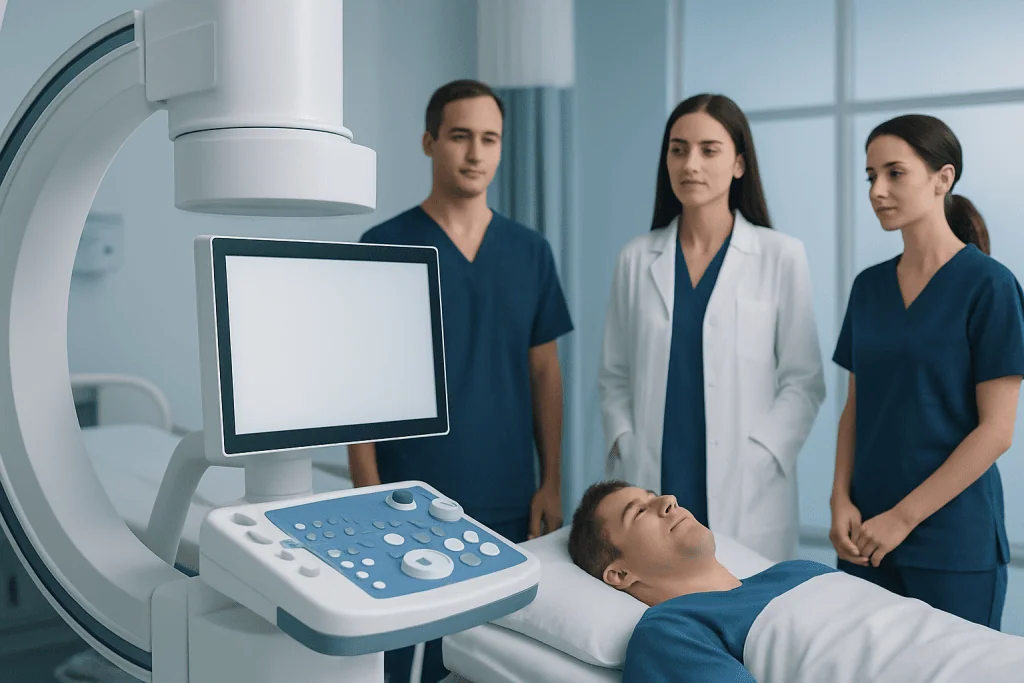
Hospital technology is most useful when it is nearly invisible to you. Its job is to help your care team make timely, informed decisions, not to impress you with machinery. In day-to-day terms, that means a few specific things.
What technologies are used by doctors in practice
The technologies doctors rely on most are often the least dramatic ones. Electronic records keep your history, allergies, medication list and previous reports in one place, so each specialist reviews the same file rather than a partial copy. Digital imaging systems let radiologists, surgeons and other consultants view the same scans on screen, discuss them together, and compare new images with earlier ones. Laboratory systems attach test results to your record as they are ready, so decisions are based on current information.
Beyond documentation, technology in medicine includes diagnostic equipment, imaging, laboratory analysis, endoscopy and similar tools, and the monitoring systems used on wards, in operating theatres and in intensive care, which track vital signs continuously and alert staff to changes. Treatment planning tools help teams prepare procedures in advance where that is relevant to your case.
What that means for your experience
The benefit you notice is rarely the equipment itself. It is the smoother experience the equipment supports: fewer repeated tests when a previous result is still valid, fewer delays between consultation and next steps, and explanations from your doctor that match what the wider team can see. Structured documentation also supports safety: your treatment plan, medication orders, test requests and discharge instructions are recorded in one system rather than passed on verbally. Technology does not remove the need for human attention; it reduces the number of places where information can quietly go missing.
- Digital review of scans and test results across departments
- One shared record instead of duplicated paper files
- Monitoring systems that support day-to-day safety on wards and in intensive care
- Structured discharge documentation you can take home to your own doctor
For a closer look at the systems behind this, see what technology supports your care at Acibadem.
Why your doctors do not work alone

Many patients picture treatment as a one-to-one relationship with a lead physician. In reality, most significant treatment involves a wider circle. Depending on your needs, your case may draw on consultants from more than one specialty, radiology and laboratory teams, anaesthesiology, nursing, rehabilitation professionals, and the administrative staff who manage timing and logistics.
You still have one lead physician who carries clinical responsibility for your treatment: that does not change. What the team structure adds is breadth. When your situation is not straightforward, or when a decision touches more than one specialty, the relevant doctors can review the same records and imaging together and agree on sequence: what needs to happen first, what can wait, and what preparation is required. You are not the courier moving findings between departments.
This matters most when your condition genuinely crosses specialties. The guide on how multidisciplinary care is coordinated when you need more than one specialist explains that process, and how our doctors review and plan your care describes what a case review actually involves. Your role in all of this is not to master the technical detail. It is to describe your history and priorities honestly, ask questions until the plan makes sense to you, and take the time you need before deciding.
The role of nurses, coordinators and interpreters
Your experience in hospital is shaped by far more than consultation minutes with a specialist. Nurses are usually the people you see most often. They handle observation, medication timing, wound care, comfort and education, and they are typically the first practical point of contact when something on the ward feels unclear. Much of what patients later remember as “good care” is nursing.
For international patients, two other roles carry real weight. Coordinators manage the non-clinical spine of your visit: collecting documents before arrival, arranging appointment flow so tests and consultations fall in a workable order, and answering the logistical questions that no clinical department owns. Interpreters support communication between you and the medical team, which matters not only for comfort, but for accuracy, since consent and treatment decisions depend on genuinely understanding what is said. Acibadem provides interpreter services and practical travel and accommodation guidance for overseas patients where needed.
A simple way to see how the roles divide:
| Who | What they handle |
|---|---|
| Lead physician | Diagnosis, treatment decisions, clinical responsibility for your plan |
| Consulting specialists | Input on questions that touch their field; joint review of complex cases |
| Nursing team | Daily observation, medications, comfort, ward-level questions, patient education |
| International coordinator | Documents, scheduling, logistics, communication outside consultations |
| Interpreter | Accurate communication during consultations, consent discussions and ward rounds |
| Radiology and laboratory teams | Producing and reporting the imaging and test results that decisions rest on |
None of these roles replaces another. If you want to understand exactly where clinical responsibility sits within this structure, the guide on doctors, teams and care responsibility at Acibadem sets it out plainly.
How decisions are made before and during treatment
Good care should feel clear, not rushed. Before treatment begins, the team typically reviews your medical history, current symptoms, previous reports and medications, and identifies any tests still needed to confirm the diagnosis or shape the plan. If your treatment needs input from several departments, expect more than one consultation. That is a sign of thoroughness, not delay.
As decisions are made, you should hear them in language you can follow: what is known, what still needs checking, what the recommended plan is, and what alternatives or timing considerations exist. If you need time to think or to talk with family, say so. A well-organised team makes space for that. Decisions about starting, stopping or adjusting any medication belong to your treating doctor, and a careful team will always frame them that way rather than leaving you to interpret a list.
During your stay, plans sometimes change, because test results add information, because your body responds in its own way, or for practical recovery reasons. This is normal. What matters is that changes are explained, that you know who leads your treatment, and that you know who to ask about the next step, the expected timeline, or the discharge process. Uncertainty about a plan is manageable; uncertainty about who owns the plan is not.
What coordinated care looks like in real life
From your side of the bed, coordination shows up in small, concrete ways. Your appointments are grouped sensibly where possible. Your reports are already open when a specialist sees you. Your companion knows where to wait and who to ask. You are not asked for the same information five times, except where repetition is deliberate, because identity and allergy checks are repeated on purpose as a safety measure.
Coordination also extends past the hospital doors. If you are coming to Istanbul or another Turkish city, you will have questions about arrival timing, hospital check-in, nearby accommodation, transfers, and how long to remain in the country after a procedure before flying. These are not separate from your care; the answers depend on your treatment plan, so they belong inside the same pathway. International patient services exist to connect those practical details with your clinical schedule.
Be realistic about the limits, too. No hospital visit is entirely without friction, and no system removes every wait or every moment of confusion. What a coordinated model can honestly offer is fewer gaps: fewer moments where nobody seems responsible, and fewer decisions you have to organise alone. Discharge is a good example, before you leave, you should receive written instructions covering medicines, activity limits and follow-up, and the guide on managing wound care and dressings after discharge in Turkey covers that stage in depth.
How to make the most of this care model
You can do a lot to help your own care run smoothly. Coordinated systems work best with complete information, and only you can supply some of it: recent reports, scan files where available, a current medication and allergy list, and a short written summary of your health history. If you have specific concerns, write them down before consultations rather than trusting a busy day to your memory.
Choose one family member or companion as your main contact for updates, especially if several people at home will want news, one clear channel is better than five partial ones. During your stay, ask who your day-to-day contact is, how results will be shared, and what the likely timeline looks like for discharge and follow-up. And say plainly when something is wrong on your side: if you are anxious, in pain, confused by instructions or worried about travel timing, the team can only adjust around what you tell them. Coordination is a two-way exercise.
Step by step
- Gather your records early. International treatment planning normally starts with a review of your existing reports, imaging, medication list and a brief health summary, so having these organised before you travel makes the first in-person appointments more focused and reduces repeated tests.
- Learn who coordinates your journey. International patients are typically assigned a coordinator or contact team before arrival. Knowing who handles scheduling, documents and interpreter arrangements means practical questions have an owner from day one.
- Use consultations to map the full team. Ask which specialists are involved in your case and why, and who carries lead responsibility. This tells you how decisions will be made and whether your plan includes tests, surgery, rehabilitation or staged follow-up.
- Ask how results and updates are shared. Find out when test results are usually discussed, who explains changes to the plan, and how your companion can receive updates within your privacy preferences.
- Plan for the stay, not just the treatment. Confirm arrival timing, expected length of stay, and whether there are travel restrictions after your procedure. Raise language or accommodation needs early rather than at the last moment.
- Keep one running list. Use your phone or a notebook to track answers, medication notes and next steps. With several professionals involved, one list keeps you and your family aligned.
- Clarify follow-up before discharge. Make sure you understand your written discharge instructions, medicines, activity limits, warning signs to watch for, and how follow-up will work once you are home, and keep the documents your local doctor will need.
Your checklist
- Passport and travel documents
- Recent medical reports and imaging files
- Current medication and allergy list
- Written summary of your medical history
- Contact details for your international patient coordinator
- Questions you want to ask the doctor and care team
- Interpreter request, if needed
- Companion contact plan for updates
- Discharge documents and follow-up notes before leaving hospital
Key takeaways
- Technology earns its place by moving information, records, imaging, results, to the right people at the right time, not by being visible.
- One lead physician carries responsibility for your treatment, but complex care draws on several specialties reviewing the same information together.
- Nurses, coordinators and interpreters shape most of your daily experience and make international care understandable and workable.
- Coordinated care includes the logistics: scheduling, document collection, accommodation guidance and discharge planning are part of the pathway, not extras.
- You improve your own experience by arriving with organised records, asking questions until plans make sense, and confirming follow-up before you go home.
Frequently asked questions
What technologies are used by doctors in a hospital like this?
Mostly unglamorous ones: electronic records that hold your history and medications in one file, digital imaging systems that let specialists review the same scans together, laboratory systems that attach results to your record as they arrive, and monitoring equipment on wards and in intensive care. Diagnostic and treatment-planning tools sit on top of that foundation.
How is technology being used in healthcare more broadly?
Across modern healthcare, technology mainly supports three things: diagnosis, through imaging and laboratory analysis; safety, through continuous monitoring and structured documentation of plans and medications; and coordination, by letting different departments work from one shared record. The pattern at Acibadem follows this same logic: the value is in clearer information, not in equipment for its own sake.
Will I only see one doctor during my treatment journey?
Not usually. One lead physician carries clinical responsibility for your plan, but depending on your condition you may also see consultants from other specialties, along with nurses, anaesthesiologists and rehabilitation professionals. This team approach means decisions that touch several fields are made with all of them at the table.
How does Acibadem support patients coming from abroad?
International patient services handle the non-clinical spine of a visit: collecting documents before arrival, arranging appointment flow, providing interpreter support, and offering practical guidance on travel and accommodation. This does not replace medical care, but it removes much of the administrative load at exactly the moments it would feel heaviest.
Why are nurses and coordinators so important to my experience?
Nurses are the people you see most: they manage observation, medication timing, comfort and education, and are the first point of contact for ward-level questions. Coordinators own scheduling, documents and logistics. Your doctor leads clinical decisions, but these roles determine how organised and understandable each day actually feels.
Can my family or companion be kept informed too?
Usually yes, within your privacy preferences and hospital policy. It works best when you choose one main contact person and agree early on how updates will be shared. That keeps information consistent and spares you from relaying the same news several times over.
How do I know if care is well coordinated?
You can name who leads your treatment, you know which tests or appointments come next, changes to the plan are explained rather than discovered, and practical questions have an obvious owner. Well-coordinated care feels organised, fewer repeated steps, fewer gaps where nobody seems responsible.
What should I ask before I leave the hospital?
Ask about your medications, activity limits, warning signs to watch for, wound or recovery care if relevant, and how follow-up will work after you return home. Make sure you leave with written discharge instructions and the reports your local doctor will need to continue your care.
Add us as a Preferred Source to see more of our trusted health content across Google Search, AI Overviews and Discover.

Update history
- PublishedJune 22, 2026
- Medical review approvedSeptember 13, 2026
- Last content updateSeptember 12, 2026
References2
- WHO: Patient safety fact sheet who.int
- MedlinePlus: Personal Health Records medlineplus.gov
More Patient Guides

Medical Chaperones in Turkey: When Patients Can Request One
Medical chaperones in Turkey can be requested for sensitive exams or when you want added reassurance during care in Istanbul.

Medical Interpreter or Family Member: Who Should Help During Appointments in Turkey?
Medical interpreter or family member in Turkey? Use a trained interpreter for clinical communication and keep family involved for support and notes.

How to Plan for Prayer, Modesty, and Cultural Needs During Care in Turkey
Prayer, modesty, and cultural care needs in Turkey can be planned in advance by sharing your preferences with your care team and…

Interpreter Support in Turkish Hospitals: When to Request Help
Interpreter support in Turkish hospitals helps you understand appointments, consent and discharge clearly in Turkey or Istanbul.