

Medical Travel to Turkey with Hearing Loss

Medical travel to Turkey with hearing loss works best when you state your communication needs before you book, carry your hearing devices and their documentation in hand luggage, and ask for every important instruction in writing. Hospitals can arrange interpreters, visual cues in waiting areas and written summaries, but only if they know in advance what you use and how you prefer to communicate.
Worried you will miss your name being called in a busy waiting room, or lose half of what a doctor says before surgery? That worry is reasonable. It is also one of the easiest parts of a medical trip to plan around, if you plan it early.
Medical travel to Turkey with hearing loss involves two separate tasks that are easy to confuse. The first is communication logistics: making sure that airports, transfers, hotels and hospital departments share information with you in a form you can reliably use. The second, for some travellers, is the treatment itself, hearing assessment, hearing aids or implant surgery in Turkey. This guide covers both, and it is honest about which parts you can control and which parts depend on decisions only a treating doctor can make.
At a glance
- Best first step: State your hearing and communication needs in your very first message to the hospital
- Helpful documents: Medical records, recent audiogram if you have one, device details and a written medication list
- Support to request: Interpreter, written summaries, visual alerts in waiting areas and companion access
- Travel priority: Airline assistance, written transfer confirmations and a device charging plan
- During care: Confirm instructions in writing before tests, treatment and discharge, asking twice is normal
Planning Medical Travel to Turkey with Hearing Loss: Start with Communication, Not Flights
A medical trip is a chain of conversations: airline desks, security, hotel check-in, hospital registration, nursing assessments, specialist consultations, consent discussions and discharge planning. When you have hearing loss, the goal is not simply to hear more of each conversation. The goal is to make sure the information that matters, preparation instructions, consent details, medication plans, warning signs, reaches you in a form you can review, question and keep.
Before you travel, tell the international patient coordinator how you prefer to communicate. You might use spoken language with hearing aids, lip reading, written notes, live captions, a sign language interpreter, a companion who supports communication, or a mix of these. Be specific and practical rather than clinical: “staff need to face me when speaking”, “do not call my name by voice only”, “message me instead of phoning”, “I need written summaries after each consultation”. The earlier the hospital knows this, the easier it is to schedule interpreter support, allow longer appointment slots and brief the departments you will pass through.
One more honest point at the start: hospitals vary in how smoothly they handle access needs on the day. Written requests made in advance are far more reliable than verbal requests made at a busy reception desk. If you are still choosing where to be treated, it is worth reading how to recognise a reliable hospital in Turkeya hospital that answers your access questions clearly before you commit tends to handle them well after you arrive.
Understanding Degrees of Hearing Loss: What “Moderate” and “Severe” Actually Mean
Hearing loss is usually described by the quietest sounds you can detect, measured in decibels (dB) across a range of pitches during a hearing test called an audiogram. Classification systems differ slightly between countries and clinics, which is why the same audiogram can be labelled differently by two audiologists. Broadly, on the grading used by the World Health Organization, mild hearing loss begins at around 20 dB in the better ear, moderate loss sits roughly between 35 and 49 dB, moderately severe between 50 and 64 dB, severe between 65 and 79 dB, and profound loss at 80 dB and above. Many audiology clinics use an older scale with slightly different bands, so treat the labels as approximate.
What does a figure like 60 dB mean in daily life? Ordinary conversational speech is spoken at roughly that level, so a person with a 60 dB threshold typically cannot follow normal conversation without amplification, most classification systems place this in the moderately severe range. Whether that is “bad” is not a useful question on its own: what matters clinically is which pitches are affected, whether one or both ears are involved, whether the loss is stable or progressing, and what it is doing to your speech understanding. Those are questions an audiogram and a specialist review answer together, not a single number.
For travel planning, the practical implication is simple: the more your hearing loss affects speech understanding, the more you should rely on written and visual channels for every important step of the trip, regardless of what any scale calls your loss.
What to Share Before You Arrive in Turkey
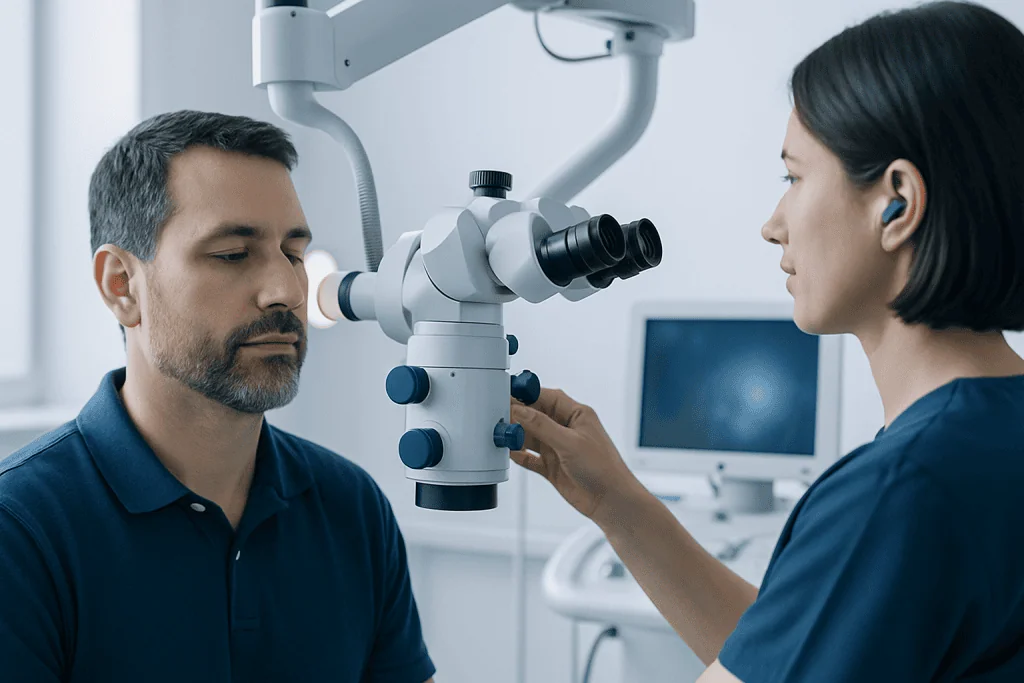
A clear pre-travel profile helps the care team understand both your medical background and your access needs. Alongside your medical records, share the type and degree of hearing loss if you know it, a copy of your most recent audiogram if you have one, the devices you use, and which languages you are comfortable with in speech, sign or writing. You do not need perfect terminology, practical detail is more useful than diagnostic labels. The guide on sharing your medical history clearly when you travel for treatment explains how to organise records so nothing gets lost in translation.
Say whether you will travel alone or with a companion. If your companion helps with communication, note-taking or decisions, ask how they can be included at registration, in consultations and during discharge conversations. Mention if long listening sessions tire you, if you need breaks, or if you prefer information in short written points rather than one long verbal briefing.
Useful details to send in advance:
- Your preferred communication method for appointments and for urgent schedule changes.
- Whether you use hearing aids, cochlear implants, bone-conduction devices or assistive listening apps.
- Any device restrictions or safety cards, especially relevant for imaging and airport security.
- Preferred contact channels, email, secure messaging or text rather than voice calls.
- Whether you need a professional interpreter (spoken or sign language) or translated written materials.
How Hearing Loss Is Assessed and Treated in Turkey
If your medical travel to Turkey with hearing loss is about the hearing itself, it helps to know what assessment and treatment normally look like, so your expectations match the process. Assessment usually starts with an ear examination and pure-tone audiometry, often alongside speech audiometry, tympanometry and, where an implant is being considered, imaging of the inner ear and hearing nerve. The findings determine which options are even relevant, no reputable clinic decides on surgery before this workup.
Treatment options depend on the type and degree of loss. Modern hearing aids remain the mainstay for most degrees of loss, and current generations are rechargeable, stream sound from phones and adjust automatically to noisy environments. Bone-conduction devices suit certain conductive losses and single-sided deafness. Middle-ear implants are an option in specific situations. Cochlear implants are generally considered when hearing loss is severe to profound and well-fitted hearing aids no longer provide adequate speech understanding; the surgery is only one part of the pathway, which continues with activation, repeated programming (“mapping”) sessions and auditory rehabilitation over months. Some causes of conductive loss, such as otosclerosis or chronic middle-ear disease, are treated with ear surgery rather than devices.
You may also read about newer directions such as gene therapy for specific inherited forms of deafness. These approaches are being studied in early clinical trials for narrowly defined genetic causes; they are investigational, not routine care, and no clinic can honestly present them as an available treatment. Be cautious with any provider, in any country, whose marketing suggests otherwise.
If an implant pathway is realistic for you, plan the calendar, not just the operation. Activation typically happens weeks after surgery, and programming sessions continue afterwards, which means either a longer stay, return trips, or an agreed handover to an audiology team at home. Ask any clinic you speak with to set this out in writing before you book flights.
How Quotes for Hearing Treatment Are Structured
This guide gives no figures, because honest figures do not exist without your file. What you can do is understand what a quote depends on, so you can compare offers on equal terms. For hearing aids, the variables are the device category and features, fitting and follow-up adjustments, and warranty arrangements. For implant surgery, a quote typically reflects the device brand and processor, pre-operative imaging and tests, the surgery and hospital stay, activation and programming sessions, and rehabilitation. Ask every provider to state what is included, what is billed separately, and what a return visit would involve.
Then look past the quote itself. Flights for return programming sessions, a companion’s costs, extended accommodation and translated reports all sit outside the clinical price. The budget checklist for costs beyond the treatment quote walks through these line by line, and it is worth checking what your travel insurance should cover before you commit, because policies treat planned treatment and its complications very differently.
Airport, Transfer and Hotel Arrangements

Airports are bright, echoing and heavily announcement-driven, which is close to the worst possible environment for hearing loss. When booking flights, request assistance from the airline if you may need help at check-in, security, boarding or connections, airlines have formal assistance processes, but they work far better when requested at booking rather than at the gate. Ask for important changes to be shown in writing, rely on the airline app for gate updates, and keep your passport, hospital invitation letter, transfer details and emergency contacts within reach.
Pack all hearing technology in hand luggage, never checked baggage: devices, spare batteries, chargers, adapters and cleaning supplies. Turkey uses Type C and Type F plugs, so a universal adapter is worth carrying, along with an airline-compliant power bank if your devices or captioning phone are rechargeable. If you have an implant, review what to prepare before flying to Turkey with medical devices or implants, including how to handle security screening with a device card.
For transfers and hotels, written confirmation prevents most problems. Ask for the driver meeting point, vehicle details where available, and a backup number that accepts text or messaging apps. At the hotel, you can request a quieter room, visual or vibrating alarm options if available, and written messages from reception instead of phone calls for wake-ups and schedule changes. None of these requests is unusual; they simply need to be made before, not after, something is missed.
Communication at the Hospital
A hospital day often spans several locations, registration, blood tests, imaging, consultation rooms, payment desks. Ask your coordinator how you will be guided between departments. If waiting areas call names by voice, request a visual cue, a staff escort or a message alert so you do not miss your turn. This is a small request that prevents real problems, and staff can only act on it if you make it at arrival, not after a missed slot.
During consultations, it is entirely reasonable to ask the team to face you, speak clearly, and pause so you can confirm understanding. Where masks are required, written notes, typing, captioning tools or an interpreter become more important, not less. Ask for the key points to be summarised at the end of every appointment, especially medication instructions, preparation steps and warning signs.
A practical habit is to agree a communication plan at the start of the first visit: who speaks, who interprets if needed, who writes down instructions, and how questions will be handled after you leave the department. Ten minutes spent on this at the beginning saves confusion across the whole stay.
Making Consent, Instructions and Discharge Safer
Consent and discharge conversations carry dense information, and hearing loss should never leave you guessing. Before agreeing to tests or treatment, ask for the purpose, the steps, the alternatives, the possible risks and the aftercare plan in a format you can review at your own pace. If anything is unclear, ask for it to be said differently or written down. This is a normal part of safe care in any hospital, not a special favour.
For planned procedures, get preparation instructions in writing: fasting times, arrival time, whether a companion is needed, and what the treating doctor has decided about your regular medicines around the procedure, any change to medication is the prescriber’s decision, and it should reach you in writing, not as something half-heard in a corridor. If sedation or anaesthesia is involved, agree in advance who will update your companion and how. The guide on keeping regular medicines on schedule during medical travel covers how to document your usual regimen so nothing is missed in translation.
Before leaving the hospital, check that you hold, in writing:
- Your medication plan as your treating doctor has set it out, with names, doses and timing.
- Wound, device or treatment-area care instructions where relevant.
- The warning signs the team wants you to watch for, and what to do about them locally.
- When and how follow-up appointments will happen.
- A written contact channel for questions after you return to the hotel or home country.
Travelling with Hearing Devices and Assistive Technology
Your hearing technology is part of your safety plan, so treat it that way. Keep devices, accessories and written device information with you throughout the journey. If you have a cochlear implant or other implanted device, carry the manufacturer card if you have one and mention it to security and imaging staff when relevant, hospital teams ask about implants before certain scans, and having details ready saves time.
Bring more supplies than you expect to need. The exact battery size can be hard to find abroad, chargers get left in hotel rooms, and long hospital days drain rechargeable devices faster than home routines do. A small labelled pouch, spare batteries, cables, drying kit, cleaning tools, backup ear tips, makes daily appointments simpler.
Phone-based tools help: live captioning, speech-to-text, translation apps, maps and written medication reminders. But never rely on a single device when communication is essential. Keep paper copies of key instructions and contact numbers for the moments when a battery dies or mobile data drops.
Follow-Up After You Return Home
Before leaving Turkey, ask how follow-up will be organised: a written medical report, imaging files, laboratory results, prescriptions and recommendations for your local doctor. Request that follow-up communication comes by email or secure written channels wherever possible, rather than depending on phone calls you may find hard to use. If you have had implant surgery, the handover matters even more, activation and programming schedules should be documented so an audiology team at home can continue them, or so return visits are planned rather than improvised.
Keep one folder for the whole trip: discharge papers, reports, invoices, medication details, emergency instructions and the international patient team’s written contact details. If a local doctor will continue your care, ask which documents they will need and whether any require translation.
Finally, if you hit communication barriers during your stay, tell the patient services team before you leave. Specific feedback: a waiting room that only called names by voice, a consultation that moved too fast, is how support actually improves, for you on a return visit and for the patients after you.
Step by step
- State your access needs in your first message to the hospital. Include your hearing loss details, devices and preferred communication methods alongside your medical question, so interpreter support and appointment flow are planned before you arrive.
- Prepare a one-page travel communication sheet. Name, languages, hearing needs, device information, emergency contact and preferred way to receive updates. Carry a printed copy and keep a digital version on your phone.
- Book airline assistance and confirm transfers in writing. Request assistance when you book flights, not at the airport. Get the Turkey meeting point, driver details and a text-capable backup number in writing before departure.
- Pack all hearing technology in hand luggage. Devices, processors, spare batteries, chargers, adapters, cleaning kit and device safety cards stay with you. Pack more supplies than you expect to use.
- Agree a hospital communication plan at the first visit. Say how staff should reach you, ask for visual cues in waiting areas, and confirm who writes down instructions.
- Get every key instruction in writing. Preparation steps, the medication plan your doctor sets, and warning signs, before tests, before treatment, and again at discharge.
- Plan written follow-up before you fly home. Collect reports, results and prescriptions in a shareable format, and confirm the written channel for questions after you return.
Your checklist
- Passport, visa documents if needed and hospital appointment confirmation
- Medical records, recent audiogram if available, test results and medication list
- Written summary of your hearing loss and communication preferences
- Hearing aids, processors, chargers, spare batteries and cleaning supplies
- Device safety cards or implant information, if applicable
- Universal travel adapter and airline-compliant power bank
- Printed emergency contacts and hospital coordinator details
- Translation, captioning and speech-to-text apps installed and tested before travel
- Notebook or notes app for questions, instructions and appointment summaries
- Travel insurance documents and your local doctor’s contact information
Key takeaways
- State your hearing and communication needs early and in writing, so support is planned rather than improvised.
- Degree labels like “moderate” or “severe” are approximate; what matters for planning is how much speech understanding is affected.
- Keep all hearing devices, chargers, batteries and safety cards in your hand luggage throughout the journey.
- Use written confirmations for transfers, appointments, preparation instructions, medication plans and discharge.
- If treatment involves an implant, plan for activation, programming and rehabilitation, not just the surgery date.
Frequently asked questions
What is considered moderate to severe hearing loss?
Classifications vary slightly, but on the World Health Organization grading, moderate hearing loss sits roughly between 35 and 49 dB in the better ear, moderately severe between 50 and 64 dB, and severe between 65 and 79 dB. In practical terms, moderate to severe loss usually means normal conversation is difficult or impossible to follow without hearing aids or other support. An audiologist interprets the full audiogram, not one number.
Is 60 dB hearing loss bad?
A 60 dB threshold generally falls in the moderately severe range. Ordinary conversation is spoken at roughly that loudness, so speech at normal volume is typically hard to follow without amplification. Whether it is “bad” for you depends on which pitches are affected, whether both ears are involved and whether the loss is changing, questions a full hearing assessment answers rather than a single figure.
What is the most recent treatment for hearing loss?
Established options include modern hearing aids, bone-conduction devices, middle-ear implants and cochlear implants, chosen according to the type and degree of loss. The newest research direction is gene therapy for specific inherited forms of deafness, which is being studied in early clinical trials for narrowly defined genetic causes. It is investigational, not routine care, and any clinic marketing it as an available treatment should be treated with caution.
Is deafness considered a disability?
In many countries, significant hearing loss or deafness is recognised as a disability for legal, workplace and accessibility purposes, which is why airlines, airports and hospitals have formal assistance processes. Definitions and entitlements differ between countries, so check the rules that apply where you live and, for travel assistance, the policies of your airline. Many deaf people also understand deafness as a linguistic and cultural identity rather than only a medical category.
Will an interpreter be available at the hospital?
Interpreter availability depends on the language, the timing and the type of appointment, so request support well in advance and say clearly whether you need spoken-language interpretation, sign language interpretation or written communication. Confirm the arrangement in writing before complex consultations rather than raising it on the day.
Should I tell the hospital about my hearing aids or cochlear implant?
Yes, before travel and again at the hospital when relevant. Some imaging tests and security processes require staff to know about implanted or external hearing devices, and hospital teams routinely ask about implants before certain scans. Carry device cards, model information or manufacturer guidance if you have them.
What if I cannot hear my name being called in the waiting area?
Tell registration staff when you arrive and ask for a visual cue, a staff escort, a text alert or for someone to come to you directly when it is your turn. It is a simple, common request, and making it at check-in prevents missed appointments and unnecessary stress.
How can I avoid misunderstandings about medicines or aftercare?
Ask for the medication plan your treating doctor has set, names, doses, timing, and the aftercare instructions in writing before you leave the hospital. Repeat the plan back in your own words, or have your companion read the notes with you. Keep copies on paper and on your phone, and remember that any change to your medicines is a decision for the prescribing doctor, never something to adjust on your own.
Add us as a Preferred Source to see more of our trusted health content across Google Search, AI Overviews and Discover.

Update history
- PublishedJune 8, 2026
- Medical review approvedSeptember 13, 2026
- Last content updateSeptember 12, 2026
References3
- Deafness and hearing loss: World Health Organization fact sheet who.int
- Hearing loss: NHS nhs.uk
- Cochlear implants: MedlinePlus medlineplus.gov
More Patient Guides

Airport Wheelchair Assistance: How to Book It for a Medical Trip
Airport wheelchair assistance is free, it exists at every commercial airport, and airlines are legally required to provide it, yet half…

Travelling With a Stoma: Flights, Supplies and Airport Screening
Traveling to Turkey with a stoma is manageable with the right supplies, airport screening plan, and recovery support in Istanbul or Turkey.
Mobility Aids in Turkey: Renting a Wheelchair, Walker, or Crutches
Mobility aids in Turkey can be rented through medical suppliers, pharmacies, and hospital-linked services in Istanbul and other cities.

Traveling to Turkey with Food Allergies or Special Diet Needs
Traveling to Turkey with food allergies or special diet needs is manageable with planning, translated allergy cards, and hotel and hospital support…