

Second Opinion or Direct Treatment Booking in Turkey: Which Comes First?

Start with a second opinion if anything about your diagnosis, staging or recommended treatment is still uncertain, or if you have received conflicting advice. Book treatment directly when your diagnosis is confirmed, your tests are recent and a specific plan is already in writing. Either way, a reputable hospital in Turkey reviews your records before confirming any schedule, so complete documents matter more than speed.
You have a diagnosis, a folder of test results and a decision to make: second opinion or direct treatment booking in Turkey, which comes first? The choice can stall everything else, flights, leave from work, a companion’s plans, so it is worth settling early.
The honest answer is that neither route is automatically better. The right sequence depends on how certain your diagnosis, tests and treatment plan already are, and how recent your records happen to be. This guide sets out when each path makes sense, what hospitals actually need from you before they can advise, and how the sequence you choose affects travel, timing and cost planning.
At a glance
- Second opinion first when your diagnosis, stage or treatment options are still uncertain, or when doctors have given you conflicting advice
- Direct booking can suit you when you hold a confirmed diagnosis, recent tests and a written recommendation for a specific treatment
- Either route starts with your records: reports, imaging files, pathology, medication list and a short summary of your questions
- Neither route skips medical review: reputable hospitals assess your file before confirming a schedule, and plans can still change after in-person examination
- Practical support: at large hospital groups, international patient services coordinate interpreters and travel logistics around the medical pathway, not the other way round
Second opinion or direct treatment booking in Turkey: how to decide
The question of second opinion or direct treatment booking in Turkey has less to do with the country and more to do with how much uncertainty is left in your file. A useful way to frame it: are you still looking for answers, or mainly looking for a schedule?
If any doubt remains about what the problem is, how urgent it is, or which of several treatments fits your case, a second opinion is usually the safer first step. It resolves the medical questions before you spend money on flights and accommodation, and it can reveal whether additional tests are needed before anyone can commit to a plan.
Direct booking makes more sense when the medical questions are already answered. That typically means a confirmed diagnosis, tests recent enough to plan from, and a doctor at home who has recommended a clear next step: a named operation, a defined course of chemotherapy or radiotherapy, or another planned intervention. In that situation, a hospital in Turkey can review your file remotely and confirm whether an outpatient consultation, pre-admission assessment or treatment booking is the appropriate starting point.
One caveat applies to both routes: “direct booking” never means skipping medical review. A reputable hospital still assesses your records before confirming anything, and the plan may be refined after an in-person examination or repeat testing. What the sequence changes is where the checking happens, before you travel, or partly after you arrive. The related question of whether to ask for an opinion or a price first is covered separately in Second Opinion or Treatment Quote: Which Should You Request First?
When a second opinion should usually come first
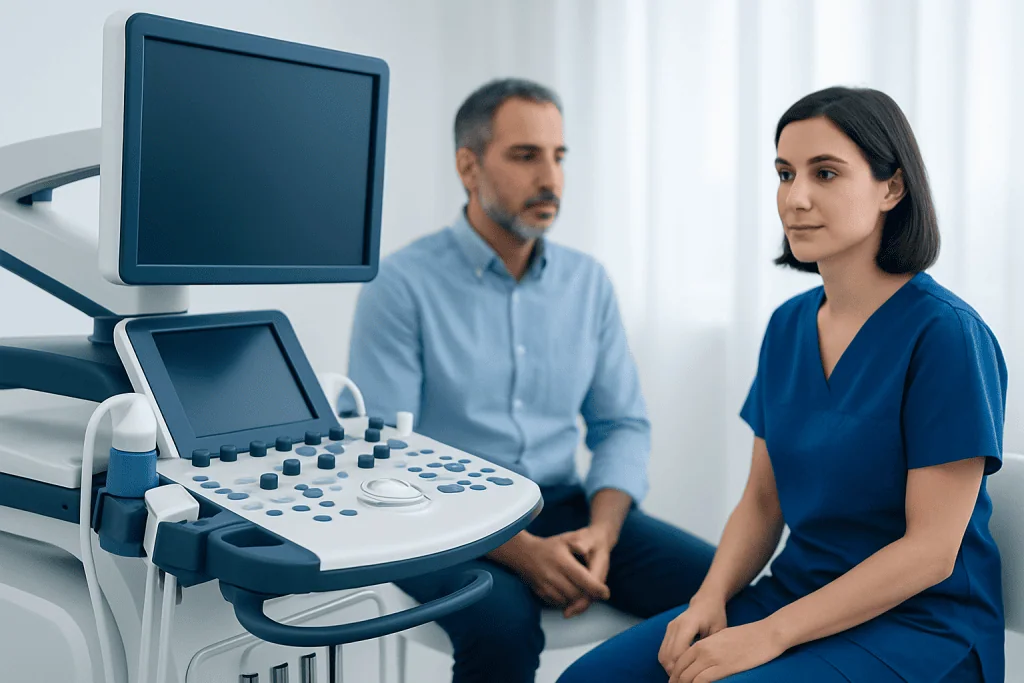
A second opinion is the stronger first move whenever the plan itself is still in question. The clearest examples are conflicting recommendations, one doctor advises surgery, another suggests monitoring, or a situation where you have been told several treatment paths are possible without a persuasive explanation of why one is preferred. In these cases the goal is not to delay care. It is to make the plan solid before you build travel arrangements on top of it.
A remote file review is also worthwhile when you are unsure whether treatment abroad is realistically suitable for your case at all. The review may show that your current tests are sufficient to move ahead, or that specific investigations are needed before any final plan can be confirmed. Learning that at home, rather than in a hotel room in Istanbul, saves time, money and stress.
Second opinions carry extra weight in areas where several specialties overlap. In a large hospital group, imaging, pathology and prior recommendations can be reviewed by a multidisciplinary team rather than a single specialist, relevant if your case involves cancer care, complex surgery, cardiology or neurology. The same logic applies with extra force when a repeat operation is on the table, because the original findings and the newer symptoms both need independent eyes.
In summary, a second opinion usually comes first when:
- Your diagnosis is not yet fully confirmed, or the stage of your condition is unclear
- You have received different advice from different doctors
- Your imaging or pathology would benefit from independent expert review
- You want to understand whether treatment is time-sensitive or can reasonably wait
- A major, hard-to-reverse decision, such as surgery, is on the table
- You would simply travel with more confidence after an independent review
When direct treatment booking can be reasonable

Direct treatment booking is a reasonable first step when your case is already clear and your records are complete. A typical example: a confirmed diagnosis, a recent pathology report, current scans, and a written recommendation for a specific procedure. With a file like that, the hospital can usually tell you within its review whether to proceed to an outpatient consultation, pre-admission planning or a booking request.
This route suits patients continuing an already established treatment plan, arranging a scheduled operation, or setting up a well-defined specialist consultation. It can also be practical when timing matters and there is little genuine uncertainty about the next step, provided the certainty is real and documented, not assumed.
Two honest limits are worth stating. First, direct booking still involves a records review before anything is confirmed, because suitability has to be checked; a hospital that offers to schedule surgery without seeing your file is a warning sign, not a convenience. Second, some decisions cannot be finalised remotely. A surgeon may need to examine you, or repeat a scan, before committing to the exact approach. Knowing which parts of your plan fall into that category is one of the most useful things to establish before you travel: the checklist in Questions to Ask Before Booking Surgery in Turkey covers this in detail.
If a clinic asks for a deposit before any doctor has reviewed your records, pause. The trade-offs are set out in Second Opinion Before You Pay a Medical Deposit: When It Is Worth It.
What hospitals need before advising you
Whichever route you choose, the quality of the advice you receive depends heavily on the documents you provide. A complete, recent file lets doctors be specific before you arrive. Missing pathology, low-resolution scan images embedded in a PDF, or blood tests from a year ago slow the process and limit how much can be said remotely.
The core file looks the same for a second opinion and for a booking request:
- Passport identification page, shared securely
- Diagnosis summary and recent consultation notes
- Imaging reports, plus the actual scan files in DICOM format where possible, reports alone are often not enough for surgical planning
- Pathology report, if a biopsy has been taken
- Recent laboratory results
- Medication list, allergies, and relevant past operations
- A short written summary of your current symptoms, your questions and your goals
If you have a timeline concern, worsening pain, a treatment window recommended by your home doctor, put it in writing rather than mentioning it in passing. International patient teams work with records from many countries and formats daily; they can advise which documents need translation and how to transfer large imaging files. Which documents speed the process up most, and why, is covered in Second Opinion in Turkey: Which Medical Records Help Doctors Advise You Faster.
Do you need a referral for a second opinion?
Generally, no. Private hospitals in Turkey do not require a referral letter from your home doctor before reviewing your case or offering a specialist opinion. You can submit your records yourself as an international patient, and the review proceeds on the strength of the documents rather than on who sent them.
That said, your home doctor remains a valuable part of the process. A referral letter or clinical summary from them often condenses months of history into a page, and if the second opinion suggests changes to your plan, your treating doctor at home needs to be part of that conversation, particularly where medication is involved, since any change to prescriptions belongs with the doctor who manages them. A second opinion abroad works best as an addition to your existing care, not a replacement for it.
How consultations and treatment are paid for in Turkey
As an international patient, you pay privately for hospital treatment in Turkey unless you hold insurance that the hospital accepts and pre-authorises. Turkey’s public health insurance covers residents enrolled in the national system; it does not extend to visiting patients, so plan on a private arrangement and confirm any insurance coverage in writing before you commit.
Rather than looking for a single price figure, it helps to understand how quotes are built. A consultation fee typically depends on the specialty and whether diagnostic tests are added on the day. A treatment quote depends on the procedure itself, the planned length of stay, the type of anaesthesia, implants or devices if any, and the pre-operative tests still required. Remote second opinions are usually priced separately from in-person care, and some hospitals fold the review fee into the pathway if you proceed to treatment: the structure varies, so ask how it works in your case. The pricing logic for reviews specifically is explained in How Much Does a Second Opinion in Turkey Cost?
One sequencing point matters here: a quote produced before your records are reviewed is an estimate at best. The more complete your file, the closer the written quote will sit to the final bill, which is another argument for getting the medical review, opinion or booking assessment, done before you fix your budget and travel dates.
Is Turkey a reasonable place to seek treatment?
Turkey has a large private hospital sector that treats substantial numbers of international patients each year, particularly in Istanbul, and the infrastructure around that: English-speaking coordinators, interpreters, airport transfers, records handling in multiple languages, is well established at the larger groups, including Acibadem’s hospitals.
Whether Turkey is right for you is a narrower question, and it depends on your condition, the specific team that would treat you, and how follow-up will be handled once you are home. That is precisely what a records review answers before you travel. Treat general reputation as background, and your own file review as the evidence that matters.
Travel, timing and cost planning: why the sequence matters
The order you choose has practical consequences. Book flights first and then discover you need further tests, and your stay becomes longer and less predictable than planned, for you and for any companion. Starting with a second opinion reduces that risk, because the review usually clarifies what to expect from the trip: consultation only, same-week treatment planning, or a longer diagnostic process.
When the plan genuinely is straightforward, direct booking can make travel time more efficient, combining consultation, pre-treatment evaluation and the first treatment step into a more predictable window. The discipline in both cases is the same: before committing to flights and accommodation, establish which parts of the plan can be confirmed remotely and which must wait for in-person assessment. Timing considerations around the trip itself are covered in When to Get a Second Opinion Before Traveling to Turkey for Treatment.
Experienced international patient support helps here, coordinating interpreter arrangements, transfers and accommodation around the medical schedule rather than the other way round. It does not replace medical decision-making, but it makes running healthcare and travel logistics in parallel considerably less stressful.
A simple test for choosing your path
Ask yourself three questions. Is my diagnosis confirmed? Do I understand the recommended treatment and its alternatives? Are my tests recent enough for a hospital abroad to plan from them? If the answer to any of the three is no, begin with a second opinion. If all three answers are yes, direct booking is a defensible next move, with the understanding that the hospital will still review your file first.
Temperament plays a part too. Some patients move quickly once they hold one clear recommendation; others only feel ready to travel after an independent team has looked at the case. Neither instinct is wrong. What matters is choosing deliberately, so the sequence protects your time, your budget and your peace of mind rather than eroding all three.
Step by step
- Gather your current medical file. Collect your diagnosis summary, consultation notes, imaging reports and the underlying scan files, pathology if relevant, recent lab results, and a medication and allergy list. Specialists often need the scan files themselves, not just the written reports.
- List what is still unclear. Write down your open questions: is the diagnosis confirmed, is surgery necessary, how time-sensitive is this? The list tells you, and the reviewing team, whether you mainly need clarification or scheduling.
- Choose a second opinion first if uncertainty is high. Conflicting advice, an uncommon condition or a major unanswered question all point to review before travel. It keeps unnecessary trips off your calendar and makes the eventual plan more precise.
- Choose direct booking if the plan is already defined. With a confirmed diagnosis and a written recommendation, ask whether you can proceed to consultation or treatment planning. Expect a records review before anything is confirmed: that check protects you.
- Confirm what can be decided before travel. Before booking flights, establish which parts of the plan can be fixed remotely and which require in-person examination or repeat tests. This gives you a realistic length of stay to plan around.
- Arrange the practical layer early. Once the medical pathway is clearer, sort passports, any visa requirements, accommodation, transfers and companion plans. Interpreter needs are easiest to arrange while the case is still being assessed, not the week you fly.
Your checklist
- Passport copy ready to share securely
- Recent consultation notes and diagnosis summary
- Imaging reports and DICOM scan files collected
- Pathology report available if a biopsy was taken
- Medication and allergy list updated
- Questions about diagnosis, urgency and alternatives written down
- Insurance position confirmed in writing, or private payment planned
- Travel timeline and companion availability considered
- Interpreter needs identified in advance
Key takeaways
- Second opinion or direct treatment booking in Turkey is really a question about remaining uncertainty: opinion first when questions remain, booking first when the plan is documented and current.
- Neither route skips medical review, reputable hospitals assess your records before confirming any schedule, and final decisions may still depend on in-person examination.
- No referral is needed for a private second opinion, but your home doctor remains part of the picture, especially for anything involving medication.
- International patients pay privately unless insurance is accepted and pre-authorised; quotes are built from the procedure, length of stay and remaining tests, so a complete file produces a more reliable quote.
- Establish what can be confirmed remotely before you book flights: it is the single best predictor of how smoothly the trip runs.
Frequently asked questions
Can I get a second opinion without a referral?
Yes. Private hospitals in Turkey generally review international cases on the basis of the records you submit yourself; no referral letter is required. A summary from your home doctor is still useful because it condenses your history, and your treating doctor should stay involved if the opinion suggests changes to your plan.
Do you have to pay for hospital treatment in Turkey?
As an international patient, yes, treatment is paid privately unless you hold insurance that the hospital accepts and pre-authorises in advance. Turkey’s public insurance system covers enrolled residents, not visiting patients. Confirm your payment arrangement in writing before committing to travel.
How much does a doctor’s consultation cost in Turkey?
There is no single figure: consultation fees vary by hospital and specialty, and the total for a visit depends on whether diagnostic tests are added on the day. Remote second opinions are usually priced separately from in-person consultations. Ask for a written breakdown of what a fee includes before you compare options.
Is Turkey good for medical treatment?
Turkey has a large, well-developed private hospital sector that treats many international patients, with established support around interpreters, records handling and travel logistics. Whether it suits your specific case depends on your condition, the team involved and how follow-up will work at home, which is exactly what a records review clarifies before you travel.
Can I book treatment in Turkey without a second opinion first?
Sometimes, yes, if your diagnosis and recommended treatment are already clear and well documented. Reputable hospitals will still review your records before confirming plans, and may advise additional consultation or testing after arrival. Treat that review as protection, not delay.
What if my tests were done several months ago?
Older tests remain useful as background, but they are often not enough for final treatment planning. The hospital may ask for updated imaging, bloodwork or a pathology review before confirming the next step. Sending what you have first lets the team tell you exactly which updates are needed.
Will I know my exact treatment plan before I travel?
Not always. In many cases the team can outline a likely plan from your records, but final decisions may depend on an in-person examination or repeat tests. Asking what can and cannot be confirmed remotely is one of the most important planning questions you can put in writing.
Do I need translations for my reports?
English-language reports are usually the easiest to review, but requirements vary by document type and specialty. International patient services can tell you which records need translation; imaging files in DICOM format can typically be reviewed in their original form without translation.
Add us as a Preferred Source to see more of our trusted health content across Google Search, AI Overviews and Discover.

Update history
- PublishedJuly 6, 2026
- Medical review approvedSeptember 13, 2026
- Last content updateSeptember 12, 2026
References2
More Patient Guides

CyberKnife Radiosurgery in Turkey: Candidacy, Treatment Schedule, and Travel Plans
CyberKnife radiosurgery in Turkey involves eligibility review, several planning steps and short outpatient visits; international patients can arrange care in Istanbul.

Traveling to Turkey for Biopsy Review: What Happens Before Treatment Is Confirmed
Biopsy review in Turkey helps confirm your diagnosis before treatment, using pathology slides, reports and specialist assessment in Istanbul.

Flying to Turkey with Recent Scan Results: How to Organize Reports and Images
Organize recent scan results for travel to Turkey by bringing reports, original image files, dates, and a clear medical summary for your…

Complications During Treatment Abroad: How International Patients in Turkey Can Prepare
Complications during treatment abroad can be managed with planning, clear contacts and follow-up support for international patients in Turkey.