What Does Oral Cancer Look Like? A Doctor-Reviewed Answer

Oral cancer may look like a non-healing sore, red or white patch, thickened area, lump, or unexplained bleeding spot. Many mouth lesions are benign, but changes lasting longer than two weeks need professional evaluation.
Key Takeaways
- Oral cancer may look like a non-healing sore, red or white patch, thickened area, lump, or unexplained bleeding spot.
- Many mouth lesions are benign, but changes lasting longer than two weeks need professional evaluation.
- Risk increases with tobacco, alcohol, HPV exposure, sun damage to the lips, and prior oral cancer.
- Doctors diagnose oral cancer through an exam and usually a biopsy, sometimes with imaging tests.
- Early assessment can improve treatment options and help rule out less serious causes.
Most mouth changes are harmless and often come from irritation, canker sores, or dental issues. Still, when people ask what does oral cancer look like, the most important answer is this: any sore, patch, lump, or ulcer in the mouth that does not heal within about two weeks should be checked by a doctor or dentist.
Overview: what oral cancer can look like
When people search for what does oral cancer look like, they are usually trying to decide whether a mouth change is something minor or something that needs medical attention. In many cases, mouth sores, bitten cheeks, irritation from sharp teeth, denture rubbing, or canker sores are the cause and settle on their own. That is why a single spot in the mouth is not automatically a sign of cancer.
Even so, oral cancer can sometimes begin as a subtle change rather than a dramatic one. It may look like a sore that does not heal, a flat red or white patch, a mixed red-and-white area, a lump, a thickened patch, or an ulcer with a firm base. Some people notice pain, but others do not, especially early on.
Oral cancer can develop on the tongue, floor of the mouth, inner cheeks, gums, hard palate, soft palate, or lips. A lesion on the lip may look crusted, scaly, or persistently cracked, while a lesion inside the mouth may look moist, pale, red, or irregular. Because normal variations and harmless lesions can look similar, the key warning sign is persistence rather than appearance alone.
A useful rule is to monitor any unexplained mouth change for no more than about two weeks. If it has not improved, has grown, bleeds easily, or is associated with swallowing difficulty, ear pain, or a neck lump, it should be assessed by a qualified clinician. Doctors may also consider related conditions such as oral cancer or other head and neck disorders when symptoms overlap.
Common visual signs and symptoms
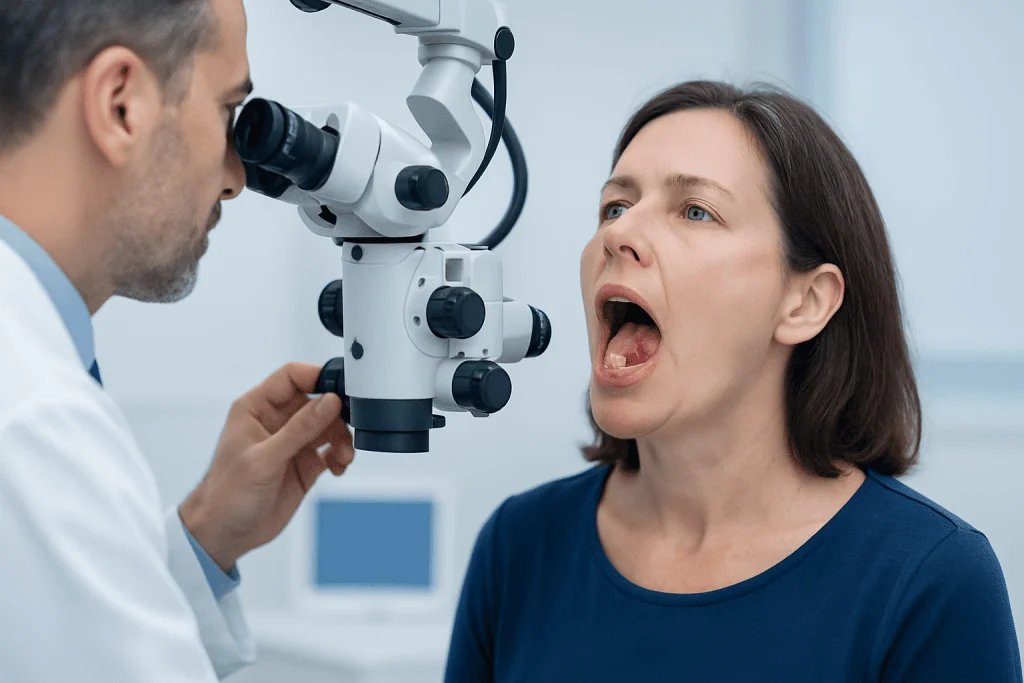
Oral cancer does not have one single appearance. Instead, doctors look for a pattern of changes that seem unusual, persistent, or progressively worse. A person may notice the problem while brushing teeth, eating, speaking, or looking in the mirror, but sometimes it is first found during a dental exam.
Common features that can raise concern include:
- A sore or ulcer that does not heal
- A red patch, white patch, or red-and-white patch
- A lump, bump, or thickened area in the mouth
- Persistent crusting or scaling on the lip
- Unexplained bleeding or numbness
- Pain when chewing, swallowing, or moving the tongue
- Loose teeth without a clear dental reason
- A feeling that something is stuck in the throat
- A neck lump or swollen lymph node
Some lesions have irregular borders and may feel firmer than nearby tissue. Others look like a shallow ulcer with a depressed center. Oral cancer can also appear as a rough patch that catches on the tongue, an area that becomes increasingly tender, or a spot that repeatedly returns in the same place after seeming to improve.
Symptoms beyond the visible lesion can also matter. Ongoing hoarseness, trouble opening the mouth, a change in speech, persistent bad breath, or unexplained weight loss may prompt a broader evaluation. These symptoms do not confirm cancer, but they help clinicians decide how urgently the area should be examined.
What can look similar but is often harmless?

One reason this topic causes anxiety is that many common mouth conditions can resemble early cancer. Canker sores are a frequent example. They can be painful, round, and ulcer-like, but they usually heal within one to two weeks. Traumatic ulcers from accidentally biting the cheek or tongue may look alarming at first, yet often improve once the irritation stops.
Other benign causes include friction from braces or dentures, irritation from a sharp tooth edge, burns from hot food, fungal infection such as thrush, harmless fibromas, geographic tongue, and inflammatory conditions like lichen planus. Cold sores usually affect the lips and often begin with tingling before blistering. Gum disease and dental infections can also create swelling, tenderness, or bleeding that may be confused with something more serious.
The difference is not always obvious from appearance alone. A harmless lesion generally improves as the tissue heals, while a suspicious lesion tends to persist, enlarge, become firmer, or return repeatedly. A doctor or dentist may also look for whether the lesion can be wiped away, whether it is fixed to underlying tissue, and whether there are related findings such as enlarged lymph nodes.
Because overlap is common, self-diagnosis has limits. If a person is unsure whether a mouth change is simply irritation or something more significant, an in-person assessment is the safest next step. This is especially true if the lesion lasts longer than two weeks or keeps recurring in the same location.
Causes and risk factors doctors consider
Oral cancer develops when cells in the lining of the mouth or lips begin to grow abnormally. Doctors usually cannot point to a single cause in one person, but they do look at known risk factors that make cancer more likely. These factors help guide the level of suspicion when a mouth lesion is being assessed.
The most important risk factors include tobacco use in any form, heavy alcohol use, and the combined effect of tobacco plus alcohol. Human papillomavirus, especially in cancers of the oropharynx, may also play a role in some head and neck cancers. Long-term sun exposure can increase the risk of cancer on the lips. Additional factors may include older age, a previous history of oral or head and neck cancer, a weakened immune system, poor oral hygiene in some contexts, and chronic irritation, although irritation alone is not considered a proven sole cause.
Not everyone with oral cancer has a classic risk profile. Some people develop it without smoking or drinking heavily, which is one reason persistent lesions should not be ignored simply because risk seems low. Equally, having risk factors does not mean that every mouth ulcer is cancer. The goal is balanced assessment rather than alarm.
Doctors may also think more broadly about cancers in nearby areas of the head and neck when symptoms include throat discomfort, hoarseness, swallowing problems, or a neck mass. In selected cases, evaluation may connect with services used for head and neck cancer treatment if a suspicious lesion requires specialist care.
How doctors diagnose a suspicious mouth lesion
The first step is usually a careful medical and dental history followed by an examination of the mouth, tongue, gums, palate, lips, and throat. The clinician will ask how long the lesion has been present, whether it is painful, whether it has changed in size or color, and whether there are related symptoms such as weight loss, trouble swallowing, numbness, or a neck lump. Risk factors such as smoking, alcohol use, and prior lesions are also reviewed.
During the exam, the doctor may feel the lesion to check its texture and firmness and may examine the neck for enlarged lymph nodes. The most important test for diagnosis is a biopsy. This means taking a small sample of tissue so a pathologist can look at the cells under a microscope. A biopsy is the only reliable way to confirm whether a lesion is cancer, precancerous, or benign.
If cancer is confirmed or strongly suspected, imaging tests may be used to understand the size and spread of the lesion. Depending on the location, this may involve ultrasound, CT, MRI, or PET-CT. Some patients may also need endoscopic examination of nearby areas if symptoms suggest involvement beyond the visible mouth lesion.
Care is often coordinated among oral and maxillofacial surgeons, ENT specialists, dentists, pathologists, radiologists, and oncologists. Where needed, doctors may plan further biopsy evaluation and staging before discussing treatment choices. In complex cases, multidisciplinary teams such as those at Acibadem International’s JCI-accredited hospitals may help diagnose and treat oral cancer for international patients.
Treatment options if oral cancer is found
Treatment depends on the exact site, size, stage, cell type, and whether the cancer has spread to lymph nodes or nearby structures. A person’s general health, speech and swallowing function, and preferences are also important in treatment planning. For many people, treatment involves more than one approach.
Surgery is often a main treatment for localized oral cancer. The aim is to remove the tumor with a margin of healthy tissue, and sometimes lymph nodes in the neck are also assessed or removed. Reconstructive procedures may be considered if the cancer or surgery affects appearance or function. Radiation therapy may be used alone in selected cases or after surgery to lower the risk of recurrence.
Chemotherapy, targeted therapy, or immunotherapy may be recommended for more advanced disease or in combination with radiation, depending on the pathology and stage. Supportive care is also central. This can include pain management, nutritional support, speech and swallowing therapy, dental care, and rehabilitation after treatment.
Patients may hear treatment discussed under broader oncology treatment planning, especially when multiple specialties are involved. Asking about the goals of treatment, possible side effects, recovery expectations, and follow-up schedules can help patients make informed decisions with their care team.
Prevention, self-checks, and practical self-care
No one can prevent every case of oral cancer, but several practical steps may reduce risk and improve the chances of early detection. Avoiding tobacco is one of the most effective measures. Limiting alcohol, protecting the lips from excessive sun exposure, and maintaining regular dental checkups are also sensible preventive steps. Vaccination against HPV may reduce the risk of some HPV-related cancers according to national guidance.
At home, it can help to do occasional mouth self-checks in good light. A person can look at the lips, gums, inner cheeks, tongue, and roof of the mouth, and gently feel for unusual lumps or thickened areas. The goal is not to diagnose cancer independently, but to notice changes that persist and need review.
If a sore appears after biting the cheek, eating very hot food, or getting denture friction, simple self-care may help while watching for improvement. This may include avoiding further irritation, keeping up gentle oral hygiene, staying hydrated, and using dental adjustments if a prosthesis rubs. However, repeated self-treatment should not delay professional evaluation if the area remains abnormal.
People who have had oral cancer before, or who have major risk factors, may benefit from more regular follow-up and lower thresholds for assessment. A dentist, primary care doctor, or specialist can advise how often to be checked based on individual risk.
When to seek medical care
A prompt medical or dental review is a good idea if a mouth sore, ulcer, patch, or lump lasts longer than two weeks. The same applies if the area is getting larger, feels firm, bleeds easily, or keeps returning in the same place. Early review does not mean the lesion is cancer; it means the cause deserves a proper diagnosis.
Medical care should also be sought sooner if there is difficulty swallowing, ongoing ear pain on one side, numbness, unexplained loose teeth, a persistent sore throat, or a lump in the neck. These symptoms can have non-cancer causes, but they should not be ignored when they persist.
People at higher risk, such as smokers, heavy alcohol users, or those with a previous history of oral cancer, should have a particularly low threshold for assessment. If there is uncertainty about which specialist to see, a dentist, family doctor, ENT specialist, or oral surgeon can usually guide the next step.
The main reassurance is that many mouth changes are not cancer, especially when they heal quickly. The safest rule is simple: if a lesion is unexplained and not healing as expected, get it examined rather than waiting for it to declare itself.
Frequently asked questions
What does oral cancer usually look like in the early stages?
Early oral cancer may look like a sore that does not heal, a red or white patch, or a small lump or thickened area. It is not always painful, which is why persistence beyond about two weeks is an important warning sign.
Can oral cancer look like a canker sore?
Yes, it can sometimes resemble a canker sore or traumatic ulcer at first. The difference is that common mouth sores usually improve within one to two weeks, while a suspicious lesion tends to persist, enlarge, or recur.
Are white patches in the mouth always cancer?
No. White patches can occur with irritation, fungal infection, inflammatory conditions, or other non-cancerous causes. Still, a white patch that does not clear or that feels thickened should be evaluated by a clinician.
How do doctors confirm whether a mouth lesion is cancer?
Doctors begin with a physical examination and medical history. If the lesion appears suspicious, the key test is a biopsy, which allows a pathologist to examine the tissue and make a diagnosis.
When should someone worry about a mouth ulcer?
Concern is reasonable when an ulcer lasts longer than two weeks, becomes firmer, grows, bleeds, or is linked with symptoms such as swallowing trouble or a neck lump. These features do not prove cancer, but they do justify a prompt check.
Can someone have oral cancer without smoking?
Yes. Tobacco is a major risk factor, but oral cancer can occur in people who have never smoked. That is why persistent mouth changes should be assessed based on how they behave, not only on risk factors.
References
- World Health Organization
- American Cancer Society
- National Cancer Institute
- Centers for Disease Control and Prevention
- National Health Service
This article is for general information only and is not a substitute for professional medical advice. Please consult a qualified doctor about your individual situation.
Persistent digestive symptoms? Get evaluated in Turkey
JCI-accredited · board-certified surgeons · reply within 24h
Add us as a Preferred Source to see more of our trusted health content across Google Search, AI Overviews and Discover.