Lichen Planus
Lichen Planus is an inflammatory condition affecting skin, mouth, nails or genitals. Learn symptoms, diagnosis and treatment options.
Quick answer
Lichen planus is an inflammatory condition that can affect the skin, mouth, scalp, nails, or genitals, often causing itchy, purple skin lesions or sore white patches on mucous membranes. At Acibadem in Turkey, evaluation focuses on confirming the diagnosis and identifying the affected areas, and treatment may include medicated creams, oral medicines, light therapy, and symptom-relief measures depending on severity…
What is lichen planus?
Lichen planus is a chronic (long-lasting) inflammatory condition that can affect the skin, the inside of the mouth, the genitals, the scalp, and the nails. The name can be confusing: lichen planus has nothing to do with the lichen that grows on rocks or trees, and it is not an infection. The term was chosen long ago because the flat-topped skin bumps it causes were thought to resemble lichen. In medical coding, the general form of the condition is listed under ICD-10 code L43.9, which simply means lichen planus that has not been given a more specific label.
In lichen planus, the immune system: the body’s defense network, mistakenly attacks cells in the skin or mucous membranes (the moist linings of the mouth and other body openings). This immune attack causes inflammation, which leads to the characteristic itchy bumps, lacy white patches, or sore areas that people notice.
Lichen planus most often appears in middle-aged adults, typically between the ages of 30 and 60. It is uncommon in children and older adults, although it can occur at any age. Skin lichen planus affects men and women in roughly similar numbers, while the oral (mouth) form is seen somewhat more often in women. Importantly, lichen planus is not contagious: you cannot catch it from another person or pass it on through touch, sharing utensils, or intimate contact.
For many people, the condition is limited to a few patches of skin that eventually settle on their own or with treatment. For others, particularly those with disease inside the mouth or on the genitals, lichen planus can be a longer-term condition that flares and quiets down over months or years.
Symptoms
Lichen planus symptoms depend on which part of the body is involved. Many people have only one form, but some develop the condition in more than one area at the same time.
Common lichen planus symptoms by location
- Skin: small, firm, flat-topped bumps (called papules) that are usually purple, violet, or reddish-brown. They often appear on the inner wrists, forearms, ankles, and lower back, and they are frequently very itchy.
- Fine white lines: a delicate, lacy white pattern on the surface of the bumps or inside the mouth. Doctors call these lines Wickham striae, and they are a classic clue to the diagnosis.
- Mouth (oral lichen planus): lacy white patches on the inner cheeks, gums, or tongue. These may cause no discomfort at all, or they may burn and sting, especially with spicy, acidic, or hot foods. Some people develop painful red, eroded, or ulcerated (open sore) areas.
- Genitals: in women, soreness, burning, or raw areas on the vulva or in the vagina, which can make intercourse painful; in men, purple or ring-shaped patches on the penis.
- Scalp (lichen planopilaris): redness and scaling around hair follicles that can lead to patches of hair loss. If untreated, this hair loss can become permanent because the follicles are scarred.
- Nails: thinning, ridging, splitting, or grooving of the nails. In severe cases, a nail may be partly or completely lost.
- Darkened skin after healing: as skin lesions fade, they often leave brown or grayish marks (post-inflammatory hyperpigmentation), particularly in people with darker skin tones. These marks are harmless but can take months to fade.
How symptoms differ by type and stage
In the early or active stage of skin lichen planus, new itchy bumps may keep appearing over several weeks. A curious feature of the active phase is that new lesions can develop along lines of scratching or minor skin injury: a pattern doctors call the Koebner phenomenon. Over time, the bumps usually flatten, the itching eases, and the areas heal, often leaving the darkened marks described above.
Oral lichen planus tends to behave differently from the skin form. It is more likely to be long-lasting, with periods of relative calm interrupted by flares of soreness. The painless lacy white type generally causes fewer problems than the erosive type, in which raw, ulcerated areas make eating and oral hygiene uncomfortable.
Because the appearance varies so much from one person to the next, only a qualified clinician can determine whether a particular rash or mouth change is actually lichen planus.
Causes and risk factors
The exact cause of lichen planus is not fully understood. What is widely accepted is that it is an immune-mediated condition: certain immune cells (T lymphocytes, a type of white blood cell) attack cells in the outer layer of the skin or the lining of the mouth as if they were foreign. Why the immune system makes this mistake in some people and not others remains unclear. Understanding lichen planus causes is an active area of research, but several associations and possible triggers are recognized:
- Hepatitis C infection: in some populations, lichen planus, especially the oral form, occurs more often in people who carry the hepatitis C virus. For this reason, your doctor may suggest a blood test for hepatitis C, particularly if there are other risk factors.
- Certain medications: some drugs can trigger a rash that looks very similar to lichen planus (called a lichenoid drug eruption). Medications that have been linked to this include some blood pressure drugs, certain anti-inflammatory painkillers, some antimalarial drugs, and others. The rash often improves after the medication is stopped, but this should only be done under medical supervision.
- Dental materials: in a small number of people, contact allergy to dental restorative materials, such as amalgam fillings, may contribute to oral lesions next to the filling.
- Genetic predisposition: lichen planus occasionally runs in families, suggesting that inherited factors may play a role in susceptibility.
- Stress and skin injury: many patients report that flares follow periods of emotional stress, and new lesions can appear at sites of scratching or skin trauma. Stress does not cause the condition on its own, but it may influence its course.
- Other autoimmune conditions: people with lichen planus appear somewhat more likely to have other immune-related conditions, such as autoimmune thyroid disease, although the overlap is not fully explained.
It is worth repeating what lichen planus is not: it is not an infection, it is not a form of cancer, it is not caused by poor hygiene, and it cannot be spread to family members or partners.
Diagnosis
Lichen planus diagnosis usually begins with a careful physical examination. In many cases, an experienced dermatologist (skin specialist) can recognize the condition from the appearance of the lesions alone: the flat-topped purple bumps, the typical locations on the wrists and ankles, and the lacy white lines are all characteristic. The doctor will also ask about your medications, medical history, and any symptoms in the mouth, genitals, scalp, or nails, since involvement of these areas supports the diagnosis and affects treatment planning.
Additional steps your doctor may use include:
- Skin or mucosal biopsy: the most reliable way to confirm lichen planus. A small sample of the affected skin or mouth lining is removed under local anesthetic (numbing medicine) and examined under a microscope. Lichen planus produces a distinctive pattern of inflammation at the junction between the outer and inner layers of the skin, which a pathologist can recognize.
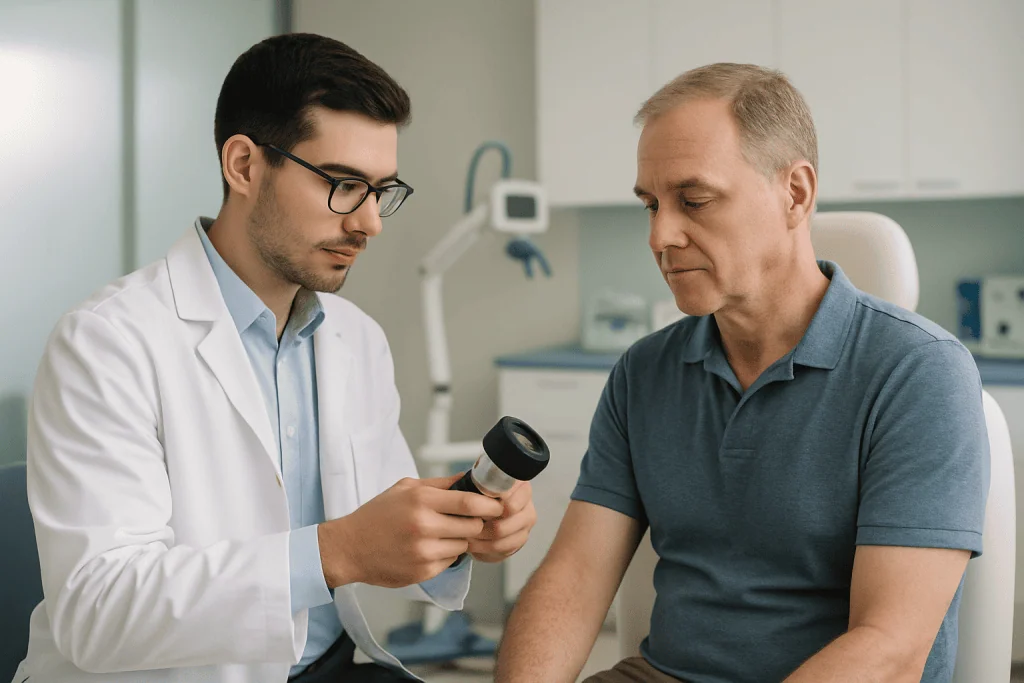
- Dermoscopy: examination of the skin with a handheld magnifying instrument, which can help the doctor see the fine white Wickham striae more clearly.
- Blood tests: there is no blood test that diagnoses lichen planus itself, but your doctor may test for hepatitis C because of the known association, or check thyroid function and other markers if another condition is suspected.
- Direct immunofluorescence: a specialized laboratory test sometimes performed on a biopsy sample. It helps distinguish lichen planus from other blistering or erosive conditions of the mouth and skin, such as certain autoimmune blistering diseases.
- Patch testing: occasionally used when a contact allergy, for example, to dental materials, is suspected as a contributing factor in oral disease.
Imaging tests such as X-rays or scans are generally not needed, because lichen planus affects the surface tissues rather than internal organs. For oral lesions, a biopsy is particularly important when the appearance is unusual or when an area is persistently eroded, because other conditions, including, rarely, early oral cancercan look similar and must be ruled out.
Treatment options
There is currently no cure that permanently removes the underlying tendency to lichen planus, but effective lichen planus treatment can relieve itching and soreness, speed the healing of lesions, and reduce the risk of complications such as scarring hair loss. Treatment is usually managed by a dermatology department; at hospital groups such as Acibadem, this condition falls under the dermatology specialty, often working together with dentists or oral medicine specialists when the mouth is involved.
Watchful waiting
Mild skin lichen planus often clears on its own, in many cases within one to two years. If lesions are few and not troublesome, your doctor may recommend simple observation, sometimes with a gentle skin-care routine and an antihistamine (an anti-allergy tablet) at night to help with itching and sleep. Painless white patches in the mouth that cause no symptoms may also simply be monitored at regular check-ups.
Topical treatments
- Corticosteroid creams and ointments: anti-inflammatory medicines applied directly to the skin are the usual first-line treatment. Potent steroids are often needed for the thickened lesions of lichen planus, used in courses under medical guidance to limit side effects such as skin thinning.
- Steroid mouth preparations: for oral lichen planus, corticosteroids can be given as gels, mouth rinses, or dissolving tablets that act on the lining of the mouth.
- Calcineurin inhibitors: non-steroid anti-inflammatory creams or ointments (such as tacrolimus or pimecrolimus) are sometimes used, particularly for the mouth, genitals, or other delicate areas where long-term steroid use is a concern.
- Steroid injections: for stubborn, thickened patches, a doctor may inject a small amount of corticosteroid directly into the lesion.
Treatments for widespread or resistant disease
- Oral corticosteroids: a short course of steroid tablets may be used for severe or rapidly spreading disease, always weighed against potential side effects.
- Phototherapy: controlled exposure to specific wavelengths of ultraviolet light, given in a supervised medical setting over a series of sessions, can help widespread skin lichen planus.
- Systemic (whole-body) medications: for disease that does not respond to the above, options your doctor may consider include acitretin (a vitamin A–derived tablet), and immune-modulating medicines such as methotrexate or, less commonly, others. These require monitoring with blood tests and are prescribed by specialists.
Procedures and surgery
Surgery plays only a small role in lichen planus. It is not used to remove ordinary skin lesions, because cutting the skin can trigger new lesions at the wound site. However, procedures may be needed in specific situations: for example, a biopsy of a suspicious oral lesion, release of scar tissue (adhesions) in severe genital disease, or dental work to replace a filling suspected of triggering an adjacent mouth lesion. Decisions like these are individualized and made together with your care team.
Self-care that supports treatment
- Avoid scratching where possible, since scratching can provoke new lesions.
- Use bland moisturizers and mild, fragrance-free cleansers on affected skin.
- For oral disease, avoid spicy, acidic, very hot, or rough-textured foods during flares, limit alcohol, and do not smoke, as tobacco irritates the mouth lining and adds to oral cancer risk.
- Maintain gentle but thorough oral hygiene and attend regular dental check-ups.
Living with lichen planus and outlook
The outlook depends largely on where the disease is and how it behaves in your individual case. Skin lichen planus is often self-limiting: in many people it clears within one to two years, although the darkened marks left behind can persist longer, and the condition can occasionally return. Nail and scalp disease can be more stubborn, and early treatment of scalp involvement matters because scarred hair follicles cannot regrow hair.
Oral and genital lichen planus tend to run a longer, relapsing course, sometimes over many years, with periods of calm and periods of flare. This can be discouraging, but most people find that flares can be managed with the treatments described above and with sensible avoidance of personal triggers.
One point deserves honest mention: long-standing erosive oral lichen planus carries a small increased risk of oral squamous cell carcinoma, a type of mouth cancer. The risk for any individual is low, but it is the reason doctors recommend regular follow-up examinations of the mouth, often every six to twelve months, or as your specialist advises, and prompt review of any sore, lump, or ulcer that does not heal. Avoiding tobacco and limiting alcohol helps reduce this risk further. Similar vigilance is advised for long-standing genital erosions.
Living well with lichen planus also means paying attention to quality of life. Persistent itching, mouth pain, or genital soreness can affect sleep, eating, intimacy, and mood. If the condition is affecting your daily life or emotional well-being, tell your doctor; adjusting treatment and, where helpful, seeking psychological support are both reasonable parts of care.
Frequently asked questions
What is lichen planus in simple terms?
Lichen planus is an inflammatory condition in which the immune system mistakenly attacks the skin or the moist linings of the mouth and other areas. It typically causes itchy purple bumps on the skin or lacy white patches and sore areas in the mouth. It is not an infection, it is not contagious, and it is not caused by poor hygiene.
Is lichen planus contagious?
No. Lichen planus cannot be passed from person to person through touch, kissing, sharing food or utensils, or sexual contact. Family members and partners are not at risk of catching it, so no isolation or special precautions are needed.
Can lichen planus heal on its own?
Often, yes, particularly the skin form, which in many cases clears within one to two years even without treatment, although darkened marks may linger afterward. Oral, genital, nail, and scalp forms tend to last longer and are more likely to need ongoing treatment. Because the course varies widely, it is best to have the condition assessed rather than assuming it will resolve.
How serious is lichen planus?
For most people, lichen planus is uncomfortable rather than dangerous, and it does not affect internal organs. The main concerns are quality-of-life issues such as itching and mouth pain, permanent hair loss if scalp disease is untreated, and a small long-term risk of oral cancer with long-standing erosive mouth disease, which is why regular specialist follow-up is recommended for oral involvement.
What triggers lichen planus flares?
Triggers differ between individuals. Commonly reported ones include emotional stress, skin injury or scratching, certain medications, and, for the mouth, spicy or acidic foods, alcohol, tobacco, and rough dental surfaces. Keeping a simple diary of flares can help you and your doctor identify your personal triggers, but a clear trigger is not found in every case.
What is the best treatment for lichen planus?
There is no single best lichen planus treatment for everyone. First-line care is usually a corticosteroid cream, ointment, or mouth preparation, with non-steroid alternatives for sensitive areas. Widespread or resistant disease may need light therapy or tablet medications prescribed by a specialist. The right approach depends on where the disease is, how severe it is, and your overall health, so treatment plans are individualized.
Is lichen planus linked to hepatitis C?
An association between lichen planus and hepatitis C infection has been observed in some populations, though most people with lichen planus do not have hepatitis C. Because treatment of hepatitis C matters for general health, your doctor may recommend a simple blood test to check for the virus, especially if you have other risk factors.
Will the dark marks on my skin go away?
Usually, yes, but slowly. The brown or grayish marks left after lesions heal are called post-inflammatory hyperpigmentation. They are harmless and tend to fade gradually over months, sometimes longer in darker skin tones. Sun protection of the affected areas may help them fade more evenly; your dermatologist can advise on options if the marks are bothersome.
When to see a doctor
Arrange a medical review if you develop an itchy purple rash, persistent white patches or soreness in the mouth, unexplained genital soreness, hair loss with scalp redness or scaling, or changes to your nails. An accurate diagnosis matters, because several other conditions can mimic lichen planus and are treated differently.
Seek prompt medical attention, do not wait for a routine appointment, if you notice any of the following red flags:
- A mouth ulcer, sore, red or white patch, or lump that has not healed within about two to three weeks.
- Bleeding, hardening, or a growing mass in an area of long-standing oral or genital lichen planus.
- Difficulty eating, swallowing, or speaking because of mouth pain, or unintended weight loss related to eating problems.
- Rapidly spreading rash, blistering, peeling skin, fever, or feeling generally unwell alongside skin changes: these may signal a different, more urgent condition.
- Signs of infection in eroded areas, such as increasing pain, swelling, pus, or spreading redness.
- New or worsening scalp hair loss with redness or scaling, since early treatment helps prevent permanent loss.
- Genital erosions causing severe pain, scarring, or difficulty passing urine.
If you already have a lichen planus diagnosis, keep the follow-up schedule your specialist recommends, particularly for oral or genital disease, and report any lesion that changes, grows, or fails to heal between visits.
Medically reviewed by the Acıbadem International Medical Board September 2, 2026
See our medical review board →
Update history
- PublishedJune 8, 2026
- Medical review approvedSeptember 2, 2026
- Last content updateSeptember 2, 2026