Butterfly Needle: What Patients Need to Know

A butterfly needle is often used for blood draws and some short-term IV treatments. Its winged design can help clinicians stabilize the needle in small or delicate veins.
Key Takeaways
- A butterfly needle is often used for blood draws and some short-term IV treatments.
- Its winged design can help clinicians stabilize the needle in small or delicate veins.
- Patients may notice less movement at the needle site compared with some standard straight needles.
- Minor bruising, brief discomfort, and rare infection or vein irritation are possible risks.
- The best needle type depends on the patient, vein quality, and the purpose of the procedure.
A butterfly needle is a short, thin needle with flexible tubing and two plastic wings that help a clinician access a vein for blood sampling or IV treatment. It is commonly chosen when veins are small, fragile, or harder to reach, and it can make the procedure more controlled and comfortable for some patients.
Overview: What a Butterfly Needle Is
A butterfly needle, also called a winged infusion set, is a small hollow needle attached to flexible tubing and two soft plastic wings. A healthcare professional holds the wings during insertion to guide the needle into a vein. It may be used to collect a blood sample, start a short-term IV line, or deliver certain medicines or fluids.
Patients often hear the term during routine blood testing, especially when a clinician expects that vein access may need extra precision. The device is commonly used in children, older adults, and people with small, fragile, rolling, or hard-to-find veins. It can also be helpful for veins on the hand or other areas where control matters.
Compared with a standard straight needle, a butterfly needle usually uses a shorter needle and a small length of tubing between the needle and the collection tube or syringe. This design can reduce tugging at the insertion site and may make positioning easier. However, it is not automatically the best choice for every person or every procedure.
How a Butterfly Needle Differs From Other Needles
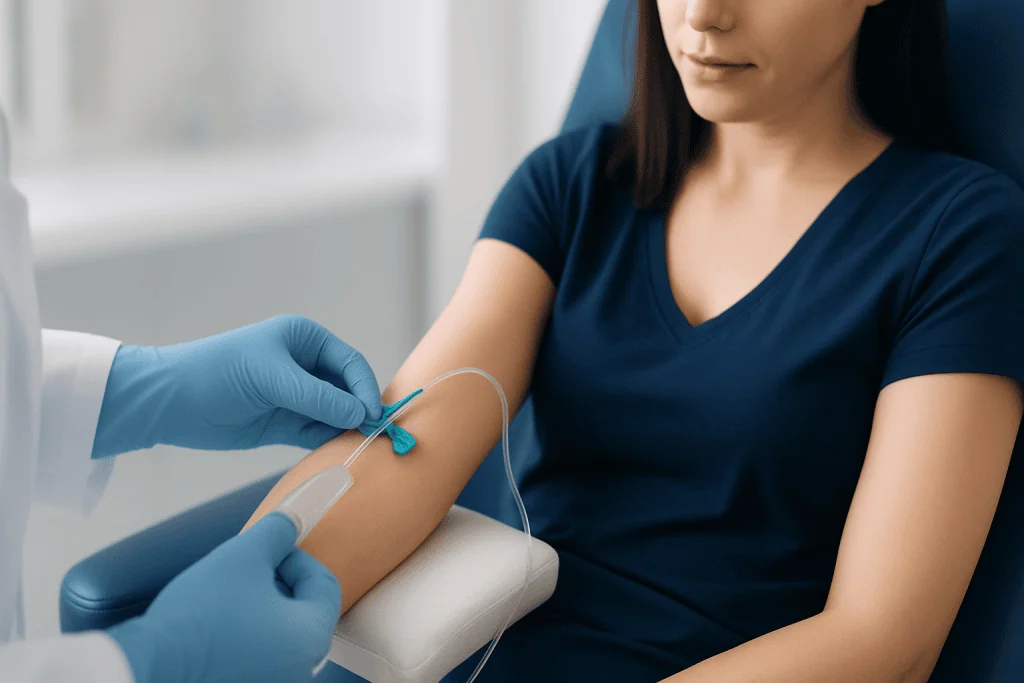
The main difference is control. The wings allow the clinician to grip and angle the needle more precisely, which can be useful when entering a small vein. The attached tubing also creates some distance between the needle and the collection equipment, which may reduce needle movement once the vein has been accessed.
For routine venipuncture, some blood draws are done with a straight needle connected directly to collection tubes. For longer or larger-volume IV treatment, a clinician may choose an IV catheter instead. In many cases, an IV catheter is preferred when fluids or medication will continue for some time because the metal needle is removed after placement and a soft catheter remains in the vein.
A butterfly needle is usually selected for a specific reason rather than as a default. That reason may be patient comfort, vein size, vein fragility, or the location of the vein. The choice also depends on the amount of blood needed and whether the purpose is a quick sample or a short infusion.
- Butterfly needle: Often useful for small or difficult veins and short procedures
- Straight needle: Common for routine blood draws from larger, stable veins
- IV catheter: Usually preferred for ongoing fluids, medicines, or repeated access
When It Is Commonly Used

Butterfly needles are most often used for blood tests. They may be especially helpful when a patient has veins that are narrow, deeper than expected, fragile, or prone to moving under the skin. Some clinicians also use them for blood cultures or blood collection from hand veins when that is the safest available site.
They can also be used for short-term IV purposes, such as giving a small amount of medication or drawing blood from an existing access point in selected settings. In some cases, patients receiving ongoing care for vein-related or blood-related conditions may already be familiar with different types of needle access. Related topics may include anemia or evaluation for bleeding disorders such as hemophilia, depending on why blood testing is needed.
In cancer care, infusion access planning depends on the treatment type, vein condition, and expected duration of therapy. A butterfly needle may be used for a simple blood draw, while longer treatments may need a different approach such as an IV catheter or other access method. For that reason, clinicians choose the device based on the goal of care rather than using one option for every patient.
What Patients Can Expect During the Procedure
Before the needle is inserted, a healthcare professional usually applies a tourniquet to make the vein easier to see or feel. The skin is cleaned with an antiseptic, and the clinician may ask the patient to relax the arm or make a gentle fist. Once the vein is located, the butterfly needle is inserted at a shallow angle.
Many patients feel a quick pinch or sting when the needle enters the skin. After that, there may be pressure but usually not significant pain. Blood then flows through the tubing into collection tubes, or medication or fluid is administered if the needle is being used for a short infusion.
When the procedure is complete, the clinician removes the needle, applies pressure, and covers the site with gauze or a bandage. Mild tenderness or a small bruise can happen afterward. If a patient is having blood work done because of broader concerns, the next step may include further evaluation such as diagnostic assessment or, in selected situations, blood testing planned by the treating team.
Patients who are nervous about needles often benefit from simple measures: staying hydrated when allowed, looking away during insertion, keeping the body relaxed, and telling the clinician about any past fainting or difficult blood draws. These details can help the team choose the safest and most comfortable approach.
Benefits, Limitations, and Possible Risks
The main benefit of a butterfly needle is precision. Because the device is easy to hold and stabilize, it may improve success in veins that are difficult to access. This can mean fewer attempts for some patients, although no device can guarantee that. It may also feel gentler in delicate veins because the tubing can lessen direct pull at the insertion point.
Its limitations are just as important to understand. Butterfly needles are not ideal for every blood draw or every IV treatment. In some situations, blood flow may be slower, or the device may not be the best option for repeated or prolonged infusion. For ongoing therapy, another form of venous access may be more appropriate, including chemotherapy infusion access when cancer treatment is planned.
Possible side effects are usually minor and temporary. These include brief pain during insertion, a small bruise, or light bleeding after removal. Less commonly, patients may develop a hematoma, irritation of the vein, or faintness during the procedure.
Serious complications are uncommon when trained professionals follow standard safety steps. Infection, significant bleeding, or injury to nearby tissue can occur but are rare. Patients who take blood thinners or have known clotting disorders should always tell the clinician before a blood draw or IV placement.
Aftercare and Self-Care Tips
After a butterfly needle is removed, gentle pressure on the site for several minutes usually helps stop bleeding and reduce bruising. Keeping the bandage on for the time advised by the clinician can protect the area. If possible, patients should avoid heavy lifting with that arm for a short period if the site feels sore.
Most mild bruising fades on its own. Applying a cool pack for brief periods may help with tenderness or swelling, as long as it is wrapped and not placed directly on the skin. The area should be kept clean and observed for any unusual changes.
Hydration can help some people feel better after a blood draw, especially if they are prone to lightheadedness. A small snack may also help if they have not eaten recently and fasting is not required. If symptoms continue beyond a short time, medical advice is appropriate.
- Keep light pressure on the site right after removal
- Leave the bandage in place as instructed
- Watch for increasing redness, warmth, or swelling
- Report ongoing bleeding, severe pain, or dizziness
When to Seek Medical Care
Most people recover quickly after a blood draw or short IV procedure with a butterfly needle. Medical advice is worth seeking if bleeding does not stop with pressure, if the bruise becomes unusually large, or if pain continues to worsen instead of improving. Increasing redness, warmth, pus, or fever may suggest infection and should be evaluated promptly.
Patients should also seek care if the hand or arm becomes numb, very swollen, pale, or cold, or if there is significant difficulty moving the limb. These symptoms are not typical after a routine venipuncture. People with known clotting disorders, those taking anticoagulants, and those with a history of severe reactions during blood draws may need extra guidance from a healthcare professional.
If repeated blood draws are difficult or especially uncomfortable, discussing vein access options can be helpful. In more complex cases, multidisciplinary specialists at Acibadem International and its JCI-accredited hospitals assess patients and plan appropriate testing and treatment for international patients, including supportive care and procedures such as intravenous therapy when needed.
Frequently asked questions
Is a butterfly needle more painful than a regular needle?
Not necessarily. Many patients describe the feeling as a brief pinch similar to other blood draw needles. Comfort often depends more on vein access, clinician technique, and the location of the vein than on the device alone.
Why would a clinician choose a butterfly needle?
A clinician may choose it when veins are small, fragile, or harder to reach. The winged design can provide better control and may help reduce movement at the insertion site during a short procedure.
Can a butterfly needle be used for IV therapy?
Yes, but usually for short-term or limited uses rather than long continuous treatment. For longer infusions, a soft IV catheter or another access device is often more suitable.
Is bruising after a butterfly needle normal?
A small bruise or mild tenderness can happen and is usually not serious. It often improves over a few days. If bruising is large, painful, or keeps spreading, a doctor should be informed.
Are butterfly needles safer for children or older adults?
They can be a good option in children or older adults because veins may be smaller or more delicate. However, the safest choice still depends on the person, the purpose of the procedure, and the clinician’s judgment.
What should a patient do before a blood draw with a butterfly needle?
Unless fasting instructions say otherwise, being well hydrated may help make veins easier to access. Patients should also tell the clinician about blood thinners, bleeding problems, past fainting, or previous difficult blood draws.
References
- Centers for Disease Control and Prevention
- National Heart, Lung, and Blood Institute
- MedlinePlus
- World Health Organization
- Infusion Nurses Society
This article is for general information only and is not a substitute for professional medical advice. Please consult a qualified doctor about your individual situation.
Explore treatments in Turkey — costs, top hospitals & a free quote
JCI-accredited · board-certified surgeons · reply within 24h
Add us as a Preferred Source to see more of our trusted health content across Google Search, AI Overviews and Discover.

More from the Health Library

Birth Control Pills Names: An Evidence-Based Guide for Patients

Best Exercises for Lung Health: An Evidence-Based Guide for Patients

Dehydrated — Explained by Medical Evidence, Not Myths

Valtrex: An Evidence-Based Guide for Patients

Choosing a Deodorant With Baking Soda for Sensitive Skin