Pectoral Girdle: An Evidence-Based Guide for Patients

The pectoral girdle includes the clavicle, scapula, related joints, and supporting muscles that help position and move the arm. Pain in the pectoral girdle can come from muscle strain, tendon irritation, joint problems, poor posture, nerve issues, or injury.
Key Takeaways
- The pectoral girdle includes the clavicle, scapula, related joints, and supporting muscles that help position and move the arm.
- Pain in the pectoral girdle can come from muscle strain, tendon irritation, joint problems, poor posture, nerve issues, or injury.
- Symptoms such as weakness, limited range of motion, clicking, swelling, or numbness may help guide the diagnosis.
- Evaluation may include a physical examination and, when needed, imaging such as X-ray, ultrasound, or MRI.
- Many pectoral girdle problems improve with rest, activity changes, physical therapy, and other conservative treatments.
- Urgent assessment is important after major trauma or when pain is severe, the shoulder looks deformed, or there is sudden weakness or numbness.
The pectoral girdle is the shoulder support system made up of the clavicle, scapula, joints, and surrounding muscles that connect the arm to the trunk. When people ask about the pectoral girdle, they are usually asking about shoulder anatomy, pain, weakness, injury, or reduced movement in this area.
Overview: what the pectoral girdle is and why it matters
The pectoral girdle is the body’s shoulder support framework. It mainly consists of the clavicle (collarbone), the scapula (shoulder blade), and the joints that connect these structures to each other and to the upper limb. Together with nearby muscles, tendons, and ligaments, the pectoral girdle helps the arm move smoothly while also providing stability.
Unlike the pelvis, which is built for strong weight-bearing support, the pectoral girdle is designed for mobility. This gives the shoulder a wide range of motion for reaching, lifting, pushing, pulling, and overhead activity. The trade-off is that this flexibility can make the area more vulnerable to strain, overuse, and instability.
Patients may hear the terms “pectoral girdle” and “shoulder girdle” used in similar ways. In everyday clinical practice, both usually refer to the same functional region around the collarbone, shoulder blade, and shoulder-supporting structures. Problems in this area can cause pain in the front, top, side, or back of the shoulder and sometimes into the neck, upper chest, or arm.
How the pectoral girdle works
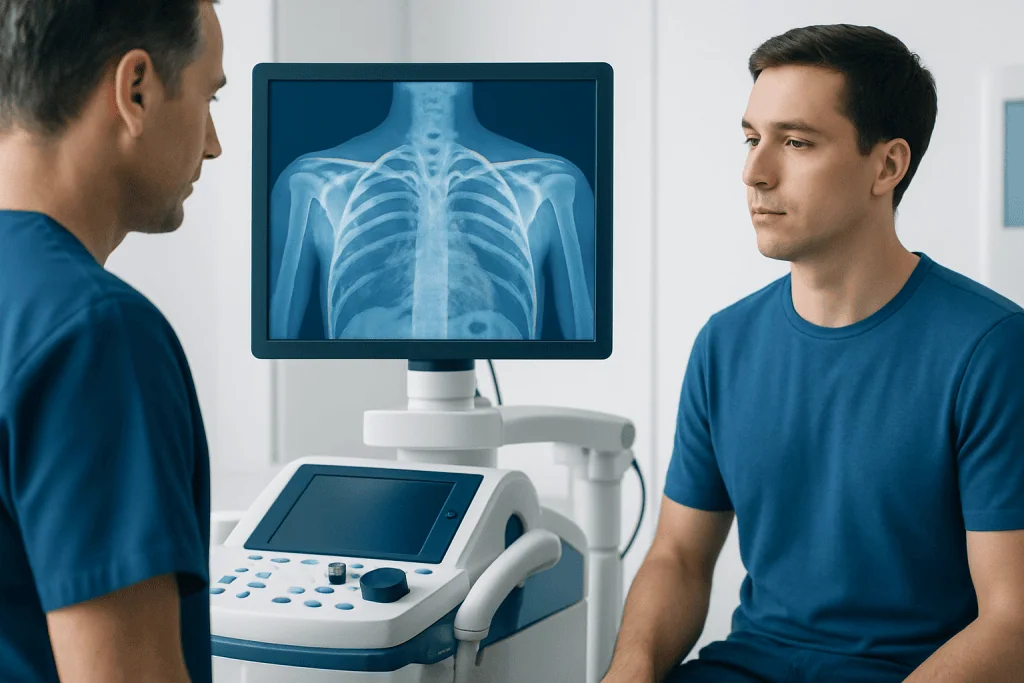
The pectoral girdle does not depend on a single bone or joint. Instead, it works as a coordinated system. Key joints include the acromioclavicular joint, where the clavicle meets part of the scapula, and the sternoclavicular joint, where the clavicle meets the breastbone. The scapula also glides over the rib cage, and this motion plays an important role in healthy shoulder function.
Several muscle groups control the pectoral girdle. These include the trapezius, serratus anterior, rhomboids, levator scapulae, pectoralis muscles, and the rotator cuff muscles. When these muscles are balanced and strong, they keep the shoulder blade positioned well and allow the arm to move efficiently.
If one part of the system is irritated or weak, other parts may compensate. For example, poor scapular control can place extra stress on the rotator cuff or shoulder joint. This is one reason why pain in the pectoral girdle can sometimes feel complex or persistent, especially in people who do repeated overhead work, sports, or prolonged desk-based activity.
Common symptoms linked to the pectoral girdle

Pectoral girdle symptoms vary depending on which structure is affected. Some people notice a dull ache around the shoulder blade or collarbone, while others feel sharp pain with lifting, reaching behind the back, or moving the arm overhead. Pain may come on suddenly after an injury or develop gradually from overuse.
Other common symptoms include stiffness, weakness, reduced range of motion, clicking or grinding sensations, and tenderness around the clavicle, upper chest, or shoulder blade. In some cases, swelling or visible asymmetry may appear after trauma. Some patients also describe fatigue in the shoulder or a sense that the shoulder is not moving normally.
If nerves are involved, symptoms may include tingling, numbness, burning discomfort, or weakness in the arm or hand. Because pain in this region can overlap with conditions affecting the neck, chest wall, or shoulder joint, it is important not to assume that every symptom comes from the same cause.
- Pain with overhead activity
- Difficulty carrying, pushing, or pulling
- Shoulder blade discomfort or winging
- Collarbone pain after a fall or impact
- Night pain or pain when lying on one side
Causes and risk factors
Many pectoral girdle complaints are related to muscle strain, tendon irritation, or posture-related overload. Repetitive movements, sudden increases in exercise, heavy lifting, and prolonged slouched sitting can all place stress on the shoulder-supporting muscles. Sports such as swimming, tennis, volleyball, and weight training may also contribute if technique or conditioning is poor.
Joint-related causes include sprains of the acromioclavicular joint, sternoclavicular joint problems, arthritis, and shoulder instability. Tendon conditions affecting the rotator cuff can contribute to pain throughout the shoulder girdle, especially with reaching or overhead use. In some patients, symptoms are linked to rotator cuff tears or irritation in nearby soft tissues.
Trauma is another important cause. Falls, direct blows, or road traffic accidents can lead to clavicle fractures, shoulder separations, dislocations, or soft-tissue injuries. Less commonly, pain may be referred from the neck, where nerve compression from a condition such as cervical disc problems can mimic or worsen shoulder girdle symptoms.
Risk factors include poor posture, repetitive overhead activity, muscle weakness, previous shoulder injury, age-related tissue changes, and certain jobs or sports. People with inflammatory joint disease or generalized joint laxity may also be more prone to ongoing symptoms.
How doctors diagnose pectoral girdle problems
Diagnosis begins with a careful history. A doctor will usually ask when the symptoms started, whether there was an injury, what movements trigger pain, and whether there is weakness, numbness, swelling, or neck pain. This helps narrow down whether the main source is muscular, joint-related, tendon-related, nerve-related, or traumatic.
The physical examination often includes checking posture, shoulder blade motion, range of movement, strength, tenderness, and joint stability. The doctor may compare both sides and use specific tests to assess the rotator cuff, acromioclavicular joint, clavicle, and cervical spine. These findings are often very informative.
Imaging is not always needed for mild symptoms, but it can be helpful when the diagnosis is unclear or symptoms persist. X-rays may show fractures, arthritis, or joint alignment issues. Ultrasound can help assess some soft-tissue problems, while MRI may be used when tendon injury, labral injury, or more complex soft-tissue damage is suspected. In selected cases, nerve testing or blood tests may be considered.
Treatment options and recovery
Treatment depends on the cause, severity, and impact on daily life. Many pectoral girdle problems improve with conservative care, especially when they are identified early. Initial treatment may include rest from aggravating activity, short-term activity modification, ice or heat as advised by a clinician, and guided pain relief measures suitable for the individual.
Physical therapy is often central to recovery. Treatment typically focuses on improving shoulder blade control, posture, flexibility, rotator cuff strength, and the coordination between the arm and trunk. Patients with overuse injuries frequently benefit from a gradual return-to-activity plan rather than complete inactivity for long periods.
When there is a more specific structural problem, treatment may be more targeted. This can include physical therapy and rehabilitation for muscle imbalance, supportive care for sprains, or specialist evaluation for fractures and instability. In persistent or severe cases, doctors may consider injections or procedures based on the diagnosis.
Surgery is not needed for most patients, but it may be recommended for certain fractures, complete tendon tears, recurrent instability, or injuries that do not improve with non-surgical treatment. For example, some patients with major tendon damage may need evaluation for shoulder surgery. If advanced imaging is needed to clarify the cause, MRI may be part of the workup. Near the end of the care pathway, Acibadem International’s multidisciplinary specialists in JCI-accredited hospitals also diagnose and treat pectoral girdle conditions for international patients.
Prevention and self-care
Not every pectoral girdle problem can be prevented, but many can be reduced through good movement habits and conditioning. Regular strengthening of the upper back, shoulder blade stabilizers, and rotator cuff can improve control and reduce overload. Flexibility work may also help if a clinician or therapist identifies tight muscles affecting shoulder mechanics.
Workstation setup matters, especially for people who spend long hours sitting. Keeping the screen at eye level, avoiding prolonged shrugging or slumping, and taking movement breaks can reduce strain around the neck and shoulder girdle. Athletes and active individuals may benefit from coaching on technique, warm-up routines, and training progression.
Self-care is most helpful when it is matched to the likely cause. Gentle movement is often preferable to complete rest for minor strains, but painful or forceful exercises can make symptoms worse. If pain lasts more than a few days, recurs often, or interferes with sleep, work, or sport, medical advice is a sensible next step.
When to seek medical care
Medical care is appropriate if pectoral girdle pain follows a fall, collision, or sudden injury, especially if there is swelling, bruising, deformity, or the person cannot raise the arm. Assessment is also important for pain that continues despite rest, returns repeatedly, or limits normal daily activities.
Prompt medical evaluation is recommended if there is marked weakness, numbness, tingling, fever, unexplained weight loss, or pain that seems to come from the neck or chest rather than the shoulder area alone. Emergency care may be needed if shoulder-region discomfort occurs together with chest pressure, shortness of breath, or other symptoms that could suggest a heart or lung problem.
Because the pectoral girdle involves many interconnected structures, an accurate diagnosis can prevent prolonged discomfort and unnecessary treatment. A qualified doctor can help identify whether the problem is a simple strain, a tendon or joint issue, a nerve-related condition, or an injury needing specialist care.
Frequently asked questions
What is the pectoral girdle in simple terms?
The pectoral girdle is the shoulder support system that connects the arm to the body. It includes the collarbone, shoulder blade, related joints, and the muscles that help move and stabilize the shoulder.
Is pectoral girdle pain the same as shoulder pain?
Often, yes, but the term is a little broader. Pectoral girdle pain can involve the front, top, side, or back of the shoulder region, including the collarbone and shoulder blade area, not just the main shoulder joint.
Can poor posture cause pectoral girdle symptoms?
Yes. Prolonged slouching or rounded-shoulder posture can overload the muscles and alter shoulder blade movement, which may lead to pain, tightness, or fatigue over time. Posture is usually one part of the picture rather than the only cause.
How long does a pectoral girdle strain take to heal?
Mild strains may improve within days to a few weeks, while more significant overuse or tendon-related problems can take longer. Recovery depends on the exact cause, how early treatment starts, and whether aggravating activities are adjusted.
Do all pectoral girdle problems need imaging?
No. Many common causes can be assessed through a medical history and physical examination. Imaging is usually reserved for suspected fractures, persistent symptoms, significant weakness, unclear diagnoses, or when surgery is being considered.
When should someone worry about pectoral girdle pain?
It is wise to seek medical advice if pain follows trauma, causes marked weakness, keeps returning, or limits daily function. Urgent assessment is needed if symptoms are combined with numbness, deformity, severe swelling, or chest-related symptoms such as shortness of breath.
This article is for general information only and is not a substitute for professional medical advice. Please consult a qualified doctor about your individual situation.
Joint and spine care in Turkey — expert assessment & treatment
JCI-accredited · board-certified surgeons · reply within 24h
Add us as a Preferred Source to see more of our trusted health content across Google Search, AI Overviews and Discover.

More from the Health Library

Rogaine for Men: A Complete Medical Overview

Mumps: A Complete Medical Overview

At Home Testosterone Test: An Evidence-Based Guide for Patients

Nose Piercings: What Patients Need to Know

Lanolin: A Complete Medical Overview