Planking: A Complete Medical Overview

Planking mainly trains the core, but it also engages the shoulders, glutes, hips, and legs. Good form matters more than duration; a shorter, well-aligned plank is usually safer and more effective than holding too long.
Key Takeaways
- Planking mainly trains the core, but it also engages the shoulders, glutes, hips, and legs.
- Good form matters more than duration; a shorter, well-aligned plank is usually safer and more effective than holding too long.
- Planking should not cause sharp pain, numbness, or joint instability.
- People with back, shoulder, wrist, or abdominal concerns may need technique changes or medical advice before starting.
- A gradual approach, steady breathing, and rest between sessions can help reduce strain and improve results.
Planking is a simple bodyweight exercise that strengthens the core, shoulders, hips, and back when performed with proper technique. It can be a useful part of general fitness, but incorrect form, overtraining, or certain medical conditions may lead to discomfort or injury.
Overview: What Planking Is and Why People Do It
Planking is an isometric exercise, meaning the body holds a stable position rather than moving through repeated repetitions. In a standard forearm or high plank, the trunk stays straight while the muscles of the abdomen, back, shoulders, hips, and legs work together to maintain alignment. Because it needs no equipment and can be adapted to different fitness levels, planking is commonly included in home workouts, rehabilitation plans, and athletic training.
People often choose planking to build core strength, improve balance, and support better posture. The term “core” includes not only the abdominal muscles but also deeper stabilizing muscles around the spine and pelvis. These muscles help transfer force during daily activities such as standing, lifting, walking, and reaching. When the core functions well, movement may feel more efficient and stable.
Planking is not a complete fitness program on its own, but it can be a valuable component of one. It works best alongside aerobic activity, flexibility exercises, and other strength training. For many people, the main goal is not simply to hold a plank longer, but to improve control, muscle endurance, and body awareness with safe technique.
How Planking Affects the Body

During a plank, several muscle groups contract at the same time. The abdominal wall helps resist sagging through the lower back, the gluteal muscles support pelvic position, and the shoulders and upper back stabilize the torso. The quadriceps and leg muscles also contribute by helping keep the body in a straight line from head to heels.
Because planking is a stability exercise, it may help improve muscular endurance rather than maximum strength. This can be useful for posture control, exercise performance, and some forms of injury prevention. However, the benefits depend on consistent, correct practice. If the lower back arches, the shoulders collapse, or the neck strains forward, the exercise becomes less effective and may place extra stress on joints and soft tissues.
Planking also places pressure on the wrists, elbows, shoulders, and abdominal wall depending on the variation used. For this reason, people with recent surgery, hernia concerns, wrist pain, or shoulder problems may need modifications. If there is uncertainty about whether planking is appropriate, a clinician or physical therapist can help assess safety and technique.
Potential Benefits of Planking
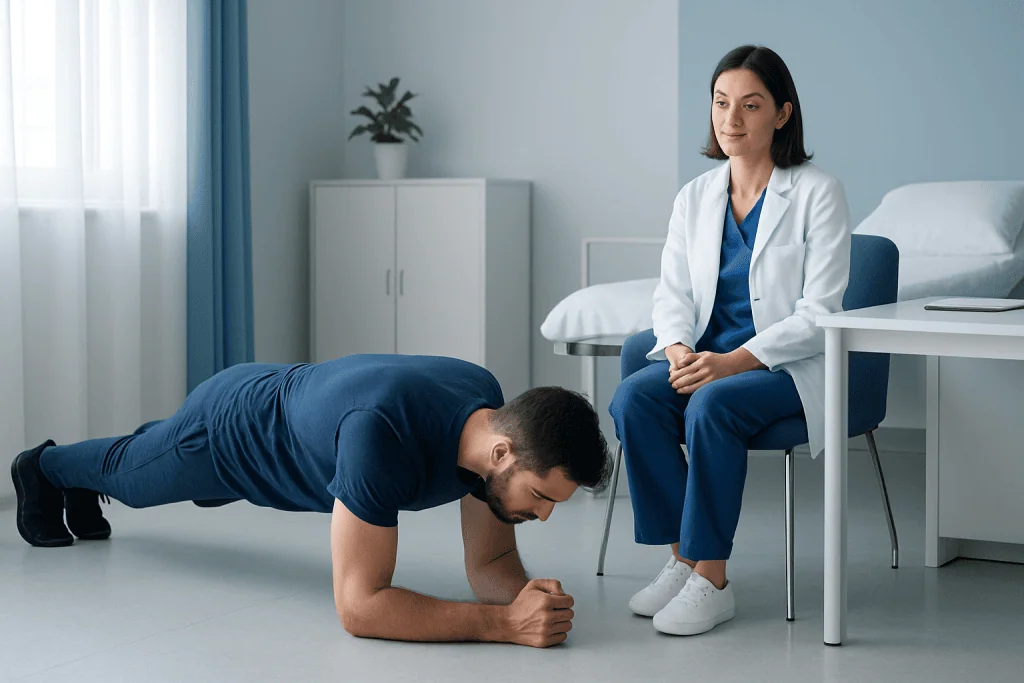
When done properly, planking can support several aspects of physical health. The most recognized benefit is improved core stability, which may help with posture and controlled movement. A stronger, more coordinated trunk can also support everyday tasks such as carrying groceries, getting up from the floor, and maintaining balance during walking or exercise.
Planking may also complement training for sports and fitness activities that require body control. Runners, swimmers, and people who perform resistance training often use plank variations to build endurance in stabilizing muscles. In some rehabilitation settings, supervised plank progressions may be used as part of a broader plan for movement retraining, especially when the focus is on muscle coordination rather than heavy loading.
Possible benefits of planking include:
- Improved core endurance and trunk stability
- Greater awareness of posture and body alignment
- Support for shoulder and hip control
- A convenient, equipment-free exercise option
- Adaptability for beginners and advanced exercisers
These benefits are usually most noticeable when planking is part of a balanced exercise routine. It is not a guaranteed solution for back pain, weight loss, or visible abdominal definition on its own, and expectations should remain realistic.
Proper Form, Common Mistakes, and Safer Variations
In a standard plank, the elbows or hands are placed under the shoulders, the head stays neutral, and the body forms a straight line. The abdominal muscles are gently braced, the hips are level, and breathing remains steady. Rather than holding the position for as long as possible, it is usually better to aim for a shorter hold with consistent alignment.
Common mistakes include lifting the hips too high, allowing the lower back to sag, holding the breath, or shifting too much weight into the shoulders. These errors can reduce the training effect and increase strain. Wrist discomfort is more common in high planks, while shoulder fatigue may appear in both high and forearm versions if the shoulder blades are not well supported.
Beginners often benefit from modified versions such as a plank on the knees, a plank with the hands on a bench or wall, or shorter timed holds with rest between efforts. Side planks, marching planks, and dynamic plank variations can be added later if form is stable. For people with joint pain or previous injuries, a structured assessment may be helpful, especially when there is a history of lower back pain or ongoing shoulder symptoms.
If pain occurs during exercise evaluation, clinicians may recommend targeted rehabilitation such as physical therapy and rehabilitation to improve movement patterns, flexibility, and muscle control before returning to more demanding plank variations.
Risks, Side Effects, and Who Should Be Cautious
Planking is generally safe for many healthy adults, but it is not risk-free. The most common issues are muscle fatigue, wrist or shoulder discomfort, neck tension, and lower back strain related to poor technique or trying to hold the position too long. In some cases, symptoms come from doing planks too often without allowing the muscles and joints enough recovery time.
Caution is especially important for people who have recent injuries, chronic pain conditions, uncontrolled high blood pressure, pregnancy-related concerns, abdominal wall weakness, or recent abdominal or spine surgery. People with joint hypermobility or reduced shoulder stability may also need closer guidance. If a person has pain that radiates into the arm or leg, numbness, weakness, or repeated episodes of instability, the issue may involve more than simple muscle fatigue.
Medical review may be appropriate when symptoms suggest a structural problem, such as persistent shoulder pain, repeated wrist swelling, or a suspected hernia. In some cases, clinicians may use imaging or specialist assessment if there is concern about an underlying joint, tendon, or spinal condition. For patients recovering from musculoskeletal injury, supervised care such as orthopedic rehabilitation may help determine when and how planking can be reintroduced safely.
When to Seek Medical Care
Temporary muscle shaking or fatigue during planking is common, especially for beginners. However, exercise should usually be stopped if it causes sharp pain, sudden weakness, dizziness, chest discomfort, shortness of breath beyond normal exertion, or pain that continues after the session. These symptoms may point to improper loading, overuse, or a condition that needs medical assessment.
A doctor should also be consulted if there is pain in the wrists, shoulders, neck, or lower back that returns each time planking is attempted, or if visible abdominal bulging appears during the exercise. Ongoing symptoms can sometimes reflect underlying issues such as tendon irritation, poor spinal mechanics, or abdominal wall weakness. Early evaluation may help prevent a minor problem from becoming more persistent.
If a person is returning to exercise after surgery, childbirth, a major illness, or a long period of inactivity, professional guidance can be useful before starting core exercises. In more complex cases, assessment by specialists in sports medicine, rehabilitation, or orthopedics and traumatology may be recommended to identify limitations and tailor a safe exercise plan.
Practical Self-care Tips for Safe Planking
For most people, the safest way to begin planking is gradually. A short hold with good form is usually more beneficial than a long hold with compensation. Starting with 10 to 20 seconds and building up over time may be appropriate, depending on baseline fitness, comfort, and any medical conditions. Rest periods between sets help maintain quality.
Warm-up matters. Gentle mobility work for the shoulders, hips, and spine, along with light core activation, may make the exercise feel more controlled. It can also help to use a mirror, record technique briefly, or ask a qualified trainer or therapist to check form. Breathing should stay smooth rather than held, since breath-holding may increase unnecessary strain.
Self-care strategies that may help include:
- Choosing a variation that matches current strength and joint comfort
- Stopping before form breaks down
- Using a mat or padded surface for elbow comfort
- Alternating plank work with other core and mobility exercises
- Allowing recovery time if muscles are sore or fatigued
Near the end of care planning, some people may benefit from a broader medical and rehabilitation approach, especially if pain limits activity. Acibadem International’s multidisciplinary specialists and JCI-accredited hospitals evaluate and treat musculoskeletal and exercise-related concerns for international patients when further assessment is needed.
Frequently asked questions
Is planking good for overall health?
Planking can be a useful part of a healthy exercise routine because it helps train core stability and muscular endurance. It is most beneficial when combined with aerobic exercise, mobility work, and other forms of strength training.
How long should a person hold a plank?
There is no single ideal time for everyone. In general, a shorter hold with good technique is preferable to a longer hold with poor form, and the duration can be increased gradually as control improves.
Can planking cause back pain?
It can if the lower back sags, the abdominal muscles are not engaged well, or the exercise is too advanced for the person’s current strength. Persistent or sharp back pain during planking should be evaluated by a healthcare professional.
Is planking safe during pregnancy?
Some pregnant individuals may be able to continue modified core exercises, but safety depends on the stage of pregnancy, comfort, and any medical concerns. It is best to ask an obstetric clinician or physical therapist for individualized advice.
What is better for beginners: forearm plank or high plank?
That depends on comfort and joint tolerance. Forearm planks may reduce wrist loading, while high planks may feel easier for some people to position, but both require good shoulder and core control.
Should planking be avoided after surgery or injury?
Often, yes, at least temporarily or until a clinician confirms it is appropriate. After abdominal, spine, shoulder, or wrist surgery or injury, a gradual return guided by a qualified professional is usually the safest approach.
This article is for general information only and is not a substitute for professional medical advice. Please consult a qualified doctor about your individual situation.
Joint and spine care in Turkey — expert assessment & treatment
JCI-accredited · board-certified surgeons · reply within 24h
Add us as a Preferred Source to see more of our trusted health content across Google Search, AI Overviews and Discover.

More from the Health Library

Flight of Ideas: What Patients Need to Know

Polychromasia — Explained by Medical Evidence, Not Myths
Enamel: What Patients Need to Know

Ingrown Fingernail — Explained by Medical Evidence, Not Myths
Jump Rope Benefits: What Patients Need to Know