Bench Dips: An Evidence-Based Guide for Patients

Bench dips primarily work the triceps but also load the front of the shoulder and chest. Going too deep or letting the shoulders roll forward can increase shoulder stress.
Key Takeaways
- Bench dips primarily work the triceps but also load the front of the shoulder and chest.
- Going too deep or letting the shoulders roll forward can increase shoulder stress.
- People with shoulder pain, limited mobility, or a history of instability may need safer alternatives.
- Good form, gradual progression, and stopping with pain can reduce the risk of irritation.
- Medical assessment is sensible if pain is sharp, persistent, or associated with weakness or loss of motion.
Bench dips are a bodyweight exercise that mainly targets the triceps, with help from the shoulders and chest. They can be effective for some people, but they also place the shoulder in a position that may increase strain, so technique, range of motion, and individual joint health matter.
Overview: what bench dips do and why they can be challenging
Bench dips are a common bodyweight exercise used to strengthen the triceps, with assistance from the chest and shoulder muscles. In a typical setup, the hands are placed behind the body on a bench or chair while the feet remain on the floor or on another bench. The body is then lowered by bending the elbows and pushed back up to the starting position.
From a fitness perspective, bench dips can help develop upper-arm pressing strength. From a joint-health perspective, however, they deserve a closer look. The exercise places the shoulder in extension behind the body, which can increase load on structures at the front of the shoulder, especially if the movement is deep, fast, or poorly controlled.
This does not mean bench dips are automatically harmful. Many healthy people perform them without difficulty. The key point is that bench dips are not the best choice for everyone, and they may be less forgiving than other triceps exercises for people with shoulder stiffness, previous injuries, or pain during pushing movements.
Muscles worked and movement mechanics
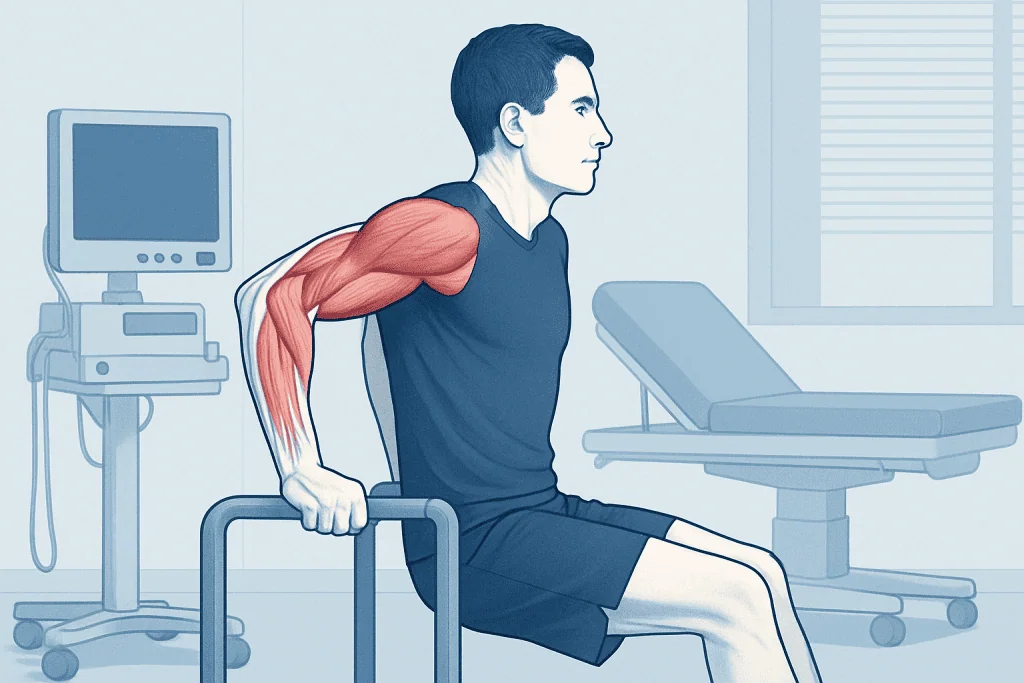
The main muscle targeted in bench dips is the triceps brachii, which straightens the elbow. Secondary work comes from the anterior deltoid at the front of the shoulder and the pectoral muscles in the chest. Muscles around the shoulder blade also help stabilize the upper body during the movement.
The exercise combines elbow flexion and extension with a shoulder position that moves behind the torso. That shoulder position is important because it changes how force is distributed across the front of the joint. As the body lowers, the shoulder may experience greater anterior stress, especially if the chest collapses, the shoulders round forward, or the elbows flare excessively.
Body mechanics also change with setup. Elevating the feet, adding external weight, or using a deeper range of motion increases demand. For some people, a small adjustment in range or a switch to a different triceps exercise can maintain training benefits while reducing joint irritation.
Potential benefits and common risks

Bench dips can be useful because they require minimal equipment and can strengthen the triceps in home or gym settings. They may also improve familiarity with bodyweight pushing patterns and can be added to a broader upper-body program when tolerated well.
The main concern is not the triceps but the shoulder. In some people, bench dips can aggravate the front of the shoulder, particularly if there is a history of overuse, instability, impingement-related symptoms, or limited mobility. Wrist discomfort may also occur because the hands are fixed behind the body in an extended position.
Common problems include going too low, shrugging the shoulders toward the ears, allowing the elbows to drift far outward, or dropping quickly into the bottom position. These patterns can reduce control and increase strain. If an exercise repeatedly causes pain rather than normal muscle fatigue, it is usually sensible to stop and reassess the technique or choose an alternative.
- Possible benefits: triceps strength, convenience, bodyweight training variety
- Possible risks: front-of-shoulder pain, wrist discomfort, irritation with poor mobility or prior injury
- Higher-risk factors: deep range, fast repetitions, added load, poor posture, fatigue
How to do bench dips with safer form
Safer form starts with a stable surface and a conservative range of motion. The hands are placed about shoulder-width apart on the edge of the bench, fingers facing forward. The body stays close to the bench rather than drifting far away, which helps avoid excessive leverage at the shoulder.
As the elbows bend, the chest should stay gently lifted and the shoulders should remain away from the ears. A useful cue is to lower only until the upper arms are roughly parallel to the floor, or less if there is discomfort. Many people do better by stopping before the deepest position rather than trying to maximize range.
During the upward phase, the arms press through the bench while the shoulder blades stay controlled rather than collapsing forward. Repetitions should be slow and even. Pain inside the shoulder joint, pinching at the front of the shoulder, or numbness is not an expected training sensation and should prompt stopping the exercise.
People who are unsure about form may benefit from a supervised exercise review. If shoulder symptoms are already present, assessment by a clinician or rehabilitation professional may help identify whether the problem relates to mobility, strength imbalance, or an underlying condition such as shoulder impingement syndrome.
Who should avoid or modify bench dips
Bench dips may not be the best option for people with current shoulder pain, previous shoulder dislocation, marked stiffness, rotator cuff problems, or pain during pressing and reaching behind the body. They can also be uncomfortable for people with wrist pain or limited wrist extension. In these cases, modifying the movement or selecting a different exercise is often more appropriate than pushing through symptoms.
Older adults, beginners, and people returning after injury may need to progress more gradually. Even if general fitness is good, a specific joint may not tolerate the shoulder position used in bench dips. A person does not need to have a major injury for the movement to be irritating; mild movement restrictions can be enough.
Modification options include reducing depth, keeping the feet closer to the body, slowing the tempo, lowering the total number of repetitions, or replacing the exercise entirely. If there is persistent shoulder weakness or suspected tendon irritation, a doctor may evaluate whether further care such as physical therapy and rehabilitation could help restore strength and control safely.
Bench dip alternatives that may be easier on the joints
People who want to train the triceps do not have to rely on bench dips. Several alternatives place the shoulder in a more neutral position. Examples include cable press-downs, resistance-band press-downs, close-grip push-ups, machine-assisted dips, and triceps extensions performed within a comfortable range.
Parallel-bar dips are often assumed to be interchangeable with bench dips, but they are a different movement and may still be demanding on the shoulders. For some people, a supported pushing exercise is better tolerated. A structured strength plan can match the person’s goals while respecting mobility and pain limits.
If symptoms arise during several pushing exercises, it may be worth looking beyond the exercise itself. Conditions involving the rotator cuff or the cervical spine can sometimes refer pain into the shoulder region. Evaluation may include examination and, when appropriate, imaging such as MRI to clarify ongoing pain that does not improve with rest or exercise adjustment.
- Often better-tolerated options: band press-downs, cable press-downs, close-grip push-ups
- Modify load first: reduce depth, repetitions, or external resistance
- Choose pain-free patterns over forcing a specific exercise
When to seek medical care
Mild muscle soreness after exercise is common and usually settles within a few days. Medical advice is more important when pain is sharp, deep in the joint, associated with a popping sensation, or does not improve after stopping the exercise. New weakness, limited range of motion, nighttime pain, swelling, or a feeling that the shoulder may slip out of place should also be assessed.
Prompt evaluation is sensible after a fall, a sudden injury, obvious deformity, or inability to lift the arm. These symptoms can suggest more than simple exercise irritation. A doctor may examine the shoulder, check neck and arm function, and decide whether tests or imaging are needed.
Depending on the findings, care may include activity modification, supervised rehabilitation, or specialist treatment for problems such as rotator cuff tear. Near the end of the care pathway, if symptoms remain unexplained or severe, multidisciplinary specialists at Acibadem International and its JCI-accredited hospitals can evaluate musculoskeletal complaints in international patients and guide diagnosis and treatment.
Frequently asked questions
Are bench dips bad for the shoulders?
Bench dips are not automatically bad, but they can place more stress on the front of the shoulder than some other triceps exercises. They may be poorly tolerated in people with shoulder pain, stiffness, instability, or a history of injury.
What muscles do bench dips work?
Bench dips mainly work the triceps, which extend the elbow. The shoulders and chest also assist, and shoulder-blade stabilizers help control the movement.
Why do bench dips hurt the front of the shoulder?
Pain at the front of the shoulder can happen when the shoulder moves too far behind the body or when the movement is done with poor control. Deep range, rounded shoulders, and fatigue can all increase irritation in sensitive tissues.
How deep should a person go during bench dips?
A moderate range is usually safer than dropping as low as possible. Many people should stop when the upper arms are about parallel to the floor, or sooner if there is discomfort.
What are safer alternatives to bench dips?
Resistance-band or cable triceps press-downs, close-grip push-ups, and other supported pressing movements are common alternatives. These options can still train the triceps while placing the shoulder in a more comfortable position for many people.
Should a person continue bench dips if there is pain?
Pain inside the joint, pinching, or sharp discomfort is a reason to stop rather than push through. If symptoms continue after rest, technique changes, or exercise substitution, a healthcare professional should assess the problem.
This article is for general information only and is not a substitute for professional medical advice. Please consult a qualified doctor about your individual situation.
Joint and spine care in Turkey — expert assessment & treatment
JCI-accredited · board-certified surgeons · reply within 24h
Add us as a Preferred Source to see more of our trusted health content across Google Search, AI Overviews and Discover.

More from the Health Library

Throat Chakra: An Evidence-Based Guide for Patients

Pimple in Ear: What Patients Need to Know

Shrimp: What Patients Need to Know

Oxycodone: An Evidence-Based Guide for Patients

Sodium Benzoate: An Evidence-Based Guide for Patients