Weber Test: What Patients Need to Know

The weber test is a quick screening tool, not a stand-alone diagnosis. It helps compare how sound is heard in the right and left ears through bone conduction.
Key Takeaways
- The weber test is a quick screening tool, not a stand-alone diagnosis.
- It helps compare how sound is heard in the right and left ears through bone conduction.
- Results can suggest conductive hearing loss in one ear or sensorineural hearing loss in the opposite ear.
- The test is often paired with the Rinne test and confirmed with formal hearing tests.
- Anyone with sudden hearing loss, ear pain, dizziness, or one-sided symptoms should seek medical care promptly.
The weber test is a simple bedside hearing test that uses a vibrating tuning fork placed on the middle of the head. It helps a clinician tell whether hearing loss is more likely to be conductive or sensorineural, often alongside the Rinne test and a full hearing evaluation.
What is the Weber test?
The weber test is a quick clinical hearing test performed with a vibrating tuning fork, usually at the bedside or in an outpatient clinic. The fork is placed on the center of the forehead, the top of the head, or the front teeth, and the patient is asked where the sound is heard best: in the middle, in the left ear, or in the right ear. This simple comparison gives useful clues about the type of hearing loss a person may have.
Its main value is not to measure exactly how much hearing a person has lost. Instead, it helps distinguish between conductive hearing loss, which happens when sound is blocked from reaching the inner ear, and sensorineural hearing loss, which happens when the inner ear or hearing nerve is affected. Because it is fast and noninvasive, the weber test remains a helpful part of the physical examination.
The test is commonly used when a person reports muffled hearing, one-sided hearing changes, ear fullness, or a recent difference between the two ears. It is especially useful when symptoms are new and a doctor needs a rapid bedside impression before arranging more detailed testing such as audiology testing.
How the Weber test works
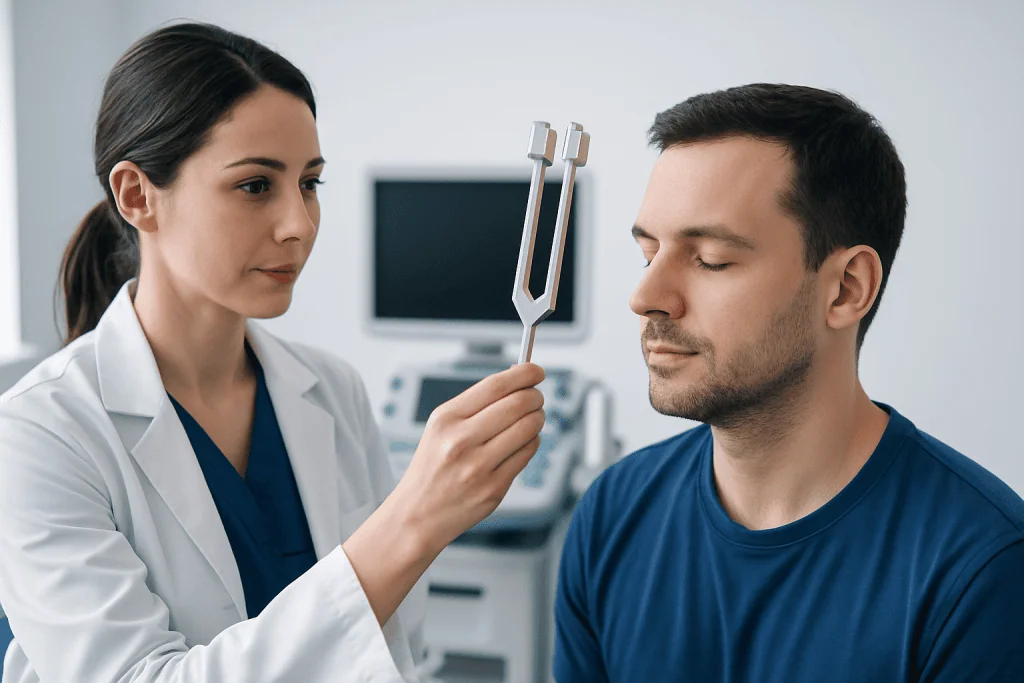
The principle behind the weber test is bone conduction. A vibrating tuning fork sends sound through the bones of the skull to both inner ears. In a person with normal, balanced hearing, the sound is usually heard in the center or equally in both ears. If hearing differs from one side to the other, the sound may seem louder in one ear. This is called lateralization.
Lateralization gives the clinician an important clue. In many cases of conductive hearing loss, sound is perceived as louder in the affected ear. In many cases of sensorineural hearing loss, sound is perceived as louder in the better-hearing ear. This may feel counterintuitive to patients, so the doctor usually explains the result in the context of the full ear examination.
The test itself is straightforward and painless. The tuning fork is struck gently to start vibration and then placed in the midline. The patient only needs to describe where the sound seems strongest. Because attention, background noise, and previous hearing differences can affect responses, the result is interpreted carefully rather than taken as a final answer.
What the results may mean

A normal weber test suggests that sound is heard equally in both ears or in the center of the head. This does not completely rule out hearing problems. Some people can still have symmetrical hearing loss in both ears, meaning both sides are reduced to a similar degree and the sound does not clearly shift to one side.
If the sound is louder in one ear, the meaning depends on the type of hearing loss. When sound lateralizes to the ear that seems blocked or full, this may suggest conductive hearing loss in that ear. Conductive causes can include earwax, fluid behind the eardrum, middle ear infection, or problems affecting sound transmission.
If the sound is louder in the opposite ear, this may point toward sensorineural hearing loss in the ear that hears less well. Sensorineural loss can involve the inner ear, the cochlea, or the auditory nerve. Conditions that may be considered include noise-related damage, age-related hearing loss, viral injury, or less commonly disorders such as acoustic neuroma.
Clinicians rarely interpret the weber test in isolation. They also consider symptoms, ear examination findings, and the results of the Rinne test. Formal hearing studies are often needed to confirm the pattern and guide treatment.
Common causes of abnormal Weber test findings
Many everyday ear conditions can change how the weber test sounds. Conductive hearing loss may happen when sound cannot travel efficiently through the outer or middle ear. This can occur with earwax buildup, middle ear fluid, eardrum problems, chronic ear disease, or swelling from infection. Temporary congestion after a cold may also affect hearing in some people.
Sensorineural hearing loss has different causes because it involves the inner ear or hearing nerve. These include age-related hearing changes, long-term noise exposure, certain viral infections, head trauma, medication-related ear toxicity, and some neurological or inner ear conditions. Sudden sensorineural hearing loss is a medical issue that needs prompt assessment because early treatment may be important.
Doctors also think about the broader symptom picture. One-sided ringing in the ear, persistent imbalance, a spinning sensation, or pressure in the ear may suggest additional vestibular or inner ear evaluation. In some patients, symptoms may overlap with vertigo or other balance-related disorders, which is why a focused ENT examination is important.
- Possible conductive causes: earwax, ear infection, middle ear fluid, eardrum injury
- Possible sensorineural causes: noise exposure, aging, inner ear disease, auditory nerve problems
- Other clues: tinnitus, dizziness, facial symptoms, or sudden onset may change how urgently tests are needed
How doctors use the Weber test with other hearing exams
The weber test works best as one part of a larger assessment. Doctors often combine it with the Rinne test, which compares air conduction and bone conduction in each ear. Together, these tuning fork tests can provide a useful bedside picture of whether hearing loss is likely conductive or sensorineural.
A full ear, nose, and throat examination is also important. The clinician may inspect the ear canal for wax or inflammation, look at the eardrum, ask about recent infections or trauma, and review any history of loud noise exposure. If symptoms include nasal blockage, sinus issues, or pressure changes, those details may also matter.
When a more complete assessment is needed, formal hearing evaluation is the next step. This may include pure tone audiometry, speech testing, tympanometry, and other specialized studies. In selected cases, imaging or further ENT assessment is arranged to look for structural causes. Patients with persistent or unexplained symptoms may benefit from ENT evaluation or a dedicated hearing loss assessment and treatment plan.
Benefits and limits of the Weber test
One reason the weber test remains widely used is that it is simple, fast, and does not require complex equipment. It can be performed in a clinic, emergency setting, or bedside examination. For patients, it is painless and usually takes only a few moments. It can be particularly helpful when symptoms are one-sided or when hearing changes developed recently.
At the same time, the test has clear limits. It depends on the patient’s perception and description of where the sound is heard. It is less reliable in very mild hearing differences, in young children who cannot describe the sound well, or in people with hearing loss affecting both ears equally. It also cannot identify the exact cause or severity of the problem.
Because of these limits, a normal or abnormal weber test should not be overinterpreted. It is best understood as a screening clue rather than a final diagnosis. If hearing loss is confirmed or symptoms continue, the next steps are guided by a doctor after formal testing and examination.
When to seek medical care
A person should seek medical advice if hearing changes last more than a short time, affect one ear more than the other, or are accompanied by ear pain, discharge, ringing, or dizziness. Even when symptoms seem mild, professional assessment can help identify treatable causes such as earwax, infection, or middle ear fluid.
Urgent medical care is especially important for sudden hearing loss, especially in one ear, hearing loss after head injury, severe vertigo, new facial weakness, or sudden loud ringing with reduced hearing. These symptoms can have several causes, and timely evaluation may affect treatment options.
For international patients who need coordinated assessment, Acibadem International’s multidisciplinary specialists and JCI-accredited hospitals diagnose and treat hearing and balance conditions with ENT, audiology, and imaging support when needed.
Frequently asked questions
Is the Weber test painful?
No. The weber test is noninvasive and usually painless. A vibrating tuning fork is simply placed on the middle of the head, and the patient reports where the sound seems louder.
Can the Weber test diagnose hearing loss by itself?
No. The weber test is a screening tool that gives clues about the type of hearing loss. Doctors usually combine it with the Rinne test, ear examination, and formal hearing tests before making a diagnosis.
What does it mean if the sound is louder in one ear?
This is called lateralization. It may suggest conductive hearing loss in that ear or sensorineural hearing loss in the opposite ear, depending on the rest of the examination and test findings.
What is the difference between the Weber test and the Rinne test?
The weber test compares how sound is heard between the two ears using bone conduction through the skull. The Rinne test compares air conduction and bone conduction in each ear separately, helping doctors sort out conductive versus sensorineural patterns.
Can earwax affect the Weber test?
Yes. Earwax buildup can cause conductive hearing loss, and this can change the result of the weber test. That is one reason doctors examine the ear canal as part of the assessment.
Should someone worry about a sudden change in hearing?
A sudden drop in hearing, especially in one ear, should be assessed promptly by a qualified doctor. While there are several possible causes, rapid evaluation is important because some conditions need timely treatment.
References
- American Academy of Otolaryngology–Head and Neck Surgery
- National Institute on Deafness and Other Communication Disorders
- Merck Manual Professional Edition
- MSD Manual Consumer Version
This article is for general information only and is not a substitute for professional medical advice. Please consult a qualified doctor about your individual situation.
Explore treatments in Turkey — costs, top hospitals & a free quote
JCI-accredited · board-certified surgeons · reply within 24h
Add us as a Preferred Source to see more of our trusted health content across Google Search, AI Overviews and Discover.