Eccentric Exercise: An Evidence-Based Guide for Patients

Eccentric exercise focuses on the lowering or lengthening phase of a movement. It may improve strength, function, and tendon capacity when prescribed correctly.
Key Takeaways
- Eccentric exercise focuses on the lowering or lengthening phase of a movement.
- It may improve strength, function, and tendon capacity when prescribed correctly.
- Mild muscle soreness after starting is common, but sharp or worsening pain is not expected.
- Progression should be gradual, especially for beginners, older adults, or anyone recovering from injury.
- A clinician or physical therapist can help tailor eccentric exercise to joint pain, tendon problems, or post-injury recovery.
Eccentric exercise is a type of strength training in which a muscle works while it lengthens, such as slowly lowering a weight or controlling the descent of a heel raise. Used appropriately, it can support strength, mobility, and tendon rehabilitation, but it should be introduced gradually to reduce soreness and avoid overloading an injury.
What eccentric exercise is and why it matters
Eccentric exercise is a form of muscle work in which the muscle produces force while it lengthens. In everyday terms, this is usually the “lowering” part of a movement. Examples include lowering into a chair, walking downhill, descending stairs, or slowly bringing a dumbbell back down after a curl. Although it may look simple, this phase places a distinct mechanical load on muscle and tendon tissue.
For many patients, the main question is whether eccentric exercise is useful. The answer is often yes: eccentric exercise can help improve strength, movement control, and tissue tolerance, especially when it is used as part of a structured plan. It is commonly included in rehabilitation for tendon-related pain and in general conditioning because it can challenge muscles effectively with controlled movement.
Eccentric loading is not automatically better than every other exercise style. In many situations, it works best alongside concentric work, isometric exercise, balance training, and flexibility or mobility work. The right mix depends on the person’s goals, symptoms, age, fitness level, and any underlying condition affecting the muscles, joints, or tendons.
How eccentric exercise works in the body
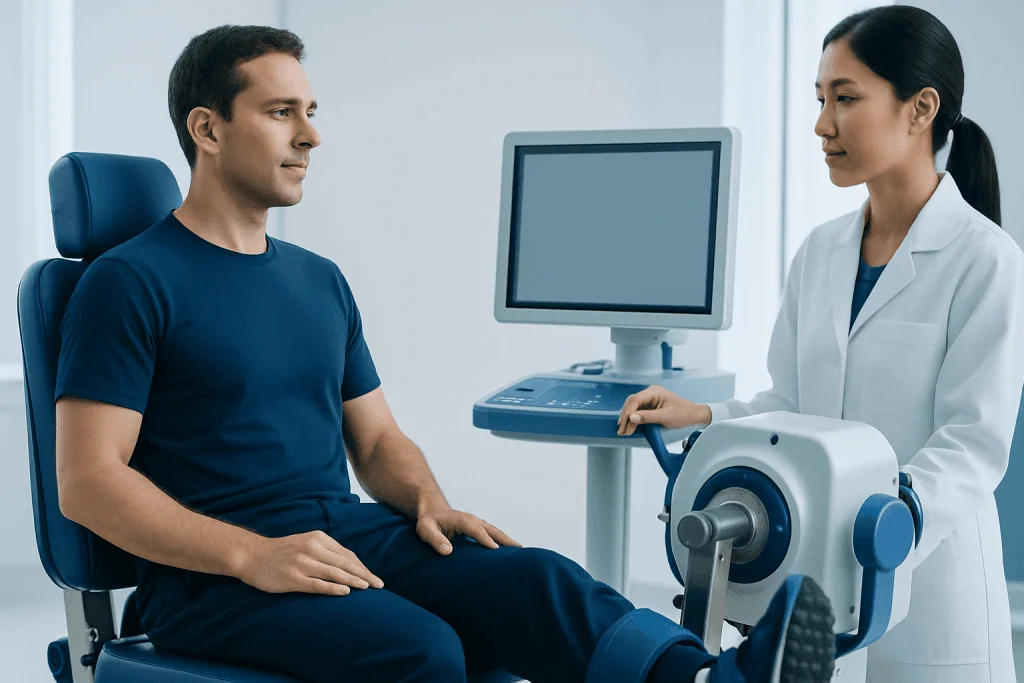
Muscles can work in three broad ways. In concentric contractions, a muscle shortens while producing force, such as lifting a weight. In isometric contractions, the muscle produces force without obvious movement, such as holding a plank. In eccentric contractions, the muscle lengthens while still resisting a load. This controlled lengthening helps the body absorb force and slow movement safely.
Eccentric exercise matters because many real-life activities depend on force absorption. The body uses eccentric control during landing, decelerating, lowering, and stabilizing. Training this capacity may improve how efficiently muscles and tendons handle load over time. This can support function in daily life, sports, and rehabilitation settings.
Patients are often told that eccentric work can feel harder or cause more soreness than other exercise. That can be true, especially in the first days or weeks, because the tissue is adapting to a new kind of load. However, a carefully graded program is meant to create adaptation without excessive pain or prolonged flare-ups. This is one reason technique, pacing, and recovery are important.
- Common examples: slow squats to a chair, controlled step-downs, heel-lowering exercises, and slow lowering of weights
- Typical goals: improve strength, build tolerance to load, support tendon recovery, and improve movement control
- Key principle: start with manageable resistance and progress gradually
Potential benefits and who may benefit most

Eccentric exercise is widely used in musculoskeletal care because it may help increase strength and improve function. It can be useful for healthy adults who want to build control and resilience, for older adults working on daily mobility, and for patients recovering from overuse problems or selected injuries. The movement pattern often mirrors everyday tasks like sitting down, stepping down, or lowering objects.
It is also commonly discussed in tendon rehabilitation. Structured eccentric loading has been used for tendon pain involving the Achilles tendon, patellar tendon, rotator cuff, and elbow tendons, although not every person needs a purely eccentric approach. In modern rehabilitation, clinicians often combine eccentric and heavy slow resistance strategies depending on symptoms and goals. Patients with persistent tendon pain may also benefit from evaluation for related conditions such as tendonitis.
Another benefit is neuromuscular control. Because eccentric movements require the body to slow down and stabilize, they may help improve coordination and joint control. This can be relevant after periods of inactivity, after some orthopedic injuries, or as part of a broader rehabilitation plan that may also include physical therapy and rehabilitation.
Common symptoms, responses, and possible risks
The most common short-term response to starting eccentric exercise is delayed-onset muscle soreness, often called DOMS. This usually develops within a day or two after an unfamiliar workout and improves gradually. Mild stiffness, muscle tenderness, and temporary fatigue can be normal, especially if the movement is new or the load progressed too quickly.
Not all pain is expected or helpful. Sharp pain, swelling, marked weakness, joint instability, or pain that continues to worsen should not be ignored. In patients exercising for tendon pain, some discomfort during or after the program may be acceptable if it remains mild and settles predictably, but severe pain or a major next-day flare may suggest the exercise is too advanced or not well matched to the problem.
Certain people should be more cautious. This includes individuals with recent surgery, acute muscle tears, suspected fractures, severe arthritis flare-ups, balance problems, uncontrolled medical conditions, or significant nerve symptoms. If there is uncertainty about the cause of pain, a professional assessment is safer than self-prescribing a demanding program. People with ongoing muscle pain or persistent joint symptoms may need a more individualized plan.
How eccentric exercise is used in rehabilitation and training
In rehabilitation, eccentric exercise is usually chosen for a specific reason rather than added at random. A clinician may use it to gradually increase a tendon’s tolerance to load, improve strength in a weakened muscle group, or retrain controlled movement after pain or injury. For example, a heel-drop program may be used for Achilles tendon symptoms, while slow step-downs may help with knee control and functional strength.
Programs are usually individualized. Variables such as body weight, range of motion, tempo, surface, and external resistance can all change how demanding an exercise feels. Some patients begin with supported movements and only later add weights or a larger range of motion. Others may need to start with isometric or gentle concentric work first and progress to eccentric loading as symptoms settle.
Supervised care can be especially useful when pain has lasted for weeks, when there has been a recent injury, or when a person is unsure how to progress. In some cases, the broader treatment plan may involve orthopedic rehabilitation or evaluation by specialists if tendon, joint, or spinal issues are contributing to symptoms. The aim is not only to reduce pain but also to restore function safely.
How to start safely at home
For many people, eccentric exercise can be started safely at home if symptoms are mild and the exercise is simple. The safest approach is to choose one or two movements that match daily function, use slow and controlled lowering, and begin with a low volume. A common starting point is a few repetitions for one or two sets, performed every other day or according to advice from a clinician.
Progress should be gradual. Patients should increase only one factor at a time, such as repetitions, range of motion, or resistance. Technique matters more than speed. Moving too quickly can reduce control and shift stress away from the intended muscles. A brief warm-up, supportive footwear when appropriate, and attention to recovery can make the program more tolerable.
Simple examples may include sitting down slowly into a chair, lowering from tiptoes in a controlled heel raise, or slowly lowering a light weight. However, exercises that stress an already painful tendon or joint are not one-size-fits-all. If there is persistent pain, recurring injury, or concern about form, assessment through sports injuries care or rehabilitation services may help identify a safer starting point.
- Use slow, controlled lowering rather than dropping into the movement
- Expect mild soreness when starting, but not severe or escalating pain
- Allow rest and recovery between sessions, especially early on
- Stop and seek advice if the exercise causes instability, swelling, or sharp pain
When to seek medical care
Medical advice is appropriate if pain begins suddenly during exercise with a popping sensation, bruising, marked weakness, or inability to bear weight. These features may suggest a more significant muscle, tendon, or joint injury that should not be managed with continued loading at home. It is also sensible to seek care for pain associated with numbness, tingling, fever, chest symptoms, or unexplained swelling.
Patients should also consider evaluation if symptoms have not improved after a few weeks of activity modification and well-structured exercise, or if pain repeatedly returns when they try to progress. A clinician can help determine whether the issue is truly tendon-related, whether imaging is needed, or whether another condition is contributing. Some people may need assessment by orthopedics, sports medicine, or rehabilitation specialists.
Near the end of the care pathway, coordinated support can still matter. Acibadem International’s multidisciplinary specialists and JCI-accredited hospitals evaluate and treat musculoskeletal conditions for international patients, including cases that may benefit from rehabilitation, imaging, and specialist orthopedic review.
Frequently asked questions
What is an example of eccentric exercise?
A simple example is slowly lowering the body during a squat into a chair. Another is rising onto the toes with both feet and then slowly lowering the heels in a controlled way. In each case, the muscle is working while it lengthens.
Is eccentric exercise good for tendon pain?
It can be helpful for some types of tendon pain when it is prescribed appropriately and progressed gradually. Many rehabilitation plans use eccentric loading or combine it with other strengthening methods. The best choice depends on the tendon involved, symptom severity, and overall function.
Why does eccentric exercise cause more soreness?
Eccentric loading can place a strong mechanical demand on muscle tissue, especially if the movement is new or the load increases too quickly. This may lead to delayed-onset muscle soreness for a day or two. Mild soreness is common, but severe pain or worsening symptoms should be assessed.
Can beginners do eccentric exercise?
Yes, beginners can often do eccentric exercise safely if they start with simple movements and low volume. The key is controlled technique, gradual progression, and enough recovery time. Anyone with pain, recent injury, or balance concerns should consider professional guidance first.
How often should eccentric exercise be done?
There is no single schedule that suits everyone. Frequency depends on the exercise, the tissue involved, symptom level, and how well the person recovers between sessions. A clinician or physical therapist can help set a safe plan and adjust it based on response.
Who should avoid eccentric exercise until they are assessed?
People with sudden severe pain, suspected tendon rupture, acute muscle tear, significant swelling, inability to bear weight, or recent surgery should not start a demanding eccentric program on their own. The same is true for those with unexplained neurologic symptoms or severe joint instability. Medical assessment can clarify what type of exercise is safe.
References
- American College of Sports Medicine
- National Institute for Health and Care Excellence
- American Academy of Orthopaedic Surgeons
- National Health Service
- World Health Organization
This article is for general information only and is not a substitute for professional medical advice. Please consult a qualified doctor about your individual situation.
Joint and spine care in Turkey — expert assessment & treatment
JCI-accredited · board-certified surgeons · reply within 24h
Add us as a Preferred Source to see more of our trusted health content across Google Search, AI Overviews and Discover.