Penile Traction Devices: An Evidence-Based Guide for Patients

Penile traction devices are not suitable for everyone and work best when recommended for a specific medical reason. The strongest evidence is for selected men with Peyronie’s disease and for length preservation in some treatment settings.
Key Takeaways
- Penile traction devices are not suitable for everyone and work best when recommended for a specific medical reason.
- The strongest evidence is for selected men with Peyronie’s disease and for length preservation in some treatment settings.
- Results, if they occur, usually develop gradually over weeks to months of regular use.
- Proper fit, careful instructions, and follow-up are important to reduce pain, skin injury, or worsening symptoms.
- A urologist should assess penile pain, new curvature, erectile changes, or concerns about safe use before starting therapy.
Penile traction devices are external medical devices that apply gentle, sustained stretching to penile tissue. For some patients, they may support treatment of penile curvature, help preserve length after certain procedures, or address selected length concerns when used consistently and under a doctor’s guidance.
Overview: What penile traction devices are and who they may help
Penile traction devices are wearable devices designed to place gentle, controlled tension on the penis over time. In carefully selected patients, this approach may help remodel tissue, improve or stabilize curvature, and in some cases preserve or modestly increase stretched penile length. They are most often discussed in relation to Peyronie’s disease, post-treatment rehabilitation, and selected concerns about penile shortening.
These devices are not a quick fix and they do not work equally well for every condition. Their benefits depend on the underlying diagnosis, the type of device used, how consistently it is worn, and whether the patient has realistic goals. A specialist evaluation is important because what seems like a length issue may actually reflect curvature, scarring, erectile dysfunction, body image concerns, or other medical conditions.
Penile traction therapy is usually considered a conservative, non-surgical option. For some men, it may be used alone; for others, it may be combined with medication, injections, or surgery as part of a broader treatment plan. When traction is used, the goal is generally gradual tissue adaptation rather than forceful stretching.
How penile traction devices work
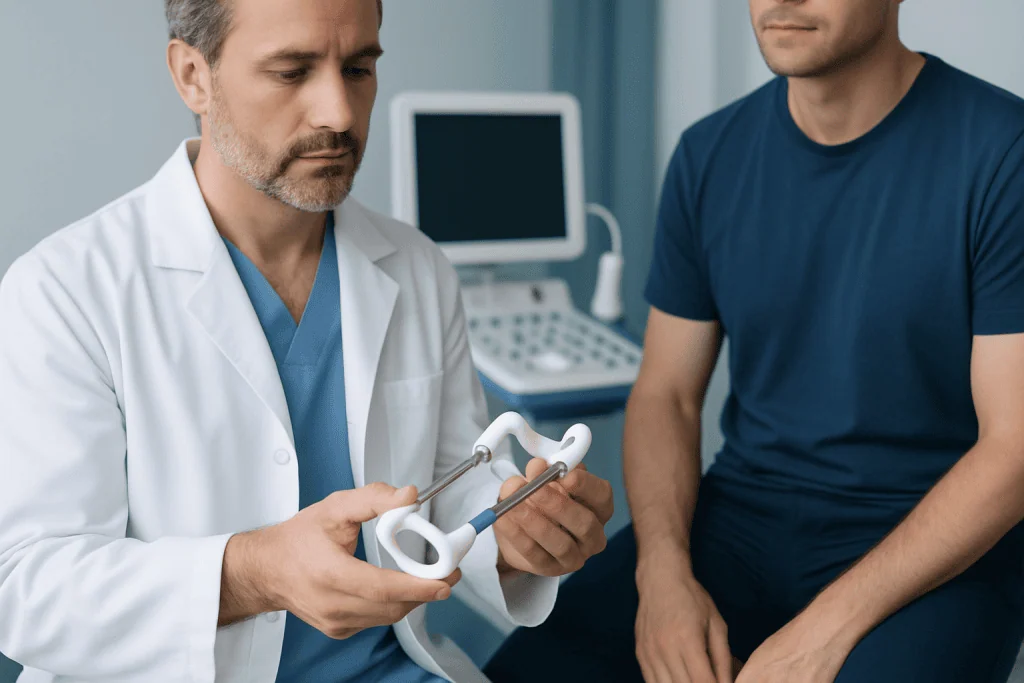
The basic principle behind penile traction devices is mechanical stretching. A frame or support system creates steady tension between the base of the penis and the glans. Over time, this controlled tension may encourage tissue remodeling. In conditions involving scar tissue, such as Peyronie’s disease, traction may help improve flexibility and reduce deformity in some patients.
Different devices use different designs, including rod-based systems and more flexible tension systems. Comfort and proper fit matter because too much pressure can cause pain, numbness, bruising, or skin irritation. The safest devices are those used exactly as instructed, with gradual adjustment rather than aggressive tension.
Doctors usually explain that traction does not produce immediate visible changes. If a benefit occurs, it is often gradual and may require regular wear over many weeks or months. Because evidence varies by condition, the expected outcome should be discussed clearly before treatment begins.
When doctors may recommend them

The best-established medical use of penile traction devices is in selected men with Peyronie’s disease, a condition that can cause penile curvature, shortening, indentation, and sometimes pain. In this setting, traction may be recommended during the stable phase or as part of a treatment plan tailored by a urologist. It may help reduce curvature in some patients and may also help preserve or improve length.
Traction may also be used in rehabilitation after certain penile procedures or alongside other treatments. For example, a doctor may discuss it after surgery or in combination with office-based therapies when there is concern about shortening or tissue contracture. In some practices, traction is considered as an adjunct to penile curvature treatment or to support recovery after selected reconstructive approaches.
Some men ask about these devices for cosmetic penile lengthening. While some studies suggest modest gains in stretched length with regular use, outcomes are variable and usually limited. A medical review is still important because expectations, anatomy, erectile function, and psychological well-being all influence whether traction is a reasonable option.
In men with erectile problems, traction is not a substitute for a proper diagnosis. If erection quality is part of the concern, a specialist may assess for vascular, hormonal, neurological, or structural causes and discuss treatments for erectile dysfunction when appropriate.
Potential benefits, limits, and what the evidence shows
Current evidence suggests that penile traction devices may offer meaningful benefit for some patients, especially those with Peyronie’s disease. Reported improvements may include reduced curvature, better preservation of length, and improved patient satisfaction in selected groups. However, study methods differ, device designs vary, and treatment schedules are not identical, so results are not perfectly predictable.
For men using traction mainly for length concerns, the likely changes are usually modest rather than dramatic. It is important to distinguish medical benefit from marketing claims. Well-informed care focuses on realistic expectations, symptom relief, function, and safety rather than promises of major enlargement.
Doctors also consider the practical limits of therapy. Success often depends on wearing the device regularly for the prescribed amount of time. Some men find this difficult because of discomfort, inconvenience, work schedules, or frustration with slow progress. If a patient cannot use the device consistently, the chance of benefit may be lower.
In some situations, a urologist may advise that another treatment is more appropriate. Depending on the diagnosis, this could include observation, medication, injections, surgery, or evaluation for related concerns such as low testosterone or urinary symptoms. A broader review may lead to care through services such as urology rather than traction alone.
Risks, side effects, and who should be cautious
When used incorrectly, penile traction devices can cause discomfort and injury. Common problems include skin irritation, redness, pressure marks, bruising, glans numbness, and pain. These issues may happen if the device is too tight, worn too long, or adjusted too quickly. Symptoms usually improve when use is stopped and the device is reviewed by a clinician, but persistent symptoms need medical assessment.
Patients should be cautious if they have active penile pain, open skin lesions, recent trauma, impaired sensation, bleeding disorders, or conditions that affect wound healing. Men taking blood thinners or those with severe curvature, severe erectile dysfunction, or uncertain diagnosis should not start traction without specialist advice. A device should never be used forcefully or despite significant pain.
Another important concern is delayed diagnosis. A new bend in the penis, shortening, pain with erection, or palpable plaque may suggest Peyronie’s disease or another condition that deserves medical attention. Using a traction device without knowing the cause may be ineffective or may complicate care if the treatment is not appropriate for that stage of disease.
How evaluation and treatment planning are done
Before recommending penile traction devices, a urologist usually starts with a detailed history and physical examination. Questions often cover when symptoms began, whether there is pain, how the erection has changed, whether intercourse is affected, and whether there has been trauma or prior surgery. Photographs of the erect penis, taken according to medical instructions, may help document curvature.
In some cases, imaging or additional testing is useful. Ultrasound can help assess plaque, calcification, blood flow, or other structural changes. If erectile dysfunction is also present, the evaluation may include risk factors such as diabetes, cardiovascular disease, smoking, or hormone-related issues.
The treatment plan depends on the diagnosis, symptom severity, and patient goals. Some men benefit from watchful waiting and reassurance; others may need combined therapy. If conservative treatment is appropriate, the doctor explains the device type, the wearing schedule, warning signs, and follow-up intervals. In more complex cases, a men’s health or reconstructive specialist may discuss options including medication or Peyronie’s disease treatment beyond traction alone.
Safe use, self-care, and when to seek medical care
Safe use begins with a professional recommendation, careful fitting, and clear instructions. Patients should start gradually, inspect the skin regularly, and stop if they develop significant pain, numbness, color change, swelling, or injury. It is also important to avoid combining traction with unapproved enlargement methods or excessive tension.
General self-care supports overall sexual and urologic health. Managing chronic conditions such as diabetes or high blood pressure, avoiding tobacco, exercising regularly, and addressing stress can all help sexual function and treatment outcomes. If erections are painful or difficult, the issue should be assessed rather than self-treated.
Medical care should be sought if there is a new or worsening penile curve, a lump or plaque, persistent penile pain, difficulty with erections, shortening after surgery, bleeding, or skin breakdown from device use. Prompt review is also important if the device seems to worsen symptoms or if there is uncertainty about whether traction is appropriate.
Near the end of the evaluation pathway, some patients may benefit from coordinated specialist care. Acibadem International’s multidisciplinary specialists in JCI-accredited hospitals diagnose and treat penile curvature and related men’s health concerns for international patients when further assessment or treatment is needed.
Frequently asked questions
Do penile traction devices really work?
They may help some patients, but results depend on the reason for use. The best evidence is in selected men with Peyronie’s disease or in situations where preserving length is part of a treatment plan. Benefits are usually gradual and modest rather than dramatic.
Are penile traction devices safe?
They can be safe when prescribed appropriately and used exactly as instructed. Problems such as pain, skin irritation, bruising, or numbness can happen if the device is poorly fitted or used too aggressively. A doctor should review any persistent discomfort or visible injury.
Can these devices treat Peyronie’s disease?
For some men, traction can be part of treatment for Peyronie’s disease. It may help with curvature or length preservation, especially when used consistently in a doctor-guided plan. However, it is not the right option for every stage or severity of the condition.
How long does it take to see results?
If results occur, they usually appear over weeks to months rather than days. Consistency is important, and the exact timeline depends on the device, the diagnosis, and the treatment plan. A specialist can explain what is realistically possible in an individual case.
Can I buy a penile traction device and start using it on my own?
Self-starting is not ideal because the underlying problem may need diagnosis first. New curvature, pain, shortening, or erectile changes can be signs of a condition that needs medical evaluation. A urologist can also help choose an appropriate device and teach safe use.
Will a penile traction device improve erections?
Not necessarily. Traction targets tissue shape or length-related concerns and does not directly treat all causes of erectile dysfunction. If erection quality is a concern, a separate evaluation is important because blood flow, nerve function, hormones, and general health may all play a role.
References
- American Urological Association
- European Association of Urology
- National Institute of Diabetes and Digestive and Kidney Diseases
- Urology Care Foundation
This article is for general information only and is not a substitute for professional medical advice. Please consult a qualified doctor about your individual situation.
Explore treatments in Turkey — costs, top hospitals & a free quote
JCI-accredited · board-certified surgeons · reply within 24h
Add us as a Preferred Source to see more of our trusted health content across Google Search, AI Overviews and Discover.