Impacted Tooth: A Complete Medical Overview

An impacted tooth remains partly or completely trapped beneath the gum or jawbone instead of erupting into its expected position. Wisdom teeth and upper canine teeth are among the teeth most often affected by impaction.
Key Takeaways
- An impacted tooth remains partly or completely trapped beneath the gum or jawbone instead of erupting into its expected position.
- Wisdom teeth and upper canine teeth are among the teeth most often affected by impaction.
- A dental examination and X-rays show the tooth's position and help guide monitoring or treatment.
- Not every impacted tooth needs removal, but painful, infected or damaging teeth commonly require treatment.
- Prompt dental assessment is important for swelling, fever, difficulty swallowing, severe pain or trouble opening the mouth.
An impacted tooth is a tooth that is blocked from erupting normally into the mouth, often because there is not enough space or another tooth is in the way. It may cause no symptoms, but dental monitoring or treatment can help prevent pain, infection, tooth damage and other complications.
Overview: What Is an Impacted Tooth?
An impacted tooth is a tooth that does not erupt fully into the mouth within its usual time frame because its path is blocked. The tooth may remain completely under the gum and bone, or it may partly emerge through the gum. This is a common dental finding, particularly in late adolescence and adulthood, and it does not always cause immediate discomfort.
Teeth need adequate space and a clear path to move into their normal position. When the jaw is too small, a neighboring tooth blocks the route, or the tooth develops at an unusual angle, eruption may stop. Dentists often identify an impacted tooth during a routine examination or on an X-ray before symptoms develop.
Third molars, commonly called wisdom teeth, are most frequently impacted because they are the last adult teeth to develop and erupt. Upper canine teeth can also become impacted. Canines play an important role in bite alignment and appearance, so their position is assessed carefully, particularly in children and teenagers.
How an Impacted Tooth May Feel and Look
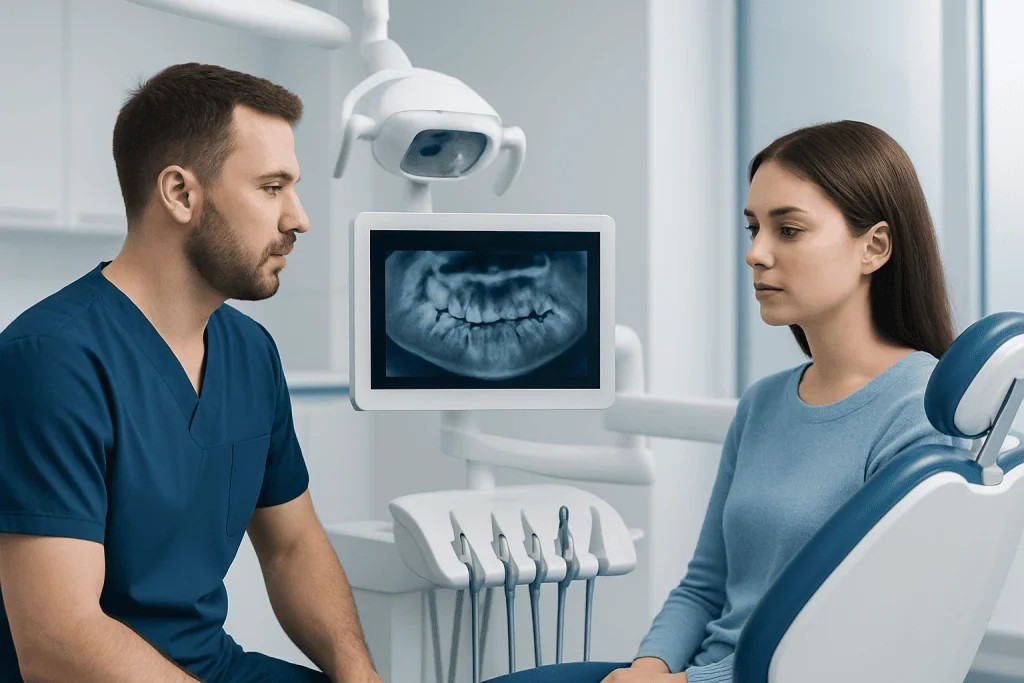
Some impacted teeth cause no noticeable symptoms. A fully buried tooth may be discovered only when dental imaging is taken for another reason. For this reason, regular dental visits are useful even when the mouth feels healthy.
When a tooth partly erupts, a flap of gum may cover part of its crown. Food and bacteria can collect beneath this tissue, leading to inflammation around the tooth. Possible symptoms include tenderness at the back of the jaw, swollen or reddened gums, bad breath, an unpleasant taste, jaw stiffness, or discomfort when chewing.
An impacted tooth may also contribute to crowding, pressure on adjacent teeth, or a visible gap where a tooth would normally be expected. In some cases, a cyst can form around an unerupted tooth or a nearby tooth can develop decay or gum disease because cleaning the area is difficult. These problems are not inevitable, but they are reasons for timely professional assessment.
- Intermittent gum pain or swelling near a partially erupted tooth
- Food trapping or difficulty cleaning at the back of the mouth
- Repeated inflammation or infection around the gum tissue
- Pressure, crowding, or changes in the position of nearby teeth
Why Teeth Become Impacted
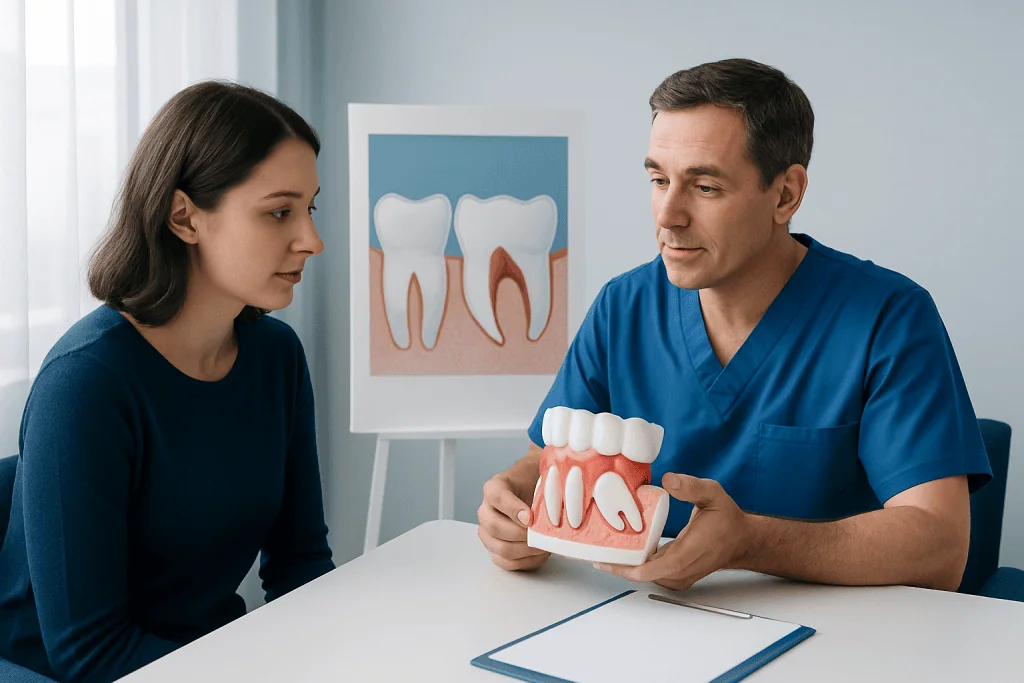
Tooth impaction usually results from a combination of anatomy, tooth development and available jaw space. Wisdom teeth are especially likely to be affected when there is not enough room behind the second molars for them to emerge upright. They may angle forward, backward, sideways, or remain positioned deep in the jawbone.
Genetics can influence jaw size, tooth size and the timing of tooth development, which may help explain why impacted teeth can occur in families. Early or late loss of baby teeth, crowded teeth, abnormal tooth position, and certain developmental differences can also alter the path of an adult tooth.
For impacted canine teeth, the cause may involve crowding, a baby tooth that remains in place too long, or an adult canine that has developed away from its normal eruption route. A dentist may monitor how permanent teeth are developing in childhood so that early treatment, such as removing a retained baby tooth or creating space orthodontically, can sometimes support normal eruption.
Dental Assessment and Diagnosis
A dentist diagnoses an impacted tooth by combining an oral examination with dental imaging. During the examination, the dentist checks for missing or partially erupted teeth, gum inflammation, signs of crowding, and the condition of neighboring teeth. The person’s symptoms and history of recurrent swelling or discomfort are also important.
Dental X-rays show whether a tooth is present, its angle and depth, the shape of its roots, and its relationship to nearby teeth, bone, nerves and sinus spaces. A panoramic X-ray is frequently used to view the jaws and teeth together. In selected situations, three-dimensional imaging may be used when more detailed information is needed for treatment planning.
Assessment is individualized. The dentist or oral and maxillofacial surgeon considers whether the tooth is likely to erupt, whether it can be kept healthy, whether it is harming nearby structures, and whether treatment risks outweigh the benefits. This approach helps avoid unnecessary procedures while identifying problems that need care.
Treatment Options for an Impacted Tooth
Treatment depends on the type of tooth, its position, symptoms, age, oral health and the effects on surrounding structures. If an impacted tooth is fully buried, symptom-free and not causing damage, a dentist may recommend periodic clinical and X-ray monitoring. Monitoring allows changes to be identified early without immediate surgery.
Partially erupted wisdom teeth that repeatedly become inflamed, develop decay, damage adjacent teeth, or cannot be cleaned adequately may need extraction. Removal is typically performed by a dentist with surgical experience or an oral and maxillofacial surgeon. Local anesthesia is commonly used, and sedation options may be discussed when appropriate for the individual and procedure.
For an impacted canine or another tooth that is valuable for bite function, the aim may be to guide it into position rather than remove it. This can involve orthodontic treatment to create space, a minor surgical procedure to expose the tooth, and an orthodontic attachment that gradually moves it into the dental arch. If the tooth cannot be moved safely or is significantly affected, removal and a plan to restore the space may be considered.
After a procedure, the dental team provides instructions on pain control, eating, oral hygiene and follow-up. Healing experiences vary, but worsening pain after initial improvement, persistent bleeding, fever or increasing swelling should be reported promptly. Acibadem International’s multidisciplinary dental and oral surgery specialists in JCI-accredited hospitals can assess and treat impacted teeth for international patients when specialist care is needed.
Prevention and Everyday Self-care
It is not always possible to prevent tooth impaction because jaw shape and tooth development are largely determined by biology. However, routine dental checkups help detect erupting problems before they lead to pain, infection or damage to nearby teeth. Dental visits during childhood and adolescence are particularly useful for observing the development of permanent teeth.
Good daily oral hygiene protects the teeth and gums around a partially erupted tooth. Brushing twice daily with fluoride toothpaste, cleaning between teeth as advised by a dental professional, and attending regular professional cleanings can reduce the buildup of plaque. A small-headed toothbrush or interdental cleaning aid may help reach difficult areas, but it should be used gently to avoid injuring the gum.
Self-care can ease minor temporary discomfort but does not correct an impacted tooth. Warm salt-water rinses may soothe irritated gums, and a dentist or pharmacist can advise on appropriate over-the-counter pain relief for an individual. People should avoid placing aspirin or other medications directly on the gum, as this can irritate or burn oral tissues.
When to Seek Medical Care
A dental appointment should be arranged if there is ongoing pain, swelling, recurrent gum inflammation, a bad taste, difficulty cleaning a partially erupted tooth, or concern that a permanent tooth has not appeared as expected. Early evaluation can clarify whether observation, orthodontic treatment or extraction is the most suitable option.
Urgent dental or medical care is important for facial swelling that is spreading, fever, pus, severe pain, difficulty opening the mouth, trouble swallowing, or breathing difficulty. These symptoms can indicate a significant infection and should not be managed with home remedies alone. Anyone with breathing difficulty should seek emergency care immediately.
People who are pregnant, have diabetes, take medicines that affect immunity or bone health, or have a condition that increases infection risk should inform their dental team. This information helps the clinician plan imaging, anesthesia, medicines and follow-up safely.
Frequently asked questions
Can an impacted tooth come in on its own?
Sometimes a tooth that appears delayed may still erupt, especially if it has enough space and is positioned favorably. However, a truly impacted tooth is blocked or misdirected and may not emerge normally without treatment. Dental X-rays help the dentist judge the likelihood of eruption.
Does every impacted wisdom tooth need to be removed?
No. A symptom-free wisdom tooth that is healthy, fully covered by bone or gum, and not affecting nearby teeth may be monitored. Extraction is more often advised when there is repeated infection, pain, decay, gum disease, cyst formation or damage to another tooth.
How is an impacted canine tooth treated?
An impacted canine may be treated with orthodontics and a procedure to expose the tooth, allowing it to be gently guided into its proper position over time. The best approach depends on the tooth's location, root development, space in the dental arch and the person's overall oral health.
Can an impacted tooth cause headaches or ear pain?
Jaw and tooth pain can sometimes be felt in nearby areas, including the ear, temple or head, particularly with an inflamed lower wisdom tooth. However, headaches and ear pain have many possible causes. A dentist or doctor can help determine whether an impacted tooth is involved.
What happens if an impacted tooth is left untreated?
Some impacted teeth remain stable and never cause problems, which is why monitoring can be appropriate in selected cases. Others may lead to inflammation, infection, cavities, gum disease, cysts or harm to adjacent teeth. Regular review helps identify whether the situation is changing.
Is impacted tooth removal painful?
Anesthesia is used so the procedure itself should not be painful. Soreness, swelling and limited jaw opening can occur during recovery, particularly after wisdom tooth surgery, but these symptoms are usually managed with the aftercare plan provided by the dental team. People should contact their clinician if pain or swelling becomes worse rather than gradually improving.
References
- American Dental Association
- American Association of Oral and Maxillofacial Surgeons
- National Institute of Dental and Craniofacial Research
- NHS
- Mayo Clinic
This article is for general information only and is not a substitute for professional medical advice. Please consult a qualified doctor about your individual situation.
Impacted Tooth in Turkey — costs, top hospitals & a free quote
JCI-accredited · board-certified surgeons · reply within 24h
Add us as a Preferred Source to see more of our trusted health content across Google Search, AI Overviews and Discover.

More from the Health Library


Related Specialists

Dr. Habibe Aslan
Inpatient Clinic Physicians
Dr. Mutlu Duran
Otorhinolaryngology
Dr. Mustafa Mert Okumuş (m)
Aesthetic Plastic & Reconstructive Surgery
Dr. Fatma Seçil Kırdök
Gastroenterology