Tongue Cancer Images: Symptoms, Causes, and Treatment Options

Tongue cancer may appear as a sore, patch, lump, thickened area, or bleeding area that does not heal. Images are useful for awareness but cannot distinguish cancer from infections, trauma, ulcers, or other mouth conditions.
Key Takeaways
- Tongue cancer may appear as a sore, patch, lump, thickened area, or bleeding area that does not heal.
- Images are useful for awareness but cannot distinguish cancer from infections, trauma, ulcers, or other mouth conditions.
- Persistent tongue changes lasting more than two weeks should be assessed by a dentist, doctor, or ENT specialist.
- A biopsy is the main test used to confirm or rule out tongue cancer.
- Treatment may involve surgery, radiation therapy, chemotherapy, targeted therapy, or immunotherapy, depending on the cancer stage and location.
Tongue cancer images can help people recognize changes that may need medical attention, such as a persistent ulcer, a red or white patch, swelling, or an unexplained lump. However, photographs cannot diagnose cancer because many harmless and treatable conditions can look similar; a clinician’s examination and biopsy are needed for confirmation.
What tongue cancer images can and cannot show
People often search for tongue cancer images after noticing a new mark, sore, or change in their mouth. In photographs, tongue cancer may look like an ulcer that does not heal, a raised or firm lump, a rough thickened area, or an unusual red, white, or mixed red-and-white patch. Some changes occur on the visible upper surface of the tongue, while others develop along the side or underneath the tongue and can be harder to see.
Images can support awareness, but they cannot provide a diagnosis. A traumatic ulcer from biting the tongue, irritation from a sharp tooth, fungal infection, geographic tongue, inflammatory conditions, and non-cancerous growths can all produce similar-looking changes. Lighting, image quality, and natural differences in tongue appearance also make online comparisons unreliable.
The most useful question is not whether a change looks exactly like an online image, but whether it is new, persistent, enlarging, painful, bleeding, firm, or associated with swallowing or speech changes. Any suspicious area requires an in-person assessment, and a biopsy is required to confirm whether cancer cells are present.
Where tongue cancer develops and what it may look like
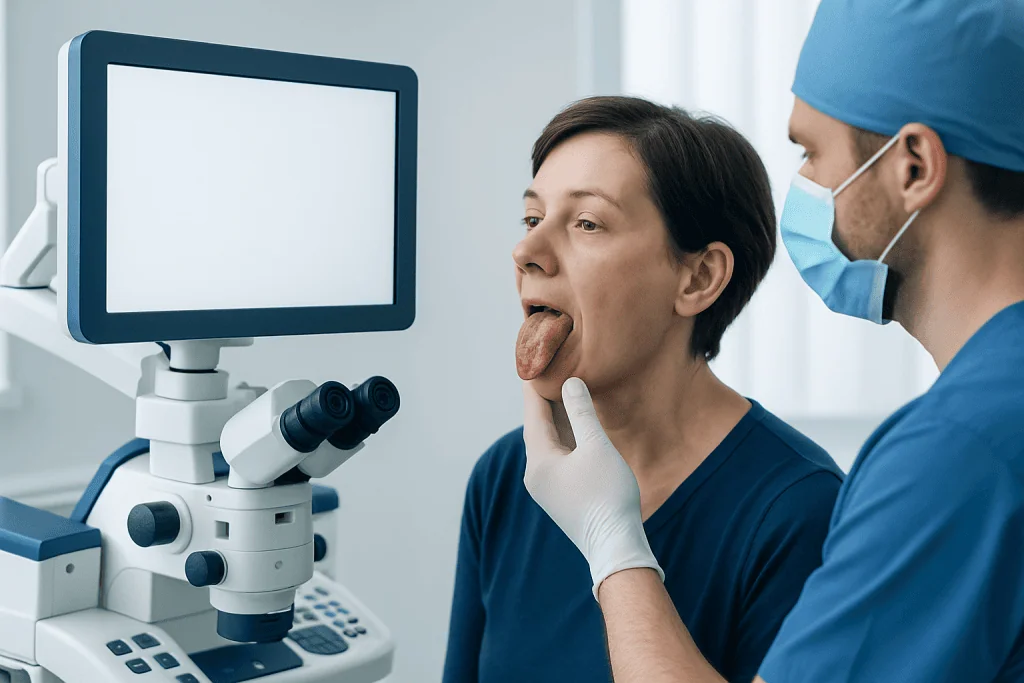
Tongue cancer is part of the broader group of head and neck cancers. Most cases are squamous cell carcinomas, meaning they begin in the thin, flat cells that line the mouth and throat. Cancers in the front two-thirds of the tongue are commonly described as oral tongue cancers. Cancers beginning at the back one-third, known as the base of the tongue, are generally grouped with oropharyngeal cancers.
On the oral tongue, a concerning area may appear as a persistent crater-like sore, a red patch, a white patch, an irregular red-and-white area, or a small growth. It may have a hard base, uneven edges, or a surface that bleeds easily when touched. It is important to note that early tongue cancer may be painless and subtle, so the absence of severe discomfort does not rule it out.
Changes at the base of the tongue are usually not visible in a mirror. They may instead cause a feeling that something is stuck in the throat, discomfort when swallowing, a persistent sore throat, altered voice, ear pain on one side, or a lump in the neck. These symptoms also have many non-cancerous causes, but they should be evaluated if they do not resolve.
- A non-healing sore or ulcer
- A red, white, or red-and-white patch
- A lump, thickened area, or unexplained swelling
- Bleeding without a clear injury
- A change in tongue movement or speech
Symptoms beyond visible tongue changes

Symptoms vary according to the tumor’s size and location. A person may notice pain on the tongue, tenderness, numbness, or a burning sensation. Some experience discomfort when chewing, swallowing, or moving the tongue. Teeth that feel loose without an obvious dental reason, unexplained weight loss, or difficulty wearing dentures can also be relevant signs in some cases.
A neck lump can occur when cancer cells have reached nearby lymph nodes. It is often painless, and it may be the first symptom of a cancer located deeper at the base of the tongue or in the throat. A clinician should examine a neck lump that persists, grows, or occurs together with mouth or throat symptoms.
Many common mouth problems improve within days or after the source of irritation is removed. In contrast, a change that lasts longer than two weeks, recurs in the same location, or becomes more pronounced merits professional evaluation. Early assessment does not mean cancer is likely; it is a practical way to identify the cause and arrange treatment if needed.
Causes and factors that can raise risk
Tongue cancer does not have one single cause. Tobacco exposure is a major risk factor, including cigarettes, cigars, pipes, smokeless tobacco, and other tobacco products. Heavy alcohol use can also increase risk, and the combination of tobacco and alcohol raises risk more than either exposure alone.
Human papillomavirus (HPV), particularly certain high-risk types, is an important cause of many cancers involving the base of the tongue and tonsil area. HPV-related oropharyngeal cancers may occur in people with no history of tobacco use. HPV vaccination helps prevent infections from HPV types associated with several cancers and may be discussed with a qualified healthcare professional according to local recommendations.
Other factors that may contribute include increasing age, a previous head and neck cancer, a weakened immune system, and long-term exposure to sunlight for cancers affecting the lip. Poor oral health alone is not considered a direct cause, but regular dental care can help identify persistent mouth changes early. A sharp tooth or poorly fitting denture may irritate tissue, but persistent lesions should never be assumed to be caused only by irritation.
How tongue cancer is diagnosed and staged
Diagnosis begins with a detailed history and examination of the mouth, tongue, throat, and neck. A dentist, oral and maxillofacial specialist, ear, nose and throat specialist, or head and neck surgeon may assess the area. For a suspected base-of-tongue lesion, a flexible camera passed gently through the nose may be used to view the throat more closely.
If an area appears suspicious, the clinician will arrange a biopsy. During a biopsy, a small tissue sample is removed and examined by a pathologist under a microscope. This is the only reliable method for diagnosing tongue cancer. Depending on the location, the biopsy may be performed using local anesthesia in a clinic or during a short procedure.
If cancer is confirmed, imaging tests such as CT, MRI, PET-CT, or ultrasound may help determine the tumor’s size, depth, and whether lymph nodes or other areas are involved. This process is called staging. HPV testing may be performed for cancers of the base of the tongue or throat because it can help guide prognosis and treatment planning.
Staging is individualized and does not depend on photographs alone. A multidisciplinary team uses pathology findings, imaging, the person’s overall health, and likely effects on speech, swallowing, and nutrition to recommend care.
Treatment options and recovery support
Treatment depends on whether the cancer is in the oral tongue or base of the tongue, its stage, its biological features, and the person’s general health and preferences. For many small oral tongue cancers, surgery to remove the tumor is a main treatment. Surgery may also include assessment or removal of lymph nodes in the neck when there is a meaningful risk that cancer cells have spread there.
Radiation therapy may be used after surgery when features suggest a higher chance of recurrence, or it may be used as the main treatment for certain base-of-tongue cancers. Chemotherapy can be combined with radiation in selected situations. Targeted therapies and immunotherapy may be options for some recurrent or metastatic cancers, depending on tumor testing and prior treatment.
Care commonly includes speech and language therapists, swallowing specialists, dietitians, dentists, nurses, and rehabilitation professionals. These services can help manage speech, eating, mouth dryness, pain, dental health, and nutrition during and after treatment. Reconstructive surgery may be considered when a larger portion of the tongue must be removed.
Follow-up appointments are important because they monitor recovery, treatment effects, and any new symptoms. Acibadem International’s multidisciplinary specialists and JCI-accredited hospitals diagnose and treat tongue cancer for international patients, with care plans developed around clinical findings and supportive needs.
When to seek medical care
A person should arrange a dental or medical appointment if a sore, patch, lump, or thickened area on the tongue lasts more than two weeks. Prompt assessment is also appropriate for unexplained bleeding, persistent pain, numbness, trouble moving the tongue, difficulty swallowing, or a change in speech that does not improve.
A new or persistent lump in the neck should be evaluated, especially when it occurs with a sore throat, ear pain, mouth lesion, or unexplained weight loss. People who smoke, use smokeless tobacco, drink heavily, or have a history of head and neck cancer may benefit from a lower threshold for seeking assessment.
Urgent medical care is needed for severe breathing difficulty, inability to swallow fluids, significant bleeding, or rapidly worsening swelling. These symptoms are uncommon, but they should not be managed by waiting for an online image comparison. A clinician can identify the cause and recommend the appropriate next step.
Prevention and practical mouth awareness
Not every case of tongue cancer can be prevented, but several steps can reduce risk. Avoiding tobacco in all forms and limiting alcohol are among the most effective measures. People who use tobacco can ask a healthcare professional about evidence-based support for stopping, including counseling and medication where appropriate.
Maintaining regular dental checkups can help detect mouth changes, dental problems, and sources of persistent irritation. At home, a person may occasionally look at the top, sides, and underside of the tongue in good light, along with the gums, cheeks, floor of the mouth, and lips. This should be a simple awareness practice rather than a source of repeated worry.
HPV vaccination is another preventive measure that may reduce the risk of HPV-related cancers. A doctor can explain who may benefit based on age, health history, and local immunization guidance. If a change is found, taking a clear note of when it began and whether it has changed can be more helpful to a clinician than repeatedly comparing it with tongue cancer images online.
Frequently asked questions
Can tongue cancer be diagnosed from images?
No. Tongue cancer images may help a person recognize changes that need attention, but they cannot confirm the cause of a lesion. An in-person examination and a biopsy are needed to diagnose cancer.
What does tongue cancer usually look like in the early stages?
Early tongue cancer may look like a sore that does not heal, a red or white patch, a small firm lump, or an area that feels thickened. It may not be painful at first. Because harmless conditions can look similar, persistent changes should be assessed by a clinician.
Is a painful sore on the tongue always cancer?
No. Most painful tongue sores are not cancer and can result from accidental biting, burns, infections, irritation, or aphthous ulcers. However, a sore that lasts longer than two weeks, repeatedly returns, bleeds, or becomes firmer should be checked.
Can tongue cancer occur in people who do not smoke?
Yes. Although tobacco is an important risk factor, tongue cancer can occur in people who have never smoked. HPV is linked to many cancers in the base-of-tongue and throat region, while other cases have no clearly identifiable single cause.
How quickly should a persistent tongue lesion be checked?
A tongue lesion that has not healed within two weeks should be evaluated by a dentist, doctor, or ENT specialist. Earlier assessment is sensible if there is a neck lump, bleeding, swallowing difficulty, numbness, or worsening pain.
What test confirms tongue cancer?
A biopsy confirms tongue cancer. A clinician removes a small sample of suspicious tissue, and a pathologist examines it for cancer cells. Imaging tests may then be used to determine the extent of a confirmed cancer.
References
- World Health Organization
- National Cancer Institute
- American Cancer Society
- Centers for Disease Control and Prevention
- National Health Service
This article is for general information only and is not a substitute for professional medical advice. Please consult a qualified doctor about your individual situation.
Persistent digestive symptoms? Get evaluated in Turkey
JCI-accredited · board-certified surgeons · reply within 24h
Add us as a Preferred Source to see more of our trusted health content across Google Search, AI Overviews and Discover.