Am I a Candidate for Gamma knife? Eligibility Criteria

Gamma Knife is a form of stereotactic radiosurgery: it treats a target with focused radiation and does not involve an incision. Eligibility is individualized and depends on the condition, target size, location, number of lesions, symptoms and previous treatment.
Key Takeaways
- Gamma Knife is a form of stereotactic radiosurgery: it treats a target with focused radiation and does not involve an incision.
- Eligibility is individualized and depends on the condition, target size, location, number of lesions, symptoms and previous treatment.
- It may be used for selected brain tumors, brain metastases, arteriovenous malformations, trigeminal neuralgia and some other neurological conditions.
- Planning requires high-quality imaging and input from specialists such as neurosurgeons, radiation oncologists and neuroradiologists.
- Most people return home the same day, but treatment effects develop gradually and follow-up imaging is essential.
- A pre-assessment form and specialist review can help clarify whether Gamma Knife is a suitable option.
Am I a candidate for Gamma Knife? A person may be eligible when a brain lesion or condition has a precisely defined target that can be treated safely with focused radiation, but suitability depends on the diagnosis, size and location of the target, prior treatment and overall health. A specialist team reviews imaging and clinical information to decide whether Gamma Knife, surgery, another radiation technique or monitoring is the most appropriate approach.
Am I a Candidate for Gamma Knife?
People may be candidates for Gamma Knife when they have a small or clearly defined target in or near the brain that can receive focused radiation while limiting exposure to surrounding healthy tissue. However, candidacy cannot be confirmed from a diagnosis alone. A multidisciplinary team considers the exact condition, imaging findings, target size and position, symptoms, previous treatments and the person’s general health.
Gamma Knife is not an operation with a scalpel. It is a highly precise type of stereotactic radiosurgery that delivers many small beams of radiation to a planned target. The individual beams have relatively low intensity as they pass through normal tissue, while their combined dose is concentrated at the treatment area. Learn more about Gamma Knife radiosurgery and how it is planned.
For some people, Gamma Knife offers a non-incisional alternative to open surgery or may be used alongside surgery, medicines, conventional radiotherapy or observation. For others, a different approach is safer or more likely to achieve the intended result. The goal of assessment is to match treatment to the individual clinical situation rather than to assume that one method suits every condition.
Conditions That May Be Considered for Gamma Knife
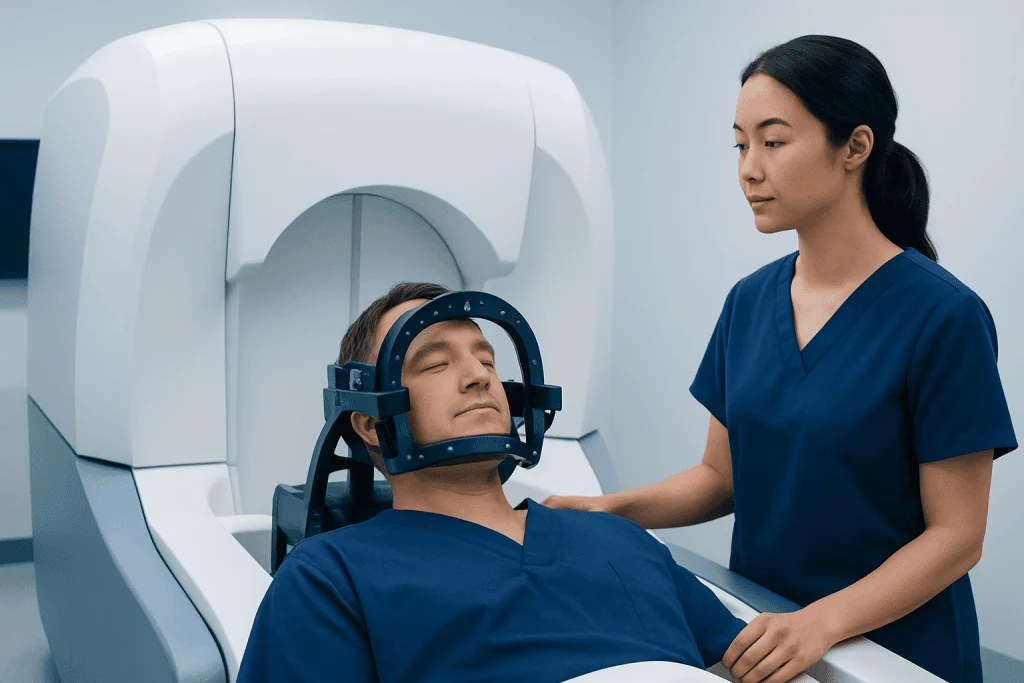
Gamma Knife is most commonly used for selected conditions affecting the brain and nearby structures. These can include certain benign brain tumors, such as meningiomas or vestibular schwannomas; limited brain metastases; pituitary tumors; arteriovenous malformations (AVMs); and trigeminal neuralgia. It may also be considered for selected recurrent or residual tumors after earlier surgery or radiation treatment.
For tumors, the team considers whether the treatment goal is local control, slowing growth, relieving pressure-related risk, or treating a remaining area after another procedure. Gamma Knife can be especially useful when a target is difficult to reach with conventional surgery or when avoiding an incision is clinically preferable. It does not remove a tumor immediately, and response is usually assessed over months through clinical review and imaging.
For an AVM, focused radiation aims to gradually cause abnormal blood vessels to close. This process can take years, so the treatment team explains the ongoing risk during the interval and the importance of follow-up. For trigeminal neuralgia, Gamma Knife may be an option for selected people whose facial pain remains difficult to control or who cannot have, or prefer not to have, another procedure.
Not every condition in these groups is suitable. Large lesions, widespread disease, targets causing urgent pressure on the brain, or conditions requiring tissue diagnosis may be better managed with surgery, other radiation techniques, medical treatment or a combination of approaches.
Eligibility Criteria: What the Specialist Team Reviews

The central requirement is a target that can be accurately seen and safely planned on imaging. Magnetic resonance imaging (MRI), computed tomography (CT) and sometimes angiography show the target’s size, shape, position and relationship to sensitive structures such as the optic nerves, brainstem and speech or movement pathways. Very large or irregular targets may not be appropriate for single-session Gamma Knife, although other stereotactic radiation schedules may sometimes be considered.
The team also reviews the number of targets, whether there has been previous radiation, and the likely benefit compared with possible side effects. Prior radiation does not automatically rule out Gamma Knife, but it can affect how much additional radiation nearby normal tissue can safely receive. A treatment plan must account for these cumulative exposures.
General health matters as well. Most people can tolerate the procedure without general anesthesia, but the team considers the ability to lie still, manage anxiety or claustrophobia, and attend follow-up appointments. Medications, including blood thinners, allergies, kidney function when contrast imaging is needed, pregnancy status and other medical conditions are discussed during pre-treatment assessment.
- A well-defined target visible on suitable imaging
- A size and location that allow safe dose planning
- A condition for which focused radiation has a clear clinical role
- No need for immediate surgical decompression or urgent tissue diagnosis
- Ability to complete planning, treatment and long-term follow-up
How Gamma Knife Works and What Happens on Treatment Day
Gamma Knife uses multiple cobalt radiation sources arranged in a specialized treatment unit. The beams converge on the planned target, allowing the team to shape radiation precisely. Before treatment, a rigid head frame or a custom immobilization mask is used to help keep the head in the exact position required for accurate targeting. The method chosen depends on the treatment system and clinical plan.
On the day of treatment, the team confirms the person’s medical history and may place an intravenous line for contrast imaging or medicines if needed. Imaging is performed with the frame or mask in place. Neurosurgery, radiation oncology and medical physics professionals then use the images to create a tailored plan that balances treatment coverage with protection of nearby healthy structures.
During radiation delivery, the person lies on a treatment couch and communicates with the care team through audio and video systems. The radiation itself is painless. The session can vary in length depending on the complexity and number of targets, and there may be time between imaging, planning and delivery. The team explains what to expect and provides instructions throughout the visit.
Most patients go home on the same day after a brief observation period. A responsible adult may be recommended to accompany the person home, particularly if sedation, pain medicine or anti-anxiety medicine has been used. Gamma Knife does not make a person radioactive, so normal contact with family members is generally safe after treatment.
Benefits, Limits and Possible Risks
A potential benefit of Gamma Knife is high precision without a surgical incision. It may avoid some risks associated with open brain surgery, reduce recovery time and allow treatment of targets in areas that are challenging to access surgically. It can also be valuable when surgery is not advisable because of a person’s health, the target’s location or prior treatments.
Its limits are equally important. Gamma Knife is not appropriate for every tumor or neurological condition, and it does not provide a tissue sample for diagnosis. Its effects are generally gradual rather than immediate. For example, a tumor may shrink slowly, remain stable or show temporary imaging changes after treatment. Conditions producing severe pressure on the brain may require urgent surgery rather than radiosurgery.
Side effects vary with the target and dose. Short-term effects can include headache, tiredness, scalp tenderness at frame-pin sites, nausea or temporary swelling around the treated area. Steroid medication may be prescribed in selected cases to help manage swelling. Some people have no significant short-term symptoms.
Less common but important risks include delayed swelling, neurological symptoms related to the treated region, radiation-related tissue injury, seizures, changes in hearing, vision or hormone function when nearby structures are involved, and incomplete treatment response. The specialist team discusses the risks relevant to the individual target before consent. Promptly reporting new or worsening symptoms supports timely assessment.
Recovery Timeline and Follow-Up Care
Recovery after Gamma Knife is often brief. Many people rest for the remainder of the treatment day and return to light daily activities within one or several days, depending on how they feel and their underlying condition. Minor headache or fatigue can occur. Frame-pin areas, when a frame is used, may be sore or mildly swollen for a short time.
The clinical effect develops over time. For a tumor, follow-up MRI scans may be scheduled over months and years to assess whether it has stabilized or changed. For AVMs, repeated imaging is needed to confirm whether the blood vessels have closed. For trigeminal neuralgia, pain improvement may occur gradually and may not be immediate.
People should follow their team’s advice about prescribed medicines, including steroids or anti-seizure medicines, and should not stop regular medications without medical guidance. Follow-up appointments are a key part of treatment, because imaging findings and symptoms together guide next steps. Some patients need additional treatment, while others continue with monitoring.
Acibadem International’s multidisciplinary specialists and JCI-accredited hospitals evaluate and treat international patients with conditions that may be considered for Gamma Knife. A pre-assessment form, together with imaging and medical records, can help the team review eligibility before travel or an in-person consultation.
When to Seek Medical Care
Anyone who has been advised to consider Gamma Knife should arrange a consultation with an appropriate specialist, such as a neurosurgeon, radiation oncologist or neurologist. It is helpful to bring recent MRI or CT scans, radiology reports, pathology reports where available, details of previous surgery or radiation, and a current medication list. These records allow a more reliable eligibility assessment.
After treatment, the care team should be contacted for persistent or worsening headache, repeated vomiting, increasing weakness, new numbness, confusion, new balance problems, visual changes, a seizure, fever or concerning changes at frame-pin sites. These symptoms do not always indicate a serious problem, but they need timely professional advice.
Emergency medical care is appropriate for sudden severe headache, loss of consciousness, a seizure that does not stop promptly, sudden weakness on one side of the body, difficulty speaking, major vision loss or other sudden neurological symptoms. These symptoms require urgent assessment regardless of whether the person has had Gamma Knife treatment.
Frequently asked questions
How do I know if I am a candidate for Gamma Knife?
Eligibility requires specialist assessment rather than a self-check. The team reviews the diagnosis, MRI or CT findings, target size and location, symptoms, previous treatments and general health. A clearly defined target that can be treated safely with focused radiation is an important factor.
Is Gamma Knife surgery the same as brain surgery?
No. Gamma Knife is stereotactic radiosurgery, meaning it uses precisely focused radiation rather than an incision or surgical removal of tissue. A head frame or mask is used for accuracy, and treatment is usually completed as an outpatient procedure.
Can Gamma Knife treat all brain tumors?
No. It may be appropriate for selected small or well-defined tumors, including some brain metastases and benign tumors. Large tumors, tumors causing significant pressure, diffuse disease or tumors needing a tissue diagnosis may require another approach.
How long does it take to recover from Gamma Knife?
Many people return home the same day and resume light activities within days. However, the biological effect on the treated condition develops gradually, often over weeks to months. Follow-up scans and appointments are needed to assess the response.
What are the common side effects of Gamma Knife?
Temporary tiredness, headache, nausea and scalp soreness can occur, particularly after frame placement. Some people may develop swelling around the treated area, which can cause symptoms related to the treatment site. The care team explains individualized risks before treatment.
Can Gamma Knife be used after previous radiation or surgery?
Sometimes. Previous surgery or radiation may make Gamma Knife a useful option for a remaining, recurrent or newly identified target, but prior treatment also affects safety planning. Specialists review earlier radiation plans and imaging before making a recommendation.
References
- American Association of Neurological Surgeons
- American Society for Radiation Oncology
- National Cancer Institute
- Radiological Society of North America
- National Institute of Neurological Disorders and Stroke
This article is for general information only and is not a substitute for professional medical advice. Please consult a qualified doctor about your individual situation.
Gamma Knife in Turkey — costs, top hospitals & a free quote
JCI-accredited · board-certified surgeons · reply within 24h
Add us as a Preferred Source to see more of our trusted health content across Google Search, AI Overviews and Discover.

Neurology
Diagnosis and treatment of disorders of the brain, spinal cord, nerves and muscles.
51 specialists in this unit