Sapphire fue hair transplant in Turkey: Hospitals, Safety & What to Expect

Sapphire FUE is a follicular unit extraction technique that uses sapphire blades to create recipient-site channels for transplanted follicles. The procedure is usually performed under local anesthesia and involves extracting follicles individually from a donor area, commonly the back or sides of the scalp.
Key Takeaways
- Sapphire FUE is a follicular unit extraction technique that uses sapphire blades to create recipient-site channels for transplanted follicles.
- The procedure is usually performed under local anesthesia and involves extracting follicles individually from a donor area, commonly the back or sides of the scalp.
- A thorough assessment of hair-loss cause, donor supply, health history, and expectations is essential before surgery.
- Temporary shedding, swelling, scabbing, and numbness can occur during recovery; visible growth develops gradually over several months.
- Choosing a properly regulated hospital and qualified surgical team helps support safety, infection prevention, and appropriate aftercare.
A sapphire FUE hair transplant in Turkey may be a suitable option for people with stable pattern hair loss and an adequate donor area, provided it is planned and performed by an experienced medical team. The quality of assessment, sterile surgical standards, realistic design, and structured follow-up are more important than the instrument alone.
Overview: What Is Sapphire FUE Hair Transplant in Turkey?
A sapphire FUE hair transplant in Turkey is a surgical hair-restoration procedure in which individual follicular units are removed from a donor area and implanted into areas of thinning or baldness. “Sapphire” refers to the material used for small blades that create channels in the recipient scalp before graft placement. It is a variation of follicular unit extraction (FUE), not a separate method of growing new hair.
The procedure can be safe when it is performed in an appropriately regulated hospital or surgical setting by qualified clinicians who assess the person carefully, use sterile techniques, and provide clear aftercare. The choice of country should not replace careful review of the clinic’s medical standards, the professional roles of the team, communication arrangements, and follow-up plan.
People considering the procedure can learn more about the broader surgical approach through Sapphire FUE hair transplant treatment information. A consultation is needed to determine whether hair transplantation is appropriate and what outcome is realistically achievable.
How Sapphire FUE Works
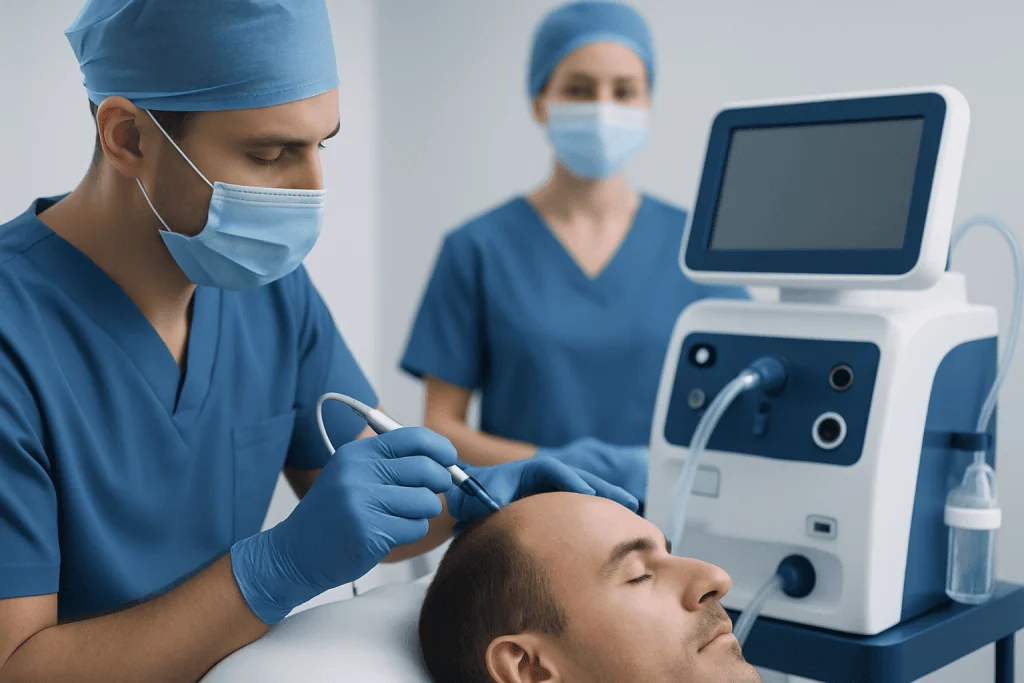
Hair follicles naturally grow in small groups called follicular units. In FUE, a clinician uses a fine extraction instrument to remove these units one at a time, most often from the back and sides of the scalp. These donor areas are usually less affected by androgenetic, or pattern, hair loss.
After the grafts are prepared, tiny channels are made in the thinning area. In sapphire FUE, these channels are created using sharp sapphire blades rather than conventional steel blades. The direction, angle, depth, and distribution of these channels influence how naturally the transplanted hair may grow and how well existing hair is preserved.
Transplanted follicles do not create an unlimited supply of hair. Donor hair is a finite resource, so the surgical plan should protect the donor area while balancing coverage, hairline design, density, and the likelihood of future hair loss. Hair transplant surgery may be considered alongside medical management of androgenetic alopecia when clinically suitable.
Who May Be a Candidate?

Suitable candidates commonly have pattern hair loss that has been assessed by a doctor, a sufficiently dense donor area, and realistic expectations about density and coverage. Candidates should also understand that transplanted hair may continue to coexist with non-transplanted hair that can thin over time.
A medical evaluation is important because hair loss has several possible causes. Sudden shedding, patchy loss, scalp inflammation, nutritional deficiencies, endocrine conditions, medication effects, and some autoimmune disorders may need investigation or treatment before transplant surgery is considered.
Factors that can affect candidacy include age, the stability and pattern of hair loss, scalp health, hair texture and color contrast, previous procedures, smoking, bleeding risks, chronic health conditions, and current medicines. A responsible consultation should include discussion of the available donor supply, expected limitations, and whether non-surgical treatment may be useful first.
- People with active scalp infection or uncontrolled skin disease may need treatment before surgery.
- Those with extensive hair loss and limited donor hair may not achieve full coverage.
- People with unrealistic expectations or pressure to proceed quickly may benefit from additional counselling before making a decision.
What to Expect: Assessment, Procedure and Travel Planning
Before surgery, the team should review medical history, medicines, allergies, prior hair-loss treatments, and scalp findings. Photographs and donor-area examination help guide graft planning. The clinician should explain the proposed hairline, the likely number of sessions, expected recovery, possible complications, and any instructions about medicines, smoking, alcohol, or scalp products before the procedure.
On the day of surgery, the donor and recipient areas are usually trimmed or prepared, then numbed with local anesthesia. Follicular units are extracted individually, kept under controlled conditions, and implanted into channels designed for the planned pattern of growth. The process can take several hours and may be performed over one or more days depending on the treatment plan.
International patients should allow enough time in Turkey for pre-procedure assessment, the procedure itself, and an early postoperative review before travel home. Accommodation and transport arrangements should prioritize rest, hygiene, and easy access to the hospital. Written aftercare instructions, an interpreter when needed, and a clear way to contact the clinical team after return travel are practical parts of safe planning.
Acibadem International’s multidisciplinary specialists and JCI-accredited hospitals support assessment and treatment planning for international patients considering hair-restoration procedures.
Recovery Timeline and Expected Results
In the first few days, mild swelling, tenderness, tightness, itching, and small scabs can occur in the treated areas. The care team typically gives instructions on sleeping position, gentle washing, avoiding rubbing or picking, and protecting the scalp from accidental contact. Strenuous exercise, swimming, direct sun exposure, and activities that increase injury risk may need to be limited for a period advised by the clinician.
Crusting usually settles as the scalp heals. Many people notice that the transplanted hairs shed within the first several weeks; this is often a temporary phase known as shock shedding and does not necessarily mean the follicles have been lost. Existing native hair can also shed temporarily after surgery in some cases.
New growth generally begins gradually over the following months. Changes are often subtle at first, with maturation in texture, length, and coverage continuing over many months. Timelines vary between individuals and depend on biology, the original degree of hair loss, graft survival, aftercare, and whether ongoing hair loss is controlled.
Follow-up appointments are important for monitoring healing and discussing longer-term hair-loss management. A clinician may recommend appropriate medical or non-surgical options where indicated, rather than relying on surgery alone to address progressive hair loss.
Benefits, Limitations and Potential Risks
Potential benefits of sapphire FUE include the use of a minimally invasive extraction approach without a linear donor scar, the ability to place individual grafts in carefully planned directions, and the possibility of natural-looking coverage when the treatment is well designed. Sapphire blades are intended to create precise recipient channels, but no blade material can guarantee graft survival, density, or a particular cosmetic result.
As with any surgical procedure, FUE can involve risks. These may include bleeding, infection, prolonged redness or swelling, pain, numbness, folliculitis, scarring, delayed healing, uneven growth, an unnatural hairline, poor graft growth, or visible thinning in an overharvested donor area. In rare situations, an additional procedure may be discussed if results are limited or hair loss progresses.
Safety depends on more than the name of the technique. Patients should ask who performs each step, whether a doctor is directly involved in assessment and surgical planning, how infection prevention is managed, what emergency support is available, and how complications are addressed. They should also be wary of promises of guaranteed density or claims that one technique is suitable for everyone.
When to Seek Medical Care
Medical advice should be sought promptly if there is increasing pain, spreading redness, warmth, pus-like drainage, fever, persistent bleeding, rapidly worsening swelling, or an allergic reaction after a hair transplant. These symptoms do not always indicate a serious problem, but they require timely assessment by the treating team or a local healthcare professional.
Before pursuing a procedure, a person should also see a doctor for sudden or patchy hair loss, scalp scaling or pain, hair loss with fatigue or other systemic symptoms, or thinning that begins after a new medicine or illness. Identifying the cause can help prevent unnecessary surgery and ensure that treatable conditions are not missed.
For people travelling internationally, it is helpful to obtain written postoperative instructions, copies of relevant medical records, and contact information for the clinical team before departure. If symptoms occur after returning home, local medical care should not be delayed while waiting for remote advice.
Frequently asked questions
Is sapphire FUE different from standard FUE?
Sapphire FUE uses sapphire blades to create the small channels where grafts are implanted. Standard FUE may use other instruments for this stage, but both approaches involve extracting follicular units individually. The clinician’s planning, graft handling, and surgical technique remain central to the outcome.
Is a sapphire FUE hair transplant painful?
The scalp is usually numbed with local anesthesia, so people should not feel sharp pain during the main parts of the procedure. Some discomfort may occur during anesthetic injections and during the first days of recovery. The treating team can explain suitable pain-relief and aftercare measures.
How long does it take to see results after sapphire FUE?
Transplanted hairs often shed in the first weeks, which can be a normal temporary part of the process. New growth usually starts gradually over subsequent months, with continued improvement as hairs mature. Individual timelines and final appearance vary.
Will transplanted hair fall out again?
The visible hair shafts commonly shed shortly after surgery, while the transplanted follicles may remain beneath the skin and later produce new hair. However, results can vary and ongoing loss of non-transplanted hair may continue. Long-term planning may include medical treatment for pattern hair loss when appropriate.
How can a person assess safety when choosing a hair transplant hospital in Turkey?
They should confirm the qualifications and roles of the clinical team, ask about the surgical setting and sterilization standards, and request a clear explanation of follow-up arrangements. A thorough medical assessment and realistic discussion of limitations are positive signs. Patients should avoid providers that offer guarantees or do not explain who performs key surgical steps.
Can everyone with thinning hair have a hair transplant?
No. A person needs adequate donor hair, a suitable scalp condition, and a hair-loss pattern that can be planned safely. Some causes of hair loss need medical evaluation or treatment before surgery, and some people may be better suited to non-surgical approaches.
References
- International Society of Hair Restoration Surgery
- American Academy of Dermatology
- National Health Service
- Mayo Clinic
This article is for general information only and is not a substitute for professional medical advice. Please consult a qualified doctor about your individual situation.
FUE Hair Transplant in Turkey — costs, top hospitals & a free quote
JCI-accredited · board-certified surgeons · reply within 24h
Add us as a Preferred Source to see more of our trusted health content across Google Search, AI Overviews and Discover.

Hair Transplant
Modern FUE and DHI hair restoration with natural, lasting results.