Baclofen Pump Surgery: Procedure, Recovery and Results

A baclofen pump delivers a small, continuous dose of baclofen through a catheter placed near the spinal cord. A screening trial is usually performed before permanent pump implantation to assess likely benefit and safety.
Key Takeaways
- A baclofen pump delivers a small, continuous dose of baclofen through a catheter placed near the spinal cord.
- A screening trial is usually performed before permanent pump implantation to assess likely benefit and safety.
- Most people stay in hospital briefly and gradually return to usual activities over several weeks, guided by their care team.
- The pump needs regular refills and eventual replacement when its battery reaches the end of service.
- Sudden baclofen withdrawal or overdose can be serious, so prompt medical assessment is important if symptoms change unexpectedly.
Baclofen pump surgery, also called intrathecal baclofen therapy, is a procedure that delivers baclofen directly into the fluid around the spinal cord to reduce severe spasticity. It may help selected people whose muscle stiffness, spasms or pain are not adequately controlled with oral medicines or other therapies.
Overview: what baclofen pump surgery involves
Baclofen pump surgery is a treatment for severe spasticity, a condition in which muscles become unusually tight and may produce painful spasms, stiffness and difficulty with movement or daily care. The operation implants a programmable pump beneath the skin of the abdomen. A thin catheter connects the pump to the space containing cerebrospinal fluid around the spinal cord.
The pump releases baclofen in very small doses directly into this fluid. This route can provide an effect with much lower overall medicine exposure than oral baclofen, which may be helpful for people who have inadequate symptom control or troublesome side effects from tablets. The goal is not necessarily to eliminate all muscle tone; some tone can support standing, transfers or walking.
Intrathecal baclofen is most often considered for spasticity related to conditions such as cerebral palsy, spinal cord injury, multiple sclerosis, stroke or acquired brain injury. It is part of a broader rehabilitation plan that may also include physiotherapy, stretching, positioning, splints and management of the underlying neurological condition.
How does an intrathecal baclofen pump work?
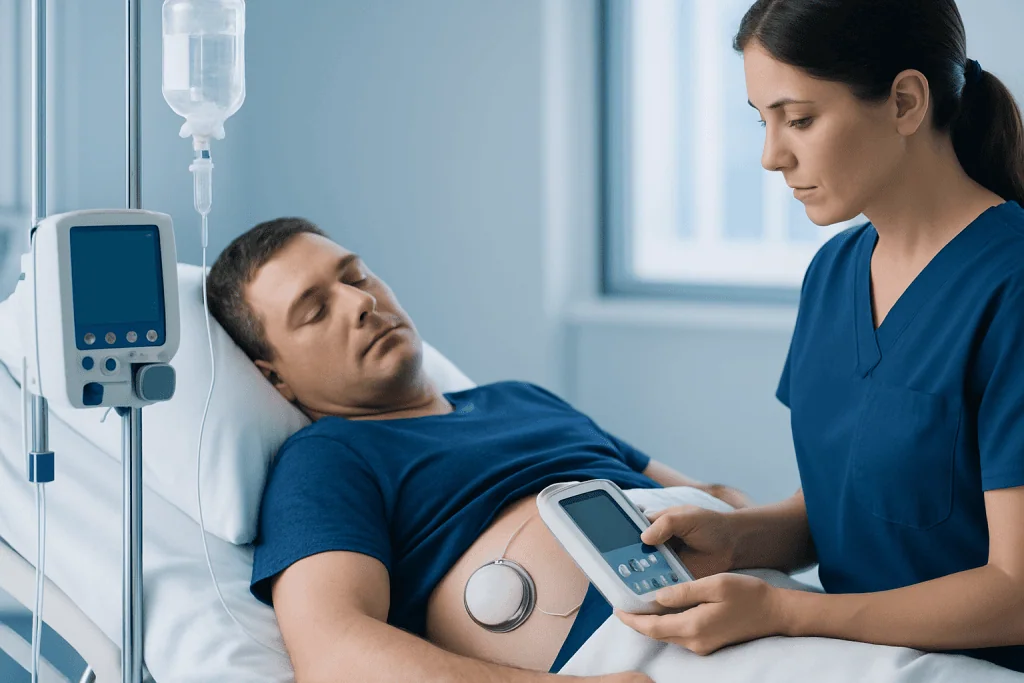
Baclofen acts on nerve signals involved in muscle activity. When delivered into the intrathecal space, close to the spinal cord, it can reduce excessive reflex activity that contributes to spasms and stiffness. The clinician programs the pump externally, allowing treatment to be tailored over time rather than relying on repeated tablets throughout the day.
The reservoir inside the pump is refilled through the skin at scheduled clinic visits. Refill frequency varies according to the pump size, prescribed dose and individual treatment plan. The device battery does not recharge; when it is nearing the end of its service life, the pump is surgically replaced while the catheter may sometimes remain in place.
A pump requires ongoing follow-up. The patient, family and caregivers should understand the refill schedule, carry device information, and know whom to contact if an alarm sounds or symptoms change. Missing a refill can lead to baclofen withdrawal, which needs urgent medical attention.
Who may be a candidate for baclofen pump surgery?

Potential candidates have spasticity that substantially affects comfort, sleep, hygiene, sitting, mobility, caregiving or participation in rehabilitation. They may have not gained sufficient relief from oral medication, or may experience side effects such as excessive sleepiness, dizziness or weakness at doses needed to control symptoms.
Before permanent implantation, most people have a screening trial. During this assessment, a clinician administers a test dose of intrathecal baclofen and monitors changes in tone, spasms, comfort, function and possible adverse effects. The trial helps establish whether the likely benefits are meaningful for the person’s own goals.
Careful assessment also considers infection, bleeding risk, spinal anatomy, breathing problems, ability to attend refill appointments and the availability of reliable support. A rehabilitation physician, neurologist or neurosurgeon commonly works with physiotherapists, nurses, pain specialists and caregivers to decide whether this approach is appropriate.
- Useful goals may include easier transfers, less pain from spasms, improved sleep or simpler personal care.
- For some people, reducing tone too much could make standing or walking harder, so pump settings are adjusted cautiously.
- The treatment does not cure the neurological condition causing spasticity.
Baclofen pump surgery: step by step
The procedure is usually performed in an operating room under general anesthesia. The surgical team first places the catheter through the lower back into the intrathecal space and confirms its position. The catheter is then tunneled beneath the skin toward the abdomen.
A small pocket is made under the skin of the lower abdomen, where the pump is positioned and connected to the catheter. The incisions are closed and covered with dressings. The pump is filled, programmed and checked before or soon after surgery, with adjustments based on the person’s symptoms and response.
Following implantation, the team monitors wound healing, pain control, muscle tone and possible medication effects. Pump programming is individualized, and it may take several follow-up visits to find settings that balance reduced spasms with preserved useful strength and function. Learn more about baclofen pump surgery as part of a specialist-led spasticity care plan.
How long does it take to recover from baclofen pump surgery?
Recovery after baclofen pump surgery varies with the person’s health, mobility, reason for treatment and whether other procedures were performed. Many people remain in hospital for monitoring for a short period, then continue recovery at home. Incision discomfort and tiredness are common in the early days and usually improve as healing progresses.
In general, the surgical wounds need several weeks to heal. The care team may advise avoiding heavy lifting, strenuous exercise, twisting movements or pressure on the abdominal incision for a period of time. Instructions differ by patient, so the surgeon’s advice should take priority over general timelines.
Functional improvement can be more gradual than wound healing. Muscle tone may change as the pump is adjusted, and physiotherapy may help a person learn to move safely with their new level of tone. Scheduled follow-up is important for programming, refills and rehabilitation planning.
Benefits, risks and long-term results
For appropriately selected patients, intrathecal baclofen can reduce severe spasms and stiffness and may improve comfort, sleep, positioning, hygiene and ease of caregiving. Some people also find that reduced spasticity supports participation in therapy or daily activities. Results depend on the underlying condition, treatment goals and the ability to maintain regular follow-up.
Potential surgical risks include infection, bleeding, fluid leakage, wound problems, catheter movement or blockage, and pump malfunction. Baclofen-related effects can include weakness, sleepiness, dizziness, nausea, low blood pressure or changes in breathing. The clinical team reviews individual risks before surgery and monitors treatment closely.
Both baclofen withdrawal and overdose require urgent assessment. Withdrawal may cause increasing stiffness or spasms, fever, itching, confusion or other changes; severe cases can become dangerous. Overdose may cause marked drowsiness, unusually weak muscles, slowed breathing or reduced alertness. Patients and caregivers should seek emergency help for severe or rapidly worsening symptoms.
What is the success rate of baclofen pump surgery? There is no single success rate that applies to everyone, because success is measured against personal goals rather than one universal outcome. A successful result may mean fewer painful spasms, easier care, better sleep or improved participation in rehabilitation. A positive screening trial and careful post-operative programming help clinicians estimate the chance of achieving meaningful benefit.
Can you walk with a baclofen pump?
Can you walk with a baclofen pump? Yes, many people can walk with a baclofen pump. The implanted device is placed beneath the abdominal skin and does not usually prevent ordinary walking once the surgical area has healed. However, walking ability depends primarily on the underlying neurological condition, strength, balance and individual response to reduced muscle tone.
For some people, spasticity contributes to support while standing or taking steps. If tone is reduced too much, temporary weakness or less stable walking may occur. This is why clinicians usually make gradual programming changes and may coordinate adjustments with physiotherapy and gait assessment.
How long does it take to recover from a pain pump surgery? Pain pump surgery and baclofen pump surgery use similar implantation techniques, so initial wound recovery is often broadly comparable: hospital monitoring is brief for many patients, while tissue healing takes weeks. However, the medicine used, the reason for implantation, overall health and the need for dose adjustments can make each person’s recovery different. The implanting team can provide the most accurate timeline.
Self-care and when to seek medical care
After surgery, patients should keep incisions clean and dry as instructed, take prescribed medicines exactly as directed, and attend all wound checks, pump refills and programming appointments. They should not change pump settings themselves or stop baclofen abruptly. Keeping a record of symptoms, spasms, sleep, mobility and side effects can help the team fine-tune treatment.
When to seek medical care: Contact the treating team promptly for increasing redness, swelling, drainage, fever, severe headache, new weakness, worsening spasms, unexpected drowsiness, a pump alarm or concerns about a missed refill. Seek emergency care for trouble breathing, loss of consciousness, seizures, severe confusion, or sudden and marked worsening of spasms or rigidity.
People considering treatment benefit from discussing their practical goals, support at home, rehabilitation needs and long-term refill arrangements with a qualified specialist. Acibadem International’s multidisciplinary specialists in JCI-accredited hospitals can assess and treat spasticity using individualized medical, rehabilitation and surgical care for international patients.
Frequently asked questions
Is baclofen pump surgery major surgery?
Baclofen pump implantation is an invasive surgical procedure because it involves placing a catheter near the spinal cord and a pump under the abdominal skin. It is generally performed under general anesthesia and requires follow-up after surgery. The surgical team will explain the expected level of complexity and individual risks.
How long does a baclofen pump last?
The pump battery has a limited service life and eventually requires surgical replacement. The exact timing depends on the model, programming and dose delivered. The care team monitors the device at follow-up visits and plans replacement before the battery is depleted.
Will a baclofen pump eliminate spasticity completely?
Not always. The aim is usually to reduce problematic spasticity enough to improve comfort, care, sleep or function while preserving useful muscle tone. Response differs between individuals, and settings can be adjusted over time.
Can a baclofen pump be removed?
Yes, a baclofen pump can be removed if treatment is no longer appropriate or if a complication requires it. Baclofen must never be stopped suddenly, so removal or discontinuation needs a carefully supervised plan. The specialist will arrange alternative treatment when needed.
How often does a baclofen pump need to be refilled?
Refill intervals vary according to the pump reservoir size and the programmed daily dose. They are scheduled in advance by the treating clinic and may range from weeks to months. It is important to attend every refill appointment to prevent withdrawal.
Can MRI scans be performed with a baclofen pump?
Some implanted pumps are MRI-conditional, meaning MRI may be possible under specific conditions. The imaging team and pump specialist need to know the exact device model before a scan is arranged. The pump may need checking after MRI according to manufacturer and clinical guidance.
References
- National Institute of Neurological Disorders and Stroke
- U.S. Food and Drug Administration
- MedlinePlus, U.S. National Library of Medicine
- American Association of Neurological Surgeons
- National Health Service
This article is for general information only and is not a substitute for professional medical advice. Please consult a qualified doctor about your individual situation.
Joint and spine care in Turkey — expert assessment & treatment
JCI-accredited · board-certified surgeons · reply within 24h
Add us as a Preferred Source to see more of our trusted health content across Google Search, AI Overviews and Discover.