Baha Ear Implant: An Evidence-Based Patient Guide

A baha ear implant can be considered for conductive hearing loss, mixed hearing loss, or single-sided deafness. The system includes an external sound processor and, for implanted options, a component placed in or under bone behind the ear.
Key Takeaways
- A baha ear implant can be considered for conductive hearing loss, mixed hearing loss, or single-sided deafness.
- The system includes an external sound processor and, for implanted options, a component placed in or under bone behind the ear.
- A hearing assessment and a trial with a non-surgical device help determine likely benefit before surgery.
- Most people recover steadily after implantation, but skin care, follow-up, and device adjustment remain important.
- MRI eligibility depends on the exact implant and sound processor model; the imaging team must check device-specific guidance.
- Costs vary by country, device type, insurance coverage, testing, surgery, and follow-up care.
A baha ear implant is a bone-conduction hearing system designed for certain types of hearing loss when conventional hearing aids are unsuitable or provide limited benefit. It transmits sound vibrations through the skull bone to the inner ear, bypassing problems in the outer or middle ear.
Overview: what is a baha ear implant?
A baha ear implant is a type of bone-conduction hearing system. “BAHA” is commonly used to describe bone-anchored hearing devices, although specific products and designs vary. The system captures sound with an external processor, turns it into vibration, and delivers that vibration through bone to the functioning inner ear (cochlea).
This pathway can help when sound cannot travel normally through the ear canal or middle ear. Rather than making sound travel through a blocked, malformed, chronically draining, or surgically altered outer or middle ear, the device bypasses those areas. It does not restore damaged cochlear hearing in the same way as a conventional hearing aid, and it is not suitable for every type of hearing loss.
Some systems use a small implant that integrates with bone behind the ear, while others use a magnetic connection beneath the skin. Non-surgical bone-conduction devices held by a soft band, adhesive, or headband may also be appropriate for some people. An ear, nose, and throat specialist and audiologist can explain which approach fits an individual’s hearing pattern, anatomy, lifestyle, and preferences.
How does a Baha hearing aid work?
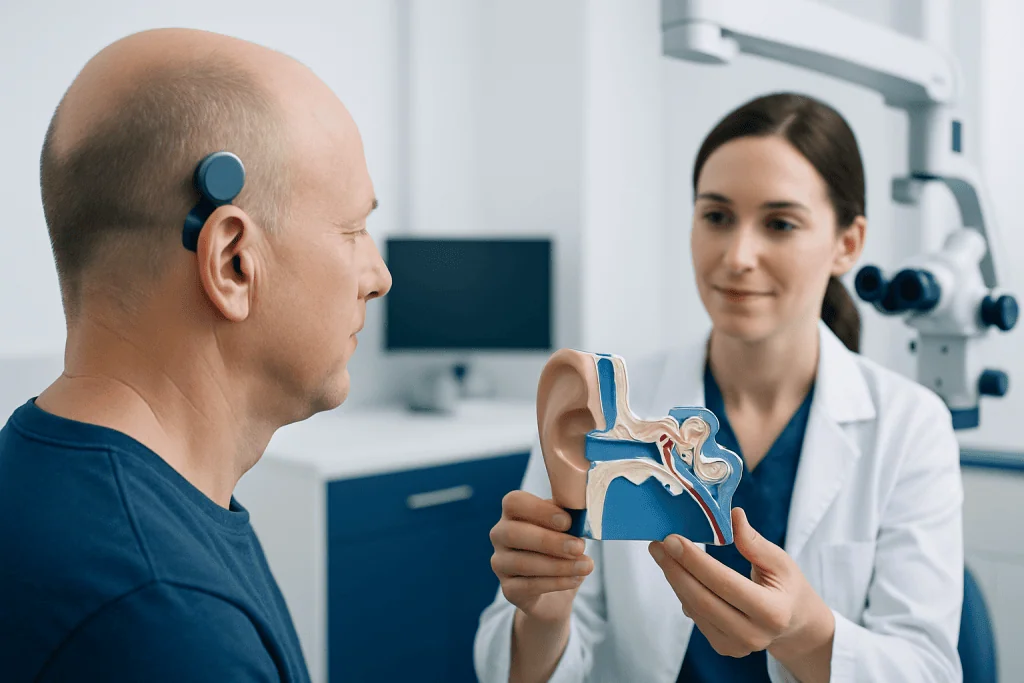
A Baha hearing aid system has an external sound processor and a way to transmit its signal to the skull. The processor contains microphones that pick up sound, analyzes the signal, and creates controlled vibrations. Those vibrations travel through the bone of the skull to the cochlea, where they are converted into nerve signals that the brain interprets as sound.
In conductive or mixed hearing loss, the cochlea may retain useful function even when the ear canal, eardrum, or middle-ear bones cannot efficiently conduct sound. For single-sided deafness, a bone-conduction system can route sound from the poorer-hearing side to the cochlea on the better-hearing side. This may improve awareness of sounds on that side, although it does not create normal hearing in both ears.
Before considering an implant, many candidates have a supervised trial using a device on a headband or soft band. This is valuable because it gives a realistic sense of sound quality, comfort, and benefit in everyday listening situations. Audiological testing also helps distinguish bone-conduction systems from alternatives such as conventional hearing aids or other hearing rehabilitation options.
Who may be a candidate for Baha ear implant surgery?

Potential candidates include adults and children with conductive hearing loss, mixed hearing loss, or single-sided deafness who cannot comfortably use, or do not gain adequate benefit from, conventional air-conduction hearing aids. Examples may include congenital ear canal differences, persistent ear drainage, recurrent outer-ear infections, middle-ear disease, or changes following ear surgery. Suitability depends on the cause and degree of hearing loss rather than a diagnosis alone.
An audiologist performs detailed hearing tests, while an ENT surgeon assesses the ears, surrounding skin, skull bone, medical history, and any conditions that could affect healing. The team may discuss hearing needs at school, work, home, and in noisy environments. For children, speech and language development, family support, and the ability to maintain the device site are also considered.
Not everyone needs an implanted system. A non-surgical device may be preferred temporarily, during childhood, while healing from ear disease, or when surgery is not desired. People with active infection, poorly controlled medical conditions, or factors that impair wound healing may need these issues addressed first. A tailored assessment is especially important for people with chronic ear conditions such as hearing loss.
- Conductive hearing loss caused by outer- or middle-ear problems
- Mixed hearing loss with adequate inner-ear function
- Single-sided deafness in selected patients
- Difficulty tolerating conventional hearing aids because of ear canal disease or anatomy
What happens during Baha ear implant surgery?
Baha ear implant surgery is usually planned after hearing testing, counseling, and a discussion of device options. The procedure is commonly performed as day surgery under local anesthesia with sedation or under general anesthesia, depending on age, health needs, and the surgical approach. The surgeon identifies a location behind the ear that allows stable placement and does not interfere with glasses or the external processor.
For percutaneous systems, the surgeon places a small titanium implant in the skull bone and an attachment that extends through the skin for connection to the processor. For transcutaneous magnetic systems, the implanted component sits beneath the skin and couples with an external processor through magnets. The precise steps, incision size, and recovery needs differ by device model.
The external sound processor is usually fitted after the surgical area has healed and the implant has had appropriate time to stabilize. At the fitting appointment, the audiologist programs the processor based on hearing-test results and feedback from the wearer. Follow-up adjustments are normal, as the brain adapts to the new sound input and listening needs become clearer.
For people considering an implantable hearing solution, bone-anchored hearing aid treatment can provide a structured evaluation, device discussion, surgery planning, and hearing rehabilitation pathway.
Recovery timeline, benefits and possible risks
Recovery varies with the surgical technique, age, general health, and skin healing. Mild soreness, swelling, numbness, or bruising around the surgical area can occur in the first days after surgery. The care team provides instructions on wound care, hair washing, sleeping position, physical activity, and when to return for review. It is important not to attach or use the processor until the surgeon or audiologist confirms that it is appropriate.
Many people return to light daily activity within days, but complete healing and device activation may take longer. After activation, adaptation is gradual. The processor may require several programming visits to optimize clarity and comfort, particularly in noisy settings. Consistent use during recommended waking hours can help the brain become accustomed to the sound.
Potential benefits include improved access to sound, clearer communication in suitable listening situations, and avoiding an ear canal device when the canal is problematic. Results are individual. A device may improve hearing-related function but cannot guarantee normal hearing, eliminate all listening difficulty in noise, or restore natural two-sided hearing for single-sided deafness.
Possible risks include wound infection, skin irritation, soreness or pressure from magnets, failure of the implant to integrate with bone, and a need for additional treatment or revision surgery. Skin reactions around a percutaneous attachment require regular cleaning and timely assessment. The surgeon can explain the device-specific risks and how they compare with non-surgical alternatives.
What is the success rate of BAHA?
There is no single success rate that applies to all Baha ear implants. Studies use different definitions of success, such as successful implant retention, absence of major complications, improvement on hearing tests, speech understanding, or patient-reported daily benefit. Outcomes also vary by device design, age, hearing condition, surgical technique, skin health, and follow-up care.
In general, bone-conduction systems have an established record of providing useful hearing rehabilitation for appropriately selected patients. The most meaningful question is whether the system is likely to improve a person’s own listening goals, such as hearing conversations at work, communicating in class, or becoming more aware of sound from the affected side.
A preoperative trial and thorough audiology assessment are among the best ways to estimate individual benefit. The care team should also discuss the likelihood of skin or surgical complications, the maintenance required, and whether another hearing option could better meet the person’s needs.
Is it safe to have an MRI with a BAHA hearing implant?
A baha ear implant MRI can be possible, but safety depends on the exact implanted system, the type of external sound processor, and the MRI scanner conditions. External processors must generally be removed before an MRI because they are electronic devices and may be damaged or become a hazard in the magnetic field.
Some implanted components are MRI-conditional, meaning scanning may be allowed only under specified conditions, such as a particular magnetic field strength or preparation steps. Certain magnetic implants may require additional precautions, and in some cases a magnet may need to be removed or managed according to the manufacturer’s instructions. The implant can also create image artifact near the head, which may affect interpretation of scans in that region.
Before scheduling any MRI, the patient should tell the radiology department and referring clinician about the implant, provide their implant identification information, and ask the implanting ENT team to confirm current device guidance. The imaging service should verify compatibility for that exact model; general online advice should not replace device-specific instructions.
How much does a BAHA device cost?
The cost of a BAHA device varies substantially and cannot be stated accurately as one figure. It may include specialist consultations, hearing tests, a device trial, the implant and sound processor, surgery and anesthesia, post-operative visits, programming, accessories, and future repairs or processor upgrades. The total also differs by country, hospital, device model, and whether surgery is needed.
Insurance or public health coverage may cover some or all parts of care when medical criteria are met, but policies vary. Before proceeding, patients can ask for a written, itemized estimate and clarification of which services are included. They should also ask about coverage for ongoing follow-up, batteries or charging equipment, replacement processors, and possible future revision care.
A decision should be based on hearing needs, likely benefit, medical suitability, and long-term support as well as financial planning. An audiology and ENT team can help compare implantable and non-surgical options in a practical, individualized way.
How effective is a Baha hearing aid?
A Baha hearing aid can be very effective for the people it is designed to help, particularly when the cochlea functions well but sound cannot travel effectively through the outer or middle ear. Users may notice better access to speech and environmental sounds, and many find it easier to communicate than with no hearing support or with a poorly tolerated conventional aid.
Effectiveness differs between people and listening environments. In quiet settings, benefit may be more noticeable than in busy restaurants or group conversations, where all hearing technologies can have limitations. For single-sided deafness, the system can reduce the “head shadow” effect by sending sound from the deaf side to the better cochlea, but it usually does not fully restore sound localization.
Good results depend on appropriate device selection, precise programming, consistent use, realistic expectations, and follow-up. A trial device allows the person to compare hearing in familiar situations before making a decision about surgery. Photographs or baha ear implant pictures can show the external processor and placement behind the ear, but they cannot predict comfort, sound quality, or individual hearing benefit.
When to seek medical care
Prompt medical assessment is recommended for sudden hearing loss, rapidly worsening hearing, severe ear pain, ear swelling, dizziness with new hearing changes, facial weakness, or discharge accompanied by fever or significant pain. Sudden hearing loss is time-sensitive and should not be managed by waiting to see if it improves.
People with longstanding hearing difficulty should arrange an audiology and ENT assessment if hearing affects communication, work, education, safety, or wellbeing. This is also important if recurrent ear infections, persistent drainage, or discomfort makes conventional hearing aids difficult to wear. Hearing loss has many causes, and a Baha system is only one possible solution.
After implantation, increasing redness, discharge, persistent pain, fever, wound opening, unusual swelling, or a loose component should be reviewed by the surgical team. Acibadem International’s multidisciplinary ENT and audiology specialists in JCI-accredited hospitals can assess hearing needs and provide care for international patients.
Frequently asked questions
What is the difference between a Baha device and a conventional hearing aid?
A conventional hearing aid amplifies sound and delivers it through the ear canal, eardrum, and middle ear. A Baha device uses bone conduction to send vibrations directly to the inner ear, bypassing the outer and middle ear. This can be useful when those structures are blocked, malformed, chronically inflamed, or surgically altered.
Can a child have a Baha ear implant?
Children may be candidates for bone-conduction hearing rehabilitation, but the best approach depends on age, skull bone development, hearing needs, and overall health. A non-surgical soft-band device is often used before implantation is appropriate. Pediatric ENT and audiology assessment is essential for planning.
Will a Baha implant cure hearing loss?
No. A Baha implant does not cure the underlying cause of hearing loss or regenerate damaged hearing structures. It is a rehabilitation device that may improve access to sound for appropriately selected people. The degree of benefit depends on the hearing pattern and individual circumstances.
Can I wear glasses with a Baha ear implant?
Many people can wear glasses, but device placement should be planned to avoid pressure or interference with spectacle arms. The surgeon will consider this during preoperative marking and may ask about regular use of glasses, helmets, or headwear. Comfort can also be addressed during processor fitting.
How do I care for a Baha implant site?
Care depends on whether the system uses a skin-penetrating attachment or a magnetic connection. Percutaneous systems usually need regular cleaning around the attachment to reduce skin irritation and debris buildup. The surgical team provides specific hygiene instructions and should review any redness, discharge, pain, or swelling.
Can I try a Baha device before surgery?
Often, yes. A bone-conduction processor can commonly be tested on a soft band, headband, or similar temporary coupling system. Although the trial does not perfectly reproduce the sound of an implanted device, it helps assess comfort, sound awareness, and everyday benefit before surgery.
References
- World Health Organization
- National Institute on Deafness and Other Communication Disorders
- American Academy of Otolaryngology–Head and Neck Surgery
- National Health Service
- U.S. Food and Drug Administration
This article is for general information only and is not a substitute for professional medical advice. Please consult a qualified doctor about your individual situation.
Explore treatments in Turkey — costs, top hospitals & a free quote
JCI-accredited · board-certified surgeons · reply within 24h
Add us as a Preferred Source to see more of our trusted health content across Google Search, AI Overviews and Discover.