Crutches for Knee Surgery: Procedure, Recovery and Results

Crutches are commonly used after knee surgery when partial weight-bearing or extra balance support is needed. After knee replacement, many people begin standing and walking with professional assistance on the day of surgery or the next day.
Key Takeaways
- Crutches are commonly used after knee surgery when partial weight-bearing or extra balance support is needed.
- After knee replacement, many people begin standing and walking with professional assistance on the day of surgery or the next day.
- A walker may provide more stability early after knee replacement, while crutches can be useful as strength and balance improve.
- Stopping crutches should be based on safe walking quality, not only on the number of days since surgery.
- New calf swelling, chest pain, breathlessness, fever or wound drainage needs prompt medical assessment.
Crutches for knee surgery can protect the healing knee, reduce pain during walking and help a person regain confidence with movement. The correct aid and duration depend on the type of surgery, weight-bearing instructions, strength, balance and progress in physiotherapy.
Overview: Why Crutches Are Used After Knee Surgery
Crutches for knee surgery are mobility aids that help a person move while limiting stress on the operated leg or improving balance. They may be used after knee replacement, arthroscopy, ligament reconstruction, fracture repair or cartilage procedures. The surgeon’s instructions about how much weight may be placed through the leg are the most important guide.
Some operations allow weight-bearing as tolerated immediately, meaning the person may put as much weight through the leg as comfort and safety allow. Other procedures require partial or no weight-bearing for a period to protect repaired bone, cartilage, tendons or ligaments. Crutches can make these instructions practical during everyday activities such as getting to the bathroom, moving around the home and attending rehabilitation.
After a knee replacement surgery, the aim is usually early, supported walking rather than prolonged immobility. A physiotherapist teaches the safest device, correct technique and a plan for reducing support as recovery progresses.
How Crutches Work and Who May Need Them

Crutches shift part of body weight from the healing knee to the arms and upper body. They can reduce discomfort, help maintain a prescribed weight-bearing limit and widen a person’s base of support. Forearm crutches and underarm crutches are common options, but a walking frame or walker is often selected first when steadiness is the priority.
Candidacy for crutches depends on the procedure and the individual. A person needs sufficient arm, shoulder and hand strength, coordination, vision and balance to use them safely. People with significant weakness, dizziness, painful wrist or shoulder conditions, neurological conditions or a high fall risk may be better served by a walker, supervised walking or another mobility plan.
The rehabilitation team also considers the home environment. Stairs, loose rugs, narrow bathrooms, poor lighting and pets underfoot can raise the risk of a fall. Before discharge, patients should be taught how to sit, stand, turn, manage stairs if necessary and use their chosen aid safely.
Step-by-Step: Getting Up and Walking Safely
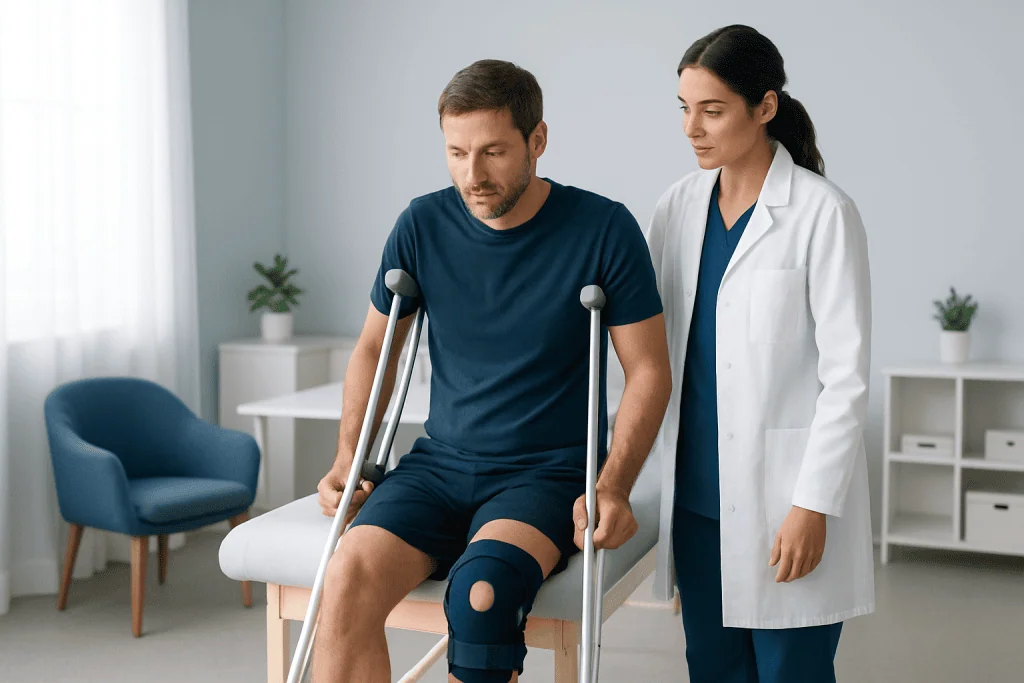
Before walking, crutches should be adjusted by a clinician or physiotherapist. When standing upright, the handgrips should generally allow a slight bend in the elbows. Underarm crutches should not press into the armpits; weight should be supported through the hands to reduce pressure on nerves and blood vessels in that area.
For a common partial-weight-bearing pattern, both crutches move forward first, followed by the operated leg as instructed, and then the stronger leg steps through. For weight-bearing as tolerated, the same sequence may be used initially while gradually placing more comfortable weight through the operated side. The precise technique can differ, so the person should follow the method demonstrated by their physiotherapist.
To stand from a chair, it is usually safer to push from the chair arms with the hands rather than pulling on the crutches. Once balanced, the crutches can be positioned for walking. To sit down, the person should back up until the chair is felt behind the legs, reach back for the chair arms and lower slowly.
Stairs require individual instruction. A common memory aid is “up with the good, down with the bad”: the stronger leg often leads going up, while the crutches and operated leg lead going down. However, weight-bearing restrictions and stair design can change this advice, so patients should not attempt stairs alone until trained and confident.
Recovery Timeline After Knee Surgery
Recovery with crutches varies greatly by operation. Following a straightforward knee replacement, people often begin assisted standing and short walks on the day of surgery or the following day. A walker is frequently used first, followed by crutches or a cane as pain, swelling, muscle control and balance improve.
How long crutches are needed after knee replacement surgery is not fixed. Many people use a walker or crutches for several days to a few weeks, then transition to a cane or unsupported walking when they can walk without unsafe limping or loss of balance. Some people need support longer, especially if they had limited mobility before surgery or experience slower recovery.
After procedures that repair structures inside the knee, such as certain meniscus root repairs, cartilage restoration procedures or complex ligament reconstructions, crutches may be needed for several weeks or longer. The surgeon may prescribe strict limits on weight-bearing to protect the repair. Attending physical therapy and rehabilitation helps patients build motion, strength and safe walking patterns at the pace appropriate for their surgery.
How long should you walk with crutches after knee replacement?
After knee replacement, a person should walk with crutches for as long as they need them to walk safely and as long as their surgical and rehabilitation team recommends. For many patients, this is a short-term stage lasting days to a few weeks, often after beginning with a walker. There is no single timetable that is right for everyone.
Readiness to reduce support is usually based on function. Helpful signs include being able to stand and walk with stable balance, controlled pain, good knee control and no marked limp. A person should not stop crutches simply to meet a target date if they still feel unsteady, are falling or nearly falling, or are walking with poor form.
Using support slightly longer can be safer than discontinuing it too soon. The physiotherapist may recommend progressing from two crutches to one crutch or a cane, often held on the side opposite the operated knee, before walking independently.
Is it better to use crutches or a walker after knee replacement?
Neither device is always better. A walker generally provides the widest base of support and can be easier to use during the earliest stage of recovery, when pain, anesthesia effects, weakness and reduced confidence may affect balance. It may be especially appropriate for people who need more stability or have difficulty coordinating crutches.
Crutches can be a good option for people with adequate upper-body strength and balance, particularly when they need to manage a prescribed weight-bearing restriction or progress toward more natural walking. They can also be easier to use on some stairs when the person has received specific training.
The best choice is individualized. The surgeon, nurses and physiotherapist consider the operation, weight-bearing plan, general health, home setting and mobility before surgery. A device should be changed only with professional advice, particularly in the first weeks after surgery.
What Is the Hardest Part of Knee Replacement Recovery?
The hardest part of knee replacement recovery differs from person to person. Many find the first several weeks challenging because pain, swelling, tiredness, sleep disruption and reduced independence occur while they are also expected to do regular rehabilitation exercises. Improvement is usually gradual rather than immediate.
Regaining knee bend and straightening can require consistent effort with the exercises prescribed by the rehabilitation team. Walking with crutches after knee replacement can feel frustrating at first, but it helps support safe movement while the muscles around the knee recover. Pain management, icing when advised, elevating the leg as recommended and pacing activity can make rehabilitation more manageable.
Emotional adjustment also matters. It is normal to have days when progress feels slow. Setting small functional goals, accepting help with daily tasks and discussing concerns early with the care team can support recovery. Persistent severe pain, rapidly worsening swelling or inability to make expected functional progress should be reviewed by a clinician.
How long does it take to get out of bed after knee replacement?
Many people are helped out of bed on the day of knee replacement surgery or the next day, depending on their overall condition, anesthesia, pain control and surgical team’s protocol. This early mobilization is typically supervised by nursing staff or a physiotherapist, who checks blood pressure, balance and the ability to follow safe movement instructions.
The first walk is usually brief and uses a walker or crutches. It is normal to feel tired, stiff or uncertain at this stage. Staff can teach safe transfers from bed to chair, walking to the bathroom and getting in and out of bed while protecting the new knee and reducing fall risk.
Patients should not get up without help until their team says it is safe, particularly after anesthesia or strong pain medicine. If dizziness, nausea, faintness or unusual weakness occurs, they should sit or lie down and tell a healthcare professional.
Benefits, Risks and When to Seek Medical Care
The benefits of crutches for post knee surgery include supported mobility, reduced load on the operated knee when needed and greater confidence during the transition back to daily activity. However, incorrect use can lead to falls, wrist, shoulder or hand discomfort, fatigue and unsafe pressure through the underarms. Proper fitting, clear instructions and gradual progression are key safety measures.
Patients should contact their surgeon or healthcare team promptly for increasing redness, warmth or drainage around the incision, fever, worsening pain that is not controlled by the care plan, new numbness or weakness, or a fall affecting the operated leg. Urgent medical care is needed for chest pain, sudden shortness of breath, coughing blood, fainting, or new one-sided calf pain and swelling, as these can require immediate assessment.
Regular follow-up allows the team to assess wound healing, range of motion, walking and readiness to change mobility aids. Acibadem International’s multidisciplinary specialists and JCI-accredited hospitals support diagnosis, surgery and rehabilitation planning for international patients with knee conditions, including knee osteoarthritis and other causes of joint pain.
Frequently asked questions
Can crutches damage the shoulders or hands after knee surgery?
Crutches can cause hand, wrist or shoulder discomfort if they are poorly fitted or used with incorrect technique. Underarm crutches should be supported through the hands rather than by leaning into the armpits. Persistent pain, tingling or numbness should be discussed with a physiotherapist or doctor.
Can a person use one crutch after knee replacement?
One crutch may be used as a later step in recovery when the person has enough balance and leg control. It is often held in the hand opposite the operated knee to reduce load through that side. The timing should be decided with the rehabilitation team.
Should crutches be used for knee surgery at night?
Crutches may be needed for nighttime trips to the bathroom if walking is not yet safe without support. Keeping a clear, well-lit path and wearing non-slip footwear can reduce fall risk. A bedside commode or other temporary arrangement may be recommended for some people.
What if walking with crutches makes knee pain worse?
Some discomfort and stiffness can occur during early recovery, but worsening or sharp pain should not be ignored. The person should check that they are following their weight-bearing instructions and using the correct technique. They should contact their surgeon or physiotherapist if pain is severe, persistent or accompanied by swelling, redness or wound changes.
When can a person drive after knee surgery?
Driving should wait until the person is no longer taking sedating pain medicines and can safely control the vehicle, including braking quickly in an emergency. The timing varies by the type of surgery, which knee was operated on and the person’s recovery. The surgeon should confirm when it is appropriate to resume driving.
Do all knee surgeries require crutches?
No. Some minor arthroscopic procedures may require only short-term support or none at all, while more complex repairs may require crutches for weeks. The need for crutches depends on the procedure, the surgeon’s weight-bearing instructions and the patient’s balance and strength. Patients should follow their individual postoperative plan.
References
- American Academy of Orthopaedic Surgeons
- National Institute of Arthritis and Musculoskeletal and Skin Diseases
- National Health Service
- American Association of Hip and Knee Surgeons
This article is for general information only and is not a substitute for professional medical advice. Please consult a qualified doctor about your individual situation.
Joint and spine care in Turkey — expert assessment & treatment
JCI-accredited · board-certified surgeons · reply within 24h
Add us as a Preferred Source to see more of our trusted health content across Google Search, AI Overviews and Discover.