Age-Related Macular Degeneration
Age-related Macular Degeneration affects central vision. Learn symptoms, causes, diagnosis, treatment options and when to see an eye doctor.

Quick answer
Age-related macular degeneration is a condition in which the central part of the retina gradually deteriorates, leading to blurred or distorted central vision and difficulty with tasks such as reading or recognizing faces. Treatment depends on the type and stage of the disease and may include regular eye monitoring, lifestyle measures, medications delivered into the eye, and supportive low-vision care.
Age-related Macular Degeneration, often called AMD, is a common eye condition in which the macula, the central part of the retina, gradually becomes damaged with age. It affects sharp central vision needed for reading, recognizing faces and driving, while side vision usually remains preserved.
Overview
Age-related Macular Degeneration is a degenerative disease of the retina that affects the macula, the small central area responsible for detailed vision. The macula allows a person to read, see fine detail, recognize faces and focus on objects directly ahead. In AMD, changes in this area can make central vision blurred, distorted or missing, while peripheral vision usually remains intact.
AMD is commonly divided into two main types: dry AMD and wet AMD. Dry AMD is the more common form and is associated with deposits under the retina, called drusen, and gradual thinning of macular tissue. Wet AMD is less common but can progress more quickly; it occurs when abnormal blood vessels grow under the retina and may leak fluid or blood.
The condition usually develops with age and is most often seen in adults over 50. It does not cause pain, and early stages may not be noticed without an eye examination. Although AMD can affect independence and daily activities, timely diagnosis, monitoring and modern treatment can help many people preserve useful vision and adapt effectively.
Symptoms
Age-related Macular Degeneration symptoms often begin subtly. A person may notice that reading requires brighter light, straight lines look wavy, or small details are harder to see. Some people describe a blurred or dark area in the center of vision, especially when looking at faces, words on a page or objects directly in front of them.
Dry AMD may progress slowly over years. In the early stage, there may be no symptoms at all, even though changes are visible during a dilated eye examination. As the disease advances, central vision may become increasingly blurred, and colors may seem less bright.
Wet AMD may cause more sudden changes. Warning signs include new distortion, a rapidly growing blurry spot, difficulty recognizing familiar faces, or a noticeable difference in vision between the two eyes. Because one eye can compensate for the other, symptoms may be missed unless each eye is checked separately.
- Blurred or reduced central vision
- Straight lines appearing bent or wavy
- Difficulty reading, sewing or seeing fine details
- Needing more light for close work
- A dark, empty or gray area in the center of vision
- Reduced contrast or color intensity
Causes & Risk Factors
The exact cause of Age-related Macular Degeneration is complex and not fully explained by one factor. It is believed to result from a combination of aging changes in the retina, genetic susceptibility, oxidative stress, inflammation and changes in the blood supply to the macula. Over time, waste deposits may collect under the retina and retinal cells may become less able to function normally.
Age is the strongest risk factor. A family history of AMD also increases risk, suggesting that inherited factors play an important role. Smoking is one of the most important modifiable risk factors, and stopping smoking is strongly recommended for eye health as well as overall health.
Other factors that may contribute include high blood pressure, cardiovascular disease, obesity, an unhealthy diet low in leafy greens and antioxidants, and long-term exposure to ultraviolet or intense visible light without eye protection. People with light-colored eyes may also have a higher risk in some populations.
- Increasing age, especially after 50
- Family history of macular degeneration
- Current or past smoking
- High blood pressure or cardiovascular disease
- Diet low in fruits, vegetables and healthy fats
- Excessive lifetime sun exposure without protective eyewear
Diagnosis
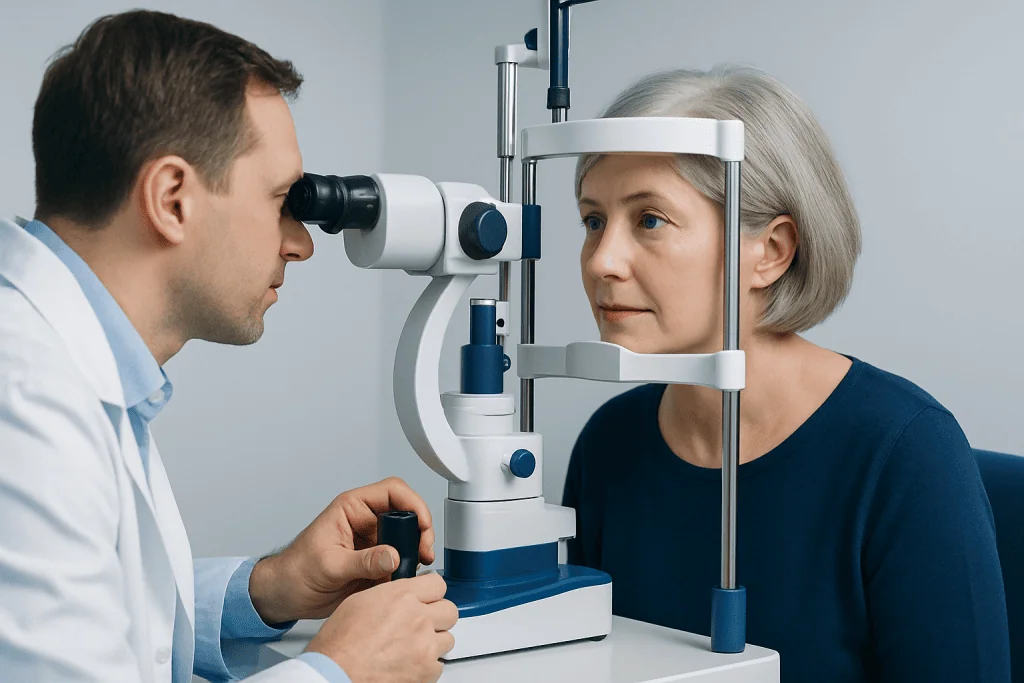
Age-related Macular Degeneration is diagnosed by an ophthalmologist or qualified eye specialist using a detailed eye examination. The doctor asks about symptoms, medical history, family history, smoking and changes in daily visual tasks. Vision is tested in each eye separately because AMD may affect one eye more than the other.
A dilated retinal examination allows the specialist to inspect the macula for drusen, pigment changes, thinning, bleeding or fluid. Optical coherence tomography, often called OCT, is a painless imaging test that provides cross-sectional images of the retina and helps detect swelling, fluid, tissue loss and structural changes. Fundus photography may be used to document the appearance of the retina over time.
If wet AMD is suspected, additional imaging such as retinal angiography may be recommended to evaluate abnormal blood vessels and leakage. An Amsler grid may also be used at home or in the clinic to check for distortion; however, it does not replace a professional examination. Diagnosis also includes determining the type and stage of AMD, because treatment decisions depend on these findings.
Treatment Options
Age-related Macular Degeneration treatment depends on whether the condition is dry or wet, how advanced it is, and how much vision has been affected. The right approach is decided by an ophthalmologist or retina specialist after examination and imaging. Treatment aims to slow progression, manage complications, preserve useful vision and support daily functioning.
For early or intermediate dry AMD, management may include regular monitoring, smoking cessation, control of blood pressure and cardiovascular risk factors, protective sunglasses, and a diet rich in leafy green vegetables, colorful fruits, fish and healthy fats. In selected patients, an eye-health supplement formula may be recommended by a specialist, particularly for intermediate disease, but it should not be started without medical advice because suitability varies.
For wet AMD, the main treatment category is medication delivered into the eye to reduce the activity of abnormal leaking blood vessels. These injections are performed under sterile conditions by trained specialists and usually require ongoing follow-up. In selected cases, laser-based treatments or other retinal procedures may be considered, but they are not appropriate for every patient.
For advanced dry AMD, including geographic atrophy, monitoring and low-vision support are important, and newer specialist treatments may be considered for some patients depending on eye findings and availability. Low-vision rehabilitation, magnifying devices, improved lighting, electronic reading aids and occupational therapy strategies can help people continue reading, managing medications, cooking and moving safely at home.
Living With / Prognosis
Living with Age-related Macular Degeneration often means learning how to protect remaining vision and adapt daily routines. Many people continue to live independently, especially when AMD is detected early and monitored regularly. Since side vision is usually preserved, AMD typically does not lead to complete darkness, but central vision loss can make detailed tasks more challenging.
Practical adjustments can make a meaningful difference. Brighter, glare-free lighting, large-print materials, high-contrast labels, voice-assisted devices, magnifiers and screen accessibility features can support reading and daily organization. Home safety measures, such as removing trip hazards and improving lighting on stairs, are also helpful.
Emotional wellbeing is an important part of care. Changes in vision can affect confidence, hobbies and social life, and patients may benefit from counseling, low-vision services or support groups. Family members can help by encouraging regular appointments, assisting with transport when needed and making home adjustments that promote independence.
The outlook depends on the type and stage of AMD, general health and response to treatment. Regular follow-up is essential because dry AMD can progress and wet AMD may require prompt treatment. Acibadem International provides diagnosis and treatment for retinal conditions, including AMD, through multidisciplinary specialists and JCI-accredited hospitals for international patients.
When to See a Doctor
A person should see an eye doctor if they notice new blurred central vision, distortion, difficulty reading, trouble recognizing faces or a dark spot in the center of vision. These symptoms may be caused by AMD or by other eye conditions, and a professional examination is needed to identify the cause.
Urgent assessment is recommended if straight lines suddenly appear wavy, if central vision changes rapidly, or if one eye becomes noticeably worse than the other. These changes can suggest wet AMD or another retinal problem that may need timely treatment. Prompt evaluation can improve the chance of preserving useful vision.
Adults over 50, especially those with a family history of AMD or a history of smoking, should discuss regular dilated eye examinations with an ophthalmologist. People already diagnosed with AMD should keep scheduled follow-ups and report any new symptoms between visits. Eye health is closely linked with general health, so controlling blood pressure, cholesterol and smoking status should be discussed with qualified healthcare professionals.
Frequently asked questions
What is Age-related Macular Degeneration?
Age-related Macular Degeneration is an eye disease that damages the macula, the central part of the retina used for sharp, detailed vision. It can make reading, recognizing faces and seeing fine details more difficult. Peripheral vision is usually preserved.
What is the difference between dry and wet AMD?
Dry AMD is the more common form and usually progresses gradually as deposits and thinning develop in the macula. Wet AMD occurs when abnormal blood vessels grow under the retina and leak fluid or blood. Wet AMD can cause faster vision changes and needs prompt specialist assessment.
Can Age-related Macular Degeneration be cured?
There is currently no simple cure that reverses all forms of AMD. However, treatments can slow progression or control disease activity in many patients, especially in wet AMD. Early diagnosis and regular monitoring are important for preserving useful vision.
Does macular degeneration cause complete blindness?
AMD mainly affects central vision and usually does not remove peripheral, or side, vision. This means it typically does not cause total darkness. However, advanced AMD can significantly affect reading, driving and recognizing faces, so specialist care and low-vision support are important.
How is Age-related Macular Degeneration diagnosed?
Diagnosis is made through an eye examination, vision testing and detailed imaging of the retina. Common tests include a dilated retinal exam and optical coherence tomography, which shows the layers of the macula. Additional imaging may be used if wet AMD is suspected.
What can a person do to reduce the risk of AMD getting worse?
Stopping smoking is one of the most important steps. Regular eye examinations, healthy blood pressure control, a balanced diet rich in leafy greens and fish, protective sunglasses and following the ophthalmologist's advice can also help. Supplements should only be used if recommended by an eye specialist.
When should someone seek urgent help for AMD symptoms?
A person should seek prompt eye care if straight lines suddenly look wavy, central vision becomes rapidly blurred, or a dark spot appears in the center of vision. Sudden changes may indicate wet AMD or another retinal condition. Timely assessment allows the specialist to decide whether treatment is needed.
References
- American Academy of Ophthalmology
- National Eye Institute
- Royal National Institute of Blind People
- European Society of Retina Specialists
- World Health Organization
This article is for general information only and is not a substitute for professional medical advice. Please consult a qualified doctor about your individual situation.
Treatments for This Condition
Doctors Who Treat This Condition

Prof. Dr. Altan Göktaş
Ophthalmology
Prof. Dr. Ayşe Öner
Ophthalmology
Prof. Dr. Banu Coşar
Ophthalmology
Prof. Dr. Berna Özkan
Ophthalmology
Prof. Dr. Dilaver Erşanlı
Ophthalmology
Prof. Dr. Dilek Güven
Ophthalmology
Prof. Dr. G. Ertuğrul Mirza
Ophthalmology
Prof. Dr. Gökhan Pekel
Ophthalmology
Prof. Dr. Haluk Esgin
Ophthalmology
Dr. Safiye Küçükgül
Ophthalmology
Dr. Sevda Arık Tekin
Ophthalmology