

Capsule Endoscopy: Swallowing the Camera — How the Pill Scan Works
Key Takeaways
- The capsule measures about 26 by 11 millimeters — the size of a large multivitamin — and packs a camera, LED lights, battery, and radio transmitter.
- It exists mainly because roughly 15 of the small intestine's 20 feet lie beyond the reach of both upper endoscopes and colonoscopes.
- Over an 8-to-12-hour battery life, the capsule captures 50,000-plus images at two to six frames per second and beams them to a recorder on your waist.
- Retention — the capsule lodging in the bowel for more than two weeks — occurs in roughly 1 to 2 percent of exams overall, and a dissolvable patency capsule can screen out high-risk cases first.
- The pill camera cannot take biopsies, remove polyps, or stop bleeding, so a positive finding often leads to a second, therapeutic procedure.
- Most people pass the capsule unnoticed within 24 to 72 hours; if passage isn't confirmed within two weeks, a simple X-ray locates it — and no MRI should happen until it's out.
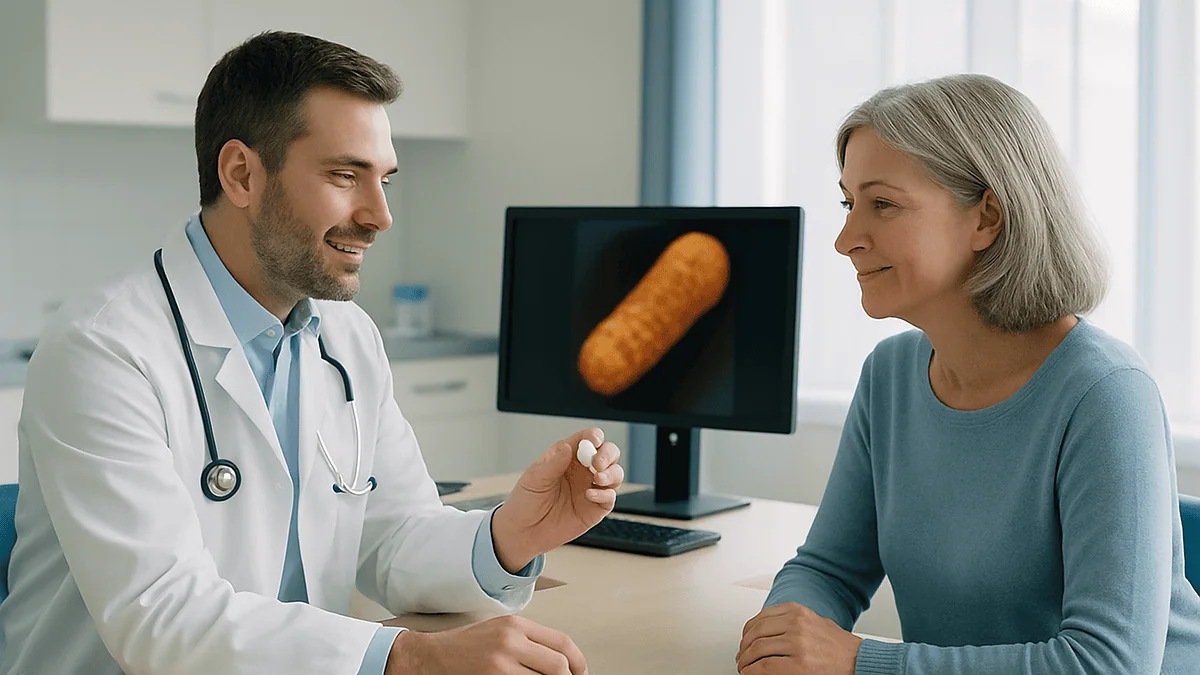
Capsule endoscopy uses a vitamin-pill-sized wireless camera that you swallow with water. As it travels through the digestive tract, it captures thousands of images and transmits them to a recorder worn at your waist. The exam takes about eight hours of quiet, normal activity, and the disposable capsule leaves the body naturally in a bowel movement, usually within a day or two.
The strangest part, patients often say, is how ordinary it feels. A nurse hands you a cup of water and something that looks like a slightly overgrown multivitamin. You swallow. That’s it — no gown, no IV, no dimmed procedure room. You walk out wearing a small recorder, and somewhere inside you, a tiny camera begins photographing territory almost nothing else can reach.
The small intestine is the longest stretch of the digestive tract — roughly 20 feet of coiled, folded tubing — and for decades it was medicine’s blind alley. An upper endoscope reaches its first inches. A colonoscope can peek at its last few. The middle 15 feet or so stayed dark.
Since regulators first cleared a swallowable camera in 2001, that darkness has had a flashlight. Here is how the pill scan actually works, what it can and cannot do, and the honest trade-offs a gastroenterologist weighs before ordering one.
Why Would a Doctor Order a Capsule Endoscopy?
Almost always, the answer is the small intestine — the one region where standard scopes run out of road. An upper endoscopy inspects the esophagus, stomach, and the first portion of the duodenum. A colonoscopy covers the colon and, on a good day, the last inches of the ileum. Everything in between, most of those 20 feet, needs a different tool.
The most common trigger is bleeding without an obvious source. When someone has blood in the stool or a stubborn iron-deficiency anemia, and both upper endoscopy and colonoscopy come back clean, the small bowel becomes the prime suspect. Gastroenterologists call this obscure gastrointestinal bleeding, and it accounts for the majority of capsule referrals.
Other reasons doctors reach for the pill camera include:
- Suspected Crohn’s disease, especially when symptoms point to inflammation beyond the reach of a colonoscope
- Monitoring inherited polyp syndromes that seed growths throughout the small intestine
- Evaluating celiac disease that is not responding as expected
- Looking for small-bowel tumors, which are rare but easy to miss on other imaging
Notice what is not on that list: routine screening for the general public. Capsule endoscopy is a targeted investigation, ordered when there is a specific question that only pictures of the small bowel can answer.
How Does the Pill Camera Actually Work?
Inside a smooth plastic shell about 26 millimeters long and 11 millimeters wide — the footprint of a large multivitamin — engineers have packed a color camera, a ring of tiny LED lights, a battery, and a radio transmitter. Once activated, the capsule photographs continuously, typically two to six frames per second, with newer models adjusting their frame rate when they sense faster movement.
Over an eight-to-twelve-hour battery life, that adds up to somewhere north of 50,000 images. Each frame is beamed wirelessly to sensors — either adhesive patches placed on your abdomen or a belt worn over clothing — and stored on a recorder about the size of a paperback book.
The capsule has no engine and no steering. It rides peristalsis, the same rhythmic muscle waves that move a meal along, tumbling gently through the stomach, into the duodenum, and down the length of the jejunum and ileum. Gravity and muscle do the driving; the capsule just keeps clicking the shutter.
That passivity is both its charm and its limitation. Nothing enters your body except the pill itself — no tube, no air pumped in, no sedation. But nobody can pause on a suspicious spot, rinse the lens, or double back for a second look. The capsule gets one pass, and one pass only.
How Do You Prepare for a Capsule Endoscopy?
Preparation is milder than for a colonoscopy, but it matters more than people expect. Food debris and dark fluid are the enemies of a clear picture, and a poorly prepped small bowel can hide exactly the lesion everyone is looking for.
Instructions vary by center, but a typical plan looks like this:
- The day before: light meals, often shifting to clear liquids by evening. Some practices add a bowel-cleansing laxative drink; studies suggest it improves visibility in the lower small intestine.
- The night before: nothing to eat or drink for roughly 12 hours before you swallow the capsule.
- Medications and supplements: your care team will review everything you take. Certain supplements — iron in particular — can stain the intestinal lining dark and are usually paused several days ahead. Mention blood thinners and diabetes medicines specifically so timing can be adjusted safely.
Two practical notes deserve a highlight. First, wear loose, two-piece clothing on test day, since sensors may be taped to your abdomen. Second, tell your doctor about any history of bowel obstruction, abdominal surgery, or known Crohn’s disease before the appointment — that conversation can change whether the capsule is appropriate at all, as we’ll see in the section on retention.
What Happens on the Day of the Test, Hour by Hour
Expect the appointment itself to be brief — often under 30 minutes. A technician attaches the sensor patches or fits the belt, connects the recorder, and hands you the activated capsule with a glass of water. Most people swallow it on the first try; the coating is slick by design.
Then comes the unusual part: you leave. Capsule endoscopy is an outpatient test in the truest sense. You can walk, work at a desk, run errands. A few rules apply while the camera is rolling:
- Skip strenuous exercise, heavy lifting, and anything that jostles the recorder or peels the sensors loose.
- Stay away from strong magnetic fields — most importantly, do not schedule an MRI until the capsule is confirmed out of your body.
- Keep the recorder close and check its indicator light occasionally, per your center’s instructions.
Eating resumes on a schedule. Most protocols allow clear liquids about two hours after swallowing the capsule and a light snack around the four-hour mark, once the camera has cleared the stomach.
Roughly eight hours in, you return the recorder and sensors — either in person or, at some centers, the next morning. The capsule itself stays on its journey; you owe the clinic the data, not the device.
How Long Does a Capsule Endoscopy Take?
Three different clocks are running, and mixing them up causes most of the confusion.
The exam clock: about eight hours, occasionally up to twelve with longer-battery capsules. This is the window when the camera records and you wear the sensors. For you, it feels less like a procedure and more like a quiet day with a gadget on your belt.
The passage clock: 24 to 72 hours for most people, which is how long the capsule takes to exit in a bowel movement. Slower transit is common and usually harmless; doctors only investigate if the capsule has not passed within about two weeks, at which point a simple abdominal X-ray can locate it.
The results clock: several days to two weeks. Someone has to review the footage — more on that below — and a written report then goes to the doctor who ordered the study.
Compare that with a colonoscopy, which occupies half a day, requires sedation and a driver, but delivers answers (and often treatment) before you leave the building. Capsule endoscopy trades speed of answers for gentleness of experience. Which trade makes sense depends entirely on the question being asked — the small bowel simply cannot be examined the fast way.
Does It Hurt to Swallow — or Pass — the Capsule?
For the overwhelming majority of people, no, at either end of the journey. The capsule is engineered to be swallowed: smooth-coated, rounded, and — while larger than an average pill — comfortably within the range of what most adults manage with a good gulp of water. Studies consistently report that well over nine in ten patients swallow it without difficulty on the first attempt.
Once it’s down, you feel nothing. The digestive tract has few of the nerve endings that register touch, so a tumbling capsule generates no more sensation than yesterday’s lunch. There is no air pumped into the bowel, which is the source of much of the bloating and cramping people associate with traditional endoscopy. No sedation means no grogginess, no IV bruise, no lost afternoon.
Passing the capsule is equally uneventful. It exits with a normal bowel movement, and most people never notice it go. There is no need to strain, no sharp edges, nothing to feel.
The honest caveats: people with existing swallowing difficulties may struggle, and for them the capsule can be placed directly into the small bowel during a brief endoscopic procedure. And in the rare event a capsule lodges at a narrowed segment of intestine, symptoms such as cramping pain or bloating can develop — a genuine but uncommon problem covered in detail below.
What Can Capsule Endoscopy Find?
The pill camera’s specialty is surface detail — the mucosal lining that CT scans and X-rays render as a blur. Its greatest hits, in rough order of frequency:
- Angiodysplasias: fragile, abnormal clusters of blood vessels that are the leading cause of small-bowel bleeding, particularly in adults over 60. They look like tiny red fern patterns on the intestinal wall and are nearly invisible to other imaging.
- Ulcers and erosions: the calling cards of Crohn’s disease, and sometimes of long-term anti-inflammatory pain reliever use.
- Tumors and polyps: uncommon, but capsule studies find small-bowel masses in a meaningful minority of patients investigated for bleeding — often earlier than they would otherwise surface.
- Celiac changes: flattening and scalloping of the villi, the microscopic fingers that absorb nutrients.
How well does it perform? In pooled studies of obscure gastrointestinal bleeding, capsule endoscopy identifies a likely source in roughly 60 percent of cases — substantially better than older small-bowel X-ray techniques. Timing matters, too: the diagnostic yield climbs when the capsule is given within days of a bleeding episode, while the culprit lesion is still active and visible.
What it produces, though, is a picture, not a verdict. Confirming what a suspicious spot actually is usually requires tissue — and the capsule cannot collect any.
What Are the Disadvantages of Capsule Endoscopy?
An honest accounting matters here, because the pill scan’s gentleness can make it sound like a free lunch. It isn’t.
It looks; it cannot touch. No biopsies, no removing polyps, no cauterizing a bleeding vessel. A positive capsule study frequently leads to a second procedure — often device-assisted enteroscopy, in which a specialized scope is worked deep into the small bowel to treat what the capsule found.
It cannot be steered. If the lens is momentarily smeared with debris, or the capsule tumbles past a lesion hidden behind a fold, that stretch of bowel simply goes unexamined. Every capsule study has blind moments.
The battery can quit early. In a minority of exams — up to one in five in earlier studies, fewer with modern longer-life capsules — the camera dies before reaching the colon, leaving the final segment of small bowel undocumented. Slow stomach emptying is a common culprit.
False alarms happen. Innocent bumps, mucus strands, and normal vascular patterns can look ominous on a still frame, occasionally prompting follow-up procedures that find nothing.
Results take time. Days to two weeks, versus same-day impressions from conventional endoscopy.
None of these is a reason to refuse the test when it’s indicated. They are reasons capsule endoscopy complements traditional scopes rather than replacing them.
Capsule Retention: The One Risk Worth Understanding
Retention means the capsule stops moving and stays in the digestive tract longer than two weeks. It is the signature complication of this test, and the numbers are worth knowing precisely because they are reassuring in context.
Across pooled studies, retention occurs in roughly 1 to 2 percent of all capsule exams. The risk is lowest — well under 1 percent — in people investigated for unexplained bleeding with no history of bowel disease. It climbs meaningfully, to several percent or more, in people with established Crohn’s disease, prior bowel obstruction, extensive abdominal surgery, or radiation injury, because all of these can narrow the intestine into a stricture the capsule cannot squeeze past.
Here is the counterintuitive part: a retained capsule usually causes no symptoms at all. Many are discovered only on the follow-up X-ray. Depending on the situation, doctors may simply wait (some capsules eventually pass on their own), treat underlying inflammation to relax the narrowing, retrieve the capsule with a deep enteroscope, or — rarely — remove it surgically. Complete bowel obstruction from a capsule is uncommon.
For higher-risk patients, there is an elegant safeguard: a patency capsule, a dissolvable dummy pill the same size as the real one. If it passes intact, the camera capsule almost certainly will too. If it lodges, it softens and dissolves within days — a failed dress rehearsal instead of a real problem.
Capsule Endoscopy vs. Traditional Endoscopy and Colonoscopy
These tests are teammates with different positions, not rivals for the same job. A side-by-side view makes the division of labor obvious:
| Feature | Capsule endoscopy | Upper endoscopy | Colonoscopy |
|---|---|---|---|
| Territory covered | Entire small bowel (~20 ft) | Esophagus, stomach, upper duodenum | Colon and end of the ileum |
| Sedation | None | Usually | Usually |
| Biopsy or treatment possible | No | Yes | Yes |
| Your day | Quiet 8-hour day; no escort needed | Half day plus recovery; driver needed | Half day plus recovery; driver needed |
| Signature risk | Capsule retention (~1–2%) | Rare perforation; sedation effects | Rare perforation; sedation effects |
| Results | Days to 2 weeks | Same day (biopsies later) | Same day (biopsies later) |
One frequent question deserves a direct answer: can the capsule replace a screening colonoscopy? Generally, no. Colon-specific capsules exist and are occasionally used when a colonoscopy is incomplete or too risky, but colonoscopy remains the standard because it does something no camera pill can — remove precancerous polyps on the spot, in the same visit that finds them. A capsule that spots a polyp still sends you back for the scope.
Who Shouldn't Swallow the Camera?
A short list of situations calls for caution, a workaround, or a different test entirely.
- Known or suspected bowel narrowing. Strictures from Crohn’s disease, prior obstruction, abdominal radiation, or certain surgeries raise retention risk sharply. Many centers require imaging or a patency capsule first.
- Swallowing disorders. Not necessarily a dealbreaker — the capsule can be carried past the stomach and released during a brief endoscopic procedure, an approach also used for young children.
- Implanted cardiac devices. Pacemakers and defibrillators appear on product labels as a precaution, though published studies have found clinically meaningful interference to be rare. This is a case-by-case conversation between your gastroenterologist and cardiologist, not an automatic no.
- Pregnancy. Safety data are limited, so the test is typically deferred unless the need is pressing.
- An MRI on the horizon. Not a contraindication to the capsule, but the MRI must wait until the capsule is confirmed out — a metal object in a powerful magnet is a genuine hazard.
The common thread: almost none of these are absolute walls. They are flags that prompt an extra step — a patency test, an endoscopic placement, a specialist consult — before the camera goes down the hatch. Full disclosure of your medical history at the planning visit is what makes those safeguards work.
When to See a Doctor: Symptoms Before and After the Test
Capsule endoscopy exists to investigate symptoms that should never be waved off. See a doctor promptly — before any test is even on the table — if you notice black or tarry stools, visible blood in the stool, unexplained fatigue or breathlessness that could signal anemia, persistent abdominal pain, or weight loss you weren’t trying for. These are the exact problems the small bowel can quietly cause, and evaluating them early widens every option.
After the test, most people sail through without a single symptom. Contact your care team without delay if you develop:
- Worsening or severe abdominal pain, cramping, or bloating
- Nausea or vomiting, especially if you cannot keep liquids down
- Fever or chest pain
- Any trouble swallowing that began with the capsule
These can signal that the capsule has lodged at a narrowing — uncommon, as the retention numbers show, but time-sensitive when it happens.
Two quieter follow-ups matter as well. If you have not seen the capsule pass (or simply aren’t sure) within two weeks, let your doctor know so an X-ray can confirm it’s gone — essential before any future MRI. And keep the results appointment even if you feel fine; a normal-feeling week says nothing about what 50,000 photographs may have captured. Findings, next steps, and sometimes genuine reassurance all live in that report.
Frequently asked questions
Why would a doctor order a capsule endoscopy?
Most often to find the source of gastrointestinal bleeding or iron-deficiency anemia when upper endoscopy and colonoscopy come back normal, pointing suspicion at the small intestine. Other common reasons include evaluating suspected Crohn’s disease, monitoring inherited polyp syndromes, investigating celiac disease that isn’t improving, and looking for small-bowel tumors. It is a targeted test for a specific question, not a general screening tool.
Does it hurt to pass a capsule endoscopy?
No — passing the capsule is painless, and most people never notice it leave. The intestinal tract lacks the nerve endings that sense touch, so the smooth, rounded capsule causes no sensation as it travels or exits with a normal bowel movement. Pain afterward is not expected; new or severe abdominal pain, bloating, or vomiting after the test warrants a prompt call to your doctor.
What are the disadvantages of capsule endoscopy?
It can only look, not treat: no biopsies, no polyp removal, no stopping bleeding, so positive findings often require a second procedure. The capsule can’t be steered, may miss lesions hidden behind folds, and its battery sometimes dies before the exam is complete. Results take days to two weeks. The signature risk is retention — the capsule lodging in a narrowed bowel — in roughly 1 to 2 percent of exams.
How long does it take to have a capsule endoscopy?
The recording itself lasts about eight hours, occasionally up to twelve, during which you go about a quiet normal day wearing a small recorder. Swallowing the capsule takes seconds and the appointment is usually under half an hour. The capsule exits in a bowel movement within 24 to 72 hours for most people, and the reviewed results typically arrive within several days to two weeks.
Can I eat or drink during the test?
Yes, on a schedule. Most protocols allow clear liquids about two hours after swallowing the capsule and a light snack around four hours, once the camera has cleared the stomach. Before the test, you’ll fast for roughly 12 hours, often after a day of light meals or clear liquids. Normal eating usually resumes once the recording day ends, per your care team’s instructions.
Do I have to retrieve the capsule after it passes?
No. The capsule is single-use and disposable, and all of its images were already transmitted to the recorder you returned. You can simply flush it. Some centers ask you to note when you see it pass, since that confirms it has left your body — useful information, because no MRI should be scheduled until the capsule is confirmed gone.
Can capsule endoscopy replace a colonoscopy?
Generally, no. The standard capsule is designed for the small intestine, and even colon-specific capsules cannot do what colonoscopy does: remove precancerous polyps during the same visit that finds them. Colon capsules are occasionally used when a colonoscopy was incomplete or is too risky, but any polyp they spot still requires a colonoscopy afterward. The two tests examine different territory and serve different purposes.
Is capsule endoscopy safe if I have a pacemaker?
Often yes, but it requires an individualized decision. Device labels list pacemakers and defibrillators as a precaution because the capsule transmits by radio, yet published studies have found clinically significant interference to be rare. Your gastroenterologist typically coordinates with your cardiologist, and some centers add monitoring on the day of the test. Always disclose any implanted cardiac device during the planning visit.
What happens if the capsule gets stuck?
Usually nothing dramatic — most retained capsules cause no symptoms and are found on a follow-up X-ray after two weeks. Options then include watchful waiting, since some capsules pass on their own; treating underlying inflammation that narrowed the bowel; retrieving the capsule with a deep enteroscope; or, rarely, surgery. Complete bowel obstruction is uncommon. Severe pain, bloating, or vomiting after the test should prompt an immediate call.
How accurate is capsule endoscopy?
For its main job — finding the source of obscure gastrointestinal bleeding — pooled studies show a diagnostic yield of roughly 60 percent, clearly better than older small-bowel X-ray methods. Accuracy improves when the test is done soon after a bleeding episode. It is not infallible: lesions behind folds can be missed, debris can obscure the lens, and suspicious findings often need a second procedure for confirmation.
This article is for general information only and is not a substitute for professional medical advice. Please consult a qualified doctor about your individual situation.

More from the Blog

Nipah Virus: Why Outbreaks Alarm Scientists — Transmission, Symptoms and What Travelers Should Know
Nipah virus is a bat-borne infection found in parts of South and Southeast Asia that spreads through contaminated fruit or date palm sap, infected…
Cancer Screening Tests by Age: What Evidence-Based Guidelines Recommend
Evidence-based guidelines recommend cervical cancer screening starting at age 21, mammograms every one to two years beginning at 40, colorectal cancer screening from 45…

RSV Vaccine for Adults: Who Is Eligible, How It Works and What Side Effects Were Recorded
RSV vaccines for adults are given as a single dose and are recommended in the US for everyone aged 75 and older, and for…

The PPD Skin Test: How TB Screening Works and How Results Are Read
A PPD test, also called a tuberculin skin test, screens for tuberculosis infection. A tiny amount of purified protein derivative is injected just under…
Virtual Colonoscopy: The CT Alternative and Its Honest Trade-offs
Virtual colonoscopy, also called CT colonography, screens for colorectal cancer using a low-dose CT scan instead of a scope. It requires the same bowel…