

Does Psoriasis Cause Hair Loss? Scalp Psoriasis, Treatment and Regrowth
Key Takeaways
- Scalp psoriasis causes non-scarring hair loss in most cases, meaning the follicle survives and regrowth is expected once inflammation is controlled.
- Psoriatic skin cells reach the surface in three to seven days instead of the normal three to four weeks, which is why scale builds up around hair shafts and snaps them.
- Diffuse shedding often appears two to three months after a flare because inflammation pushes follicles into a synchronized resting phase.
- Hair regrows at roughly half an inch a month, so visible recovery takes months even after the scalp looks clear.
- Smooth bald patches without scale are not psoriasis and need separate assessment, even in someone who has psoriasis elsewhere.
- Gentle washing with fingertips and softened scale protects hair; the damage comes from force, nails and picking rather than from washing frequency.
Psoriasis itself does not destroy hair follicles, but scalp psoriasis can cause temporary hair loss. Thick scale, inflammation, scratching and picking at plaques can break hairs or push follicles into a resting phase, so hair sheds. Once the inflammation is controlled, hair usually grows back over several months. Permanent loss is uncommon and generally linked to long-standing, untreated or scarred skin.
The hairbrush tells the story before the mirror does. A woman in her forties described it to me this way: for years her scalp psoriasis was an itch she managed with a fingernail and a dark sweater. Then one winter the bristles came away furred with hair, and the plaque above her right ear started to look thin. Her first thought was not about skin at all. It was, quietly, am I going bald?
That fear is common enough that dermatology clinics field it weekly, and the internet answers it badly. Forums swing between reassurance and alarm; product pages hint that the right shampoo will fix everything. The actual evidence is more interesting, and on the whole more hopeful.
What follows is an honest tour of what psoriasis does to a scalp, why hair comes out, why it almost always comes back, and where the genuine warning signs lie.
Can psoriasis cause hair loss? The honest short version
Yes, but with an important asterisk. Psoriasis is an immune-driven skin condition, not a hair-follicle disease. The plaques it produces on the scalp sit on top of the follicles rather than attacking them the way some other conditions do. Hair loss, when it happens, is collateral damage from what the plaque and the person’s response to it do to the hair shaft and the follicle’s growth cycle.
Dermatologists distinguish two broad kinds of hair loss. In non-scarring loss the follicle survives and can restart. In scarring loss the follicle is replaced by fibrous tissue and does not recover. Scalp psoriasis sits almost entirely in the first category. The Cleveland Clinic puts it plainly: hair lost because of scalp psoriasis usually grows back once the skin is treated.
Think of a lawn under a tarp. Leave the tarp for a season and the grass yellows and thins. Pull it off and, given water and time, the lawn returns, because the roots were never removed. That is a fair mental model for a psoriatic scalp. The tarp is inflammation and scale; the roots are your follicles.
Where the model breaks down is at the extremes: decades of thick, untreated plaques, repeated infection from broken skin, or aggressive picking that damages the surface over and over. In that territory, some permanent thinning can occur. It is the exception, and it is largely preventable.
What is actually happening on a psoriatic scalp?
Normal skin renews itself on a leisurely schedule. Cells born in the deep layer take roughly three to four weeks to travel to the surface and flake away unnoticed. In psoriasis, the immune system misfires and accelerates that journey to as little as three to seven days, according to the NHS. Cells arrive at the surface before they have matured, pile up, and form the silvery-white scale that defines the condition.
On the scalp this crowding has consequences it does not have on an elbow. Hair shafts have to push through the plaque. Scale wraps around the base of each hair like a collar. Blood vessels beneath the plaque dilate, which is why the skin looks red or violet and feels warm. Nerve endings become sensitized, producing the itch that many patients rank as worse than the appearance.
Scalp involvement is common. The Cleveland Clinic estimates that roughly half of people with psoriasis have it on the scalp at some point, and for some it is the only site. Plaques favor the hairline, behind the ears and the nape of the neck, but can cover the whole scalp in a helmet-like sheet. Overall, psoriasis affects about 2 in 100 people in the UK, per the NHS, with similar figures reported in the US.
None of this, on its own, kills a follicle. But it sets up the conditions under which hair starts to leave.
Why does the hair fall out? Three overlapping mechanisms
Hair loss in scalp psoriasis is rarely one thing. It is usually a stack of three.
Mechanical breakage. Hair trapped in thick scale becomes brittle where it exits the skin. Combing, brushing or even sleeping on a pillow snaps it. Picking scale off takes hairs with it, root and all. This is the most immediate cause and the one people notice on the brush.
Inflammatory shedding. Follicles run on a cycle: a long growing phase, a brief transition, then a resting phase that ends in shedding. Stress on the scalp, including inflammation, can push a large batch of follicles into rest at the same time. Two to three months later they release their hairs together, a pattern called telogen effluvium. Mayo Clinic describes this delayed, diffuse shedding after a physical or emotional shock, and an inflamed scalp qualifies as a local shock.
The itch-scratch loop. Scratching feels like relief and is, in fact, injury. Psoriasis has a well-documented tendency to flare where skin is damaged, the so-called Koebner phenomenon, so scratching can enlarge the very plaque that caused the itch. Repeated trauma also inflames the skin around the follicle opening and increases breakage.
The practical implication matters: two of these three mechanisms are driven by hands and hairbrushes, not by the disease itself. That is where most of the leverage sits.
Will hair loss from scalp psoriasis grow back?
In the large majority of cases, yes. Because the follicle is intact beneath the plaque, it retains the ability to produce a new hair once the environment above it calms down. This is the single most reassuring fact in the whole topic, and it is well supported: the Cleveland Clinic, the NHS and Mayo Clinic all describe scalp-psoriasis hair loss as typically temporary.
Regrowth tends to follow a recognizable sequence. First the scale thins and the redness fades. Then the shedding slows, often a few weeks after the skin looks better, because hairs already in the resting phase still need to complete it. Finally, short fine hairs appear along the edges of the old plaque and gradually thicken.
Where regrowth disappoints, there is usually a reason. Long-standing untreated plaques, particularly on the crown, can leave the skin thinner and the follicle openings less visible. Recurrent bacterial infection from broken skin can scar. Years of habitual picking can too. Age-related or hereditary thinning may also be happening underneath the psoriasis and be unmasked when the plaque clears, which is easy to misattribute.
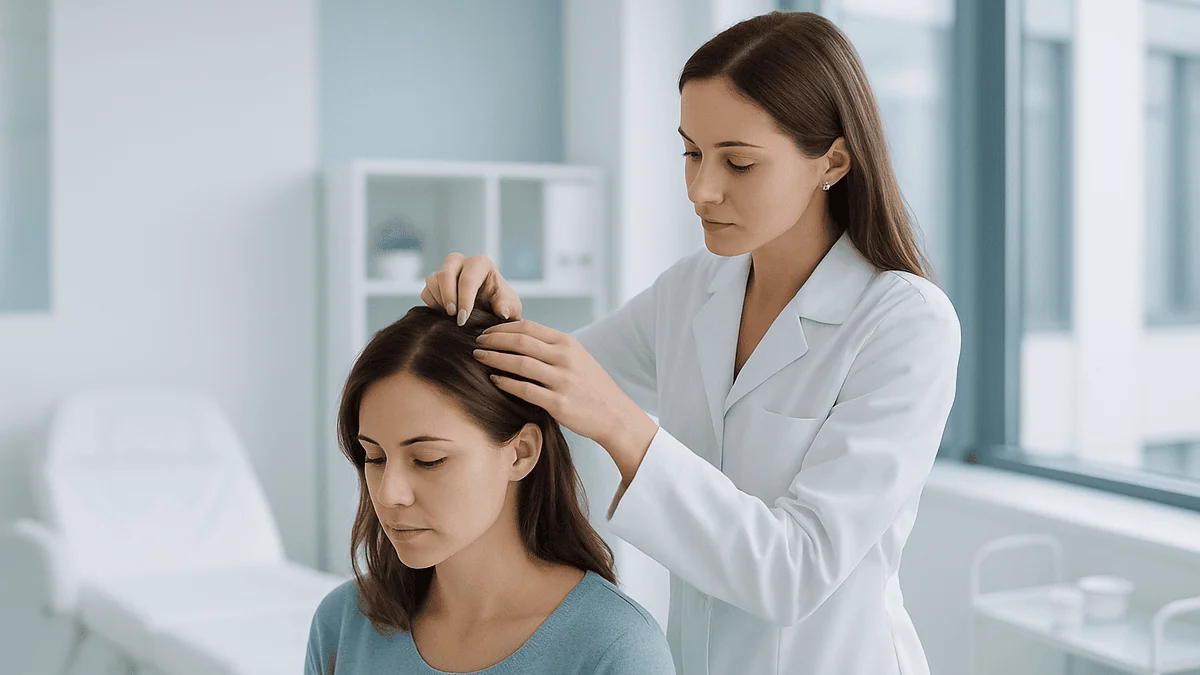
If hair has not returned six to twelve months after the skin has been clear, a clinician should look at the scalp closely, sometimes with a magnifying dermatoscope, to check whether the follicles are still present. Follicle openings that have vanished suggest scarring and change the conversation. Visible openings mean patience is still the right strategy.
How long does regrowth take? Set the calendar, not the alarm
Hair is slow, and knowing exactly how slow prevents a lot of unnecessary despair. Scalp hair grows about half an inch, roughly one centimeter, per month, according to the Cleveland Clinic. A follicle that was pushed into rest by inflammation must finish that resting phase, shed its old hair, and then rebuild a new shaft from scratch.
Laid out as a timeline, using figures from Mayo Clinic and the Cleveland Clinic:
- Weeks 0 to 6: treatment reduces scale and inflammation; breakage falls quickly because there is less scale to snag hair.
- Weeks 6 to 12: delayed shedding from the earlier inflammation may still occur, which feels like a setback but is the cycle running its course.
- Months 3 to 6: fine new hairs become visible at the plaque margins; density begins to recover.
- Months 6 to 12: hair reaches a length and thickness that reads as normal to the eye.
Two variables stretch or shrink this. The first is how completely the skin is controlled; a plaque that keeps flaring keeps resetting the clock. The second is scratching and picking, which restarts breakage regardless of how good the treatment is.
A useful habit is to photograph the area in the same light once a month. Day-to-day, nothing seems to change. Month-to-month, the pictures usually tell a more encouraging story than the mirror.
Is it definitely psoriasis? Conditions that look alike
Several scalp problems produce flakes, itch and shedding, and they are treated differently. Getting the label right is not academic; it decides whether hair will come back on its own.
| Condition | What the scale and skin look like | Hair loss pattern | Follicles |
|---|---|---|---|
| Scalp psoriasis | Thick, silvery-white, sharply edged plaques; often past the hairline onto forehead or neck | Diffuse or patchy thinning under plaques; breakage | Intact; regrowth expected |
| Seborrheic dermatitis | Greasy, yellowish, finer flakes; poorly defined borders; eyebrows and nose creases often involved | Mild shedding, usually from scratching | Intact |
| Alopecia areata | Smooth, skin-colored bald patches with no scale | Round, coin-sized patches appearing quickly | Intact but immune-targeted; often regrows |
| Fungal infection (tinea capitis) | Scaly patches with broken hairs; sometimes swollen, boggy areas | Patchy, with black dots where hairs snapped | Intact unless severe |
| Scarring alopecias | Shiny, smooth skin; redness or pustules around follicles | Slowly enlarging permanent patches | Destroyed |
Psoriasis and seborrheic dermatitis overlap so often that dermatologists use the word “sebopsoriasis” for the gray zone. Mayo Clinic notes that a clinician usually diagnoses psoriasis by examination alone, sometimes checking nails, elbows and knees for corroborating clues. A skin sample is occasionally taken when the picture is unclear or when scarring is suspected.
One pattern deserves a specific flag: smooth bald patches without any scale are not psoriasis, even in someone who has psoriasis elsewhere. The two conditions can coexist, and the second one needs its own assessment.
What is the biggest trigger for psoriasis?
People want a single villain, and the evidence refuses to provide one. Psoriasis flares are the product of a genetic tendency meeting an environmental push, and the push differs from person to person. The NHS lists the well-established triggers: skin injury, including scratching and sunburn; excess alcohol; smoking; emotional stress; hormonal changes, particularly around puberty and menopause; certain medicines; and infections, notably streptococcal throat infections, which are a classic trigger for the small-spot form of psoriasis.
If pressed to rank them for the scalp specifically, two stand out for practical reasons rather than because studies crown them. Stress is the trigger patients report most often, and the relationship runs both ways: a visible, itchy scalp is itself stressful, and stress lowers the threshold for scratching. Skin injury is the one most directly under a person’s control, because on the scalp the main source of injury is fingernails and aggressive scale removal.
Weather matters too. Cold, dry air and reduced winter sunlight are associated with flares for many people, and the NHS notes that sunlight in moderation can help some; sunburn, however, is a trigger, so “more sun” is not sound advice.
The honest answer to the question, then, is that your biggest trigger is personal and discoverable. A simple log of flares alongside sleep, stress, illness and alcohol over a few months often reveals a pattern more reliably than any general list.
Should I wash my hair more often if I have scalp psoriasis?
This question has a myth on each side. One camp believes washing dries the scalp and worsens flakes; the other scrubs daily to “get the scale off.” The evidence supports neither extreme and does not prescribe a magic frequency.
Washing does three useful things for a psoriatic scalp. It removes loose scale so there is less to catch on the brush. It delivers medicated ingredients, when a clinician has recommended them, to the skin rather than to the hair. And it reduces the yeast and oil that can aggravate the overlapping seborrheic component. The Cleveland Clinic and NHS both describe medicated shampoos as a mainstay of scalp treatment, which only works if the product reaches the scalp and sits there for the recommended time before rinsing.
What harms is not frequency but force. Hot water, vigorous rubbing with fingernails and scraping plaques with a comb all injure the skin, invite the Koebner response and snap hairs. Lukewarm water, fingertips rather than nails, and letting scale-softening products loosen the plaque before it is gently removed are the habits that protect hair.
Frequency, therefore, can follow your hair type and lifestyle. Fine, oily hair may do better with more frequent gentle washes; textured or dry hair may need fewer washes and more conditioner on the lengths. Whatever the schedule, the scalp should be treated as inflamed skin, because it is, and handled the way you would handle a graze on your arm.
How to prevent hair fall due to psoriasis: habits that actually help
Prevention here is mostly about protecting hairs that are perfectly healthy from being broken by scale, tools and hands. The following are low-risk and consistent with NHS and Cleveland Clinic guidance.
- Soften before you remove. Let a scale-loosening product or a plain oil sit on the plaque so scale lifts on its own; peeling dry scale takes hair with it.
- Comb wet hair with a wide-toothed comb, starting at the ends and working toward the scalp, to reduce pulling at the inflamed base.
- Skip tight styles. Ponytails, braids and extensions add traction to follicles already under strain, and traction itself is a recognized cause of hair loss.
- Keep heat away from the scalp. Blow-dryers on a cool setting, held at a distance, avoid drying and cracking plaques.
- Keep nails short and find a substitute for scratching: a cool compress, a dab of moisturizer, or pressing rather than raking.
- Treat the whole scalp when advised, not only the visible plaque; early inflammation is often invisible under hair.
Behind the list sits a single idea. Every hair that leaves because of scratching or a hard brush is one the follicle then has to replace on its slow schedule. Break fewer hairs and the follicle’s ordinary output becomes visible again as density. That is not glamorous advice, and it is the intervention with the best ratio of effort to result.
Diet, supplements and special rinses attract a great deal of attention online. Evidence that any of them prevents psoriasis-related hair loss is thin; a balanced diet supports hair generally, and a clinician can check for common deficiencies if shedding seems out of proportion to the scalp findings.
How scalp psoriasis treatment works, and what to expect from it
Treatment aims at the inflammation, not the hair. Fix the skin and the hair follows. Decisions about which option suits a given scalp belong to the treating clinician, but understanding the tiers helps set realistic expectations.
Topical treatments form the first tier. Some reduce inflammation directly; others slow the accelerated cell turnover; scale-softening ingredients thin the plaque so the active treatments can reach the skin and so hair can move freely. On the scalp these come as lotions, gels, foams and shampoos designed to get past hair. The NHS notes that topical treatments can take several weeks to show their effect, so a fair trial is measured in weeks, not days.
Light therapy uses controlled ultraviolet exposure under medical supervision. Hair blocks light, so scalp use often requires special combs or a very short cut, which limits its role.
Systemic treatments, including biologic medicines, are considered for extensive or stubborn disease. They act on the immune signals that drive plaque formation throughout the body rather than on the surface. Timelines vary by medicine; improvement typically emerges over weeks to a few months.
What none of these do is speed up the hair cycle. Even with a fully cleared scalp, regrowth runs on the follicle’s own clock described earlier. Patients who expect hair to reappear within a month of clearer skin often abandon treatments that are working. The skin is the leading indicator; the hair is the lagging one.
Can psoriasis treatments themselves cause hair loss?
Occasionally, and it is worth knowing so that a new pattern of shedding is reported rather than endured.
Hair shedding appears among the listed side effects of some systemic psoriasis medicines. The mechanism is usually the same telogen effluvium described earlier: the body registers the change as a stressor, a batch of follicles enters rest, and diffuse shedding follows two to three months later. This pattern is typically reversible and often settles even while treatment continues, but only a prescriber can weigh it against the benefit the medicine is providing.
Medical literature also contains case reports of “paradoxical” reactions, in which a treatment that calms psoriasis coincides with a new immune skin problem, including alopecia areata, the condition that produces smooth round bald patches. These reports are uncommon, and case reports cannot establish how often such events occur or prove cause. What they do establish is that a smooth, scale-free bald patch appearing during treatment deserves a look from the prescribing team rather than an assumption that it is “just the psoriasis.”
Topical treatments used on the scalp rarely cause hair loss. The more frequent problem is the reverse: hair gets in the way of the treatment, so the plaque persists and continues to break hairs. Local irritation from a product can also prompt scratching, which brings the itch-scratch loop back into play.
Stopping a medicine abruptly because of shedding is a decision with its own risks, including rebound flares. The right move is a prompt conversation, not a quiet discontinuation.
Stress, sleep and the itch-scratch loop that sabotages regrowth
Ask a room of people with scalp psoriasis what wakes them at night and the answer is itch. Ask what they do about it half-asleep, and the answer is scratch. Nighttime scratching is a leading cause of the hair on the morning pillow, and it is almost entirely unconscious.
Stress feeds this loop from several directions. It is a recognized psoriasis trigger in its own right, per the NHS and Mayo Clinic. It lowers the threshold at which itch becomes intolerable. It fragments sleep, and poor sleep amplifies itch perception the following day. And visible hair loss is itself a source of stress, closing the circle.
Breaking the loop is therefore partly a skin task and partly a nervous-system one. On the skin side, treatment that reduces inflammation reduces itch, often within the first couple of weeks even before plaques visibly shrink. On the behavior side, small structural changes help: short nails, cotton gloves or a soft cap in bed for a few weeks, a cool damp cloth on the bedside table, and a fixed wind-down routine that makes deep sleep more likely.
Psychological support has a legitimate place here, not as a consolation prize but because psoriasis is linked with higher rates of anxiety and low mood, something the NHS explicitly highlights. Talking therapies, structured stress-reduction programs and simply being taken seriously by a clinician all reduce the load on the scalp indirectly. A calmer person scratches less; a scratched-less scalp grows more hair. The mechanism is unglamorous, and it is real.
When to see a doctor about scalp psoriasis and hair loss
Most scalp psoriasis can be diagnosed and managed by a primary care clinician, with referral to a dermatologist for extensive, stubborn or diagnostically uncertain cases. Certain situations should prompt an appointment sooner rather than later.
Book a visit if scale and itch have not improved after a fair trial of measures recommended by a clinician; if hair is coming out in clumps rather than a gradual increase on the brush; if bald patches are smooth and scale-free, which suggests a different diagnosis; if the scalp becomes painful, weepy, crusted or produces pus, which can indicate infection; or if areas of the scalp look shiny and hairless with no visible follicle openings, which raises the question of scarring and merits a specialist opinion while follicles can still be assessed.
Seek urgent care, the same day, for the rare red flags: rapidly spreading redness covering most of the body with fever, chills or feeling generally unwell, which can signal a severe form of psoriasis requiring hospital assessment; or signs of a serious skin infection such as spreading heat, swelling and fever.
Two other prompts are easy to overlook. New joint pain, stiffness in the morning or swollen fingers in someone with psoriasis should be assessed, because a proportion of people develop psoriatic arthritis and earlier treatment protects joints. And if the psoriasis is affecting mood, sleep or willingness to leave the house, say so; that is a medical concern, not a personal failing, and there is help for it.
Frequently asked questions
Will hair loss from scalp psoriasis grow back?
In most cases, yes. Scalp psoriasis rarely destroys hair follicles, so once inflammation and scale are controlled the follicles resume producing hair. Expect a delay: shedding can continue for a few weeks after the skin improves, and new hair grows at about half an inch per month. Persistent bald areas that remain a year after clear skin, especially if the surface looks shiny, should be examined for scarring.
Can psoriasis cause permanent hair loss?
Rarely. Permanent loss requires the follicle to be scarred over, which is not how psoriasis normally behaves. It has been described in long-standing, untreated, heavily picked or repeatedly infected plaques, where chronic damage to the skin surface eventually affects follicle openings. Early treatment and protecting the scalp from scratching and harsh scale removal keep the risk low.
What is the biggest trigger for psoriasis?
There is no single biggest trigger; it varies by person. Recognized triggers include stress, skin injury such as scratching or sunburn, streptococcal throat infections, excess alcohol, smoking, hormonal shifts and certain medicines. For the scalp specifically, stress and self-inflicted skin injury from scratching matter most in practice, because both are common and both are modifiable. Keeping a flare diary helps identify your own pattern.
Should I wash my hair more often if I have scalp psoriasis?
Frequency matters less than technique. Regular gentle washing removes loose scale and lets any clinician-recommended medicated shampoo reach the skin, which helps. What harms hair is scrubbing with nails, hot water and scraping plaques off dry. Choose a frequency that suits your hair type, use lukewarm water and fingertips, soften scale before removing it, and leave medicated products on the scalp for the time advised.
How can I prevent hair fall due to psoriasis?
Protect the hairs you have while the skin is treated. Soften scale before removing it, comb wet hair gently from the ends, avoid tight styles and hot tools on the scalp, keep nails short and find a substitute for scratching. Treat the inflammation consistently as directed, because a controlled scalp sheds less. Most hair loss here comes from breakage and scratching, both of which are within your control.
How do I know if my hair loss is from psoriasis or something else?
Psoriasis-related loss sits under or around thick, silvery, sharply edged plaques and is patchy or diffuse rather than in neat circles. Smooth, scale-free round patches suggest alopecia areata; greasy yellow flakes with fuzzy borders point to seborrheic dermatitis; broken hairs with black dots suggest a fungal infection; shiny skin with no follicle openings indicates scarring. A clinician can usually tell by examination, sometimes using a magnifier.
Does scratching scalp psoriasis make hair loss worse?
Yes, in two ways. Scratching pulls out and snaps hairs directly, and it injures the skin, which can enlarge or trigger plaques through the Koebner phenomenon, prolonging the inflammation that causes shedding. Nighttime scratching is often unconscious, so short nails, a soft cap in bed and treating the itch itself are practical ways to reduce the damage while treatment takes effect.
Can psoriasis medication cause hair loss?
Some systemic psoriasis medicines list hair shedding as a possible side effect, usually a temporary telogen effluvium that appears two to three months after a change and often settles. Uncommon case reports describe new alopecia areata patches during certain treatments. Topical scalp treatments rarely cause hair loss. Any new shedding pattern should be discussed with the prescribing clinician rather than prompting an abrupt stop, which risks a rebound flare.
How long does it take for scalp psoriasis treatment to work?
Topical treatments commonly take several weeks to show clear improvement in scale and redness, and systemic treatments typically take weeks to a few months. Hair lags behind the skin: shedding may continue briefly after the scalp improves, and new growth becomes visible over three to six months. Monthly photographs in the same light are a more reliable gauge of progress than daily mirror checks.
When should I see a doctor about scalp psoriasis and hair loss?
See a clinician if scale and itch persist despite recommended measures, hair is falling in clumps, bald patches are smooth and scale-free, the scalp is painful, weepy or crusted, or areas look shiny without follicle openings. Seek same-day care for widespread redness with fever or feeling unwell, or signs of spreading infection. New joint pain or stiffness in someone with psoriasis also warrants assessment.
References
- NHS — Psoriasis: overview, symptoms, causes and treatment
- MedlinePlus — Psoriasis
- NIH NIAMS — Psoriasis
This article is for general information only and is not a substitute for professional medical advice. Please consult a qualified doctor about your individual situation.

More from the Blog

Hyaluronic Acid: The Moisture Magnet, Explained Properly
Hyaluronic acid is a sugar molecule your body already makes that binds water — up to roughly 1,000 times its own weight. Applied to…

Azelaic Acid: What It Treats (Rosacea, Acne, Pigmentation) and How It Sits Alongside Retinoids
Azelaic acid is a topical treatment approved for rosacea and acne, and used off-label for melasma and dark marks left by breakouts. It calms…

How to Get Rid of a Double Chin: The Exercise Myth vs Real Options
Chin exercises alone rarely eliminate a double chin, because spot-reducing fat is not physiologically possible and the cause is often genetics, jaw structure, or…
Dry Brushing: What It Does for Skin and What It Does Not
Dry brushing is a form of mechanical exfoliation: sweeping a dry, natural-bristle brush over the skin removes dead cells and can leave skin smoother…
How to Get Rid of Eye Bags: What Works by Cause, Not by Trend
Getting rid of eye bags depends on the cause. Fluid-related puffiness — the kind worst in the morning — often improves with more sleep,…
What Causes Skin Tags — and Why You Should Not DIY-Remove Them
Skin tags are small, soft, harmless growths that form when loose collagen fibers and tiny blood vessels get wrapped in a thin stalk of…